"
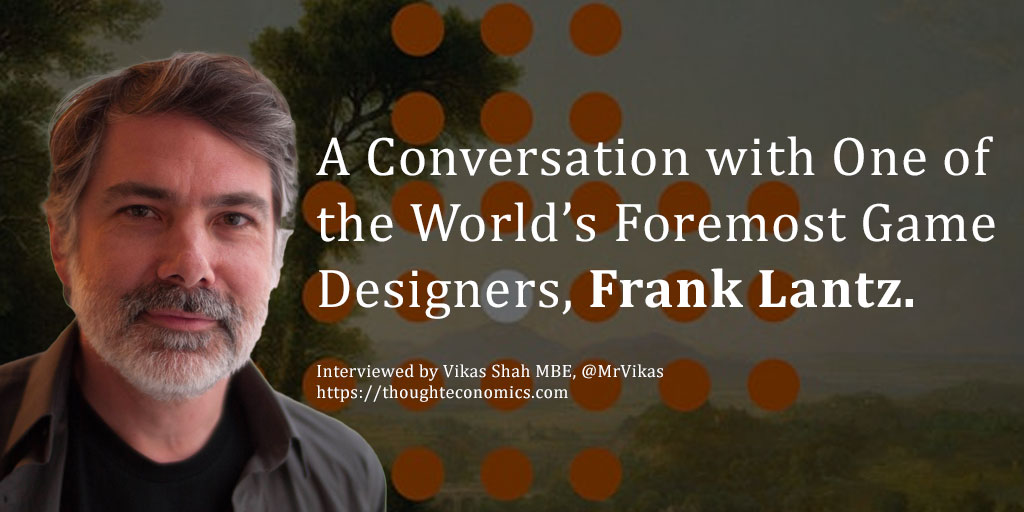
Games are not just a source of entertainment; they can be a tool for self-improvement, a way to understand decision-making and break free from suboptimal patterns. The initial lesson in any game is that natural talent alone isn't enough. Every time I encounter a new game, I think I might be naturally good at it, but that's rarely the case. However, the truth is empowering: with effort, you can become proficient at any game.
— Frank Lantz
Game designer and NYU professor known for game theory and interactive entertainment
"
I would describe games as an art form centred around systems. Viewing the world as a system means perceiving it as a collection of interconnected elements. These elements interact in a way that both enables and restricts themselves and each other. Essentially, what is observed is the collective behaviour of these elements as they unfold over time, creating a range of possibilities.
— Frank Lantz
Game designer and NYU professor known for game theory and interactive entertainment
"
Video games are a medium through which we explore the nature and implications of computers. Recalling the early days of computers, large mainframes were used for serious tasks like missile trajectory calculations during the day. At night, enthusiasts would experiment with these machines, conjuring imaginary worlds of cave networks or empires, continuously discovering more engaging problems.
— Frank Lantz
Game designer and NYU professor known for game theory and interactive entertainment
"
I do believe there's something fundamentally essential about free play—the open-ended combination of elements not confined by a narrow context. This concept is vital not only to humanity but to life itself. Consider Johan Huizinga, the sociologist and anthropologist who, in his book 'Homo Ludens,' famously argued that play is a necessary precondition for culture. I find this perspective accurate.
— Frank Lantz
Game designer and NYU professor known for game theory and interactive entertainment
"
The endurance of games like backgammon or chess lies in their continual presentation of an interesting problem. These strategy and decision-making games are like a well from which we draw insights. As a game designer, I can attest that while creating games, most rule combinations aren't inherently fascinating. Often, a game concept might initially seem uninteresting or static, and despite efforts to invigorate it, it remains lifeless.
— Frank Lantz
Game designer and NYU professor known for game theory and interactive entertainment
"
I see games as psychology experiments that we conduct on ourselves. This realization struck me while playing Sudoku. When you first encounter Sudoku, you're acutely aware of the rules you're applying to solve the puzzle. It's a conscious effort, like turning a crank and watching the puzzle get solved. However, as you progress, those initial heuristics, those rules of thumb, become internalized. You stop being aware of them; they become second nature, and you start focusing on more subtle, higher-level heuristics.
— Frank Lantz
Game designer and NYU professor known for game theory and interactive entertainment
"
Sometimes, a game just works; it becomes a little engine that generates mystery and interest, prompting questions like 'What happens if I do this?' This is the hallmark of a living game.
— Frank Lantz
Game designer and NYU professor known for game theory and interactive entertainment
"
I acknowledge the monumental impact of the convergence of games with computers, leading to the creation of video games. This fusion marked a significant cultural explosion, underscoring the importance of games in the context of modern technology.
— Frank Lantz
Game designer and NYU professor known for game theory and interactive entertainment
"
Play is a mock version of these activities, allowing us to experiment and understand how they work and interconnect. Questions like 'What if I did it this way?' arise in play, exploring different possibilities.
— Frank Lantz
Game designer and NYU professor known for game theory and interactive entertainment
"
I do believe there's something fundamentally essential about free play—the open-ended combination of elements not confined by a narrow context. This concept is vital not only to humanity but to life itself.
— Frank Lantz
Game designer and NYU professor known for game theory and interactive entertainment
"
I would describe games as an art form centred around systems. Viewing the world as a system means perceiving it as a collection of interconnected elements. These elements interact in a way that both enables and restricts themselves and each other.
— Frank Lantz
Game designer and NYU professor known for game theory and interactive entertainment