"
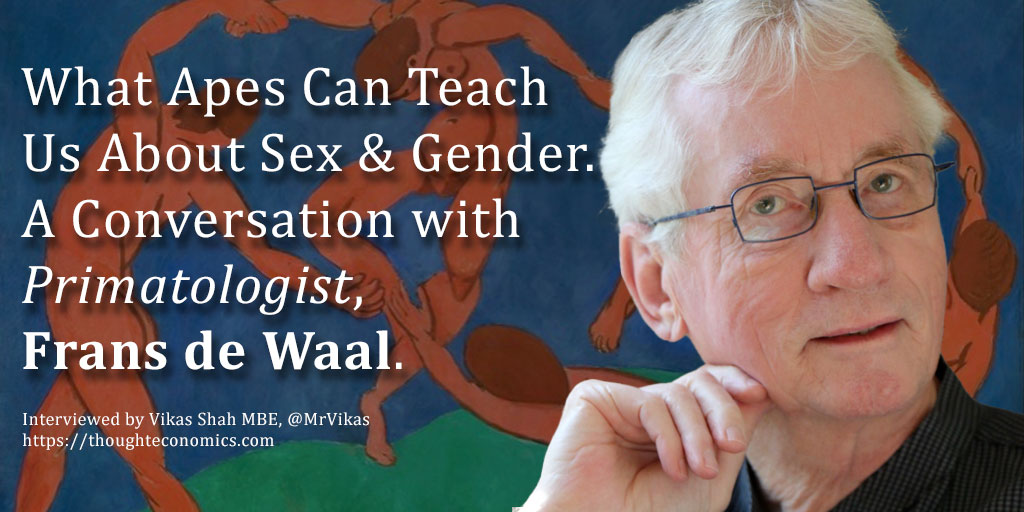
Gender identity drives self-socialization. People think adults socialise their children, but children socialise themselves. We see the same process in the Great Apes. Young females imitate their mother – and copy the diet and tool techniques of their mothers much more reliably than the young males do.
— Frans de Waal
Primatologist & behavioral psychologist who studies animal cognition and emotions
"
The smallest male can be dominant based on his social skills. Think about it; nobody walks into a big store in London and assumes the biggest person is the boss! It might be the old man; it might be the young woman!
— Frans de Waal
Primatologist & behavioral psychologist who studies animal cognition and emotions
"
I've known many individual monkeys and apes, and I'm struck by how much diversity and gender diversity there is which I have been ignoring. We always look for typical behaviours… a typical male does X… a typical female does Y. We overemphasise the typicality of men and women. If we start looking in primates, we'll almost certainly find the same sort of gender diversity we find in humans.
— Frans de Waal
Primatologist & behavioral psychologist who studies animal cognition and emotions
"
In society, we assume (still) that male dominance is natural, and that males will make better leaders. We see no evidence of that in primates. We assume (still) that homosexual behaviour isn't natural, but we find homosexual behaviours in all primates. In some of our closest species- such as the bonobo- it's extremely common, perhaps as common as heterosexual behaviour.
— Frans de Waal
Primatologist & behavioral psychologist who studies animal cognition and emotions
"
Biology doesn't need to be obeyed, but it always needs to be considered. If we discuss gender differences, we cannot act as if biology doesn't exist. We live at a time where a group of people – for ideological reasons – have made it clear that they think we can shove biology aside, that everything is culturally constructed, and we can act like biology doesn't exist. That's not going to work, that's not how the world works.
— Frans de Waal
Primatologist & behavioral psychologist who studies animal cognition and emotions
"
We are a very flexible species, and we can change things. It is clear biologically that men are more violent than women. This is true for all primates. However, there are societies we know – from anthropological studies – where violence is extremely rare because kids are elevated, from a young age, to be peaceful and not to fight at all. Even a trait that is basic in our biology is still subject to cultural influence.
— Frans de Waal
Primatologist & behavioral psychologist who studies animal cognition and emotions
"
Controlling strength takes a lifetime to learn – and young boys need to learn about physical strength, and how to employ it constructively not destructively. A male gorilla could easily kill a baby with his thumb but we see male adult gorillas playing gently, and tenderly with babies.
— Frans de Waal
Primatologist & behavioral psychologist who studies animal cognition and emotions
"
The smallest male can be dominant based on his social skills. Think about it; nobody walks into a big store in London and assumes the biggest person is the boss! It might be the old man; it might be the young woman!
— Frans de Waal
Primatologist & behavioral psychologist who studies animal cognition and emotions
"
Gender identity drives self-socialization. People think adults socialise their children, but children socialise themselves. We see the same process in the Great Apes. Self-socialisation we see, is not limited just to humans! That's why I talk about the idea of gender in apes, not just sex.
— Frans de Waal
Primatologist & behavioral psychologist who studies animal cognition and emotions
"
When you observe chimpanzees and other apes, you see how extremely humanlike they are in almost everything they do. We have been so indoctrinated to think we are special (as a species) that when you see an ape up close and see they are- in essence- us, you don't know what to do with those feelings.
— Frans de Waal
Primatologist & behavioral psychologist who studies animal cognition and emotions