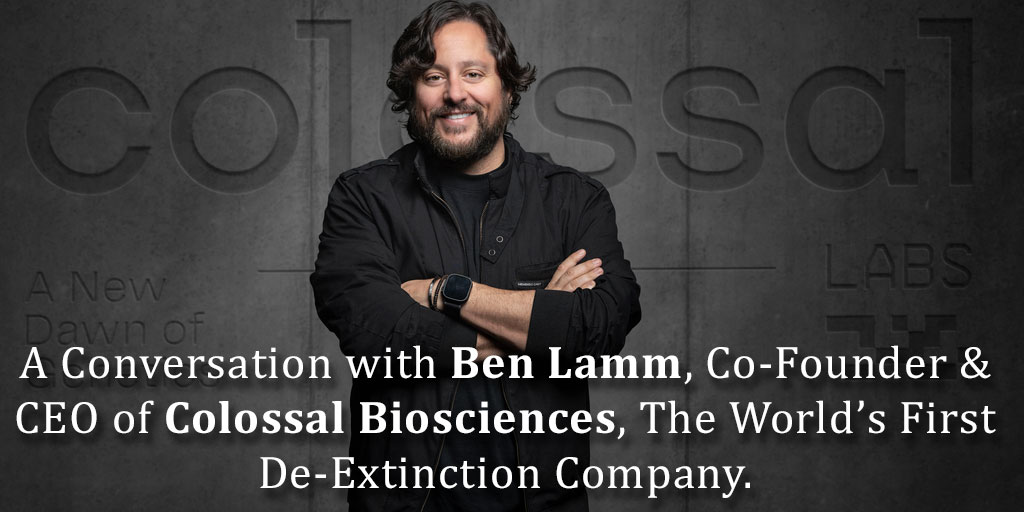
Ben Lamm is the Co-Founder and CEO Of Colossal Biosciences (the world’s first de-extinction company) which he founded alongside world-renowned geneticist and serial biotech entrepreneur George Church, Ph.D. Colossal are the first business to apply CRISPR technology for the purposes of species de-extinction and work to create innovative technologies for species restoration, critically endangered species protection and the repopulation of critical ecosystems that support the continuation of life on Earth. In their own words, “Colossal are accepting humanity’s duty to restore Earth to a healthier state, while also solving for the future economies and biological necessities of the human condition through cutting-edge science and technologies.”
Ben is a serial technology entrepreneur driven to solve the most complex challenges facing our planet. For over two decades, Ben has built disruptive businesses that future-proof our world. In addition to leading and growing his own companies, he is passionate about emerging technology, science, space and climate change. Prior to Colossal, Ben served as the founder and CEO to a number of companies, including Hypergiant, an enterprise AI software company focused on critical infrastructure, space, and defence acquired by Trive Capital; Conversable, the leading conversational intelligence platform that helps brands reach customers through automated experiences acquired by LivePerson; and Chaotic Moon, a global creative technology powerhouse acquired by Accenture. He was also the Co-founder of Team Chaos, a consumer gaming company acquired by Zynga. Ben is a fellow and on the Board of Trustees at the Explorers Club, whose mission is to promote the scientific exploration of land, sea, air, and space by supporting research and education in the physical, natural, and biological sciences.
Q: If Colossal succeeds, extinction becomes preventable or reversible. How do you think that makes us, as humanity, rethink our relationship with nature?
[Ben Lamm]: I think that we must move to a model where we value nature differently and work by integrating with nature. And that’s one of the things I’m very, very excited about—leveraging synthetic biology. Because if we can create excitement, wonder, and solutions to problems like loss of biodiversity, then I think that not only can we inspire the next generation, but we can give them hope.
Unfortunately, I was speaking at the Aspen Institute earlier this year and heard a gentleman talk, and it was terrifying. It rattled me to my core. He said that because we live in a 24-hour news cycle, unlike people did in the 1950s, and because we’re constantly being bombarded with data on social media and all these different channels, the constant doom and gloom around climate—and now around biodiversity and other issues—it’s not like we’re saying all these bad things are happening and the next generation is excited about solving them. They’re actually shutting down.
Data is showing that the amount of information we’re sending them without hope, and the ratio of hope versus negativity, is shutting down the next generation, which is terrifying. And so it’s not like, “Oh my gosh, there’s a fire—they’re going to go put the fire out.” They’re like, “Oh my gosh, what’s the point? The fire is too big.”
And so, I take what we do very, very seriously, because outside of the technological advancements for conservation and human healthcare, that inspiration level—how we think about and value nature—I think has to change. But we have to do it in a way that gives people hope. And that doesn’t mean we should stop doing what we’re doing with conservation. We just have to start innovating at a faster scale, and doing it in a way where we can then communicate those innovation wins to the next generation in a way that gets them excited and gives them hope.
Q: How do you bring investors and stakeholders along with you on such a huge mission?
[Ben Lamm]: I think one of the things we did differently—not in our outward-facing communications, but with investors—that I think we did a good job on is really three core areas. From day one, we said that we wanted to create value, create impact, and create inspiration. We’re not going to build a business that just creates impact—we’re not a nonprofit. We’re not going to just create a company that inspires the next generation. We have to create value. We were clear about that, but we also said we want to do all three. And as long as we’re doing all three, we’re never going to lose for our investors and shareholders, and we’re not just creating hype.
So that was the first thing I think we did: we made people agree on that thesis. The second thing that I think we did a really good job on was painting a very long-term picture, saying, hey, today we’re going to solve a bunch of hard problems. And those problems can be applied to different use cases other than conservation and de-extinction, which essentially gives you a safety net in the long-term vision. And so we have successfully, at Colossal, spun out three companies, two of which we’ve announced. One is Form Bio, which is computational biology for human healthcare—applying some of our models to human healthcare—and that company is valued at over $100 million. Our second company, Breaking, which is plastic degradation, was valued at over $100 million. And our third one is valued even significantly higher, and we haven’t even announced it yet. It’s been working for two years and we haven’t even announced the company yet—it’s just been itself.
And so I think we’ve done a good job of setting and managing expectations with investors, saying, hey, in the short term we’re going to help de-risk your investment by building out technologies that can be monetisable in a myriad of different non-conservation use cases. But secondly, we have a long-term vision around carbon credits, biodiversity, and working with government that could create a different relationship with nature and help annuitize nature. You’ve seen other market makers, like crypto and others, try to think through these economic models, and it’s taken time for adoption, but now you have stable economies based on that. Designing that framework so that it benefits countries, locals, and Indigenous peoples in building an economy and a model is very, very hard. So if we’re going to get to that eventually, we have to start by asking you to believe in that and invest in that long term, which we think can be quite large. We can help subsidise it and help de-risk it in the early days of the technologies.
And so I think that clear roadmap—and the fact that from day one we said, hey, we’re going to monetise technology in the short term, and we’re going to monetise carbon credits, biodiversity credits, and nature credits through the annuitization of nature in the long term—has really mattered. We’ve said that from day one. And now what we’re finding in this step three, which I think we did a good job of communicating to investors, is saying, hey, there’s a bunch of stuff that we don’t know in the middle. We know we can do the first thing. We believe we can do the second thing. But we think there’s a lot of stuff at 1.5 that we’ll figure out—and we’re starting to see that now.
Q: How do you manage the complex, and numerous ethical considerations with work around genetics, biology and science at this level of ambition?
[Ben Lamm]: So we do it like an onion—we do it in layers. The first thing is we set an outer layer. At Colossal, we are not going to work in humans or non-human primates because we felt like we’re already going to have an uphill battle with transparency and education, and we don’t want people to be like, if a hair-loss treatment comes out of Colossal, “are they selling a gene from a woolly mammoth?” We didn’t want that. That’s an extreme example, but you know what I’m saying.
And so that first layer is evolving. The big thing that I try to do—which sometimes frustrates some of our critics—is that we’re very open in saying we haven’t solved everything, and we’re going to do things wrong. But this is where it goes back to the onion model, where it’s like, okay, that’s an easy thing we can do. So, like Form Bio, which has a direct application to human healthcare, we’re going to spin that out. We’re going to put that under different governance. I am not going to make those decisions there in the same way I’m making decisions on de-extinction. We’re going to let other women and men make those decisions as they relate to the application of our technologies for the use case of human health. So that was the first thing.
The second thing is animals. We’re certified by American Humane. We’re certified by Humane Global, the oldest humane organizations in the world. And so anything that we do, we want to make sure that if we say we’re a de-extinction and species preservation company that also wants to create impact and inspiration, we have to do it in a way that doesn’t hurt animals. We have to be thoughtful about how we innovate our technologies to help animals. So first is human health and human welfare. Second is animal welfare.
And then after that, we try to make decisions through a kind of committee-based approach around what species we’re going to bring back, where we’re going to invest our dollars, and what fits our core ethos. I mean, I could spend an hour just going through the onion layers, but that framework—and those first two principles—are the things that kind of set the table stakes for us to even have a conversation. If it’s not going to be beneficial to humans, if we can’t do it at arm’s length from humans, and if we can’t do it in a way that’s good for animals, then we just don’t touch it.
Q: Was this the rationale for having the foundation alongside the business?
[Ben Lamm]: I think we were very thoughtful in the plan in a lot of regards. There are areas where we get surprises and delights. We did not plan, when we launched the company, to ever have a foundation. That was not part of our mission from day one. But what we found is that while we would open-source technologies—like, oh, we built some models for bioacoustic research—and we were like, okay, anything that we develop for conservation, we’re open-sourcing. So great, conservation is excited, but conservation is also like, that’s exciting, we don’t have the money to implement it.
So it’s like, even if we built cars and gave cars to people, if they don’t have enough money to put gas in the cars, it doesn’t get them anywhere. So part of our idea was twofold. One, innovation in conservation—we are not so draconian that it has to happen at Colossal. And so we said, why don’t we stand up a foundation and a nonprofit so that we can do two things. One, we say that anyone working to innovate new technologies in conservation—because there’s not enough, and there should be a thousand organisations doing that—we will fund that, as long as they open-source it for conservation. That’s a requirement.
The second thing we said was that we will also subsidise partners that want to use advanced genetic rescue, cryopreservation, and genetic engineering technologies for conservation if they can’t afford to do that. They can apply. So those were kind of our two thought processes.
Q: Which of your early achievements as a company are you most proud of?
[Ben Lamm]: I think the two that I’m most excited about—and it’s kind of like asking, what’s your favourite extinct species that you’re working on, because that will make people mad at me if I make a decision—but I’ll tell you two that I’m very excited about.
On the cloning side, not even as it relates to the red wolves, even though I love wolves, the application of isolating endothelial progenitor cells, which are partially differentiated, I think could be massively helpful for biobanking and for creating a global network of bio vaults, number one. But I also think that, going back to our core thesis on ethics, it’s a better way to clone that’s even less invasive for animals. So it’s higher cloning efficiency, it’s less invasive, and we can also take some of that blood and biobank it. So it solves a lot of problems. And I think that’s why Time gave it one of the top technologies. So that’s one.
The other one that we’re not as far along on yet, but we’re making progress on, is chytrid. And most people don’t know about chytrid, but it is one of the biggest drivers of global extinction. It’s a fungus that’s attacking amphibians, and amphibians are super important for ecosystems. I don’t want to give you data that’s not accurate—if it’s not the biggest, it’s one of the biggest issues in conservation. Because with chytrid, many people are trying to solve it, but in addition to the work and technologies that Colossal is doing, we made a $3 million investment commitment from the foundation to help solve chytrid. And when we were talking to people globally about chytrid—remember, this is one of the most important conservation issues ever—when you add up all the global funding for chytrid, no one’s invested that much. And I’m like, if this is one of the biggest extinction-related problems in the entire world, across the entire animal kingdom, that’s crazy to me.
And so we have some early progress. Because I have a lot of different roles, I’m not exactly sure how much of that we’ve communicated publicly yet. We have some early positive indicators on chytrid, but we haven’t solved it yet. I think that chytrid, and EHV, and this endothelial blood cloning and bio-banking—this cryopreservation work that we’ve done—if we do nothing else, those three technologies make conservation 100 times better. Even if we do nothing else.
Q: How is AI playing a role in your work?
[Ben Lamm]: So, you know, what’s crazy is that most people position themselves as AI companies. We’re more of an AI-integrated company, where AI is integrated across what we do. I wouldn’t say we’re an AI company. I think AI is woven across the spectrum, ranging from our bioacoustics work in conservation, to our modelling work for herd dynamics, rewilding, and building synthetic herds of elephants and socialisation, all the way to ancient DNA assembly and comparative genomics.
And so for us, without AI on the de-extinction side, it would add decades to the effort, number one. And on the conservation side, even though we’re applying it to—I don’t know what exact percentage—but at least 50 to 75 percent of our conservation projects, I assume that most of those projects would not be doable without it.
Q: What is the role of public education when creating fundamentally new science, concepts and possibilities?
[Ben Lamm]: … most people don’t recognise this about Colossal. Even though the science is insane, if all we had to do was the science, this would be a lot easier. We work with governments, we work with Indigenous people groups, with conservationists, we work with critics—some of our biggest critics are now part of the company. And what’s interesting is that because we have an attitude of running toward critics, I think this goes back to inspiration.
One of my previous companies was a conversational intelligence platform, so I understand a lot about intent recognition, sentiment analysis, and whatnot. And for something as crazy and polarising as de-extinction—and by the way, even conservation is polarising in some categories, which I think is crazy in itself, but that’s more of an ego thing than anything—what’s wild is that we run, on average, 96 to 97.5 percent positive or neutral feedback. That means there’s a real conversation happening on both sides. And then we run anywhere from 2.5 to 3 percent pretty negative feedback, and that ranges from conspiracy theories to people wanting to argue semantics about what makes a mammoth a mammoth.
But what sometimes frustrates critics in that 2 percent is that, look, our goal is to inspire the next generation, build new technologies, and bring awareness. If you want to call our mammoths ‘mammoths’, great. If you want to call them cold-tolerant Asian elephants with engineered mammoth alleles across 1.5 million years of genetic divergence and fixed mutations, you can say that too—whatever makes you happy. I don’t think it’s our job to persuade people. I think it’s our job to be transparent and educate people.
And I think that attitude is sometimes frustrating to that critic layer, because they’re like, no, we want you to say this. And it’s like, okay, we’re not going to do that because we don’t agree with you—but that’s okay. We think you should say whatever you believe. But going back to it, I think the issue they have is that in a world where science is under attack, in a world where conservation is underfunded, in a world where universities are attacked, we’re bringing hundreds of millions of dollars into conservation. We’re funding 17 academic labs across the world. We literally fund over 60 postdocs in academic labs separately.
And so what’s crazy is that sometimes people say, well, Ben doesn’t like academia. And it’s like, I have 240 academics that work for me—it’s crazy. I believe everyone has a right to their opinion, but we think it’s our responsibility to educate, not persuade. And part of our mission is that if someone wants to have a semantic argument about something that’s super trivial, they’re missing the forest for the trees. But that’s okay, and they have every right to do that.
But I want to get back to a world where kids are putting baking soda into red food colouring and making a volcano, like Bill Nye. And some of those same people who want to have semantic arguments will be like, well, Bill Nye’s not a scientist. And I’m like, but he inspired a whole generation to want to be scientists. That’s just me—I have this childlike wonder around it. And as a company, we try to instil that. But that’s all we can do. We can just try to communicate the best we can.
[Vikas]: it feels in some ways that your work could give people a ‘moon landing’ moment!
[Ben Lamm]: I know it’s very easy because we’re biased—we agree with that. We think we can help create a generation that wants to be conservationists or geneticists because of our success here. And I think our success here, not just from a technology platform perspective, will catapult synthetic biology forward by a decade. And that’s not even factoring in the technology advancements within synthetic biology itself.
Q: Will the work of Colossal help us gain a better understanding of ‘what’ life is?
[Ben Lamm]: I think it would be too arrogant to say yes. I think we will solve parts of it, and I think the parts that we solve will allow others to ask the right questions to solve other parts. And that’s the beautiful thing, I think, about what we’ve successfully built so far at Colossal—and what we’re now innovating on—is that we’ve built this end-to-end capability.
If you take away de-extinction, and particularly species preservation, we’ve built this synthetic biology pipeline where we can do everything from analysing DNA, to comparing DNA, to writing DNA, to editing DNA, to building DNA, to piecing it all together, and then successfully putting it into living species. And so when you take away extinction and you take away species preservation, that pipeline—I think objectively—makes us the number one genome engineering company in the world. And there’s a lot more to come, and we’re just getting started.
Q: With a mission this ambitious, do you think there’s also the economic opportunity of creating a new market?
[Ben Lamm]: I think that most people focus on the application of synthetic biology, and potentially its pairing with AI, as it relates to human healthcare. And as I mentioned earlier, we will play a role in some of that. But to your point, I think there’s a whole category of leveraging AI and synthetic biology for non-medical use cases.
Whether that’s cleaning up plastic in the ocean, bringing back extinct species, saving species, engineering resilience into species, or engineering crops and animals to live in a world that we can work better with—and that they can be more resilient in—I think there’s an entire category where synthetic biology for non-medical use cases is still very nebulous. But I think that both Colossal and the ecosystem of companies we’re building around Colossal will demonstrate that over time.
Q: How do you consistently attract the best talent and keep people aligned and motivated by your mission?
[Ben Lamm]: It’s a great question, but it’s a pretty easy answer. It’s like, do you want to go work on yeast and bacteria in an academic lab that’s massively underfunded? There’s a lot of talk—academia is very competitive and very toxic. Or do you want to go work on primordial germ cells to make a dodo, and work with Peter Jackson and the Māori people and Ngāi Tahu of the South Island, who have a cultural connection to the South Island giant moa?
So not only are you doing breakthrough science, you’re doing something that’s cool, and you’re doing something that actually means something to a group of people. And because of that, it’s kind of like fishing with dynamite—it’s just easy. Recruiting the best talent is easy, because the mission is cool and it’s impactful.