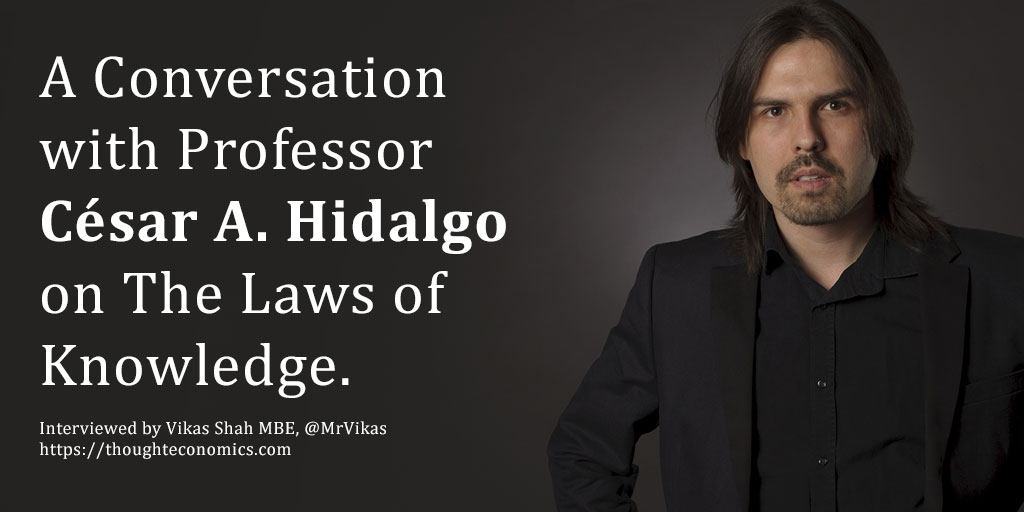
In this interview, I speak to Professor César A. Hidalgo, a physicist and global leader in the field of economic complexity. He leads the Center for Collective Learning at the Toulouse School of Economics and Corvinus University of Budapest, is the founder of DataWheel, and author of Why Information Grows.
We discuss his latest book, The Infinite Alphabet: And the Laws of Knowledge (Allen Lane, 2025), which presents a blueprint for understanding how intellectual innovation and economic growth actually happen. We talk about the three underlying principles that govern the growth of knowledge—laws of time, space, and value—and look at fascinating case studies ranging from how a 21-year-old “wonder Brit” kick-started the American Industrial Revolution, to why innovation hubs like Silicon Valley and Zhongguancun succeed while “cities of knowledge” elsewhere fail to take root.
Q: When you look at Yachay in Ecuador and Neom in Saudi Arabia; what can we as executives and leaders learn from those failures before attempting very large-scale innovation projects and capability building initiatives?
[Cesar Hidalgo]: I think both examples share one glaring mistake. They overlook the fact that even though knowledge diffuses, it is also agglomerative—it tends to concentrate. Since both projects target remote locations, they miss this dynamic. When it comes to the growth of knowledge, you need to double down on the capacities you already have; you want to build on cities that possess a foundation.
In Ecuador, that would be Quito or Guayaquil, which already have universities and the real estate markets researchers need. Similarly, Saudi Arabia has cities like Riyadh, Jeddah, or Mecca that would be better places to develop a city of knowledge. Neom is a slightly different case because it’s more of a utopian vision, but the risk remains. When you build in a remote location, costs skyrocket, attractiveness is hard to engineer, and the complementarities that help knowledge stick to a place simply aren’t there.
[Vikas: Was there insufficient pushback?]
[Cesar Hidalgo]: I don’t know personally if there was pushback, or whether the advisors brought in were so interested in the contract that they would have agreed to anything—even if they lacked faith in the project. That is where I think you see the dangers of these types of mega-projects.
I think that might have been the case in Saudi. In Ecuador, the president’s political staff likely had a similar incentive. You have a leader with the financial means to push this gargantuan project, and if you throw yourself on the tracks, you’re just going to get steamrolled. So what’s the incentive for you to do that? It requires a level of altruism and self-sacrifice that is hard for people to muster. So, I don’t know exactly how it went down, but I assume many people had that intuition—but they also had the intuition that sometimes it’s better not to say anything.
Q: What can we learn from your study of Donetsk, about the unexpected aspects of innovation and place?
[Cesar Hidalgo]: Donetsk is an example of a city created where nothing existed before—just some natural resources. But crucially, Donetsk didn’t try to be good at everything all at once. That is a big difference compared to Yachay. Yachay wanted to be good at all frontier technologies: biotech, AI, robotics, and aeronautics. Donetsk, in the beginning, only had to focus on one thing: pig iron.
Pig iron is one of the simplest forms of iron—basically ingots. Do you know why it’s called pig iron? When you smelt the mix and pour it into sand moulds, it flows through a central channel into smaller side chambers. It looks just like piglets suckling on a teat. That’s where the name comes from. It’s a very simple form; essentially, you melt it, cast it into ingots, and ship it as raw material.
So they focused on just one thing. I think it is possible to build, say, a power plant or a single-focus operation in a remote location. The other factor—and this is part of John Hughes’s genius—is that he realized the knowledge needed to develop that operation required packing seven ships with 100 people and a bunch of equipment. And he packed all of that knowledge. It probably wasn’t easy to convince people in London to move to a flatland in the middle of the Russian Empire, but he did it.
In many of these other mega-projects, they aren’t working with established teams moving en masse. A famous counter-example is Operation Paperclip, where von Braun was brought to the United States with his entire team. The team was the vessel for the knowledge. That recognition is important. So, if you draw a parallel between Donetsk and Yachay: if Yachay wanted to succeed at all those different technologies using the Donetsk model, they would have needed to pack 300 ships full of people. Because just for that one simple thing—pig iron—John Hughes needed seven ships and over 100 people
Q: What are cities and regions doing wrong when trying to become- say- the ‘next Silicon Valley…’ ?
[Cesar Hidalgo]: I think there is an honest trade-off between labour market protection and learning. There is a model I use in the book from Linda Argote that shows a lot of organizational learning happens not just because individuals learn, but because they connect effectively—finding the right people to work with or the right tools to execute tasks. There are actually laboratory experiments demonstrating that knowledge isn’t just stored in people or the sum of individuals; knowledge exists in the network.
If you view the labour market as a system, it is always searching for those matches. It never achieves perfect matching; it’s always ‘on the way there.’ But it needs to constantly learn because technology changes and people retire, which keeps the system out of equilibrium. Now, if you have an extremely static labour market—like the high protection laws in France or Spain—you get stability, but you sacrifice learning. There is less transfer of knowledge because there is less reallocation of people to tasks or teams. You pay a ‘learning cost’ for that ‘stability dividend.’
That is extremely important. The United States is unique—perhaps the only country in the world with ‘at-will’ employment, where the relationship can end at any moment without a specific reason. People might dislike the instability and pressure that comes with that, but from a learning perspective, there is an advantage we need to consider.
The other thing I’ve been thinking about is how we allocate resources to innovation. In Europe, and perhaps here too, the mistake we make is thinking in terms of ‘taxing to spend’ rather than ‘investing.’ Those are very different mentalities. The comparison between Yachay and Zhongguancun illustrates this. In Yachay, they said, ‘Okay, we’re going to spend a billion dollars on buildings and salaries.’ But when—or how—that generates a return? God knows. If you’re honest, you know it won’t; you’re just digging a hole you don’t know how to get out of.
In the case of Zhongguancun, instead of just paying for things, they generated investment funds that acquired equity in the activities people were doing. That creates a very different set of incentives. We have to get out of this ‘tax to spend’ mentality and think about using resources to create investment funds that support local businesses, while also expecting to get something back as those businesses appreciate.
Q: I love the story about Samuel Slater spearheading the industrial revolution in the USA, what can we learn from that?
[Cesar Hidalgo]: On one hand, we don’t know the counterfactual: what would have happened to Samuel Slater if he had stayed in Derby? Perhaps he wouldn’t have been as successful. In a sense, part of his success came from bringing knowledge to a place where it generated a higher return. That was the core of his entrepreneurship.
On the other hand, while it might be hard to identify these people a priori, your innovation policy needs a way to track their impact a posteriori. When thinking about migration and innovation, it’s not about how many people enter; it’s about how many become large net contributors. How many superstars did you attract?
Think of the English Premier League. It succeeds because it is an attractive destination for young, talented players. The question is: are you more attractive than Real Madrid? That is what you measure yourself against in terms of global appeal. Now, the economy is more complex than soccer, but the analogy still holds. It comes down to how many superstars you manage to attract.
Q: What can we learn about the smoothness and diffusion of knowledge?
[Cesar Hidalgo]: One of the things we know by now is that knowledge diffusion mediated by migrants tends to be intergenerational. We have papers in the book that hint at this: for example, when German chemists were expelled and moved to the United States, the people who really adopted their ideas and technology were from the next generation. There’s a similar study looking at musicians that traces influence through motifs used across time—and again, it is an intergenerational process.
So, if you think about it in those terms, you realize you can bring Samuel Slater in, and sure, he had an impact right away. But the generation that truly drove the Industrial Revolution were the ones younger than him—the adopters of the idea. It was not Moses Brown. Moses Brown benefited from the relationship, but he didn’t acquire the technology. If Moses Brown had moved to California, he wouldn’t have been able to build a mill. But the apprentices who worked with Sam? They would have.
Q: What can we learn from your research of understanding where our real competitive strengths lie?
[Cesar Hidalgo]: Take Steelcase, the furniture manufacturer in the United States. You learn that their advantage is not really based on materials, but on their real-time manufacturing capabilities—specifically, their logistics. What is important to understand about these counterintuitive capacities is that, just as we have wrong-headed ideas about where to set up innovation districts, we also have wrong-headed ideas about which sectors an economy can develop.
I work a lot across the developing world, and many resource-rich countries tend to ‘discover’ the idea that they should add value to their raw materials. And they usually go about it in a very bone-headed manner. For example, I’m from Chile. Chile has a lot of lithium, which is used to produce batteries. So, people tend to think, ‘Chile should be producing batteries.’
But the places that actually produce batteries, like Shenzhen or Seoul, are dense cities of innovation. They are the polar opposite of the salt lakes in the north of Chile where you extract the lithium. The proximity to the material doesn’t give you an advantage. Silicon Valley didn’t specialize in silicon transistors because there was a lot of sand nearby. Materials move much more easily than knowledge. But when people mistakenly believe that the material is the binding constraint, they tend to come up with these bone-headed development strategies.
Q: Did you find any laws or specific rules in your research?
[Cesar Hidalgo]: Okay, so the three laws are really ways of packaging a lot of other principles. The first law is about the growth of knowledge over time, and it has three components.
First, at the level of individuals, teams, or even firms, knowledge grows and then saturates. It has a finite ‘carrying capacity.’ This is known as Thurstone’s Law. Knowledge grows like a power function—roughly like a square root—so it rises quickly and then flattens out.
What is interesting is that while these individual units are finite in their ability to accumulate knowledge, society at large looks infinite because we have Moore’s Law on top of that. This happens because of changes in the teams—the incumbents—that perform best in a particular industry.
This tells you that it is vital to have a market open enough for renewal. You don’t want to get stuck on the flat part of Thurstone’s learning curve, where you eventually have to double your entire history of output just to gain one more unit of learning. That becomes extremely expensive. You see this dynamic in the S&P 500: the top 50 companies change enormously every 50 years. They displace one another because they find different ways of doing the same thing—like the internet displacing communication conglomerates by sucking in their ad revenue.
Then there is the law of forgetting. I realized this week in the UK that if I were to write another book now, it should be called Forgetting and the Loss of Knowledge, because that is what people are most interested in. It follows the ‘use it or lose it’ principle.
The fact that we don’t always see knowledge decay is not because knowledge sticks magically, but because we are constantly offsetting that natural decay rate.
That decay is accelerated by things like turnover. If you cannot retain workers, you lose knowledge very quickly. Estimates in the book suggest a decay rate of about 3% to 6% a month—which is nearly 50% a year. Knowledge can decay extremely fast.
I think the West struggles with this because we believe that if we did something once, we can do it forever. We think, ‘Of course we built a subway in the 19th century, why can’t we build one the same way today?’ But if you stop doing something for 20 years, you are back at the beginning of the learning curve. The same applies to nuclear power or going back to the Moon. You stop going, and you lose the capacity to go back.
There is a beautiful example I learned from a colleague, George Richardson, about the Ise Temple in Japan. It gets rebuilt every 20 years. Every cycle, they gather a crew that includes the last generation who built it and a new generation being trained to build the next one. In Europe, we love preserving heritage buildings, and that is beautiful. But in this example, they aren’t preserving the building itself; they are preserving the ability to build it. It’s a deeper layer of memory, preserved by constantly rebuilding rather than by relying on art restorers.
Q: Can businesses apply these principles?
[Cesar Hidalgo]: Yeah, of course, businesses are very heterogeneous and have many different practices. One example that comes to mind: after publishing Why Information Grows, I was invited by the CEO of Schindler—the company that manufactures elevators and walkways in Ebikon, Switzerland—to present to their executive team.
One thing Silvio told me at the time was that everyone who joins Schindler has to spend the first six months doing service calls for elevators. It doesn’t matter if you are going to be the CEO or the CFO; everyone has to know the business.
That is a humbling and interesting practice. Even if you are going to be in finance, you need to understand who you are doing the finance for—the guys out there every day doing those service and maintenance calls. You need to understand what the business is actually about. I think that practice is a lot like the Ise Temple example: you are trying to preserve knowledge, not by hiring people who already have it, but by forcing them to acquire it through on-the-job practice.
Q: Is it important therefore for leaders to understand the difference between complex and complicated?
[Cesar Hidalgo]: The way to demystify complexity is to look at the dictionary definition: it just means being composite. I don’t think people fear the word ‘composite’ the way they fear the word ‘complexity.’ We understand that many systems are composite. Complexity just adds a layer: systems aren’t just composite; they are structured. You don’t just throw a bunch of bricks together and get a house. You have to structure them to produce a building. That is what complexity adds to something being composite.
In the book, we treat complexity as the alphabet that defines the space of possibilities you can explore. I use music as an example. I’ve been a bad musician for about 25 years now, but I keep at it. What I like about music is that you are never going to explore it completely—it is truly infinite. But even if you pick up an instrument like the piano or the guitar, it is just 12 notes repeated over and over.
Yet, they combine in a myriad of ways. Complexity is about that space of possibilities.
In that analogy, a complex economy is like having a piano. A simpler economy is like having an instrument with just one string: you can pluck it and change the tone, but you cannot play a chord. You can’t make other combinations. Complexity opens that space of possibilities. And having that space open is important, because in a changing world, it provides the opportunity to adapt. It might be difficult to know which path to take when you have so many, but at least you have the option. In places without that complexity, the path you need might not even exist.