In a world of dating apps, swipes, and algorithmic matchmaking, we’ve been sold a story about love rooted in competition: that attraction is a marketplace, that some people are simply “worth more” than others, and that primal evolutionary drives determine who we desire and why. Over the past few decades, evolutionary psychology has spread this narrative widely—fuelling anxiety, cynicism, and a deeply transactional view of romance. But what if the science doesn’t actually support any of this?
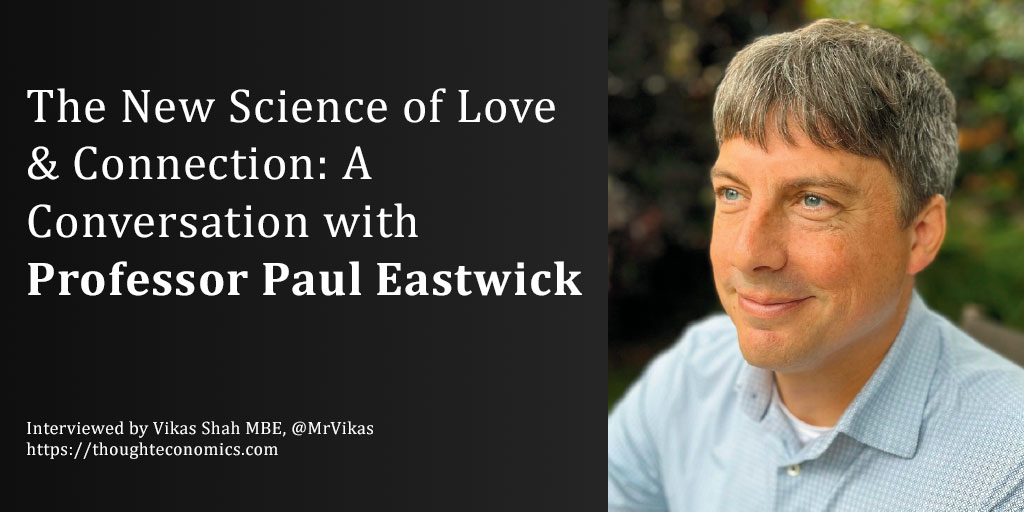
In this interview, I speak to Professor Paul Eastwick, Professor of Psychology at UC Davis, where he serves as head of the Social-Personality Psychology program and director of the Attraction and Relationships Research Laboratory. He has published over one hundred scientific articles and chapters, and his research has been featured in The New York Times, The Atlantic, NPR, and Scientific American Mind. He also hosts the popular podcast Love Factually with his longtime colleague Eli Finkel. His new book, Bonded by Evolution: The New Science of Love and Connection (Crown, 2026)—described by Science magazine as offering “riveting insights on the idiosyncratic, contingent ways real relationships develop” and by Daniel H. Pink as “rigorous science written with warmth and moral clarity”—draws on pathbreaking research to reveal that lasting attraction has always been built not through competition, but through gradual, often mundane moments that forge strong attachment bonds.
Q: First of all, what a fascinating book. I think this is the book that all of us need to read right now, particularly because the world of love and dating is so difficult. In your book, you reframe love not as a market of mate value, but as an emergent evolutionary process. That feels like a really fundamental shift. What is that shift, why is it so fundamental, and how does it change how we should understand human nature?
[Professor Paul Eastwick]: I do think it’s very tempting, especially if you focus a lot on what it’s like when people meet and are trying to impress strangers, to think that we live in a competitive mating marketplace and the winners get to date the best people while the rest of us have to settle for the middling folks. But what we see in the science—in our research and the research of others who are studying real, live close relationships as they unfold over time—is something very different. We often see that romantic partners basically see the best in each other. They’re wearing rose-coloured glasses. And the primary thing that brings people together is what we would call attachment bonds or pair bonds: the idea that people are looking for somebody who they feel has their back, somebody who’s going to celebrate their successes, and somebody who’s going to be there for them. It’s a little hokey, a little squishy, but this, I would argue, is the most complete characterisation of what close relationships are like. And it doesn’t imply that close relationships are easy—it’s very hard to build something lasting and sustaining where two people can do that for each other. But thinking about it as a competition, where I’ve got to get the best mate and trade up to get a better mate—the actual science of close relationships is not nearly so grim. As a result, we can at least have a little bit more optimism that it doesn’t have to feel so competitive.
Q: It does seem as if some of this goes against the traditional evolutionary psychology approach of innate drives and determinism. It feels as though we’ve had a big social cost from that assumption when approaching the world of meeting someone.
[Professor Paul Eastwick]: When we think about attraction, close relationships, or gender differences, there is a tendency—if we’re talking about biology, genetic causes, or evolved causes—to think that if something has evolved, it’s more fixed, harder to change, and that there are fewer routes to intervene between whatever that mental process is and the outcome you might want to prevent. This is a bias that people have. We know more about this now than we did 30 or 40 years ago, as evolutionary psychology was taking off. When you tell people these things, they get a little fatalistic about it. They tend to think, ‘Well, I guess there’s not much I can do about that.’ I would call that a bias. It is wrong just as often as it’s likely to be right. The issue is that even scientists feed this tendency sometimes, because we too kind of think that biological means it’s harder to change. We really need to interrogate and deconstruct that assumption. It’s rarely true, and it can lead people to internalise some of these effects in a way that can be pretty damaging and totally unnecessary.
Q: I know there’s a natural tendency to apply your research to romantic bonds, but do you think the same principle holds true for parent–child bonds, friendships, or bonds within the workplace as much as it does for the archetypal romantic bond?
[Professor Paul Eastwick]: It absolutely can. In fact, what’s so interesting about the evolutionary perspective I talk about in the book is that it derives from what I would argue is the original evolutionary psychologist: John Bowlby, the founder of attachment theory. Bowlby was mainly looking at caregiver–child bonds. He was interested in how young children come to feel safe, how they come to feel comfortable exploring the world. It was only in the last few decades that researchers started to say, ‘We think this is going on between adult romantic partners too—let’s bring this same evolutionary lens.’ That is very much the evolutionary perspective I champion. The cool thing about Bowlby’s perspective was that attachment bonds can exist in a wide variety of formats. It can describe all sorts of different relationships—not just family relationships, but also friendships and workplace relationships, as you mentioned. There are people who have brought the attachment lens to look at people and their pets these days. The romantic bonds are interesting because you get other things wrapped up in them—like sex, and in some cultures monogamy or not. But the attachment is the core, and it’s really the attachment that I focus on.
Q: When we look at the world of dating right now, we’re all reduced to swipes and likes on apps. When I was reading your work, it really struck me that the actual important parts of attraction and bonding are almost the exact opposite of what most people signal on dating apps. How do we communicate properly in this new world? Because dating apps cause us to self-optimise around data, whereas what actually creates bonds is very different.
[Professor Paul Eastwick]: It’s not good. And you feel like a product when you’re on these things. You feel like you’re selling yourself. But what’s amazing is that when you get people in person, actually interacting, much of the time they don’t do that same optimisation, especially if you give them just a few nudges. I’m a big fan of what we call the 36 Questions test, sometimes called the Fast Friends procedure. It’s a series of questions that two people who have never met can ask each other. The idea is that you’re building some openness, some vulnerability, some intimacy with somebody you’ve only met an hour or two ago—and you’d be surprised at the level of depth that people can reach in a short amount of time. You talk about fear of death and things you wish you’d told somebody but never did. This tool is truly the best thing that the science has come up with for getting two people to like each other. A little bit of optimisation can be effective—you should be eating healthy and exercising and doing the basics. But I tend to think in terms of relational optimisation: how can I put two people in the best position to share things about themselves that allow them to find conversational pathways that happen to go well? That is really hard to do if you’re swiping on photographs. I need to be able to bring people together in person in order to do it.
Q: It also seems to reveal that whatever the situation—whether you’re making friends with someone or getting to know them romantically—the most simple parts of our humanity are the bits we need to reveal for that bond to be created. So what are the sorts of things we ought to reveal or demonstrate in order to create those strong bonds?
[Professor Paul Eastwick]: It’s a great question. A little bit of vulnerability can sometimes go a long way, and that’s what some of these questions are designed to elicit. I’m also reminded of a recent scientific paper—I wasn’t affiliated with this paper, but I was a reviewer on it. What it suggests is that in a getting-to-know-you kind of scenario that’s romantically tinged, they compared whether people were liked more when they were basically like, ‘I can handle this task on my own,’ or if they were like, ‘I could really use your help here.’ The more likeable people were the ones who said they could use help. That’s another illustration of what a little bit of vulnerability looks like when you’re first getting to know somebody. If you’re trying to make a first date go well and you’ve thrown away the résumé-date idea—you’re not just exchanging facts and figures about yourself, but finding a way to hone in on something the person across from you really cares about, demonstrating that you don’t know much about it, and that maybe their knowledge or expertise could be helpful to you—that’s about one of the best things I could come up with. And I think maybe this advice is really the antidote that men need right now. You don’t need to posture, you don’t need to act like you know everything. In fact, go the other way. Be impressed by what somebody else knows, and maybe even indicate that they could help you with something.
Q: What should the heuristics be here? In today’s world, people tend to rely on sexual history, reputation, or some other hierarchical measure. But it seems as though your approach means we ought to be looking at a whole new range of heuristics. People who use those traditional measures tend to end up making serious mistakes in friendships and romantic relationships. With the research you’ve done, what other things can we look for as determinants?
[Professor Paul Eastwick]: There are other things. The problem is they just take a little time to assess well. All of the objective metrics that you can see—how attractive somebody is, height, income—if we fast-forward to what it’s like to be in a relationship with that person, ultimately it all means nothing. It’s just a dart throw. None of those things predict much of anything. One thing people can focus on—and generally speaking, I’m not a fan of the mindset that says, ‘I’ve got to pick the right person in order to be happy long-term’; I think that whole mindset is misguided—here’s a better way to think about it. You’re interacting with somebody—and interaction is key. How do you feel when you’re with this person? Do they make you feel like a better version of yourself? Is your mind expanding, going in different directions? Are you trying new things? Or do you feel small? Do you feel less attractive than you do when hanging out with your friends? If you feel like a small, constrained person, bad sign. If you feel like you’re expanding and growing, really good sign. But you can’t know this even on a coffee date. You’ve got to spend time with somebody and see what it feels like. There really is no way of getting around the time-consuming investment required to see how well you fit with somebody.
Q: A lot of people talk about attachment styles, but there’s that concept of safe or secure attachment being the base. From what you’re saying, my read is that whatever the form of relationship, you’ve got to work and cooperate to form that secure base, and then that allows for well-being, resilience, and psychological flourishing.
[Professor Paul Eastwick]: Exactly. There’s a lot of popular discourse around attachment styles, and they are very useful scientific concepts. It is very true that for people who have an anxious or avoidant style, there are costs to seeing the world that way—costs to feeling like you’re going to be rejected, and costs to closing people out. But when it comes to who you pick for a partner, I worry less about whether you’re selecting somebody who is anxious or avoidant, because one of the main ways that people shift their attachment style is through their close relationships. When people get into a relationship that provides a modicum of secure attachment, they start to feel more and more secure in that relationship, even if it hasn’t fully changed their conceptualisation of themselves and how they behave in other relationships. Give it a little more time and it will start to filter through and change how they feel about themselves in a more enduring way. Because the relationship itself is the main tool for providing a person with a secure sense of self, I do encourage people who are extremely avoidant, for example, to consider therapy. But if you’re worried about a person you’re really into being a bit avoidant, the relationship can provide a sense of security in time.
Q: The other thing you observe more and more commonly in society now is people not giving the time or the space. Two people bump into each other on a plane and think, ‘Oh, we could be friends,’ but both sides don’t make enough time investment in each other to actually get to that point. People are too quick to reject someone for some silly reason and never actually give themselves the opportunity to determine whether this friendship or relationship could become a safe place.
[Professor Paul Eastwick]: I think we’re always trying to be efficient, and I’m as guilty of this as anybody. If I’m waiting in line and I’ve got two minutes, I can get a few emails off. I totally get it. But I’m not against scheduling some time to be social, to put the phones down, and to reconnect with people you’ve maybe lost a little touch with. For people who are struggling with dating and feel like the apps aren’t doing it for them, I think my advice would be: go and reconnect with a friend you haven’t seen in a while. I don’t care what the gender of the friend is, but work out your social muscles again. Just spend time with other people and then work on growing those other social networks for the sake of having other people around, rather than optimising your dating life.
Q: How fundamental is this to our well-being? It does feel as if that social muscle in most people is not strong anymore, because we spend so much of our time online and on our own. And that seems to have a real psychological consequence.
[Professor Paul Eastwick]: It really does. Having more social connections—this is just one of the most fundamental things in relationship science. The more social connections people have, and it can be romantic but absolutely does not have to be, the healthier they are, the happier they are. The less likely they are to die in a given period of time. Our social connections truly provide a sense of safety and well-being that we feel at a deep physiological level and a psychological level too. It’s very important to maintain a sense of social connection with the people around you. This is why when people go through a breakup, it can be so difficult, because they’ve lost a big part of their social network right there. They’ve lost the person they’d usually go to when something bad happens. So breakups are as good a time as any to reconnect with your social universe.
Q: Do you think as leaders we can also use this research? It seems as if adapting the thinking in your work can help you not just understand your teams better, but become the kind of leader people really stick with. When businesses go through difficult periods, that’s often when people get off the boat. But really good leaders form almost a pair bond with their team—the team are like, ‘I’m with you.’
[Professor Paul Eastwick]: I absolutely buy this. I don’t know the leadership and workplace literature as well as some of the romantic and friendship literature, but the idea that these same principles apply completely makes sense. People form bonds when they’re together for a while—bonds of friendship, but also camaraderie around doing important tasks together that you get really invested in. It’s not so different from what our ancestors were doing 50,000 or 100,000 years ago, bonding over some important task that we were going to have to do together. I do think the same sorts of principles apply. I don’t know how to tell somebody to balance that, because all of the motivated biases will come into play too. It’s possible that, realistically, you really should leave a company or reorganise your team, but you really like having those people around. When these considerations come into play, I don’t know how to advise people. But for maintaining camaraderie, maintaining cohesion, a lot of these things still apply.
Q: Finally—this is a fascinating area of research, but what was the story for you? Why did you decide this was going to be your big area, and what made you realise you could make a real impact here?
[Professor Paul Eastwick]: When I discovered evolutionary psychology—and I think like a lot of people in the 1990s—what hit me was how fascinating it is that we can use ideas about deep-time events that would have been unfolding slowly, 50,000, 100,000, a million years ago, and see how that affects who we are today and how we’ve been confronting many of these same challenges for hundreds of thousands of years. At the same time, the particular story coming out of evolutionary psychology did not feel to me like the right depiction of the way relationships work. Not that there weren’t some truths embedded in there, but the full story seemed deeply off. Frankly, it seemed too bleak, too competitive. Not that there isn’t some competition, but the emphasis seemed wrong. So what I wanted to do when I went to graduate school was learn about how people studied ongoing close relationships. Those tended not to be the evolutionary psychologists—that was a different branch of researchers. I wanted to learn their tools and bring them to bear on things like initial attraction, which did tend to be where evolutionary psychologists were focused. Over the last 20 years or so, as people have gotten more excited about studying attraction with these lenses, we’ve really started to see a merging of the initial-attraction and close-relationships fields, and that’s been pretty exciting.