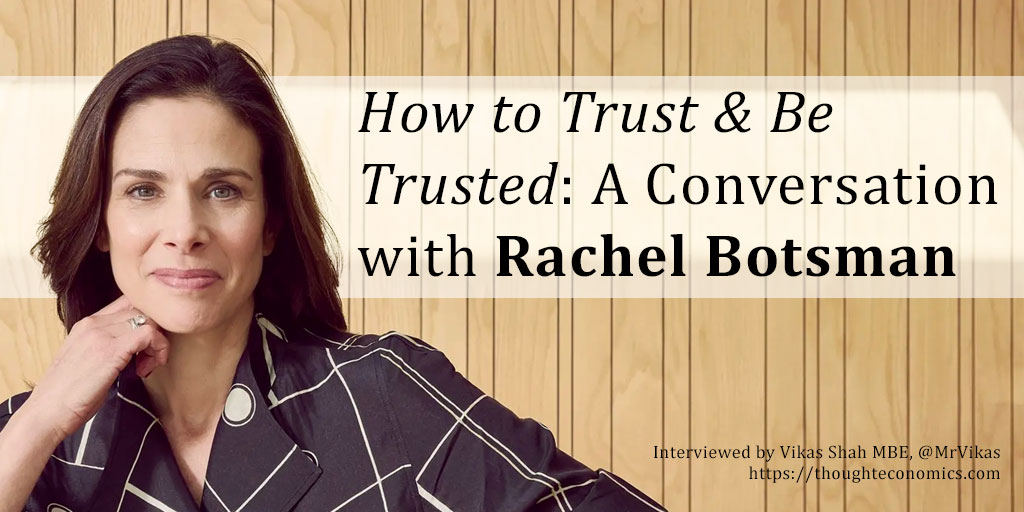
In this interview I speak to Rachel Botsman– author, designer, and lecturer renowned for her work on trust and societal change. A leading expert in the field, she has written three influential books—What’s Mine Is Yours, Who Can You Trust?, and How to Trust & Be Trusted—translated into 14 languages.
As a former Trust Fellow at Oxford University, Rachel teaches leaders and entrepreneurs how to navigate trust in technology, work cultures, and society. Her TED Talks have been viewed over five million times, and her insights regularly appear in the media, including The New York Times, WIRED, Harvard Business Review and The Financial Times. She also engages with over 90,000 subscribers through her popular newsletter, Rethink with Rachel.
Q: What is it that allows humans to take the leap of faith to trust each other?
[Rachel Botsman]: It is kind of magical, or miraculous, depending on how you think about it. So, before I explain how it happens—because the definition is slightly counterintuitive, and that ties directly to how it works—trust is a confident relationship with the unknown. And the reason this is so important is that trust isn’t, at its essence, an asset or an attribute or a currency. It’s a belief. It’s what we believe about someone or something. That definition is slightly counterintuitive because, often, when people think about trust, they talk about knowing what to expect from someone or knowing what the outcomes will be. So, they’re actually thinking about trust through the language of risk, thinking about it in terms of certainty. And that’s not what trust is.
The reason this ties to your question is that most of the time we don’t think about trusting our place, and most of the time we don’t think about trusting other people. Even in this interview, I’m not consciously thinking about trusting what you’re going to write, and you’re probably not thinking about trusting what I’m going to say. And that’s exactly how it works. But in higher-risk situations, when the unknown or uncertainty increases, that’s when we start to become conscious of trust. So whether you’re hiring a builder and making a large expenditure, making an investment, introducing a new AI tool, letting your kid walk to school for the first time, or hiring a babysitter—these moments where you can really feel the unknown—that’s where you need trust.
And even though we talk about trust being in decline in the world, human beings are remarkable in their propensity to trust others. We tend, as you say, to forget that this is magic. It’s the social glue that keeps us together, that enables us to trust strangers. And that is deeply biological; it’s what keeps us alive. So, to answer your question, being able to trust is actually what makes us human. It’s a very innate thing. And often, distrust and mistrust are learned behaviours that start to set in around the age of four.
Q: Are there signals that create an instant sense of trust (or distrust)?
[Rachel Botsman]: Yes, and it’s not necessarily a good thing. It makes it easier to trust someone if something feels familiar, but what it’s really doing is reducing the unknown. Your mind believes less trust is required. So, if you and I look alike, if we went to the same school, if we share accents, or if we find someone in common, these become the anchors of conversations in social situations. They’re all what we call trust signals—things we use to decide whether someone is trustworthy. And those signals aren’t very reliable because people tend to rely on intuition rather than information to assess them. So yes, if someone seems familiar to you or has some kind of familiar connection, it becomes much easier to trust that person.
This is why product designers, when introducing something new, talk about the law of familiarity. I like to call it “strangely familiar”—how you take something foreign and make it feel more familiar to people. Ben and Jerry’s were amazing at this: when they introduced a new, crazy flavour, they paired it with a familiar one. And I think in politics, economics, and business, we don’t think enough about that strangely familiar concept. We assume people will give their trust or embrace change just because something is new and different, but that’s not the case.
Q: How does trust break?
[Rachel Botsman]: I’m going to give you the macro view and then we can dive deeper. The number one thing is misread intentions. You assume someone has ill intent toward you—maybe to hurt you, harm you, or make you feel uncomfortable—and you don’t check in on those intentions. Then a narrative forms in your head, and that’s when you start spiralling. You can apply this to your children, to relationships, and it happens constantly at work. Remote work exacerbates this problem because the gap where a narrative can form is bigger when you can’t quickly check in with people. So misread intentions—and the story that builds around them—is the number one issue.
If you want to get more granular, I find it helpful when teaching students to talk about the capability side of trustworthiness and the character side, which you’ve probably heard me discuss in relation to how to trust, how to be trusted, and how people evaluate trust. On the capability side, you have two traits: competence and reliability. Trust can break around these. If you hire someone and they do a terrible job, or you buy a product and its rubbish, trust can fracture. But capability problems are much easier to fix. You see this with companies—when Samsung’s phones melted, they could address it quickly because it was a capability issue. You can resolve that with training, product fixes, whatever is needed.
Where trust really breaks down in human relationships is on the character side. And that’s tied to two deeply human elements. The first is empathy. This can break in two ways: you don’t feel like the person cares, or you feel like they put their own interests first. Or, more actively, you don’t feel supported. You’ve probably experienced this—someone tells you they’re listening and they care, but there’s no follow-through. But the deepest and hardest place to repair trust is integrity, which comes back to intentions. This is when you can no longer believe that a friend, teacher, boss, leader, or company has intentions, interests, and motives that even remotely align with your best interests.
Q: How is influencer culture reshaping trust?
[Rachel Botsman]: It’s a very astute question, because people tend to talk about social media without focusing on the influencer dimension, which is crucial. I’m not going to go so far as to call them con artists, because that’s not true, but they are masters at quickly earning your trust—or manipulating it. And two things change here. One is the speed at which we give our trust away. The other, which we see in the research—particularly around Gen Z and Gen Alpha—is that older generations give their trust to experts and influencers based on who and what: credibility, qualifications, and institutional affiliations. Younger generations, by contrast, trust based on how someone makes them feel. And you can manipulate that incredibly effectively in 15 seconds of video: the music, the mood, the atmosphere. You can intentionally design that for your own gain, while the other person thinks it’s for their benefit simply because they feel good in the moment, without pausing to ask, Who am I actually giving my trust to?
I see this all the time—I’m a long-distance runner, and it’s amazing how many unqualified physios and sports coaches are out there giving advice because that’s their business. But should you trust the information they’re sharing? Probably not, unless they have real credibility and qualifications. So, it’s a huge problem. We often talk about misinformation and disinformation, but the deeper issue is the speed and flow of trust, because we’re responding to feeling rather than expertise and credibility.
… you don’t want to draw a dichotomy of “be very trusting in face-to-face relationships and be careful in the digital world,” because it’s not that linear. But there is a correlation: if you lose the ability to form face-to-face trust—if you lose that relational trust—you can become less savvy about where you place your trust online, because there’s a kind of vacuum or void. You need to trust people. So, if you’re not going into work, not leaving your house, not belonging to real-world communities, you’ll find that trust elsewhere. And I don’t think the answer is simply getting offline or taking phones away. It’s asking: can we nurture healthy, trusting relationships?
And one of the things we’re seeing in the research—this is a slightly waffly answer, but it’s really important—is that children, because they take fewer physical childhood risks in the real world, are experiencing a decline in trust in themselves and in others. Their ability to take those risks in the world is decreasing, and that is a huge problem.
Q: Are digital interactions and AI reshaping trust?
[Rachel Botsman]: Well, you could argue it’s easier digitally because there’s less friction. We call these vulnerability loops. So, if you said something that involved some kind of emotional exposure—you took a risk with me and shared something, or I shared something I hadn’t shared with anyone else—you need to catch that as a human being. You need to notice that I’ve shared it, and you need to hold it. You don’t necessarily have to send a signal back, but when you do, the loop strengthens. So, if you say, “Oh, Rachel, I really appreciate you sharing that. Do you know this thing happened to me?”—not in a way that competes or compares but simply reciprocates—that’s a trust loop.
The reason I mention this is that AI tools are incredibly good at replicating that. If I share something, they know how to give empathy and validation immediately; they know how to close the loop. And here’s the tension: humans aren’t practicing the art of trust with each other, or even with themselves, enough. Yet they’re outsourcing those trust loops to digital tools almost instantly.
Q: What should leaders know about the relationship of vulnerability to trust?
[Rachel Botsman]: I think part of why leaders have become slightly fearful of it is because it’s been misunderstood. This isn’t a criticism of Brené Brown—she’s been very clear that vulnerability must have boundaries—but for some leaders, the line between the personal and the professional no longer feels clear enough. It’s one of those workplace issues tied to “bring your whole self to work” and hybrid working. And trust benefits from clearer boundaries, because trust needs clear expectations and clear limits. Vulnerability isn’t oversharing; it isn’t necessarily personal. And that’s where some of the fear has come from—this sense that leaders might need to role-model less sharing about their personal lives.
Yet vulnerability can look very different. I was watching The Graham Norton Show on Friday, and Jacinda Ardern has this new film out. The way she’s conducting these interviews—sharing that she found out she was pregnant a week before she got elected, the responsibility and guilt she felt, having to keep that secret—was it right, was it wrong? That’s vulnerability. So what I see in a lot of leaders is this question: how do I be vulnerable in a way that isn’t emotional oversharing, but still holds clarity and boundaries?
Q: How can we repair trust?
[Rachel Botsman]: The first thing I’m going to say sounds quite basic, but it’s to actually decide: is this a breakdown of trust, or is it simply low trust or lack of trust? Those are very different things. Someone might ask lots of questions or seem slightly sceptical because they haven’t made the decision to trust yet—and those people can be very thoughtful. Doubt is not a bad thing. If someone is just curious or there’s a bit of friction, that’s not trust breaking down.
When trust is breaking down, there are three stages: people become defensive, then disengaged, and then disenchanted. And disenchanted is the most dangerous stage because people turn to other things—they turn their back. So what you want to do is recognise when trust has actually broken down and catch it in that defensive stage. Then you can go back to the traits I mentioned: was it competence, was it reliability, was it empathy, was it integrity? Usually you can trace it to something—an event that happened. Maybe you didn’t invite them to something, you were always late, you cancelled—that’s the reliability side of trust.
As we talked about, it’s when you get to the deeper things—patterns that make someone feel you don’t care, or a conflict between their values and the organisation’s values—that the repair becomes harder. Still possible, but harder.
Q: How do we build trust every day?
[Rachel Botsman]: First, the language of “built” has to be thrown away. It’s a terrible way of thinking about trust, even when you’re trying to put this into practice, because it assumes I’m going to do something and somehow have power over you. But the other person decides whether to give you their trust. You have to earn it. So that simple reframe—I have to earn this from the other person—is really important.
And it’s crucial to be consistent in the way you show up over time. I find it helpful to think less about the what or the why—which get a lot of focus at work—and more about the how. How do you show up day in, day out? How do you speak to people when you’re busy or under pressure? How do you treat people when something has gone wrong? How do you handle a complaint? How do you deal with disappointment? The how is how people experience you. And the how is often what shapes that daily feeling of trust.
It’s such a common leadership mistake to focus on what they’re going to deliver, what the benefits are, what the policy is, what the outcomes are, or why something is happening—and not be clear about how they expect people to show up, or what others can expect of them. And that how is absolutely key to earning trust day in, day out.
Q: Can we bridge the trust gap to people where there is animosity or dislike to start with?
[Rachel Botsman]: Yeah, do you know, it’s so funny—this happened to me. I lead a board, and it actually happened yesterday. Separating out that I don’t necessarily like this person or their values, yet I can still trust them to run the work streams they’re meant to run—it’s so hard. Often it’s because someone says something they feel so right or justified about, and it touches something close to our beliefs, our religion, our ideology, our family—something personal. And if I’d chosen to react in that moment, my response wouldn’t have been great.
So preventing trust from collapsing means being able to distinguish: what can I still trust this person to do, and what do I simply not like or agree with? Creating the space to think about that takes time; it can’t happen in the moment. And I think so much of what’s happening in culture is that we can’t get comfortable with that discomfort. It’s not going to be easy to work with this person, but they are genuinely good at what they’re meant to do. We just have different political beliefs on certain things we’re probably never going to agree on. At some point we’ll probably have to talk about it, but I can dislike them and still trust them. They can actually be loyal. Loyalty and trust—those aren’t the same thing. You can be loyal to someone without needing to trust them.
In the most fractured situations, you look for: what’s something we both need, both agree on, both share? That’s why people use kids so much as common ground—most people want a better world for their children. Let’s hope most relationships don’t get to that level of fracture. To be honest, that’s why I wrote How to Trust and Be Trusted—I’ve been teaching this for over 18 years, and the mistakes are so common and so preventable. It’s not rocket science. And once you see it, you think, Oh, that’s how it works.
nn
n