Left behind places can be found in prosperous countries—from South Yorkshire, integral to the industrial revolution and now England’s poorest county, to Barranquilla, once Colombia’s portal to the Caribbean and now struggling. More alarmingly, the poorest countries in the world are diverging further from the rest of humanity. Why have these places fallen further behind? And what can we do about it?
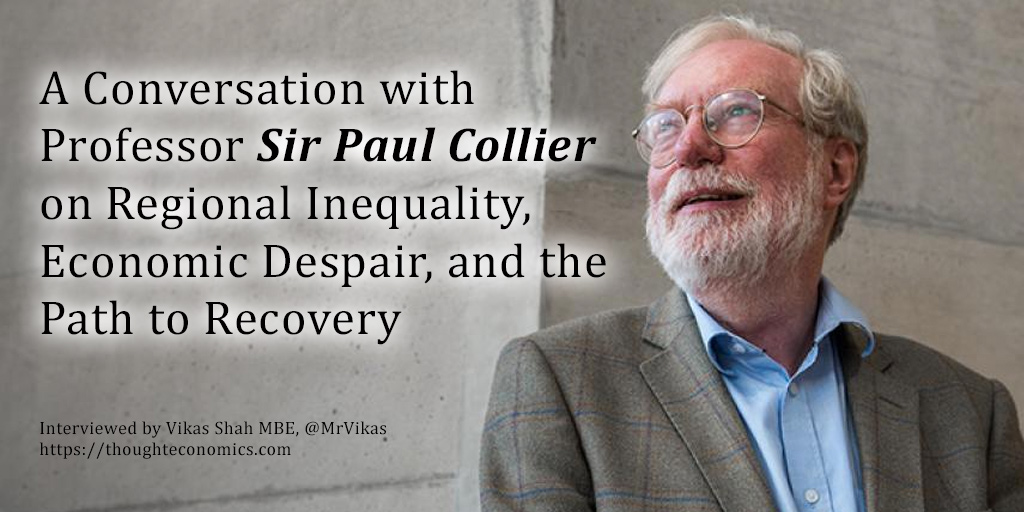
World-renowned development economist Paul Collier has spent his life working in neglected communities. In this interview, we discuss his new book Left Behind, where he offers his candid diagnosis of why some regions and countries are falling further behind, and a new vision for how they can catch up. In our discussion, Collier lays the blame for widening inequality on stale economic orthodoxies that prioritise market forces and centralised bureaucracies like the UK Treasury. In contrast, a new wave of academic research has revealed the crucial role of collective learning, social capital and local agency in reversing decline and equalising life-chances.
Q: First of all, congratulations on a very important and timely book. I think many people who seek to understand why things are the way they are economically in the UK should read it. The starting point is when you reframe regions as being ‘left behind’. From your research, what are the core systemic forces that have driven this decline? It seems that our mainstream economic narrative has not really captured it.
[Professor Paul Collier]: They missed it. You’d have to be pretty blind to miss it, because the big phenomenon is the movement of capital. Where does investment flow? Milton Friedman had a postulate about this. He got a Nobel Prize and all the rest of it, very fancy. But as soon as you interrogate this postulate, it’s manifestly rubbish. The postulate was that capital would move into a region hit by an adverse shock. So, Sheffield’s steel industry collapses. ‘Oh well,’ says Milton Friedman, ‘that means wages are cheaper, property is cheaper, and so capital will move in.’ Which sounds fine until you think about it for more than two minutes. When the Sheffield steel industry collapsed, incomes collapsed, and so demand in the region collapsed—businesses of all sorts, not just steel but shops and businesses that sold things to consumers. The consumers were poorer, and so businesses started to fail. Investment didn’t flow into this region saying ‘oh good, a depressed region.’ It flowed out to the places which were booming. At that time, the early 1980s when Sheffield was smashed up, about twenty manufacturing cities all around the country got smashed up. The boom region was London, because it wasn’t manufacturing stuff. So the capital flowed out of the depressed regions into the boom region and accentuated the divergence. That was the first pretty elementary thing that Friedman got wrong. It’s an empirical matter—you can measure this stuff. It has been measured. The empirical evidence shows: sorry Friedman, you’re just wrong. In fact, his stuff was really a leap of faith rather than an empirically thought through and justified theory. So, there we go. That was the initial shock. But then things get much worse.
Q: With that in mind, if I look at Manchester where I’m speaking to you from today, the city lost a huge manufacturing base. The economic shock was extremely rapid, with whole swathes of the community suddenly becoming almost left unattended. When my dad was in textiles in the 1970s and 80s here, he always used to say that it meant large parts of the region lost a sense of who they were—and that was almost as powerful as the economic shock itself. Is that something you’ve observed too?
[Professor Paul Collier]: I’ve investigated this—the psychology of what happens to a community hit by one of these adverse shocks, like my own community of Sheffield or your community of Manchester. What happened was that people saw their place going down while London was booming. It’s not countrywide; it’s not that everyone in the country is poorer. London’s doing fine. So people ask: why are they not doing fine when London’s doing fine? They start to look for who’s to blame. A very common step, which certainly happened in Sheffield, was that they started to blame each other. Businesses in Sheffield—the steel industry contracting rapidly, other businesses failing—found two scapegoats and used both. One was the local government: ‘Our local government is absolutely indifferent to business interests.’ The other scapegoat was the workers: ‘Our workers were unionised and lazy and greedy, always demanding higher pay.’ And of course, the workers say: ‘We’re not the greedy ones—you’re the ones living in big houses, you’re the ones that are greedy.’ The local government does the same thing: ‘We’re not helping you lot, you’re all greedy capitalists and we’re a socialist city.’ So we retreat into polarised blame games, and that is very common.
Q: If I look at most of the cities in the North, where I have the most visibility, the thing I’ve found really surprising is that you’ve got massive amounts of the population living in multi-generational poverty as a result of this decline, but the cities seem to focus only on tech, AI, and sectors which are not particularly productive from an employment perspective. Then they still wonder why poverty is getting worse. Even now that we have a degree of devolution, it seems as if cities are missing that obvious point you stated at the start—they’re not really doing enough to look after the populations that were impacted by these massive economic shocks.
[Professor Paul Collier]: Well, partly that’s because they’ve got very little power. Andy Burnham is very much in the news at the moment. I was with him on Monday because he spoke at the Institute for Fiscal Studies as I did. His point is that Manchester has very little agency as a local government. He had to fight tooth and nail even to win the right to set his own bus routes, which is completely crazy. When Sheffield wanted the powers—and indeed Manchester too—when they wanted the power to get money to reset bus routes, they were referred to the Treasury, who decided there was one agency it could trust for competence other than itself in this field of bus routes, and that was called TfL. So they said: apply to TfL for money. What does TfL stand for? Transport for London. So Manchester and Sheffield had to apply to Transport for London for money to allocate to their bus routes. This is so comically bizarre that if you put it in a novel it would seem too silly. But that’s how it is. The power is amazingly concentrated in Whitehall with a few very clever technocrats who go into it as their first job. I know—I’ve still got lots of my students, I teach at Oxford, fancy economics—in they went. First job fast-tracked into the Treasury, and then they’re assigned, aged 24 or 25, things like planning bus routes for Manchester, doing this, doing that, raising some more tax. At the moment, the basic principle in the Treasury is that whatever you do, don’t give money to local governments because they will squander it. So local governments have been vastly reduced in their money and their powers, so much so that 80% of the money they do get is then earmarked by government for what’s called statutory purposes. They’ve no discretion over how to spend it—they’re just told they’ve got to spend it on this or that. So the amount of discretionary spending they’ve got is very small. It’s ridiculous.
Q: Would it be fair to say, then, that there’s almost a case for—and I’m not talking about a federal model like the US—but when I visit the US, based on the differing economic needs of each state, their tax policy can be extremely granular. Detroit had massive deindustrialisation, and they were able to change their tax policy to attract different types of inward investment. It seems as though that level of regional control—hypothetically, the North could have its own tax system versus the South to incentivise growth—it feels as if we need almost that level of control regionally to enable the intervention necessary to solve some of these problems.
[Professor Paul Collier]: Yes, I think local governments need money. They need powers. For example, one thing that’s quite a good idea is to plan a zone of a city as an enterprise zone where you cluster firms together. Value chains and clustering is the name of the modern game in terms of industrial policy, and so they need the powers to take quite a large area of the city and say this is going to be kept free of the cheap and nasty jobs, the warehouse jobs. A good example is in Rotherham. South Yorkshire is about the poorest region in England, and Rotherham’s about the poorest space in South Yorkshire. But there is a cluster there, a zone—the Advanced Manufacturing Park—and that was an area that was derelict. It was cleared and the only mistake they made was not having the confidence to make that area big enough. Because eight years after they started it, it was chock-a-block full, and they failed to do things like coordinate transport, so it’s very hard to get to that area. You’d have to drive and then there was nowhere to park, so the defining feature of that area now is cars parked illegally on all the roads and all the pavements. But it is a testimony to success. I’ve been several times around that region to talk to the firms, and they say it’s tragic that there’s nowhere else to move anywhere close to expand further—’we’re going to expand in Wales.’ So that was the big mistake. Manchester can do the same, and my advice would be: more ambitious. Now, that’s one thing that’s needed. It’s by no means the only thing that’s needed. Outside of London, the businesses we’re now talking about in the North and the Midlands are very largely SMEs—small and medium enterprises. What they most need—maybe 1% of those SMEs are really capable of growth—but it’s that 1% that really matters. They will be generating the jobs of the future, and they’ll be in all sorts of different things. We’re over-inclined to say ‘this is a sector’; it’s only one way to think of things. So this is a cluster of interdependent firms which will need all sorts of things. The workers in those firms will need stuff to eat, so there’ll need to be firms making local stuff. What the 1% of SMEs in a region that can really grow desperately need is local risk finance. We can think of this as venture capital. You can either do it through banks that lend on prospects—the British banks are totally hopeless at that. The German banks are very good at that, with a decentralised banking system that works just fine for Germany. In Britain, since our banks are very big, very hopeless, and very conservative, won’t lend on prospects—we don’t want to finance investment at all. So we need venture capital. But we need venture capital that will work for SMEs, and that means it’s got to be locally based. We’ve got a lot of venture capital, but it’s nearly all in London and the Southeast. What’s very important about trying to assess a firm is being close to it so you can get what’s called tacit knowledge. Is the managing director a drunk? That’s a pretty fundamental question—I don’t know. Is he a bully and hated by his staff? The only way you know that is if you’re there, local, and you can talk with a lot of people. People would say ‘you shouldn’t have touched that one with a bargepole’, whereas ‘this one’s really going some—there’s a really dynamic young guy that people love working for.’ That’s the sort of thing you’re looking for. So locally based venture capital. Now, we don’t have it. We don’t have it. A tiny bit in Leeds, a tiny bit in Manchester. Nothing at all in Sheffield as far as I can see. Sheffield’s a city of half a million people with no local venture capitalists—this is central. So we’ve got a public bank called the British Business Bank, which is supposed to do this, and it doesn’t. It’s asleep at the wheel.
Q: On the finance side, if we look at development economics and the methods used elsewhere, exactly to your point, it’s about bringing people who are in poverty back into the system, enabling micro-businesses and SMEs to grow. If I look at Bangladesh or elsewhere and they’re deploying micro-finance and different types of credit unions, it does seem as if we need a lot more financial innovation to enable this. I was a trustee of a large homelessness charity in Manchester. Ten thousand people a month came, and a lot of those people just can’t get banked. They can’t get accounts. They can’t get themselves out of that situation. Even if somebody says ‘actually, I want to start a hairdresser’, ‘I want to start whatever’, they can’t get access to micro-loans to start their small business at all. So you’ve got the venture capital level up here for someone who might want to build a business that employs 25, 50, or 100 people. But there’s a whole section of millions of people in the UK who either cannot get access to credit or can’t get access to micro-loans to start small businesses.
[Professor Paul Collier]: There’s quite good evidence now that micro-finance does enable people to lift themselves one notch up, one notch up. Ironically, we’ve got a very good public institution that finances SME growth abroad in poor countries, which is called BII—British International Investment. It’s the oldest and most respected of all the development finance institutions. It’s over 60 years old and very good. We don’t have an equivalent for Britain. It’s got a team of a couple of hundred very skilled young people, very enthusiastic, and they’re tasked with finding good SME opportunities in very poor countries. If that team were given the instruction to go and work in Scunthorpe—which is where I’m working at the moment—Scunthorpe has deaths of despair just as bad as many poor countries. If the BII team was sent into Scunthorpe, they’d find good things to do. And I know there are loads of entrepreneurial young people in Scunthorpe looking for opportunities.
Q: And that applies to individuals as well, doesn’t it? The research and data support the fact that if you want to lift families out of poverty, micro-finance enables better nutrition, better education—it enables all those components. For example, if I look at Wythenshawe down the road from me, or certain areas like that, you’re now second and third generation in poverty and there doesn’t seem to be a way out. There are two parts to this I wanted to ask you. First, does that same principle apply to individuals in terms of individual finance? And secondly, there also seems to be a hope gap. When I meet people on the edges of Liverpool or Sheffield or Manchester or elsewhere, there’s a lack of hope for the future—a sense of ‘well, this is it now.’ We seem to need to bridge the hope gap alongside the practical financing.
[Professor Paul Collier]: Yes. I don’t know if you’ve come across the Case-Deaton work on deaths of despair, which is a study of America. The opposite of hope is despair, and what Anne Case and Angus Deaton discovered was that despair is literally a killer. If people lose the will to live, they die much younger than is necessary. If we measure in Britain by despair—the number one adult male deaths per thousand, suicide deaths—it’s Blackpool. Number two, Grimsby. These are places which have a brilliant past. Blackpool, when I was a kid, was huge—the treat in September would be to go to Blackpool for the day.
Vikas: It was the same when I was growing up, yes!
[Professor Paul Collier]: Grimsby had a glorious past in fishing. It was the main fishing centre for the whole North Sea. Of course, the fish went, and the crowds went from Blackpool—they went to have their holidays in Spain instead—and so now we’ve got despair. There’s a counter to despair, which is reinvigorating these communities. Reinvigorating them, again, takes some public money and some private initiative. Starting with the micro-finance of people at the bottom which will lift them up, and the SME finance, and a good public agency. As I say, if the British Business Bank did its job, they’d absolutely be doing this.
Q: Do we also need to invest in the cultural space for this? If we think about how to bring back a sense of hope to these communities, I completely agree there’s the case to make sure the practical tools are there—i.e. a young person wants to start a business, they can get the capital and do it, great. But the step before that is making them feel hopeful enough that they think ‘maybe I should do this.’ When I’m meeting people in those places, they just feel utterly dejected, almost like ‘what’s the point?’ So is this where cultural interventions or arts or social initiatives come in? How do we actually give people a sense of moral purpose, just a sense of purpose in being, to get them to even want to do that?
[Professor Paul Collier]: There are many things that could be done here. I’ll tell you what I’m doing. I’m working at the moment with Scunthorpe and Sheffield. I’m very lucky to have a working-class cockney guy who made his money in Rotherham, legitimately—really brilliant business, a brilliant guy—and then he said, ‘I’ve been over-rewarded for my work, so I want to give my money to help other people, to help young people in places where there isn’t enough hope.’ So he’s sponsoring a contest, a bit like Dragons’ Den. The plan—and it’s still being discussed, it’s the community’s decision—I was literally online a couple of days ago with a lot of the community activists in Scunthorpe. Probably by September there’ll be a contest in Scunthorpe, and that contest will run every year for the next five years. It will say: if you are a young person, say 18 to 25, in Scunthorpe, and you go in for this contest and you win it, you’ll get—whatever it is—£10,000. And you can set up a little business with that. What’s more, we’ll have a mentor for you, because a young person setting up a business—it’s not a walk in the park. There are all sorts of difficulties. So we’re setting up a mentoring system. The whole thing can be pitched in schools and in colleges of further education. At the moment, in a lot of places, the big entrepreneurial opportunity is crime. Very often the preferred crime is trading in drugs. In despairing places there’s a big market in drugs—the elderly despairing want to buy drugs, and the teenagers who want a bit of excitement get into trading them. Now, these are obviously a downward spiral to hell. So trying to replace that with an upward spiral—imagine that. If kids coming up to school-leaving age started to say ‘how about we go in for one of these contests? Why don’t we put our heads together and come up with some plan?’ And then they win. There’ll be examples—maybe ten winners—and those ten winners will become role models. Some will succeed and some won’t. But there’ll be enough examples of success. There’s some very good work done actually in very poor countries, in Ethiopia, showing that even a 20-minute video of somebody who’s succeeded uplifts and inspires young people to say ‘I can be that.’ That’s what’s missing—the role models of success. But they’re relatively easy to generate and relatively cheap to generate.
Q: Do you think that can also help us resolve some of the conflict we’re seeing in communities? We’re almost seeing communities that were previously quite integrated sort of ghettoising into factions and fighting each other online and elsewhere. It seems as if people are falling into very ideological battles because when there’s despair, it’s almost an inevitability.
[Professor Paul Collier]: Despair leads to blame and anger. Blame and anger. We talked about the blame. Anger? Look at the riots. These are understandable emotions, but they can be countered. They have to be countered by hope. And if you don’t provide credible hope, you get mavericks coming along offering incredible hope. If we think hard enough, we might think of who in Britain is offering incredible hope—and ditto in America. There are plenty of mavericks trading on bullshit hope. Sorry, that’s a technical economics term. But credible hope—you have to grasp a bit harder, but it’s perfectly feasible. There’s example after example in Left Behind of communities which have lifted themselves back up. They’ve come together, and in many ways that’s the hardest first step—to say, instead of fighting amongst yourselves, come together and think of a better future. Try and create and imagine a better future for your kids. What would it look like? And that can be done.
Q: As a bit of a round-up, I was imagining the audience for the book—I was imagining your book in the hands of policymakers and philanthropists. What do you hope are the most important messages in your book that if a policymaker were reading it, or if a philanthropist were reading it, they would say ‘I need to do this’?
[Professor Paul Collier]: I think the message for philanthropists is: if you use your money well, intelligently, don’t just fritter it away on little nice things—build a school, feed people. Try to integrate it into a larger strategy of which your contribution is a part. The strategy really needs, if possible, to include local government, because local government is sometimes in a good place to integrate things like the police service, the mental health service, and the business community. Quite a lot of crime is committed by people who are on drugs, and the drugs are part of the crime scene. So try to come up with a solution which says ‘what’s the sensible thing to do here?’ I came across a wonderful example of a café that a practising clinical psychologist set up—a café targeted at single young women with kids. You don’t want to be a single young woman with a kid in a depressed place, because what on earth is your hope? This café was nice, it was attractive, and the women could meet each other, talk to each other—then they felt less lonely and became a bit stronger. Then some of them worked serving in the café. That was again—once they were working and serving, they were earning. That established both an income stream but also a sense of dignity and purpose: ‘I’m now working, I’m now earning my own money.’ And what happened to that whole thing, that café? It got closed. It needed a very small subsidy—a tiny amount of money. But when there were budget cuts, the health service said, ‘Oh, this is peripheral, running a café? We’re not subsidising a café.’ The mental health service said, ‘We’re dealing with treating mental health, that’s our priority, not a café.’ The police said, ‘You want us to subsidise a café? We’ve got to try and hunt down these criminals!’ And so none of them were willing to contribute to the whole. That’s the terrible dilemma: everybody has to contribute to the whole for the thing to work. I’m a big fan of the moral philosopher Michael Sandel, who has just won the Berggruen Prize. We’ve worked together. He’s coming to see me in about ten days. He comes fairly regularly to Oxford—he was originally a student here so he likes coming back. His whole concept is contributive justice. He’s asking: under what conditions do people have a duty to contribute to the whole, even if they’re fairly poor? He goes through a checklist of the conditions where everybody should contribute to the whole. Equality of voice—do we have that in Britain? No. Equality of respect—do we have that in Britain? No. So Sandel says if they are not there, they become the first-order priorities. Because until you’ve got those established, you can’t begin with anything else.
Q: What are some of the other dimensions that he puts into that model?
[Professor Paul Collier]: It’s very much about contributing to a whole community, coming together and seeking to say: under what circumstances should people feel a duty—even if they disagree with what’s decided—but they do need to be treated with respect, be heard, be listened to, and then this is a fair discussion. And you’ve got to be rich enough, high enough income, so you can afford to contribute to the whole. If you can’t afford to contribute to the whole, you’re not at base one, as it were. So if those are the things he’s advocating: you’ve got to get to base one with these three conditions. Everybody’s earning enough so it’s meaningful that they can contribute. Everybody’s got equal voice. Everybody’s got respect. And then—bang—there’s a duty to take part and contribute to the whole. A good example of that is Switzerland. Switzerland is the antithesis of Britain—it’s radically devolved through referendum. You get referendums at a local level, national level, regional level. The Swiss are always voting on one referendum or another. The good side of that is they’ve learned that they’re all active citizens. If you just sit at home and don’t bother to vote, things happen and you’ve only got yourself to blame. So the Swiss do vote in these referendums. I go to Switzerland quite a lot to give talks and such, and one of the things I learned is that even when people lose a referendum, if it’s been an active debate and a fair vote, they accept the result. So they say ‘I didn’t agree with that, but I do understand that I’m obliged to do this.’ And that’s the step—that contributive justice step—where everybody contributes and everybody accepts the outcomes.