Why did France lose to the Nazis, despite its defenders having more tanks, troops, and guns? How did Ukraine repel Russia’s initial onslaught? How do you know if you can trust an ally? How can we make clearer decisions under pressure?
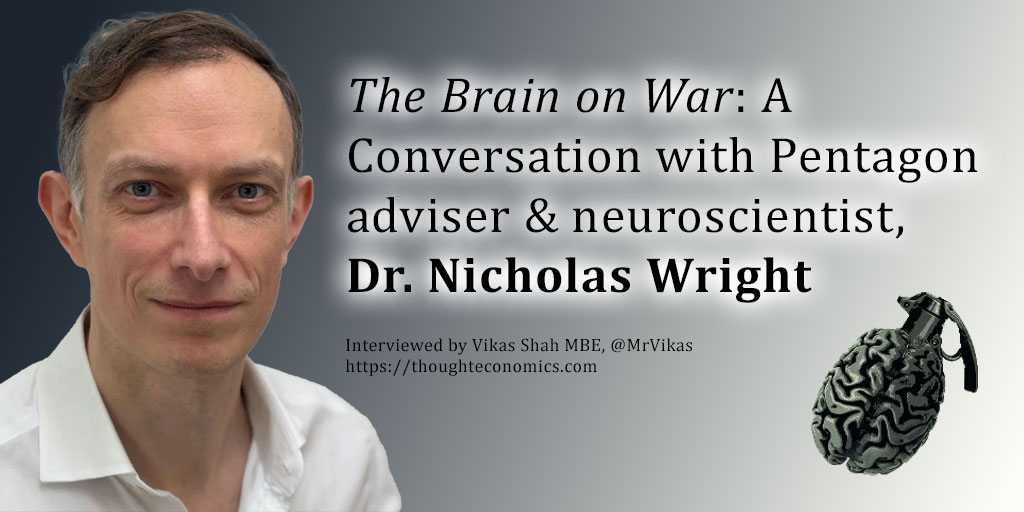
In this interview I speak to Dr. Nicholas Wright, neuroscientist and adviser to the Pentagon. In his recent book Warhead, Nicholas takes us on a fascinating journey through the brain to show you why, if you want to understand warfare, you must first look inside your own head. Drawing on his work as a neuroscientist, and over a decade advising the Pentagon and the UK Government, he reveals how, whether we like it or not, the brain is wired for conflict – in the office or on the battlefield.
Q: How does it change our view of conflict to think about the brain at the centre?
[Dr. Nicholas Wright]: I think this is something that would have been a lot less controversial just a few decades ago, when people still remembered that, yes, the material side of war is obviously important, but it’s only ever one aspect of it. And so, I’d say the big difference here is that we have to recognise that if we ignore or downplay the human side, we could lose. That, I think, is really the key insight for why and how things should be done differently.
To give two practical examples: we can think about why, in the Battle of France in May 1940—as you mention later on—the Allies, Britain and France, actually had more trained men, more guns, more tanks, more planes. Their tanks and planes were pretty much as good as, if not better than, the German ones. Yet within seven weeks of the German offensive, Hitler’s cavalry was clattering down the Champs-Élysées. Why did that happen? On one side, it was because the Germans made better use of combining human judgment with the technologies of their time. They were much better at harnessing shock and surprise than the British and French. They were better at decision-making, better at communicating, better at delegating. They could simply make decisions faster and better than the Allied militaries.
And then in our own time, we need to think about human–machine teams and things like AI. This is one of the big questions in working with the Pentagon: human–machine teams. Because you can have the best AI in the world and the best robots in the world, but if they aren’t integrated well with the humans, then you will lose. That’s one side of it.
Then on the other side, why did Hitler win in just over six weeks? It’s because the French will to fight collapsed. And the will to fight is always fundamentally psychological. And if we don’t recognise that we need to think about the will to fight, and the will to fight aggressively, then we will lose.
Q: What creates the will to fight?
[Dr. Nicholas Wright]: … there’s not just one system in the brain that determines everything. Our brains work like an orchestra of different systems, and I think we can focus on two crucial sets of systems here. The first set is to do with fear. Fear is useful—we need fear. To give an example, there’s a small part of the brain called the amygdala, which sits low down in the brain and is important for fear. If you lose that part of the brain, which happens in some rare cases, you can lose the ability to feel fear yourself and also the ability to perceive fear in others. And what does that mean? It doesn’t mean that people who lose the amygdala become fearless criminals; it actually means they often become victims of crime because they can’t learn how to act appropriately in potentially dangerous situations. So we need fear, but fear has to be harnessed, and a crucial way we harness it is through training. This is absolutely central. We need to think critically about training, because one key way to strengthen the will to fight is precisely through training.
So when I talk about the Battle of France, for example—the French, like the Germans, spent eight months ostensibly at war with Nazi Germany before the offensive in May 1940, but the French barely trained at all. The Germans were training, training, training. The French were barely training, and that was catastrophic for them, because training helps you turn fear from something that paralyses you or makes you flee into something that spurs you to take the right decisions in very difficult situations. So the first thing is training, and in our time what’s going to be crucial is training effectively.
There was a very famous American general, George C. Marshall, who was the top U.S. general in World War Two. He led all American military forces and later the Marshall Plan, after Robertson and the Somme. But what a lot of people don’t know is that ten years before World War Two, he was in charge of training at the Infantry School in Fort Benning in America, and he revolutionised training there. He did it by helping people deal with surprises and prediction errors. Our brains are constantly making predictions about the world, and we learn when those predictions turn out to be wrong. So what Marshall did was deliberately redesign training so that people learned how to cope with a wide range of unpredictable challenges—turning the unpredictable into something more predictable, or at least something they could cope with and react to more effectively.
So I think training is essential to turning fear into something useful, and that’s something we can really improve in our time. What we need now is the George C. Marshall of our era to help us train better than the Chinese and the Russians.
Q: In modern time, we’ve seen some of that element of fear removed with the amount of warning notice given- for example- with the Russia v Ukraine conflict?
[Dr. Nicholas Wright]: … it’s really important to remember that—not all of government, but the British and the Americans—said, look, the Russians are going to go. This is in February 2022. And Vladimir Putin is the kind of guy who does a lot of things, so you’re never totally sure precisely what he will do. But he was conducting a lot of exercises near the Ukrainian border, and the British and Americans said, look, he is going to go to war. He is going to invade. And then he did. But the French and the Germans, for example, had similar types of intelligence and basically did not believe it was going to happen.
Because the British and Americans consistently said, this is what’s going to happen, this is the type of thing that’s going to unfold—exactly as you say—the surprise was much less, because we had managed those expectations. So, the shock was much lower for our own populations watching events unfold. And equally importantly, if not more importantly, the Ukrainian military were able to distribute themselves. If you look carefully at what they did, they dispersed their forces in ways that made them much harder for the Russians to find. They knew the Russians were coming, so they were prepared and could strike effectively.
And it’s important to remember that they were outnumbered twelve to one north of Kyiv, right? And completely outmatched in terms of tanks, planes, artillery—all of it. Outmatched, yet they pushed back those Russian forces that colossally outnumbered them. And a crucial aspect of that outcome was that we removed a lot of the Russian surprise.
Q: What are your views on the concept of cognitive warfare?
[Dr. Nicholas Wright]: So, the first thing to say is that in an actual war, the cognitive part of it has always been crucial. That’s not new. If you read Sun Tzu, the famous ancient Chinese philosopher of war, he talks about deception, he talks about psychological components—tricking your enemy using psychology. So that’s always been there, from Sun Tzu onward. If you read Carl von Clausewitz, the Prussian philosopher of war and probably the most influential thinker in the Western military tradition, again for him war was a contest of wills. The moral and psychological dimensions were always central. So that has always been the case. If you look at the British in World War II, we were brilliant at deception. And if you’ve watched SAS Rogue Heroes, it’s true: the British had extremely effective deception campaigns to stop the Germans beating us. And we did manage to stop them in crucial areas.
Now, that said, in a war the cognitive dimension is very rarely going to be decisive on its own. The British used extremely effective disinformation campaigns and military deception—and I do work on military deception with the American and British governments—but even though we were very, very good at it, and we need to be very, very good at it now in 2025, 2026, 2027 and so on, remember that the British also had tanks, they had logistics, they had planes, and they had very brave human beings prepared to risk their lives fighting aggressively to kill others. All of those things were every bit as necessary, if not more so. So in war, the cognitive dimension is really important, but it will only ever be one dimension, and we shouldn’t overplay it.
Now, there’s a separate issue, which is what I would say the world is in now—grey zone conflict. This is a bit like the Cold War. It’s more than what would traditionally be thought of as peace or normal competition between states, but it’s less than what would traditionally be thought of as war, which is large-scale violence between human groups of thousands. In World War II, sixty-odd million died. That’s war. This is not war. Britain is not at war in any meaningful sense, in my opinion, with Russia. We’re not at war with China. If we were, that would be an entirely more serious issue, partly because of nuclear weapons and the fact that half the population of Britain could be dead tomorrow morning. But we are in a grey zone conflict with them.
Now, what does that mean? It means we’re trying to influence them and their populations, and they’re trying to influence us and ours. To that end, we need to defend ourselves. Crucially, we also need to defend ourselves against their information operations—disinformation, misinformation, information campaigns designed to disrupt our society, sow discord, and push narratives that favour them and disfavour us. There is a huge amount of evidence that we face these challenges. The Trump administration released a report just a few months ago describing how the Iranians, Chinese, and Russians are all conducting information operations aimed directly at the American population. So we need to defend ourselves against those cognitive information operations.
But we must always remember, in the West as democracies, that we have to do this within the character of a free society. That will hopefully always be what separates us from them: that we defend ourselves, but we do so within the character of a free society. And that’s always been something people who work in this area emphasise—and of course I’ve spoken to people about this for many years—they will always say that in the West.
Q: What are your view that multinational and supranational businesses have the same power as government in conflict?
[Dr. Nicholas Wright]: I think the idea that lots of crucial businesses had no fixed abode was nonsense. It was always nonsense. The idea that Google or Meta weren’t American companies was a fiction they liked to tell themselves. It just simply wasn’t true. And I’ll tell you why: physically, their servers are in actual places. The NSA—the National Security Agency—or GCHQ in Britain defends them in terms of cyber, and they have access to hard power. Google is not allowed to kill people, I sincerely hope; that would not be appropriate. And yet sometimes that kind of force is necessary when there are people literally trying to destroy the information infrastructure of other countries. So, the idea that those companies were not protected by a state—the United States or Britain—states with very powerful capabilities, was just nonsense.
Let me give you two tangible examples. I don’t know if you saw this, but recently Donald Trump had a business dinner in the White House and he sat there with all the tech leaders. Does anybody have any doubt whatsoever where the power lay in that relationship? He sat there and said, “Satya, tell me what you’re investing in. Oh, that’s wonderful, wonderful. Sam, tell me what you’re investing in. Brilliant.” Who was in charge? You don’t have to be a baboon to see who had the biggest bluest bottom in that room. And the reason is raw power.
There are two sources of power that leaders have. One is dominance—you have the ability to exert physical power over others; you have guns, you have physical strength. The other is prestige. Humans are a species that learns from one another; we’re the only apes that teach. Teaching and learning shape how we operate, and prestige determines who we learn from. Prestige matters. But in that room, the power was with Donald Trump.
And I’ll just say it’s exactly the same in China. There’s a famous Maoist saying—Mao Zedong, the Chinese leader who won the Chinese Civil War and effectively set up modern China. Mao said, “Power grows from the barrel of a gun.” And the party will always control the gun. The point is that the civilian leadership—in his case the party, in the American case the president or Congress—is in charge of the gun. And nobody doubts that Xi Jinping, China’s paramount leader, is in charge. He is in charge of the gun.
So the idea that those companies—Jack Ma, or whoever—are going to be more powerful than Xi Jinping, or that Sam Altman is going to be more powerful than Donald Trump, is absurd. If that were ever to happen, they would need their own military to overcome the state. They would need their own security services, their own part of the military. At that point it would be a civil war or a coup. Because ultimately, real power rests upon force.
Q: Given the rationality of peace, why do we tend to war?
[Dr. Nicholas Wright]: Steven Pinker is obviously a very clever guy. And in broad terms, I agree with the essential idea he put forward in The Better Angels of Our Nature, which you were just describing—that the arc of history tends towards people, broadly speaking, living more peacefully within society. Like, I’m sitting here in London now, and compared to almost anywhere that has ever existed in the whole history of the world, this is physically much safer than anything that’s ever happened anywhere. Despite the fact that everyone thinks everything’s going to hell in a handbasket, that’s complete rubbish. So I agree with him on that. And I also agree that interstate wars, great-power wars, have broadly decreased in frequency. I hope that trend continues, and I think there are reasons to be optimistic that it will.
But the fact that wars have declined, yes, I agree—but that’s a dangerously incomplete picture for understanding the world, because wars do break out, just as they did in World War One. That war came after 99 years without a general European war, without a world war of note. And then a general war broke out. So wars do break out, and one of the challenges we face now—and it hasn’t even been 99 years since the end of World War II—is that if wars break out now, we have far more powerful capabilities than anyone has ever had before. Nuclear weapons are enormously powerful. And with AI, we will have the ability—quite possibly, if not certainly—to build absolutely horrific biological weapons over the course of a prolonged great-power war, and great-power wars often go on for many years. Britain was in World War II for roughly six years; China for roughly eight. These things go on for years. The Manhattan Project began as back-of-the-envelope stuff at the start of World War II; by the end, there were literally two atomic weapons plots.
So the fundamental flaw in his idea is that he’s very clever, but he’s not wise. He doesn’t see enough of the big picture to recognise that wars do break out, and we need to plan for that just as we plan for the fact that the world is hopefully getting more peaceful—and I think it is getting more peaceful. But we need to hold both sides of the picture. If we only look at one side—if we think the world is a disaster and we all need ever more powerful militaries to smash each other to pieces—that’s a disaster. If we think the world is more peaceful so we don’t need to worry about war—that’s also a disaster. We need to consider both, put them together, and that will help us make wiser choices and live better as individuals and as societies.
Q: What do you hope we (as citizens) can all learn from understanding the neuroscience of war?
[Dr. Nicholas Wright]: … as I mentioned earlier with that metaphor of an orchestra, we have wonderful systems throughout our brain all the way down to the brain stem. Information begins in the brain stem and travels through many different brain regions, ending right up at the frontal pole, the area just behind the forehead. And that frontal pole can do multiple things—like thinking about our own thinking and doing introspection—and that has always been central to wisdom. Now, all of those brain regions matter, and together they work as an orchestra that helps us navigate the fifth-dimensional complexity with which we live our everyday lives.
Now yes, throughout those systems we need fear—fear is useful—and yet fear can drive groups and individuals toward conflict. There is no single system of “reason” in human brains that guarantees we avoid conflict; conflict will always be a part of us for many reasons spread across all those brain systems. But equally, reconciliation is every bit as natural to humans in conflict. We have incredible capabilities for understanding others so that we can cooperate with them. We reconcile. We make unilateral conciliatory gestures as we build trust. Remarkably, we have an extraordinary capacity for building trust—far more than any other animals. We can build societies.
People worry, “Oh, it’s a disaster, society is falling apart,” and that’s often what they focus on. But what’s actually remarkable is not that societies fall apart, but that we can form societies of more than a couple of hundred individuals at all. No other primates can. No other apes can form societies larger than a few hundred. And yet we can form societies of thousands, of millions. That’s because we have the ability to create models of ourselves—our identity, who am I—and then models of how our societies work, cultural sets of rules about “how things work around here.” Those cognitive abilities enable us to build these remarkable societies.
So we have incredible brains, and those remarkable brains—made up of many different systems—can, yes, drive us toward war, but they also drive us toward reconciliation, preparation, and peace-making. We need to steer all those different systems. And we also need to remember that those systems are built for a tough world, which means they make us very resilient. We are very resilient people.
You asked for one thing that would be a central message about why I’m optimistic for the future. I’m very optimistic for the future. I’m not optimistic because I think we can stop all wars—that’s not possible. But I am optimistic that we can make wiser choices, choices that reflect what we really are as humans, choices grounded in self-knowledge. And so that involves understanding why humans behave as we do. If we can understand that better—and I think we can—then we can reduce the chance of wars breaking out, and we can reduce the chance of wars escalating in ways we don’t want. We can also understand ourselves better, and we can understand that potential weapon of war—the human brain—so that if war does break out, we can win that war. And we need to be able to win wars today, because we face very capable and serious adversaries. Hopefully it won’t come to that, but it may, and if it does, we will need to fight and win. Balancing those things requires wisdom.
So again, wisdom involves self-knowledge. Ancient China, ancient Egypt, ancient India—all emphasized that the central component of wisdom is self-reflection. And this comes back to that wonderful part of the brain, one of my favourites, the frontal pole—the area just behind the forehead that helps us think about thinking. We’re learning so much more about that system, and it is essential to making wiser choices through self-reflection. And we know we can enhance that in all of us—we can all become wiser.
There are lots of practical ways to do that. For example, on social media, stop and reflect before you forward something. In our daily lives, take a third-person perspective on things. If you’re a leader in a business, deliberately have people around you who will challenge your perspectives and offer alternatives. Winston Churchill, for example, was a very wise leader during World War II, and a crucial part of that was that he didn’t pick yes-men. He chose people—like top military commanders—who would argue with him and present things he did not want to hear. And Churchill changed his mind many times in World War II about really important issues, like invading Norway to chase the Germans out, and many others.
So I am optimistic, and I want to end on a note of optimism. One of the main reasons is that we can make wiser choices, and all of us can make ourselves wiser. If we understand the processes in our brains, that helps us build a bigger picture of ourselves. And through that self-knowledge, we can build a more peaceful world.