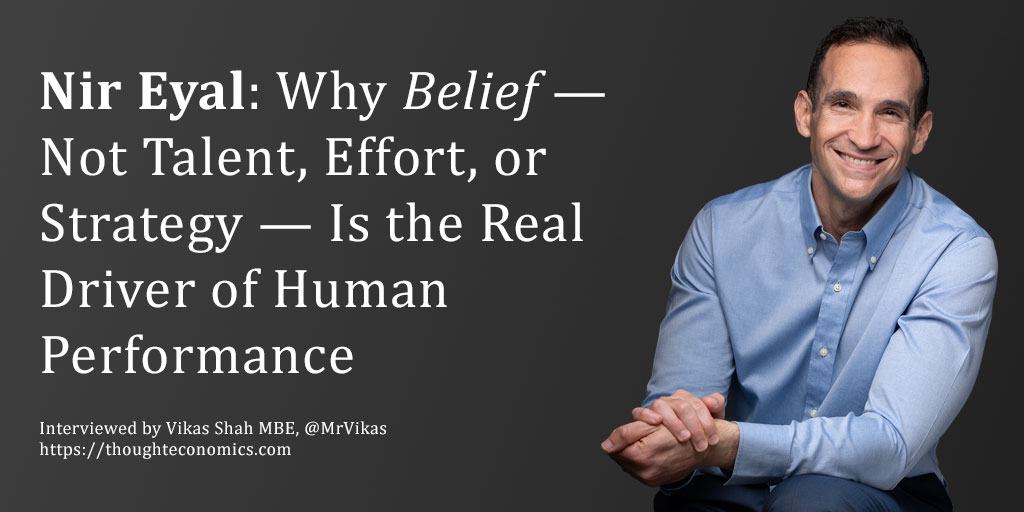
Nir Eyal is one of the most influential thinkers at the intersection of psychology, technology, and human behaviour. A former lecturer at the Stanford Graduate School of Business and the Hasso Plattner Institute of Design at Stanford, he has spent over two decades studying how and why people do what they do. His first book, Hooked: How to Build Habit-Forming Products, gave the world a landmark framework for understanding how products embed themselves into daily routines — and became essential reading in Silicon Valley and beyond. His second, Indistractable: How to Control Your Attention and Choose Your Life, tackled the other side of that equation: how to reclaim focus in an age engineered to steal it. Both became international bestsellers, selling over a million copies in more than thirty languages. As an angel investor, Nir has backed companies including Canva and Kahoot!, and his writing has appeared in The New York Times, Harvard Business Review, The Atlantic, and Psychology Today.
His third book, Beyond Belief: The Science-Backed Way to Stop Limiting Yourself and Achieve Breakthrough Results (Simon & Schuster, March 2026), became an instant New York Times bestseller. It is the product of five years of research and asks a deceptively simple question: why do so many people know exactly what they should do — and still not do it? Eyal’s answer is that belief is the missing variable in our understanding of motivation, and it challenges both the self-help tradition and mainstream management thinking. Drawing on neuroscience, clinical psychology, and behavioural economics, the book offers a rigorous, practical framework for identifying and replacing the hidden assumptions that define our limits. In this conversation with Thought Economics, Nir Eyal explores what beliefs actually are, how they silently filter our perception of reality, and why changing them may be the most powerful intervention available to leaders, organisations, and anyone striving to go further than they thought possible.
What Beliefs Actually Are
Q: Most people have never stopped to ask what a belief actually is. How do you define it — and how is it fundamentally different from a fact or an opinion?
Most of us treat the word “belief” as interchangeable with “opinion” or even “faith,” but they’re actually three distinct things — and confusing them is a big part of why people get stuck.
A fact is an objective truth, verifiable through evidence. Faith is a conviction that doesn’t require evidence at all. And belief lives in the vast, messy space between the two. Think about the real decisions that shape your life: Will this business succeed? Is this the right person to marry? Should I take this job? You can gather data, but you’ll never have complete certainty. Demanding absolute proof before acting risks paralysis, and acting on pure faith risks getting blindsided. Your brain needs working models of reality that help you make decisions without perfect information. That’s where belief lives.
The key insight — and this is what separates this book from most of what’s been written on the subject — is that a belief is a firmly held opinion, open to revision when new evidence arrives. That openness is everything. It’s what makes a belief a tool rather than a prison. The real question isn’t “Is this belief true?” but “Does this belief serve me?”
Q: You describe motivation not as a straight line between knowing and doing, but as a triangle — and argue that belief is the missing third side. What does that mean in practice?
We’ve been told for decades that motivation is about knowing what to do and having good enough reasons to do it. That’s the conventional model. You need the right strategy and the right incentive. But if that were true, why do so many people know exactly what they should eat, exactly how they should exercise, exactly how they should manage their time — and still not do it? Knowledge and incentive aren’t enough.
To sustain motivation, we must know what to do — that’s behaviour — know why we do it — that’s benefit — and believe our actions will yield results. That’s the missing third side: belief.
Without that conviction that your effort actually matters, you quit. That’s the pattern I kept seeing in my own life — decades of yo-yo dieting where every approach worked until I stopped believing in it. The most formidable obstacle to any meaningful change is rarely a lack of a good strategy or resources. We don’t fail because we make mistakes; mistakes can be fixed. We fail because we quit. And we quit because belief collapsed, not because the strategy was wrong.
The Surprising Power of Belief
Q: Your book describes the brain processing 11 million bits of information per second, but only 50 reaching conscious awareness — and beliefs determining which 50. What does it mean that two people can look at the same situation and literally see different realities?
This is the finding that stopped me cold when I first encountered it. Your conscious mind can handle around fifty bits of data every second. Compare that to the eleven million bits of total raw data collected by your senses in the same amount of time — the equivalent of seeing every word of War and Peace flash before your eyes twice per second. We live life through a keyhole.
And here’s the crucial part: your conscious mind isn’t receiving an objective recording of reality — it’s getting an extraordinarily condensed highlight reel, curated by your nonconscious, based on what your beliefs flag as important. Two people can witness the same meeting, the same conversation, the same news event, and walk away with completely different accounts — not because one of them is lying, but because their beliefs are literally filtering different information into conscious awareness.
The phrase “seeing is believing” has it exactly backwards. The research shows that believing is seeing. What you expect to find shapes what you actually find. And once you understand that, you realise that changing your beliefs isn’t a soft, feel-good exercise — it’s a direct intervention on your perception of reality itself.
Q: The research on lucky versus unlucky people is remarkable — those who believed they were lucky spotted a hidden answer in 11 seconds; those who believed they were unlucky took over two minutes. What does that tell us about opportunity and what we’re capable of?
The researcher behind this work, Dr. Richard Wiseman, spent over a decade trying to understand why some people consistently feel lucky and others don’t. His research revealed that so-called lucky individuals don’t actually experience more good fortune; they simply see more of it.
In one of his most famous studies, he asked participants to flip through a newspaper and count the number of photos it contained. Halfway through, a huge ad proclaimed: “Stop counting. There are 43 photos in this newspaper.” Below this was a second message: “Tell the experimenter you have seen this and win $250.” Most “unlucky” participants missed the message entirely. They were so focused on the assigned task that they filtered out everything else — including a cash prize staring them in the face. Meanwhile, those who considered themselves lucky were far more likely to spot the message and claim the money.
What this tells us is that luck isn’t a mysterious force that visits some people and bypasses others. Lucky people look wider and see more. Their beliefs about what’s possible calibrate their attention to notice opportunities that others are literally incapable of seeing — not because the opportunities aren’t there, but because their perceptual filters have screened them out. And crucially, most breakthrough moments result from strategic actions that create the conditions for luck to occur. You can engineer it. That’s the whole point.
Q: The rat study — where a simple belief intervention produced a 240-fold increase in persistence — is extraordinary. What are the implications for how we think about human potential and what we write off as fixed limits?
When I first tell this story to audiences, they don’t believe me. And I understand why.
Researcher Curt Richter placed rats into cylinders of water and measured how long they could swim. The wild rats — stronger, fiercer, better swimmers by nature — drowned within fifteen minutes. Every single one. But when he rescued a new group of wild rats just before drowning, held them briefly, and returned them to the water, something extraordinary happened. Those conditioned rats swam for sixty hours. Not sixty minutes. Sixty hours. More than two and a half days of nonstop swimming.
That’s a 240-fold increase in persistence. And nothing physical changed. What changed was a vital belief: that persistence could lead to salvation. Escape was possible. That belief gave them a reason to keep going.
The implication that I find genuinely unsettling is this: if the sixty hours of capacity was always there in those rats — if it just needed to be unlocked — what are we writing off as fixed limits in human beings that are actually just locked potential waiting for the right belief? We treat so many of our limitations as objective truths about ourselves. The research suggests they may be something else entirely: working models we’ve adopted that happen to be wrong.
How We Change Our Beliefs
Q: If someone recognises a belief that’s been holding them back — what does the process of actually changing it look like? What’s the first step?
The first step is a conceptual shift, and it matters more than any technique. You have to stop thinking of your beliefs as truths and start treating them as tools. Beliefs aren’t wishes or manifestations; they are mental models built through experience, evidence, and deliberate construction. That means they can be rebuilt.
The moment you ask “does this belief serve me?” instead of “is this belief true?” — something loosens. Take Maria, a software engineer I profile in the book. After a rough presentation, she developed a crippling belief: “I’m a terrible presenter.” Her brain then did exactly what brains do — it filtered everything through that lens, confirming the belief at every turn. Beliefs don’t change by themselves. They require intentional strategies to pull your attention away from old narratives and redirect it toward something more useful.
What worked for Maria was what I call proving yourself wrong. She created a “reality log” — for two weeks, documenting every interaction related to her communication skills, not just the stumbles but the successes. In two weeks, she had logged seventeen positive interactions, three neutral ones, and only two that were genuinely negative. “It was like switching from a funhouse mirror to a regular one,” she said. “The distortion disappeared once I started looking for the full truth.”
The evidence had always been there. Her belief had been filtering it out. That’s how insidious limiting beliefs are — and why the first step has to be questioning their usefulness, not just their accuracy.
Q: You argue that procrastination, overeating, and poor time and money management are all really the same problem — pain management. How does reframing them as belief problems change how we solve them?
This reframe changed everything for me personally, and I think it’s one of the most practically useful ideas in the book.
We think we’re waiting for motivation. But motivation doesn’t show up first — discomfort does. When we procrastinate, we’re not failing at finding motivation; we’re avoiding anticipated discomfort. Our brain predicts that the workout will hurt, the conversation will feel awkward, or the mental effort will strain us. This anticipation creates an immediate urge to disengage.
Unfortunately, our predictions are often wrong. We tend to overestimate how long unpleasant sensations will last. “Anticipatory anxiety is almost always worse than the thing itself,” according to researcher Ethan Kross.
Here’s why this is a belief problem: the anticipation of pain is a prediction — and predictions are driven by beliefs. Change the belief about what an experience will feel like, and you change the motivational calculus. I only learned to manage procrastination when I learned to manage my pain — not by eliminating discomfort, but by changing my relationship with it, viewing those feelings of resistance as signals that I was about to do important, meaningful work. That mental shift didn’t make the work effortless. But it made the struggle feel purposeful. And purposeful struggle is one we keep showing up to.
Business and Leadership
Q: Leaders make high-stakes decisions every day based on assumptions they’ve never examined. How much of what we call strategy is really just institutionalised belief — and how dangerous is that?
Enormously dangerous — and enormously underappreciated as a risk.
Here’s the mechanism. Your beliefs act as perceptual filters. They determine what information even reaches conscious awareness. Belief-consistent information processing means you seek evidence that confirms existing beliefs while filtering out contradictory information. At the individual level, that’s manageable. At the organisational level, when a leader’s unexamined beliefs shape company culture, hiring decisions, competitive assessments, and what data gets surfaced in meetings — you’re operating with a systematically distorted picture of reality.
I tell the story of Anne Mahlum, who built a $100 million fitness company from nothing. Her conviction that people could transform fuelled extraordinary breakthroughs. But the same conviction that built her company eventually needed updating when her intensity started burning people out instead of energising them. What once inspired people was now beginning to burn them out.
That’s the trap. When conviction becomes an integral part of your identity, it becomes increasingly difficult to accept feedback. The very beliefs that fuelled your rise can become the ones that hinder your growth. Strategy is, in large part, institutionalised belief. The question is whether your organisation has any mechanism for examining those beliefs — or whether they’re just the water everyone swims in, invisible and unquestioned.
Q: You’ve worked with organisations like [JPMorgan](https://www.jpmorganchase.com/), [Amazon](https://www.amazon.com/?tag=thoughteconom-21), and the [US Air Force](https://www.af.mil/). What’s the most common limiting belief you encounter in senior leadership — and what does it cost them?
The most pervasive one I encounter is some version of: “incentives are enough.” The belief that if you get compensation, titles, and performance systems right, motivation takes care of itself. It’s the dominant mental model in most large organisations, and it’s wrong in a way that costs billions.
The research is clear that motivation requires three things — knowing what to do, knowing why it matters, and believing that your effort will yield results. Leaders invest heavily in the first two and almost never in the third. They’ll redesign org charts, build OKR frameworks, and run engagement surveys — but they won’t address the core beliefs their people hold about whether their work actually matters, whether the organisation is capable of change, and whether they personally have the agency to make a difference.
The other common one is what I’d call the “this is just how it is here” belief — a collective learned helplessness about culture, about bureaucracy, about what’s possible. People mistake a belief that has calcified into organisational culture for an objective fact of organisational life. Helplessness isn’t learned — it’s the default. What we must learn is hope. And hope is built through mastery experiences, through evidence that action produces results. Leaders who understand that can shift an entire culture. Leaders who don’t spend years wondering why engagement scores don’t move.
The Bigger Picture
Q: Self-help has promised belief-driven transformation for decades. You’re explicitly positioning this book against that tradition. What’s the critical difference — and why should a sceptical reader take this seriously?
The sceptical reader is exactly who I wrote this book for. And my answer to them is: your scepticism is well-earned — but it’s been pointed at the wrong target.
The “think positive” and “just believe” mantras we’ve all heard are not exactly wrong, just incomplete. They acknowledge that beliefs matter but offer no practical way to build them. They treat beliefs as something you either have or don’t, like a mysterious quality you can turn on or off at will.
The self-help tradition from Norman Vincent Peale to The Secret) to modern manifesting culture promises that alignment between your thoughts and your desires is sufficient — that the universe delivers what you vibrate toward. Scientific research shows that positive thinking alone often fails to produce lasting benefits and may even backfire. Gabriele Oettingen’s work demonstrates that people who vividly imagine their desired outcomes without accounting for obstacles actually perform worse — their bodies physiologically relax as if the goal has already been achieved, draining the energy needed to act.
This book is a staunch rejection of magical thinking and blinding denial. A belief is only a good tool if it holds up to real-world feedback, remains open to revision, and doesn’t require ignoring evidence to sustain it.
The difference isn’t philosophical — it’s structural. This book is built on peer-reviewed science: neuroscience, clinical psychology, behavioural economics. The framework — attention, anticipation, agency — gives you three concrete levers that research shows actually move human behaviour. And the test for any belief isn’t whether it makes you feel good. It’s whether it makes you better at engaging with reality. That’s not self-help. That’s applied science.
Nir Eyal’s book Beyond Belief is available now. Visit
Get the book: Beyond Belief • Free Belief Change Guide: nirandfar.com/belief-change
Bonus content & 30-Day Belief Transformation Journal: nirandfar.com/beyond-belief
Also by Nir Eyal: Hooked • Indistractable • Website: nirandfar.com