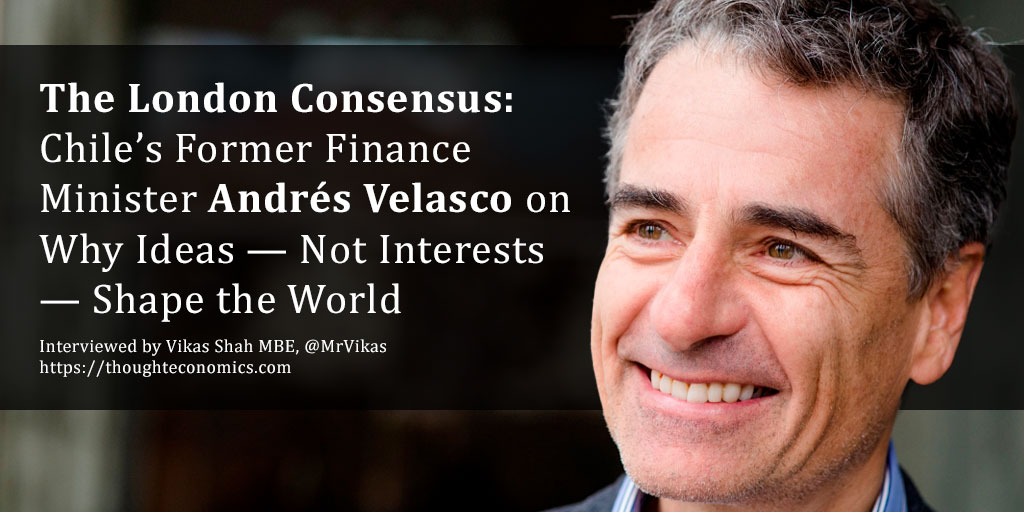
Professor Andrés Velasco is one of the most distinguished economist-practitioners of his generation. The Dean of the School of Public Policy at the London School of Economics, Velasco served as Chile’s Minister of Finance from 2006 to 2010 under President Michelle Bachelet, where his disciplined stewardship of the country’s copper windfall — building a sovereign wealth fund that later financed Chile’s crisis response — earned him recognition as Latin American Finance Minister of the Year. A member of the Group of Thirty and the G20 Eminent Persons Group, and a former presidential candidate in Chile, Velasco holds a PhD in economics from Columbia University and has held professorships at Harvard’s Kennedy School and Columbia’s School of International and Public Affairs.
His new book, The London Consensus: Economic Principles for the 21st Century (LSE Press, 2025), co-edited with Tim Besley and Irene Bucelli, is a direct response to the Washington Consensus that shaped global economic policy for thirty-five years. Drawing on contributions from leading economists connected to the LSE — including Dani Rodrik, Philippe Aghion, Hélène Rey, and Christopher Pissarides — the volume argues for a new framework built on principles rather than prescriptions, with wellbeing, place, resilience, and political legitimacy at its centre. In this conversation with Thought Economics, Velasco explains why ideas are more powerful than interests, why the same policy can be brilliant or catastrophic depending on context, and why the greatest threat to our civilisation is not technological but political. Previous Thought Economics conversations on economics and policy include those with Larry Summers, Sir Paul Collier, Kate Raworth, and Yanis Varoufakis.
Q: Could you set the scene for readers? Why are you doing this and how does it relate to the original Washington Consensus?
[Prof Andrés Velasco]: People of a certain generation, myself included, were around thirty-five years ago when a very influential volume was published in the United States. It’s the sort of thing that some people love and some people hate, but it was hugely influential. It helped shape the policies of Margaret Thatcher in this country, of Ronald Reagan in the United States. It helped shape the policies of the World Bank and the International Monetary Fund.
It’s been exactly thirty-five years since that book came out. So Tim Besley, my colleague at the LSE, and I thought, well, maybe this is the right time to revisit that set of issues. We simply asked colleagues — everybody in the book, every author is connected to the London School of Economics, either they teach there now or they’ve taught there in the past or they did their PhD there — and we said, regardless of your subject, whether it’s international trade or labour markets or technology and AI or public finance: what is it that we know today that we didn’t know in 1990? And what policies should we adopt today that were not in the playbook of the 1991 Washington Consensus?
That’s essentially the book. And you will see that it’s an eclectic book. Some chapters say the Washington Consensus in my field had five propositions, and of the five, maybe three are still valid, but two are complete nonsense — or maybe they’re obsolete. We need to throw them out the window and replace them with something else. So it’s not black and white, it’s not zero or one, it’s not all good or all bad. It tries to say: we have learned. Some of the old lessons still apply, but many of them don’t, and here’s a replacement.
Q: In your book, you argue that it’s ideas rather than interests that shape policy and history. Is it economic paradigms that shape reality, or do they merely rationalise things that were already unfolding?
[Prof Andrés Velasco]: Well, we economists are very interest driven. So whenever you talk about ideas, many colleagues are uneasy. But I think there are plenty of good reasons to think about ideas and the role they play. Everybody’s heard, of course, of the famous Keynes quote that every madman in authority is still responding to the ideas of some long-dead scribbler. But more importantly, I think there are two reasons why ideas matter.
First of all, reality is complicated, and we all struggle to make sense of it. Ideas, and more precisely economic approaches or paradigms, give you a way of interpreting reality. Otherwise, you just go online and get lots of data bits, but you struggle to make sense of them. And whenever they interpret reality in one way as opposed to a different way, paradigms or approaches have a great deal of power. That’s one reason.
The other reason is that we humans are very identity driven. We’re very groupish. That’s what psychology and behavioural science has taught us over the last half century. And therefore, often we like a paradigm not necessarily because of its contents. We like it because people we like, like it. If you were born in 1950 in the north of England and your parents worked in a steel mill, chances are 99.9% that you voted Labour, because that’s what people like you did. And you probably supported a football team where everybody also voted Labour, and you probably went to a pub where most people also voted Labour. So paradigms are also excuses for human agglomeration, human groupishness. And because life requires collective action, whenever a bunch of people agree on something, that makes it very powerful as well.
Q: How do we make the distinction between principles and policies? Because the natural logical conclusion from what you’ve said is that we should be using principles rather than policies, but that doesn’t seem to be the case. What leads us down the road of policies rather than principles, and how do we distinguish between the two?
[Prof Andrés Velasco]: So maybe let’s start by clarifying what we mean by principles and policies. And an example will save us a thousand words. Imagine the principle is that labour should be fairly rewarded for its efforts. If you want to get more technical, let us say the principle is that labour ought to be paid its marginal product. So if an extra worker produces an extra car, then over a year that worker should get the value of the car.
Now, you might think of different policies that policymakers could come up with to ensure that labour is properly rewarded. But those policies are going to have massively different effects depending on circumstances. If you begin in a perfectly competitive labour market with no monopoly or monopsony, no big buyer of labour, and you apply a very high minimum wage, then you’re going to create unemployment and labour will be unfairly rewarded because some people will have a reward of zero — they will have no job.
By contrast, if you’re in a town in which the only employer is Amazon and therefore Amazon sets wages, well, Amazon will be tempted to set wages too low and therefore a minimum wage will in fact have beneficial effects on every front. Not only will you have more pay, you will also have more employment. Same principle, different policies, different effects.
This is where many policymakers get lost, because they campaign on simple ideas. One simple idea is a higher minimum wage. Is that a good idea? Well, the boring economist will say “it depends.” It could be a good idea. It could be a terrible idea. It all depends on starting circumstances.
Q: If we move towards a principles-based approach, would that not also mean that the dominant methods we use to measure our economy are no longer fit for purpose?
[Prof Andrés Velasco]: Not sure that has to be the case. There are certain things we measure more or less easily. We survey businesses and we have some idea of what the consumer price index looks like. We construct indices of employment or output — we call it GDP. And that’s perfectly fine. We need that. Better measurement gives us better policies, other things equal.
But one point we make in the book is that there are many things that matter to people which are not easily measured. That doesn’t mean we should stop measuring the other things. It simply means we should worry about things that are not in GDP. I think it’s pretty clear over the last twenty-five, thirty years — think about the experience of the UK or the US — inevitably, some industrial jobs are going to be lost. This is long before we worry about China and trade, simply because machines are better at making things and therefore the share of industrial employment is going down everywhere. Germany is losing factory jobs and so is the US, so is the UK, so is China.
However, what we didn’t quite see in the beginning is that these losses are very concentrated geographically. They hit particular towns and cities and regions very hard. And there you get a very nasty negative social multiplier, because jobs are lost and some people leave, and the ones who are left behind are typically the ones who have fewer skills. Then you get into all kinds of social ills — alcohol, mental health problems, and so on. The tax base of the community also goes down, and therefore government is not well placed to provide the things people need.
But the point here is that not only are incomes being lost — a sense of community, a sense of pride, a sense of belonging has also been lost. Those things clearly matter for human wellbeing. We’re just not very good at measuring them. And one explanation for why so many people are so angry in so many democracies today — advanced, rich democracies in Europe or North America or East Asia — is that people feel they’ve been disrespected, that their community or their group has been left behind. That’s hard to measure, but important nonetheless.
Q: I love that incentive versus justice question. You emphasise wellbeing rather than money. Does modern capitalism optimise for the wrong function, and how does the economy look different if we optimise for wellbeing?
[Prof Andrés Velasco]: First, the clarification. I don’t think money is the enemy of wellbeing and I don’t think economic growth is bad. So we’re not making a case for degrowth. I was born in a developing country. I believe that countries of the world which are not rich ought to have a chance to get rich. You hear about degrowth in North America or in Western Europe, but you don’t hear about degrowth in India or in South Africa or in Brazil. So we’re not making a case against economic activity or against growth or against material prosperity. That is very much needed. We’re simply saying that in addition to that, other things matter to people. And capitalism, if properly regulated, can provide them.
Let me give you a very concrete example. We have typically asked people to go where the jobs are. This might mean that if there are no jobs in your city, you move across the country in search of a job. Well, maybe you now have a better-paying job, but you’ve left behind the people you love and your community and the football team with which you played on Sundays.
Or let me give you another example. The developing world has grown gigantic cities. Jakarta has 42 million people. São Paulo has something like 25 million. A working-class person in Jakarta or in São Paulo or in Lagos probably spends an hour and a half or two hours going to work every morning in a crowded bus, and about two hours going home in the evening. Do the arithmetic. That person is away from home for twelve hours, but is only being paid at work for eight. That is a massive loss in human wellbeing. That person spends four hours in a cramped bus without family, without friends, without anything to do, feeling lonely, feeling hot, feeling uncomfortable. And also implicitly being taxed — you leave home for twelve hours, but you only get paid for eight. That’s a tax rate of one third.
So an economy in which wellbeing is taken into account is an economy in which we think about the structure of cities, in which we try to make sure that people live close to jobs or that jobs move toward where people are, where we spend time thinking about public transport so that getting to work is fairly easy and fairly safe. That can be done. Some cities and some countries accomplish it, others don’t. It’s not rocket science, but it does require a certain mindframe on the part of policymakers.
Q: Does that wellbeing anchor also extend to how we ensure people have hope? In the North of England where I’m based, there are communities with multi-generational poverty. Even with a social safety net, there isn’t a sense of hope or the ability to engage. Is this where the politics and the economics truly connect?
[Prof Andrés Velasco]: Absolutely. I would say that is not the job of the economic policymaker. That is the job of a political leader. And of course, in some countries they’re one and the same. A political leader has two goals, or ought to have two goals. One is to ensure that people think and believe in the bottom of their heart that you’re working for them — that you’re not working for the rich people in the City of London, you’re working for the average man or woman in the north of England or in Wales.
Secondly, political leaders have to be realistic about the present. Yes, we face lots of challenges, but they must be hopeful about the future. We can address these challenges. We can all row in the same direction. I love an expression coined by an American political theorist, Margaret Levi, who talks about “communities of fate” — not necessarily communities of faith. You don’t have to pray to the same God or go to the same church, but you share a fate. We’re all in it together. And it is the job of the prime minister or the president to persuade people that we are all in it together, and that if you fall behind, we will lend you a hand.
It’s remarkable how few political leaders today manage to persuade people of that. And it’s really the first order of business — what a prime minister or a president ought to be doing at eight in the morning every day. Are people persuaded that my government is working for them? I think Donald Trump fails the test. Many other people fail the test.
Q: You suggest we need more focus on narratives. Economics is so central to everyone’s life, but so poorly explained and understood. What is your core thesis around narrative?
[Prof Andrés Velasco]: A narrative is an account of where we are and where we’re going. The first thing I would say about a political narrative is that it must have a goal. Narratives are not about means, they’re about ends. And often politicians and economists get confused about this. I heard a very senior economic advisor in the British government recently say, “Our goal is economic growth.” And I thought to myself, no — economic growth is a means. The goal must be something else. It must be shared prosperity. It must be happier lives. It must be communities in which we all feel that we belong. It must be mutual respect. Those are ends. So the first thing is to get that differentiation clear in one’s head.
But secondly, a narrative is a way of helping all of us understand the world. I have a PhD in economics. I’ve been teaching economics in the US and the UK for nearly thirty years. And often I get up in the morning, go online, read the newspaper, and I’m not quite sure I understand what’s going on, because economic reality is endlessly complex and the landscape is shifting all the time. A good narrative is not one that gets stuck in details. You could argue endlessly about exactly why the price of eggs is higher today than it was two years ago. But a narrative says: no matter what happens to the price of eggs or to the price of fuel in the middle of a war, there are institutions and mechanisms and people who will work to soften this blow.
And that’s realistic as well. I was a policymaker in my own country about a decade ago, and I learned that people also want to be told the truth. Everybody understands that if there’s a war in the Middle East, the cost of fuel is going to go up. If you say it will never go up, people don’t believe you. But the question is, given that it will go up, will it go up quickly or slowly, by a lot or by a little? Will there be compensation? That’s the sort of thing a narrative weaves — not the technicalities. Nobody really cares about and nobody really has the time to sort out the design of a subsidy. That’s for technicians. But there has to be a sense that there’s a story we tell ourselves about ourselves. That’s what I mean by a narrative.
Q: Most countries don’t have unlimited money. Policymakers have X amount of money but a hundred X things to do. Can this paradigm-based thinking help them make better decisions when interests are competing?
[Prof Andrés Velasco]: Two thoughts on this. Policymaking is about choice, clearly. And if you’ve spent five minutes with a policymaker, you know that the choices are not always appetising, and they’re tough. I don’t think you can get away from choice. Policymakers have to be honest and say, “I wish we could do it all, but we cannot.”
Having said that — that’s the bad news — let me share two bits of good news. One is that these principles we were talking about help us organise choice. An able policymaker says, “I’m not going to get caught up in the technicalities of the policies. How does this policy fit with the overall goals that are central to my narrative?” If an overall goal is that people ought to get paid fairly, that labour ought to be fairly rewarded, well — how does this proposed amendment to the budget fit into that scheme of things?
The second bit of good news is that sometimes scarcity and sometimes crises can be invigorating for policymakers. There’s a piece in the newspaper this morning that says Keir Starmer’s government was not doing too well, but the war has been a bit of a jab of vitamins, because when you confront a difficult situation, you can exercise leadership. The analogy was to Gordon Brown during the world financial crisis. I was in government in Chile at the time, and I got to see Gordon Brown doing his bit up close. He was very, very impressive. He knew economics, he knew finance — even though he’s trained as a lawyer, he’d been Chancellor for a long time, so he was really in command of his brief. And he exercised leadership not only within the UK, but also across the world. I remember one World Bank–IMF meeting in Washington in which the UK delegation was really calling the shots because the Americans were completely lost. That energised Brown and gave him the kind of leadership that up until that point he’d been lacking. What’s the American cliché? “A crisis is a wonderful opportunity that should not go to waste.” There’s a good bit to it.
Q: We’re not short of crises — wars, AI, populism, inequality, climate change. The crises are not just more frequent, but bigger. What are you most concerned about from the perspective of what will reshape capitalism and our world?
[Prof Andrés Velasco]: First, let me voice a caveat. It is true that we face immense challenges, and I’ll talk about at least one of those in a second. But let us not get carried away. The average human being on planet Earth lives a longer, healthier life today than at any other point in human history. In the country where I grew up, life expectancy used to be 55 or 60 years. Today it is 85, and for women, close to 90. People are better fed, people have better healthcare, and people are more educated than ever before in human history. So let us not despair too much.
Now, that doesn’t mean that all is fine. All is not fine. And if you ask me to choose among that long list of challenges, I will choose one without hesitation, and that’s politics. We have the technological means to deal with climate change. We have the technological means to deal with pandemics. We don’t quite know what AI will bring, but it could be bad news and also brings good news. This is not a technical problem. It is mostly a political problem. We human beings cannot come to an agreement on how to reduce emissions, how to make sure AI creates more jobs than it destroys, or how to strengthen our public health so that the next pandemic doesn’t catch us unprepared. We know how to do that. We just need to agree to do it.
And the reason it’s hard is that many people want to be free riders and get somebody else to pay for it. And because we also have massive identity and ideological struggles, most of which don’t make a lot of sense from a rational point of view. Clearly, if you spend five minutes on it, you’ll realise that being anti-vax makes absolutely no sense. But we human beings suddenly identify with a cause, however crazy, and we go to battle. So then millions of people think vaccines are terrible. It’s a terrible idea, but that’s a political problem. If we get our politics under control, the rest is fun and games.
Q: As a roundup, what would be your hope as the main takeaway from The London Consensus? What are the actionable things you hope policymakers and leaders take from your work?
[Prof Andrés Velasco]: Here’s my hope. It is not simply that the world today has many bad political leaders doing bad things. The list is long, beginning with the president of the United States. But a second problem, which doesn’t always get enough attention, is that there are plenty of reasonable, moderate, reformist, liberal leaders who just don’t quite know what to do. If I look at governments in Western Europe or North America or in my part of the world, Latin America, I can see some reasonable presidents or reasonable prime ministers. But what they’re lacking is a playbook — a way of organising their priorities and fighting the kind of authoritarian populism that is threatening democracy today, in rich countries and poor countries, North and South, East and West.
Our book doesn’t give them a pre-made playbook. We resist the temptation of saying “these are the ten policies that everybody has to follow.” In that sense, we’re very different from the Washington Consensus of thirty-five years ago. But our book does provide a framework for thinking about a playbook and for picking the right playbook for the country in question. The playbook that a liberal democrat may adopt in South Africa will be different from the one they adopt in Britain or in Indonesia or in Brazil. But our book ideally will help them make that choice. That is my hope.