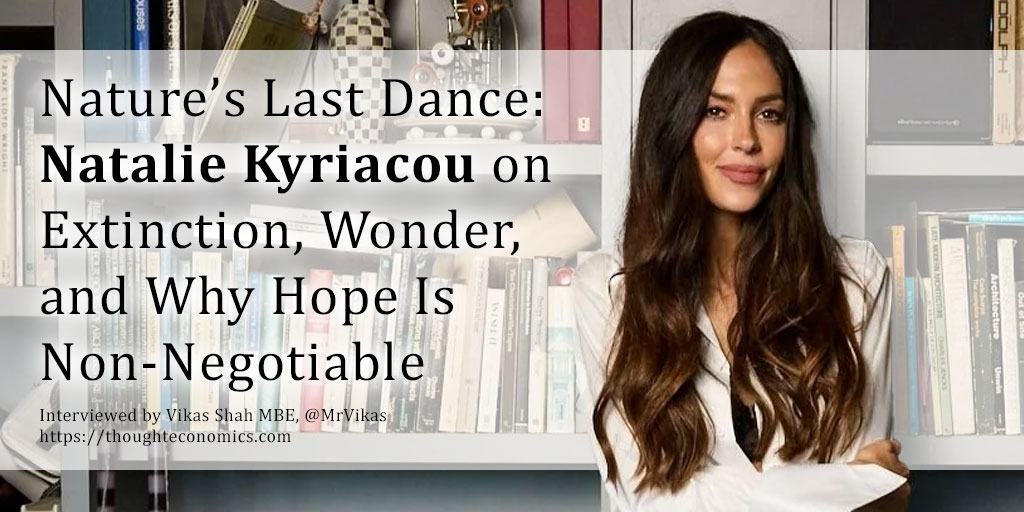
We are living through the sixth mass extinction in the history of life on Earth — the first to be caused by a single species. Scientists estimate we are losing species at up to a thousand times the natural background rate, with the biodiversity crisis now regarded by many researchers as an existential threat equal in severity to climate change — and yet far less visible in our politics, our institutions, or our collective imagination. The framing we have inherited — that nature is a backdrop, a resource, a category separate from human life — has not only failed to protect the natural world; it may be the very cognitive architecture that is accelerating its destruction. Changing the relationship between humanity and nature is not merely a conservation challenge. It is a civilisational one, requiring us to interrogate the stories we tell, the systems we build, the measures we use to define progress, and the values we pass to the next generation.
Natalie Kyriacou OAM is an award-winning environmentalist, author, and company director who has spent her career connecting people with the natural world through curiosity, storytelling, and community. Awarded the Medal of the Order of Australia and named in Forbes 30 Under 30 for her services to wildlife and environmental conservation, she is the founder and chair of My Green World, a board director at the Foundation for National Parks & Wildlife and CARE Australia, a UNESCO Green Citizens Pathfinder, a member of the XPrize Brain Trust for Biodiversity and Conservation, and an Australian delegate and Climate Justice Lead at the W20 — the official engagement group of the G20. She was a finalist for the UN Environment Programme Young Champion of the Earth award and is LinkedIn’s Top Green Voice. Her debut book, Nature’s Last Dance: Tales of Wonder in an Age of Extinction (Affirm Press, 2025), was named one of the Best Australian Books of 2025 by The Guardian, longlisted for the Indie Book Awards 2026, praised by Dame Christiana Figueres and Dr Bob Brown, and described by Trent Dalton as “the most breathtaking reminder of the wild and miraculous waking dream that is our natural world.” In this conversation, Natalie challenges some of our most foundational assumptions about intelligence, progress, economics, and what it will truly take to halt the extinction crisis.
Q: Your book argues that nature is not the backdrop to our lives, but our lives themselves — that we are nature, and there is no separation. How different is that from our prevailing worldview, and what does genuinely accepting it change about how we organise human society?
[Natalie Kyriacou]: My book, Nature’s Last Dance: Tales of Wonder in an Age of Extinction, says that nature is not the backdrop to our lives — it is our lives. We are nature and nature is us. There is no separation. There is no human mastery over nature. It just is. It does not work that way. We are part of a system. And what we have done is build human-centred systems that shape our world order. These systems are sometimes inadvertently built on a logic of dominance over both nature and communities. And this logic we continue to uphold today — in our economies, the way we govern society, our laws, our politics. My argument is that we have built these human systems that are completely made-up constructs, and we see them as inevitable, but they are fundamentally incompatible with nature. We need nature to exist. It is so simple to me. We do not exist without nature, therefore we are not the masters of nature.
Q: Our self-designation as the “intelligent species” sits uncomfortably alongside the fact that we appear to be the first species to actively cause the mass extinction of everything around us. Are we actually as intelligent as we think we are?
[Natalie Kyriacou]: Humans won’t like my answer to this, and it probably speaks to our hubris. I don’t think humans are uniquely intelligent. Crows use tools. Dolphins understand human language. Elephants grieve and teach. Octopuses solve problems. What we have isn’t superior intelligence — it’s superior destructive reach, enabled by technology. The story we’ve told ourselves that we are categorically separate from nature is the destabilising force, because every species is constrained by nature and is part of a system. We invented this ideology that we’re exempt from nature’s rules, that we’re masters over nature, and that ideology is incorrect. And I’d say it’s probably a mark of our lack of intelligence.
We have so much to learn from nature, and we have fundamentally misunderstood it because we have always positioned ourselves at the centre of it. It’s funny because every time we have these notions of what humans are and how we’re superior — we think, oh, we use tools — and then Jane Goodall comes along with the chimpanzees and they start using tools, and we think, oh no, all right, how are humans different? And then a crow starts using tools and dolphins start understanding language. I think we’re really scrambling to figure out what sets us apart. And we’re not going to find it — because we’re not apart from nature. We are not superior to nature. We just tell ourselves we are.
Q: You make a strong case for narrative over data when it comes to changing human behaviour around nature and the environment. What made you see the power of storytelling, and how do we use it more effectively?
[Natalie Kyriacou]: I saw a gap. We have scientists, for example, who do incredible work. Their role is to undertake the research and show the world what the problems are, what the innovations are, what the solutions are — to show us the ways that the world works. And then that research would immediately go to policymakers and the general public, who interpret it in their own way. But what we didn’t have were people able to bring colour and life to that science. And the result was that we either had mainly environmentalists repeating — yelling back and forth at each other — that climate change is bad and citing 1.5 degrees and various numbers and data, and that being largely ignored.
I think we need more empathy in the way we converse with each other, and we need more stories. The more stories you have, the more people you can reach, because everybody has different contexts and experience, and different stories will appeal to different people. For example, if I want to talk to my grandma who grew up in Cyprus, in a little village, she is not going to care about the data. What she will care about are the stories of wine and olive oil and how that might impact her — stories of her ancestors, stories of the plants and the trees and the ecosystems around her. It is about talking to people in a language they understand. That is why all of us should be getting better at telling these stories — because you need to be able to feel and connect with them in order to act.
Q: Does effective environmental storytelling require storytellers who have a more holistic understanding of history, politics, and social context than most currently have?
[Natalie Kyriacou]: No, not at all. And I think there is also an absence of empathy. As this ideological divide grows — which is often fuelled by social media and technology — we are spending less time actually talking to people who think differently to us, and less time trying to understand them. And I think that’s a really big problem for storytellers, because in order to have robust and interesting stories, we need to capture and be aware of a wide diversity of perspectives, different histories, different philosophies. Our stories at the moment are very, very limited, and they are often designed to appeal to people who think exactly like us. And that’s a really big problem. To be a good storyteller — to tell the kind of stories that genuinely reach people — you have to be willing to engage with perspectives completely different from your own.
Q: Has your work in wildlife and environmental education — particularly with young people — shaped how you think about communicating these ideas?
[Natalie Kyriacou]: Absolutely. My ultimate goal is to have a world that protects nature and communities, and I want to do whatever I can to make that happen. That means being able to communicate with anybody and everybody across a whole range of different audiences. I probably learnt how to do that by working with kids, because being able to explain complex topics to children is genuinely hard. You need to really, really, really understand something before you can do it. I loved finding ways to make it fun, drawing more imagination and creativity into it, and being challenged by the children themselves.
The work I did with kids was never about us teaching them — it was about us learning from them. For example, I had a wildlife and environmental education charity and we put an eight-year-old on our advisory board, because this was collaborative and participatory. We’ve got something to learn from everyone. I think we don’t see young people as current leaders, and we don’t see them as holders of wisdom — and I think that’s wrong. Working with children in particular is what taught me to tell stories.
Q: Amid all the evidence of nature’s fragility and the scale of the extinction crisis, what examples of nature’s resilience have you encountered? And what have the more unconventional conservation efforts you write about taught you?
[Natalie Kyriacou]: Nature is incredibly resilient. We just need to leave it alone. We’re talking about destruction that is relentless — a relentless onslaught where we don’t give nature any time to heal at all. But there have been really extraordinary examples of its resilience.
One of the most striking is Chernobyl. This was the world’s worst nuclear disaster, and in its wake, nature rebounded and thrived — which led scientists to pose the question: are humans worse for the world than the world’s worst nuclear disaster? And I think the answer is yes, if we’re seeing nature thrive in the wake of such a disaster. Then there are stories of the sea otter along the US West Coast being eradicated — essentially by the fur trade — with the ecosystems around it greatly diminished. And then when conservationists worked on bringing the sea otter back, ecosystems flourished. We have so many examples of nature’s resilience.
And then there are the really quirky stories of wonder and human ingenuity — the extraordinary, sometimes absurd, lengths that conservationists are going to to protect wildlife. Most people have seen the conservationists who dress up in panda suits, dressing as the animals so they feel more relaxed — whether it’s to help them mate with others, to feed them, or to acclimatise them for release. I interviewed one conservationist whose job is to saw the horns off rhinos so they can’t be poached anymore. I met a wildlife rescuer who spent Christmas Eve dangling upside down from inside a stormwater drain to protect a tiny little lorikeet. There is nothing off limits for conservationists. They are doing absolutely everything they can to protect species because things are bad — things are catastrophic — and they are trying to put a band-aid on a haemorrhaging wound, just keeping species alive with the hope that something will give, that some policy will change.
Q: Most institutions still treat the environment as a sector — something that happens separately from everything else. Why haven’t we applied the same kind of systems-level thinking to nature conservation that we have, however imperfectly, to climate change?
[Natalie Kyriacou]: I think truly embracing systems thinking requires a fundamental upheaval of our economic, political, social, and cultural systems. And those systems are very fiercely protected by the people who benefit from them — a very small handful of powerful people. So there is a lot of pushback to that.
I also feel that we rely on institutions to do more than they were ever meant to do. A lot of these global institutions were built to solve problems of a different era. The United Nations, the IMF, the WTO — these post-war institutions were for the most part designed to avoid catastrophe or the outbreak of another war. None of them were designed for planetary systems management. And so we find ourselves in this place where we keep tweaking a broken system. My argument in the book is that we need to think a little bit more imaginatively than a simple tweak. We need rather more than that.
Q: Are the economic incentives we’ve constructed — carbon markets, GDP as our primary measure of progress — fundamentally incompatible with the protection of nature?
[Natalie Kyriacou]: The incentives for climate action through carbon markets have had mixed results — quite fairly positive across Europe, far less so in somewhere like Australia. But that’s really different, because that’s not nature. That’s not looking at nature as a whole. That’s looking at one facet with one value — greenhouse gas emissions — which is at least measurable. When you talk about nature more broadly, how do you measure it? How do you value it? There isn’t one particular value. This financialisation of nature can potentially work when you’re talking about carbon emissions, but it’s very, very difficult around nature more broadly.
I have a real problem with the direction this has taken. For a while I thought putting an economic value on nature was genuinely positive — I have spoken to a few economists about this — because it was allowing us to think differently, potentially shifting markets towards renewables. But I think our current economic system is just fundamentally incompatible with nature. We’re not going to get the results we want. We’ve had carbon markets for decades and things aren’t getting a whole lot better.
Capitalism is built on a notion that we can have infinite growth on a finite planet. And even economists know that isn’t feasible. The world is currently incentivised to extract and destroy. And then we have GDP as a measure — which is, in my mind, such a dangerous measure. It was designed for a specific post-Depression purpose, and Simon Kuznets, the economist who designed it, said that it should never be equated with welfare. And yet here we are. War boosts GDP. Oil spills boost GDP. Cancer and bushfires and drug addiction and gambling addiction and health crises — these all boost GDP. GDP mostly measures how money changes hands. It still rises when society is suffering immensely. So our incentives are really destructive. We can put a carbon market on that and talk about how we value nature, but we’re still operating within the confines of an economic system that is built on a logic of destruction.
Q: The scale of the extinction crisis can feel paralysing for individuals, communities, and even large institutions alike. What do the people in your book who are actually doing something about it have in common? What makes them compelled to act rather than paralysed?
[Natalie Kyriacou]: I think a lot of it comes down to connection with community. The people I found who were most compelled to act were those who felt deeply connected with their community and just started somewhere — and it wasn’t that they needed to do absolutely everything, but they knew they were working within a system, within a community, and could contribute their own strengths to complement others. For the most part, it was collective action — a faith in community, often starting at a grassroots level, and a willingness to cross political or social divides and connect with other people.
And I think what we’re seeing now is really remarkable: a collision of systems changing simultaneously. It’s a patchwork, it’s chaotic, but it’s real. We’ve got people working on the rights of nature, trying to embed those rights into constitutions. We’ve got young people teaming up with nuns to sue governments over climate inaction. We’ve got grassroots communities doing restoration work. We’ve got policymakers trying to shift laws, economists rethinking GDP. It is this patchwork of things. What really helps move that forward is collaboration, collectivity, and being connected with communities.
And I worry that in the age of AI and social media and technology, we are becoming disconnected from community. So we really need to make a conscious effort to focus on connection. That is where the power is — and that is what separates the people who act from the people who feel paralysed by the scale of the problem.
Q: How do you remain hopeful? And why is active hope — rather than fear or urgency — essential to this work?
[Natalie Kyriacou]: I think hope is active. It’s a discipline. The environmental movement probably lost a few years by focusing on catastrophe — by being dealers in catastrophe. And I understand why, because I was one of them. But that focus on catastrophe really triggered a threat response in people and shut a lot of them down — people who became paralysed, or started to deny, or stopped wanting to build movements. So I see wonder and hope as really essential.
The way I stay hopeful is partly because I’m fortunate to be in a position where the people I’m surrounded by are people who are dedicating their lives to making the world a better place. But beyond that, it would be such a profound disservice to give up. It’s such a disservice to young people to just give up. It’s such a disservice to the scientists who have spent decades working on this to just give up. So of course I’m going to be hopeful. Of course I’m going to do everything I can to make a difference — whether it’s big or small — because I’m not giving up on young people, or on all of the conservationists and scientists and everybody else who is trying to make the world better, or who has the next eighty years of their life to look forward to. There is no other option but to be hopeful. That’s what activates me the most. There is simply no other option.
Q: Where did your passion for the natural world and for communities come from? How did it become so central to everything you do?
[Natalie Kyriacou]: I think it was almost the opposite — my passion for the environment and communities was so central to me that it became my work, and my hobby, and everything else. Because for a long time I didn’t get paid for any of this. I would just start charities and do all of this stuff I was passionate about.
It was a couple of things. One was that I was a very sensitive little girl. I loved books, I loved nature, and I was highly, highly sensitive. My mum still talks about how there was this penguin cartoon show, and I cried for a very long time when the penguin dad was mean to the penguin. I was very sensitive, very nature-oriented, outdoors all the time. And when I wasn’t outdoors, I was at the library reading.
And then there were family values. My family is Greek Cypriot, and there is a very strong sense of community — generosity of heart, you look out for one another, you cause less harm, you tread lightly on the world. But then I was always hyper-curious. I wanted to explore the world, meet new animals and people. And so I did a couple of trips abroad and did some volunteering — one was with the orangutans — and those experiences reinforced and deepened everything. I had really profound experiences with wildlife and communities. It was lots of little things that shaped me, but sensitivity was probably the biggest one. I cared about the world. I just cared.