With nuclear weapons, the barrier to entry is the reason we are all still here. You need fissile material, weapons grade uranium or plutonium, and a system to deliver it. Biology has no such barrier. It is also, as Annie Jacobsen points out in this conversation, the only category of catastrophe in which an accident produces precisely the same mayhem as a deliberate attack. A lab leak and an act of war look identical from the inside, and the world has no reliable way of telling them apart.
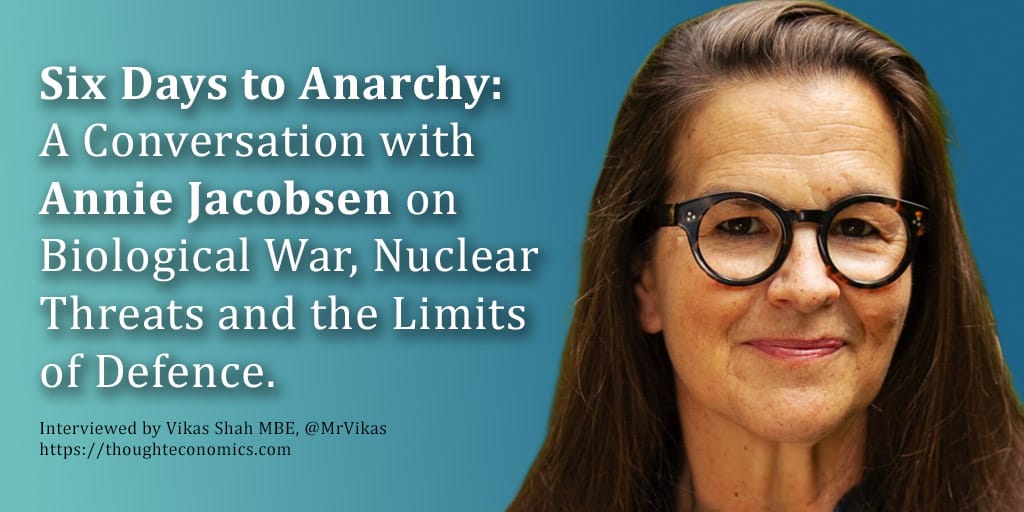
Jacobsen has written eight books on American national security, among them the New York Times bestsellers Area 51 and Operation Paperclip, and The Pentagon’s Brain, her history of DARPA, which was a finalist for the 2016 Pulitzer Prize in History. A graduate of Princeton and a former contributing editor at the Los Angeles Times Magazine, she found a far larger audience in 2024 with Nuclear War: A Scenario, a minute by minute account of a nuclear exchange that Legendary Entertainment optioned for Denis Villeneuve within weeks of publication. Biological War: A Scenario, published this summer by Torva, is its companion, and was optioned for television on the day it appeared. Eight days before we spoke she had been in Stockholm, addressing the Riksdag as a guest of Swedish Physicians Against Nuclear Weapons, SIPRI and the Alva Myrdal Centre.
The expectation you bring to a writer of worst case scenarios is a kind of fatalism, and it is wrong. What emerges in conversation with Jacobsen is the voice of an institutionalist. She wants verification mechanisms and enforcement protocols. She wants a stronger State Department and a United Nations taken seriously rather than tolerated. She argues that the great disaster of COVID was not a policy failure but the fracturing of science into factions over the question of where the virus came from, a question still unresolved. And when I asked her what gives her hope, she did not reach for a treaty or a technology. She described Ronald Reagan in 1983, who believed more nuclear weapons made America safer, watching an ABC television film called The Day After, writing in his White House journal that it had left him greatly depressed, and then picking up the telephone to Mikhail Gorbachev.
In this conversation we discuss the asymmetry between nuclear and biological weapons, the carve out in the Biological Weapons Convention that permits defensive research, why an engineered pneumonic plague is the pathogen that planners genuinely fear, the six days in which a civilisation could descend into anarchy, the collapse of public trust since COVID, the Treaty on the Prohibition of Nuclear Weapons, launch on warning, and what it would take for the world to make a change of the kind it made in the 1980s.
Q: Congratulations on the books. You have now written detailed scenarios for both nuclear and biological war. What led you to conclude that a biological catastrophe could be the more dangerous of the two, and what makes us so vulnerable to it now?
[Annie Jacobsen]: When we think about nuclear weapons, you must consider the high barrier to entry. You have to have fissile material, weapons grade uranium or plutonium. You have to have a weapons system: an ICBM, an intercontinental ballistic missile, a sub launched ballistic missile, a B-2 bomber or another nuclear capable jet fighter bomber.
You have no such barrier with biological weapons. This is a terrifying concept that most certainly should be confronted by all of us.
Q: Your book opens with an accident at a Russian facility in Siberia, which sits uncomfortably close to the truth. How does something that happens in an isolated place, far from anywhere, become a global catastrophe, and why do the first 48 hours decide it?
[Annie Jacobsen]: The scenario I write begins with a lab accident at a BSL-4 lab called Vector in Siberia, Russia. Vector was the home of the illegal Soviet biological weapons programme. The current State Department, previous State Departments and other administrations believe Russia absorbed that illegal programme and continues to work on biological weapons.
In my scenario, there is a lab accident at Vector and something gets out. Also in the scenario, there happen to be ten international sportsmen who are on a big game hunting trip in that area. They come into contact with an infected person, and boom. Within 24 hours, they are on aeroplanes that will take them to six of the seven continents.
Whenever we are considering a biological catastrophe, it is worth holding on to a very simple sequence. Outbreak. Possible epidemic. Potential pandemic. Why those scenarios escalate is precisely what we are talking about today.
The carve out that made the research legal
Q: Before plausibility, there is a prior question. There are laboratories in Britain, China, Russia and everywhere else where governments are working on civilisation ending pathogens. The question looks as though it answers itself, and then it does not. Why is that research happening at all?
[Annie Jacobsen]: Well, the short, nefarious history goes like this. Once upon a time, after the Second World War, the superpowers all pursued and developed biological weapons. We had a significant arsenal. So did Russia, and so did other countries.
But in 1972, after really understanding the existential threat that biological weapons pose to all of us, biological weapons became illegal. Some 180 nations eventually signed on to the Biological Weapons Convention treaty, known as the BWC, which makes them illegal. Everyone agreed to destroy their existing arsenals and never do biological weapons work again.
But there is a tiny carve out in the BWC that allows for defensive research. If you are pursuing a medical countermeasure, a vaccine, an antibiotic, you can engineer pathogens in a laboratory under safety conditions in the pursuit of public health. That carve out has become a very dangerous and slippery slope toward what many people believe is biological weapons engineering.
Q: Your scenario turns on an engineered pneumonic plague. What made you choose that pathogen? My own cursory reading suggested, to my surprise, that you had not reached for an exotic one at all. You had reached for the most likely one.
[Annie Jacobsen]: Unfortunately, yes. People are shocked. They think, oh my God, she chose some outlier. That is not true. Military organisations around the world have been seriously concerned about the use of plague as a biological weapon.
Not bubonic plague, which we are all familiar with in a cursory way because of the Black Death, the plague of the fourteenth century that killed one third, maybe as many as one half, of the people in Europe. Somewhere between 25 and 50 million people are understood to have died. Bubonic plague comes from the bite of a flea carrying the bacteria Yersinia pestis. But where bubonic plague becomes incredibly dangerous is when it becomes pneumonic plague. Pneumonic as in pneumonia, as in the lungs. And pneumonic plague is transmissible through contact. That is where it becomes Mother Nature’s incredible killer, and that is how the Black Death essentially worked: it was really bubonic and pneumonic plague together.
Now, what is interesting is that since the advent of antibiotics, of penicillins, people have been saved from the scourge of plague, because antibiotics kill Yersinia pestis bacteria. But here is where we get to the very nefarious dark heart of biological warfare. That is the manipulation, the engineering, of Mother Nature’s pathogens to defeat a medical countermeasure like an antibiotic. That is precisely the quality of the pathogen in the scenario I write, and it is based on science fact, not science fiction, because it is something Soviet biological weapons engineers were specifically working on. This was decades ago, in the very early days of genetic modification. What can be done now should terrify the mind.
“That carve out has become a very dangerous and slippery slope toward what many people believe is biological weapons engineering.”
Q: AI has been used to design new antibiotics and to do a great deal of good in medicine. The corollary must hold too. It raises both the ability to design these pathogens and the lethality you can design into them.
[Annie Jacobsen]: That is right. And I chose specifically not to use AI enabled biology in my scenario, because I wanted people to understand how incredibly dangerous the genetic modification of pathogens is without using AI. That is, genetically modifying something in a laboratory like Vector.
It is worth thinking about the three basic tenets of pathogens. A pathogen is either a virus or a bacteria, and both can be deadly. Three qualities make a pathogen particularly dangerous. Its virulence, meaning how many people it will kill. Its transmissibility, meaning how I can catch it. And then whether or not there is a medical countermeasure to defeat it.
Pneumonic plague is so dangerous because its case fatality rate, its virulence, is 100 per cent. And that is in Mother Nature. 100 per cent. The only other pathogen that can really kill 100 per cent of people without medical countermeasures is rabies, and that is a virus. Now, add to that the fact that pneumonic plague is contagious, and that with a few genetic tweaks it can go from being passed through spit and coughing to being passed in the air. It can become aerosolised, to be airborne. Now you have the potential for extraordinary death rates. That is precisely what happens in the scenario I write.
Q: In your scenario, agencies work out that something terrible may have happened long after the clock has run down. With nuclear weapons we at least have sophisticated detection. With this we appear to be blind. How weak is our ability to detect and contain it?
[Annie Jacobsen]: We are blind. We all learned from the COVID pandemic that diagnostics are everything, and diagnostics is a fancy word for testing. You have to be able to test someone to know how to treat them. Because pneumonic plague has such a short window, because it is so lethal so fast, by the time testing can occur and you have not been given antibiotics, you are dead. If you do not take antibiotics within 24 hours of your first symptoms, you will die.
Why the first responders die first
Q: When you wrote that civilisation could descend into anarchy in six days, I was sceptical, until I read the detail. Then I decided the case was conservative rather than alarmist. Talk us through those six days.
[Annie Jacobsen]: One of the most terrifying components of biological war, which everyone who works on dangerous pathogens knows, is that the first people to die will be the first responders. And first responders are the most critical component of stopping an outbreak. So there you have a terrifying loop: the people best equipped to help will be dead the quickest. That is why everything moves so quickly.
The second component is this. I base Biological War: A Scenario on Pentagon war games and also on pandemic planners’ gaming scenarios. One of the most common components that planners are up against is the concept of fear of infection. You see that little phrase over and over again in planning. Fear of infection. It is such a powerful concept, and we all know what it means from COVID, which had a case fatality rate of 1 per cent or less. So imagine a scenario in which you are aware that the case fatality rate is 100 per cent. The fear of infection is what makes people panic, and that is what leads very quickly to anarchy, as civilians begin to do anything they can and everything they must to keep themselves and their families safe. That includes attacking facilities where medical countermeasures like vaccines and antibiotics are stored.
This is not a figment of Annie Jacobsen’s imagination. These are existing facts in planning documents.
Q: Is there any plausible way for a government to contain such a pathogen? Reading those exercises, there seems to be no meaningful way to protect a population. What is actually being planned for is continuity of state and continuity of leadership.
[Annie Jacobsen]: In my interviews with subject matter experts, one line stands out above all the others. It comes from a former defence official, Colonel Tom Ehrhard, who worked in the Office of Net Assessment, the legendary war gaming facility inside the US Pentagon, and who worked specifically on both nuclear and biological scenarios.
He told me that, very much like nuclear war, there is no real homeland defence against a large scale biological attack, and that also includes an accident. What Ehrhard said is that there are only things you can do to mitigate extermination.
That sums it up in the most simple, practical and difficult to face way.
Q: We are in a world of fragile conflict points, with leaders who have shown they will do whatever it takes, and with highly ideological terrorist groups. How likely is your scenario, given that the nuclear route has such high barriers to entry and this one has none?
[Annie Jacobsen]: Another disturbing document that comes to mind is the Pentagon threat spectrum, which lists weapons of mass destruction on a scale. Of course, nuclear weapons are the most destructive, and so they are at the far end of the spectrum for that reason. Biological weapons are a very close second, and they are considered the greatest overall threat, for the reasons we discussed earlier and also because a biological catastrophe is the only scenario the United States would face whereby an accident gets the same response, and results in the same mayhem, as an actual attack.
If you think about nuclear weapons, you understand that the concept does not apply. God forbid there was a nuclear accident, but nations would perhaps move quickly to help one another. A lab accident is the most plausible, most terrifying scenario that confronts all of us today.
“There are only things you can do to mitigate extermination.”
The treaty that does not exist yet
Q: We did not regulate nuclear weapons until they had been used in anger, and the difference here is that the blast radius of a biological weapon is civilisational rather than geographical. Why have we not reached a meaningful treaty on this research, and what would it take?
[Annie Jacobsen]: Well said. As one State Department official said to me, it has been a cross your fingers and hope approach. One of the reasons I wrote Biological War: A Scenario was to present people with the facts, and perhaps create the idea among all of us that it is time for a treaty that has verification mechanisms, that has enforcement protocols, and most importantly has an understanding that a biological catastrophe is something that would impact all of us.
Q: COVID emerged, the Prime Minister told Britain to stay at home, and everyone did. Within weeks much of society had decided it did not believe him, and that was a virus with a low lethality rate. If a Prime Minister announced a far deadlier pathogen tomorrow, I do not think people would comply.
[Annie Jacobsen]: I could not agree with you more. I wrote Nuclear War: A Scenario to show how absolutely horrific nuclear war would be, and I wrote Biological War: A Scenario for much the same reason. One of the reasons the books have been so well received, not just in the United States but around the world, is that people are aware of their capacity as a cautionary tale. Everyone knows how we all behaved in COVID, which you just described very well. So now you must really pause and think: wait a minute, what is the best way forward?
Q: Would civil society be resilient enough to listen, without Homeland Security getting involved in our respective countries?
[Annie Jacobsen]: Well, that is exactly it. You could say we shall see, but that is far too dangerous a statement.
Q: This is the thing I cannot get past. It is invisible until you catch it. Somebody could drop a vial the size of an AirPod case at an airport and, six days later, civilisation is over. How do we make people aware of that without frightening them to death?
[Annie Jacobsen]: The best way for me to answer that is through the three things I would change in how humanity approaches existential threats, because that is what you are talking about. To me this is very clear.
It begins with knowledge, and I would hope that my book adds to the knowledge base. What follows next is empowerment. People get to realise that these are man-made problems. This is not an asteroid strike, about which there would be nothing we could do. Nuclear war, biological war: man-made problems. Nuclear weapons, biological weapons: man-made problems, therefore man-made solutions.
The third component would be the realisation, after you have the knowledge and you understand the capacity for empowerment, that there is a need for diplomacy. I mean that both in a political sense, in a world sense, and I also mean it individually. That means communication. You have to have a little more respect for people with different ideas than you.
One of the great disasters of COVID was the fracturing of science over the debate between whether it was a lab leak or of natural origins, a story that has yet to be resolved. But to vilify someone with a different set of ideas only creates more problems in a world in which existential problems are bigger than all of the small infighting. So diplomacy is an individual responsibility, and it is also the responsibility of our elected leaders. I believe there should be a strengthening of the State Department, of diplomacy. The United Nations, to my eye, is an incredible organisation and should be looked upon that way. And finally, if we are specifically talking about bio, America must re-enter the WHO, the World Health Organisation, and be an equal partner in those kinds of organisations, that kind of diplomacy and communication, so that we can move forward and not backwards.
Sweden, neutrality and the limits of a militaristic answer
Q: Use cases is an awful phrase, but it is the right one here. Policy professionals increasingly think that a marauding Russia is likelier to reach for a biological weapon nobody can trace than for an ICBM. Is that where State Department thinking has landed?
[Annie Jacobsen]: I like that you began with use case, because I am going to give you a use case example that answers what you just said.
I have just returned from Sweden, where I spoke to the Swedish parliament as a guest of Swedish Physicians Against Nuclear Weapons, a 50-year-old organisation that has won two Nobel Peace Prizes. The reason they had me in Sweden was that Sweden, a new NATO member, has now switched its position, because of a marauding Putin, because of a threat in its own backyard. That long-standing position, going back to before the First World War, was one of neutrality, of being diplomats, the North Star of that concept. Sweden has now joined NATO and is making a move toward a more militaristic approach to security, including potentially hosting French nuclear weapons on Swedish soil.
I was asked to give a condensed version of Nuclear War: A Scenario, to raise a question among the people who make policy: is an aggressive militaristic approach the best approach, or is diplomacy? I do not have that answer, but I am delighted to be part of that conversation.
Q: It would be remiss not to turn to nuclear weapons, and there are very few occasions in life when I get to say that sentence. Even the soberest foreign policy writers no longer exclude a weapon being used in anger this decade. What are you hearing about the likelihood?
[Annie Jacobsen]: Right now we are in no treaties regarding nuclear, with the exception of the original NPT from 1968. Treaties essentially put guardrails on people, both in their behaviour and in their thinking.
There is a treaty on the books right now at the United Nations called the TPNW, the Treaty on the Prohibition of Nuclear Weapons. While a lot of the details of it are difficult, including Global Zero, which most nuclear weapon states will never adhere to, what is interesting to me about the concept of a treaty is disarmament, meaning a reduction in weapons and a reduction in aggression. The reason I bring up the TPNW is that it has a profoundly important narrative concept to it, which I was not familiar with until I met these colleagues at the United Nations. It goes like this. You cannot make nuclear threats.
What a brilliant concept. Nuclear threats are incredibly dangerous. One of the reasons I began my book in the first place goes all the way back to the first Trump administration. I have now written eight books on national security, and I have studied every president, every POTUS, President of the United States, through an executive power lens. I do not write about politics. When a US president, President Trump in his first administration, was making nuclear threats with another nuclear armed nation, the Supreme Leader of North Korea, I myself was shocked. I had never heard such rhetoric, let alone from a US president. That led to the question: what if deterrence failed? That is why I wrote Nuclear War: A Scenario, and that is how I got so many defence officials and high ranking former presidential advisors to speak with me about it, because they too were extremely concerned about nuclear threats.
Nuclear threats are incredibly dangerous. Since the invasion of Ukraine, we have heard Mr Putin and his advisors repeatedly make nuclear threats. They are not veiled. They are talking about nuclear threats, about tactical weapons on the battlefield. Most recently, since the United States attacked Iran and started a war there, we have heard the President of the United States make the most thinly veiled nuclear threat, which can almost not even be considered veiled at all. It was very clear to many people in the United States that he was threatening nuclear use when he spoke about ending a civilisation. That should be prohibited.
[Editor’s note]: Annie asked during our conversation that the exact wording be supplied here. On 7 April 2026, as a deadline over the Strait of Hormuz expired, President Trump posted that “a whole civilization will die tonight, never to be brought back again” if Iran did not agree a deal. The remark drew international condemnation, including from the Prime Minister of the United Kingdom and from Amnesty International. On 23 April the President told reporters he would not use a nuclear weapon against Iran.
No such thing as a limited nuclear war
Q: Friends of mine have walked around Hiroshima, which is curious when you consider that the weapon dropped there was the crudest ever used, and that a modern warhead is hundreds of times more powerful and would leave the ground uninhabitable for thousands of years. Does civil society understand that?
[Annie Jacobsen]: One of the things I make clear in Nuclear War: A Scenario is that there is no such thing as a limited nuclear war. If the United States and Russia are involved in a nuclear exchange, no matter how it begins, whether NATO is involved or not involved, whether China is involved or not involved, no matter how it begins, it ends in nuclear Armageddon. Every person in the nuclear command and control chain knows that.
Q: This will sound an odd question. Pragmatically, the surest way to prevent Armageddon is not to answer the first bomb, and yet I cannot imagine Russia putting a nuclear weapon into a European or American city without a response. Will that chain always pull the trigger?
[Annie Jacobsen]: What I can tell you is this. If the United States is attacked with a nuclear weapon, it will respond with nuclear force. It does not wait. We have a policy called launch on warning. We do not wait to absorb a nuclear blow. We launch once we are warned of an attack. The room for misunderstanding and miscalculation in that kind of apparatus is extraordinary. And I take readers through Nuclear War: A Scenario, not nuclear war the only scenario. But it becomes obvious after you read the book: no matter how nuclear war begins, it ends only one way, and that is in total Armageddon.
Q: This is where AI worries me. Three or four years ago no terrorist organisation could have built a signalling infrastructure convincing enough to trigger that response, because we would have known it was not real. I am no longer convinced of that.
[Annie Jacobsen]: The world is at a moment of extreme risk, and weapons of mass destruction threaten all of us. Nuclear weapons, biological weapons and artificial intelligence sit at the top of the threat spectrum for the possibility of creating a near extinction level event. Sometimes the points of inflexion like the one we are at now, these points of extreme risk, are the perfect opportunity to make a change.
Q: We have talked about the extinction of civilisation, from biologics to warheads, and yet when I read your books and hear you speak, you remain hopeful. What gives you that hope?
[Annie Jacobsen]: Man-made problems, man-made solutions. I will give you a quick example.
In 1983, Ronald Reagan believed more nuclear weapons made the United States more safe. And then he watched an ABC TV movie called The Day After, which imagined a nuclear war between Russia and the United States. I really believe in the power of narrative storytelling. It is why I write my books. Ronald Reagan, after he watched that movie, became greatly depressed. He wrote that in his White House journal. As a result, he picked up the phone and spoke to Mikhail Gorbachev. Because of their conversations, because of the understanding of the threat, the world went from 70,000 nuclear warheads at the all-time high in 1986 to the approximately 12,300 today.
It did not happen in a vacuum. People were absolutely terrified of nuclear war in the 1980s. They were protesting in Central Park, in Hyde Park. Together, the world made a change. That should stand as a perfect analogy of what needs to be done now.
“Man-made problems, man-made solutions.”
————————
Biological War: A Scenario by Annie Jacobsen is published in the United Kingdom by Torva. Her earlier book Nuclear War: A Scenario is also available.