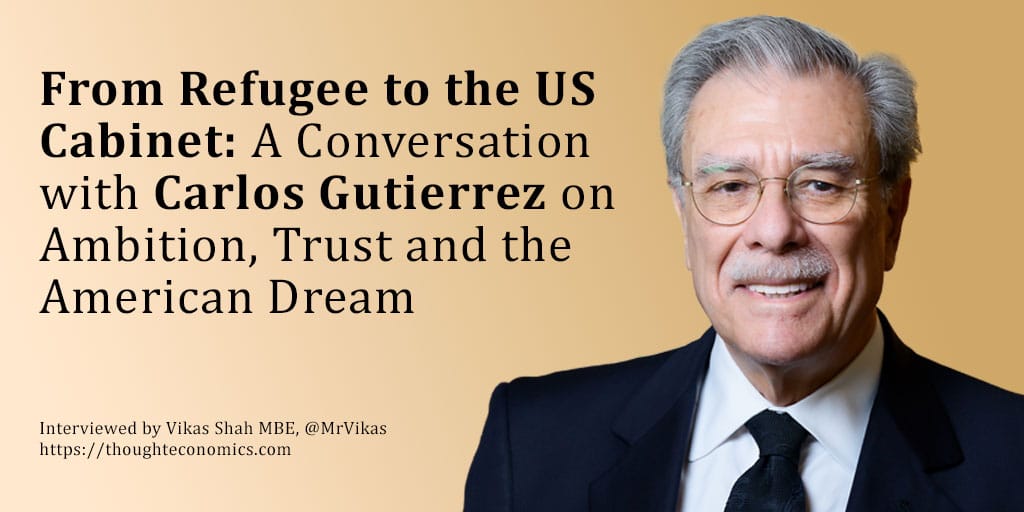
The van had a rooster painted down one side. Carlos Gutierrez was twenty-two, had no degree, and had recently joined the Mexican subsidiary of Kellogg’s as a sales representative and management trainee. His round was the corner shops of Mexico City, boxes of Corn Flakes sold one order at a time, with the back seat of the company car pressed into service as a filing cabinet. Twenty-four years later he was running the company. Six years after that he was sworn in as US Secretary of Commerce.
He was six years old when his family fled the Cuban revolution in 1960, leaving his father’s pineapple plantation behind and arriving in Miami with almost nothing. He learned his first words of English from the bellhop at the hotel where they stayed. The family later moved to Mexico, where his father took a job with Heinz. Gutierrez studied business administration at the Monterrey Institute of Technology in Querétaro but never took a degree, making him the most recent member of a US Cabinet without one. He joined Kellogg’s in 1975, was appointed president and chief executive in April 1999 as the youngest CEO in the company’s hundred-year history, and served under George W. Bush from 2005 to 2009, co-chairing the Commission for Assistance to a Free Cuba and working on the administration’s attempt at comprehensive immigration reform. He went on to serve as vice chairman of Citigroup and chair of the Albright Stonebridge Group, and is co-founder and executive chairman of EmPath, the machine-learning company he describes in this conversation. He sits on the boards of MetLife, Occidental Petroleum and Exelon, and on the advisory councils of the George W. Bush Institute, the Tent Partnership for Refugees and TheDream.US. He is a regular commentator on CNBC.
It is, on the face of it, the American dream in its purest form, an arc almost too neat to be true. What makes his memoir, [[Sheer Will: Learning to Lead When There Is No Path|https://www.amazon.co.uk/dp/1250381169?tag=thoughteconom-21]], unusual is that it is not really a book about arriving. It is a book about the improbability of the journey, the doubts along the way, and the things that were sacrificed to make it happen. Gutierrez was not diagnosed with ADHD until he was sixty-five, and the book is candid about both what the condition cost him and what it gave him: hyperfocus, interpersonal intuition, a high tolerance for risk.
What is striking in conversation is how little triumphalism there is in it. Gutierrez is a lifelong Republican who served in a Republican Cabinet and remains a committed defender of free trade, and he says without hesitation that Donald Trump saw something real in the towns globalisation hollowed out, something he and his colleagues had missed because they were reading national statistics rather than local ones. He is also the man who founded Republicans for Immigration Reform, and who asks here, plainly, how he could be against immigration when he arrived as a refugee. The thread running through all of it is trust: what it takes to earn it on a factory floor, how politicians squander it by promising to keep open plants that cannot survive, and why he thinks it is the one thing a leader cannot hand over to a machine. In this conversation, we spoke about whether his journey would still be possible today, the price ambition extracts, what a late diagnosis explained and what it did not, how trust is built and lost, what globalisation’s defenders failed to see, and why leadership matters more in an age of technology, not less.
Q: If I look at your life journey, arriving as a child refugee from Cuba, becoming the CEO of Kellogg, and then a member of the US Cabinet, it is such an arc of that classic American dream. Do you think that if you’d arrived in the US today as that same child, that same dream and those same opportunities would still exist?
[Carlos Gutierrez] It’s a great question, and I think it does still exist, because the culture of the country hasn’t changed. The specific circumstances might be harder to repeat. Somebody arriving from Cuba and starting out in Mexico as a salesperson, that’s a particular set of accidents. But the idea that someone can come to this country without a college degree and somehow work his or her way up the corporate ladder, or any other ladder, is still valid.
One of the things about this country that I think is very advantageous is that people here are constantly looking for talent. Whether it’s sports or business or politics, people like to spot new talent, and that’s simply part of the culture. There is no jealousy of success. So yes, I would think that maybe not in the same circumstances, but it would happen again.
Q: You talk about ambition as not just wanting success, but as a relentless refusal to be average or inconsequential. I like that idea, because it resonates with a lot of people, but it also highlights the point at which ambition stops being a virtue and starts taking from our families, our health, or the people around us. How have you balanced ambition against it taking too much from your life?
[Carlos Gutierrez] That’s something I would have to start over again to really fix. And I need to be very upfront here: I did sacrifice everything else. In my mind, it’s part of the price you pay. But there’s no question, I spent so much time on a plane, so much time at the office, that work became my number one priority.
The way I rationalised it was to say, look, this is good for the family. If I succeed, it’s good for the family, so therefore what I’m doing is for the family. So I’m probably the worst person to ask about work-life balance. Nobody talked about it back then, and in any case it is anathema to the hyperfocus that comes with ADHD. I tried, but my priority was always, always the career.
And it could be a bit of a problem now, as I look back. They say some people find their self-esteem in different places. I found my self-esteem in work. I wasn’t lucky enough to be able to say I’m going to find my self-esteem in family and just be a family person.
Q: Where did you find your resilience? Any one of the roles you’ve held sits very much at the top of what most people could take from a stress and endurance perspective, and so many Thought Economics readers are C-suite executives and founders in that same world. How did you cope with the consequential nature, and the stresses, of the roles you’ve had?
[Carlos Gutierrez] There’s a sense I picked up from the Cuba experience that if you’re not struggling, you’re not really working, you’re not really doing what you’re supposed to be doing. Life is a struggle. Don’t be surprised. It’s never going to be easy. So I think mentally I was a bit prepared for that.
The other things I did to try to ease the tension: I smoked, and I drank a lot of coffee. From the very first moment of the day, I knew that I had to do something to stay focused.
Q: You’ve spoken about being diagnosed with ADHD at sixty-five, and I had my own diagnosis last year, so I’m a fellow traveller. What aspects of it do you think really helped you, would anything have changed had the diagnosis come sooner, and do you think organisations really understand unconventional talent and neurodiversity?
[Carlos Gutierrez] I think that’s a great question, and no, I don’t think they do. I believe the first things an organisation sees are the downsides, the negative symptoms. The disorganisation, the procrastination, the difficulty staying focused on one thing. It would be very difficult.
One of the things that can be done is skills. Before I started writing the book, I had a startup that used machine learning to identify the skills that every employee in an organisation has. Most people think they have two or three skills. People actually have anywhere from fifteen, twenty, twenty-five. So that would surface some of the skills that come from ADHD, interpersonal intuition, for instance, which I think is extremely important, and which I would attribute directly to ADHD. Hyperfocus is another that I’m sure would surface in one of those assessments.
But aside from that, my concern is that, no. These people, we all get lost. We get lost inside an organisation. Nobody really pays attention, and when they do, they conclude, well, that’s the disorganised individual. You don’t get that chance to break away. I’m just very lucky that I did, and that people seem to have overlooked my deficiencies. As someone with ADHD, I feel very fortunate.
Q: My own experience has been that the ADHD traits give you hyperfocus, and that lets you distil and digest really complex information very effectively. I wonder whether that’s also been part of your success, because acknowledging the benefits of the diagnosis feels really important too.
[Carlos Gutierrez] Yes, absolutely. Hyperfocus, for me, is so strong and so intense that the odds of being successful in that specific task go up substantially, because you’re thinking about it twenty-four hours a day. Most people don’t do that. So I found that to be an incredible advantage.
Now, the downside is that everything else falls by the wayside. My office was a mess because I was focused on one thing, and my record-keeping as a salesman on the road was chaotic. I used the back seat of the company car as an ad hoc filing cabinet. So yes, they all have problems attached to them. But it is a tremendous, tremendous advantage.
Q: I got a real sense from your book that your leadership philosophy is deeply anchored in trust. You describe showing workers charts and data, and realising that none of it accomplishes anything until they believe you respect them. Looking at organisations today, it feels as if we’ve won the ability to measure things and lost the ability to lead people as people. How do you gain trust and really lead?
[Carlos Gutierrez] I think that’s the hardest thing to do. Trust and leadership go hand in hand. People have to trust their leader.
That first meeting on the shop floor was a resounding dud. I showed them charts documenting how poorly that plant was performing compared to Kellogg’s other plants around the world, and when I opened the floor for questions, nobody said a word. Most of them simply looked puzzled. I think they assumed I was blaming them, when in fact I knew management deserved most of the blame. So I went back, a number of times, and I didn’t bring any charts and didn’t talk about numbers. I worked instead to gain their trust.
What we did in that specific circumstance in Mexico was to show the workers that they would get a benefit from their own work. Profit sharing. We increased salaries. That was very important, because they realised: I am getting part of the benefit of what I’m working for. That was probably the most effective part of gaining trust.
But it’s also this. Do people trust that you will make the right decision for the company when the moment comes? Not the right decision for you, but the right decision for the company. It’s trust that you believe in something bigger than yourself, that you believe in the people you work with, and that you have their best interests at heart. I think that’s trust. And once you get it, it’s an amazing thing to have. But you can lose it very easily.
Q: How can governments approach this? In the UK we have a breakdown of trust within society, and also between society and business. People see businesses as great big tax-avoiding ogres. But if we want society to function and grow, we need trust, we need social cohesion, we need people to trust immigrant populations. How can governments support the building of trust, and why does it matter for growth?
[Carlos Gutierrez] I think the hardest place to gain trust is in politics. In business, I can see how you can do it through the organisation, the things I was saying, that you make the right decisions for the company, that you make sure people get the benefit of their work.
But politics is a discipline of its own, and I learned this when I was in Washington. It is very much about how you get ahead. How does the politician get ahead? The whole system is built around that question, and that means sometimes swerving, changing your position, saying one thing and doing the other, because it is a game of holding on to your job. In business, if you want to hold on to your job, you have results. You have the numbers that show that you should keep it. Politics is a bit different. It’s going to be very hard.
Q: Does that extend to globalisation, one of the biggest enabling factors of global growth over the past half century? In your book you remain a passionate defender of globalisation and free trade, but note that political leaders did too little for the communities that suffered its consequences. Is that also part of the breakdown of trust, what was the political mistake, and can we put it right?
[Carlos Gutierrez] I think what happened is very interesting, because I used to quote the national numbers. We would say, look, globalisation is working, look at our GDP, our inflation is low, our unemployment is low, so the economy is strong. But what we didn’t pay a lot of attention to, what I didn’t pay a lot of attention to, was the local towns where a plant would close because of globalisation and people would be out of a job. That impact doesn’t hit the national numbers. It isn’t big enough to make an impact nationally, but it’s more than big enough for the impact on those people.
Donald Trump saw that. He saw that need. He saw that people were suffering because of globalisation, and he exploited that. It was always there. It was always there to be exploited. And it begs the question: what else is out there that could be exploited through politics? But that was one.
So I think in the future we have to do something to help these people. We have programmes, but they don’t really work. They’re not executed correctly. Trade Adjustment Assistance was set up in 1962 to help communities affected by changes in trade, and the certification required to qualify was slow and onerous, the retraining was ineffective, and workers were kept out of the workforce for so long that re-entry became harder, especially for older ones. It was classic Washington: lawmakers passed a bill so they’d have a positive talking point, and then put no effort into its execution.
And that’s where I say, you know, that it comes back to politicians and trust. When politicians say, we are going to keep your factory open, knowing that there’s no way that factory can compete in a globalised world, that also works against trust. What they should say is: you’re going to lose your job because of what is happening around the world, and we have to retrain you. Nobody says that.
Q: It’s been the same here. Manchester de-industrialised extremely rapidly and left a void for communities, and there was never that discussion about the inevitability of it. Here’s what’s happening, and here’s what we’re going to do. Instead we bail out steel plants.
[Carlos Gutierrez] By the way, our plant was in Manchester, the Kellogg plant. It’s a big plant in Manchester, and it’s been there since the 1930s.
And it’s interesting: textiles went from Manchester to New England, Boston, Massachusetts, Rhode Island, and then eventually moved south to the Carolinas, and then eventually to Vietnam and Central America. Some textiles are still in South Carolina; some mills are still there. Politicians would say, we are not going to let that plant close. We will take care of your mill. We will protect your mill. There’s no way that they can deliver on that. And then workers have this false sense of comfort that someone is looking after them.
[Editor’s note: Kellogg’s Manchester plant, at Trafford Park, opened in May 1938 and was the company’s first manufacturing base in Britain. In February 2024 its owner, Kellanova, proposed closing the site; the closure was confirmed in May that year and is due to complete by the end of 2026, with the loss of around 360 jobs. The company cited the plant’s 1930s six-storey layout and the unviable cost of modernising it.]
Q: I wonder whether that has also been one of the real anchors of the immigration debate, because so much of the time, those same politicians say you’re losing your job because of this, and that’s why we’re going to protect you by cracking down on immigration. There are legitimate concerns about pressure on services, but by most measures immigration is a net good for economic growth. How would you make the case to a society that holds both of those things at once?
[Carlos Gutierrez] An economy grows as a function of productivity and the number of workers. The number of workers, and how productive they are. Our working-age population is growing at maybe half a per cent. In order to grow our economy, we need to be growing our working-age population a lot more than that. We cannot grow through productivity alone. The numbers will not work, not even in the age of AI. So in order for us to be prosperous, we need immigrants to come in and help.
That’s nothing new. That’s what this country is all about. And it’s very interesting: we have the debate about immigration, we talk about it, and then we don’t talk about the fact that forty or fifty per cent of the best CEOs in Silicon Valley are immigrants. It is everywhere in our society, and it’s part of the beauty of this society. How can I be against immigration when I came to this country as a refugee?
So I worry that we are taking away something that has made this country so unique and special, which is immigration, that people come and pursue the American dream as entrepreneurs and pioneers. It’s the history of this country. We talk about competing with China a lot. The Chinese model is exactly the opposite. It’s centralised. There is no immigration. It’s all Chinese. Well, we are just the opposite, but we need to double down on what we do well. And what we’re doing today is that we’re not adopting the China model, but we’re sort of dismissing our own, or leaving it behind.
Q: At the beginning of your book you write that AI can do many things, but won’t replace the human drive to overcome challenges. Are you bullish or bearish on AI’s impact, and how do you think it will change society?
[Carlos Gutierrez] I am an optimist about AI. I think we’re in a wonderful new era. I wish I were twenty-five again. I think technology will create jobs. We talk about the jobs that will be lost, but the new jobs that will be created through the innovation that AI brings are just, well, it’s hard to imagine them today.
AI has changed what we consider to be intelligent. I remember when I was in the corporate world, intelligent was someone who had what we called the steel-trap mind. They could remember eight things coming out of a meeting and nothing would fall by the wayside. Today, if you want the eight things, you can ask ChatGPT. Memory is not necessarily a skill that people will pay for. So it’s about critical thinking, creative thinking, using all this data and actually being able to analyse it in a critical fashion.
The problem with that is that I’m beginning to see AI can also do that. I have had some wonderful debates with ChatGPT where the AI is just not in agreement with what I want to do. And we sit there and we argue. That is very telling, because that is not just spewing out the facts.
Leadership, though. I have not seen AI be able to connect with people, motivate them, have empathy. Those are the things that I think humans bring to the party, and I have not heard or seen that AI can do them. So leadership, ironically, in an era where everything is technology, is more important than ever.
Q: As a roundup, I want to talk about legacy. We can all read your memoir and take different things from it, and different parts of your journey will resonate with different people. But as you were writing the story of your journey, what do you really hope people take from it?
[Carlos Gutierrez] I hope they have a sense of who I am. It’s not a typical memoir, in the sense that it’s not just about successes. It’s not just about things that I did and how powerful I ended up being. It’s more about how unlikely the journey was.
There is a point in everyone’s journey when you feel: am I up to this? And the good thing is to answer that with a firm yes and to keep trying, and keep trying. But I don’t think there is anyone who has made it up the ladder, or made it in business or in their field, without doubting whether they were doing the right thing at one point. I hope that comes across, the humanity. I was just another person who got thrown into this, and I was very fortunate, but that doesn’t mean I had the skill of having the confidence that I could do it a hundred per cent of the time.
I think that’s very important. I think everyone has that. Humility is important. Vulnerability is important. And I hope that comes across. Also a little bit of humour, because you can’t go through life with ADHD without having a bit of humour in the book. But that’s what I would like. And I would like my family to read it and say, okay, I understand him a little bit better now.
Q: I think that comes across in abundance. I have the great privilege of speaking with leaders like yourself who’ve achieved all these things, and I get sent the bio in advance, and it’s so intimidating. He’s done this and this and this. What your memoir does really well is say: look, that’s the bio, and if you were a betting man, that would not have been the bio for that child. But here’s what happened.
[Carlos Gutierrez] That’s right. And in any career, there are moments when it could have gone both ways, where at that moment you could have lost it, or you made a decision, or something happened, or someone saved you, and you were able to move on. Every career, I believe, has those inflexion points where it could go one way or the other. I was fortunate that many of those went my way. They don’t always.
I mentioned luck. I think the thing about luck is that you have to have the skill to recognise it. That’s all. Because we all have fortunate circumstances in front of us, but sometimes we don’t see them. We don’t recognise that luck has come our way.
—–
Sheer Will: Learning to Lead When There Is No Path by Carlos Gutierrez is published by St. Martin’s Press on 6 October 2026, with the UK edition available from Amazon.