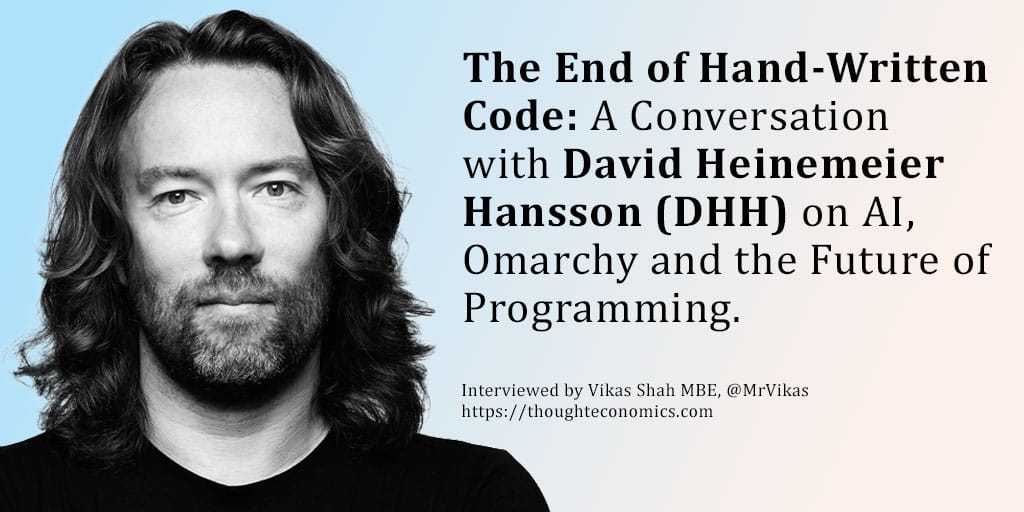
On 23 September 2026, David Heinemeier Hansson walked on stage at Rails World in Austin and told an audience of software developers about his great-great-grandfather. Laurits Tuxen was a Danish court painter whose group portrait of Christian IX and his family took the best part of three years to complete. Then the Kodak Brownie put a camera within reach of ordinary families, and the painted portrait became a luxury. Programmers, he told the room, are now standing where Tuxen stood. The billing for the talk was blunter still: his company, 37signals, has gone “pencils down” on hand-written code.
Heinemeier Hansson is one of the most influential figures in modern software. In 2003 he created Ruby on Rails, a free toolkit for building web applications, and by his own count the companies that started on it, among them Shopify, GitHub, Airbnb and Coinbase, are now worth more than half a trillion dollars combined. He co-owns 37signals, maker of the project-management software Basecamp, with Jason Fried, and together they have written four books on running a company differently, including Rework, which has sold more than a million copies, Remote and It Doesn’t Have to Be Crazy at Work. He has raced at the 24 Hours of Le Mans 13 times, winning his class with Aston Martin in 2014, and he has sat on Shopify’s board since November 2024. His newest project is Omarchy, a free alternative to Windows and macOS built on Linux and designed from the start to be run with the help of AI agents. Its fourth version, Quattro, shipped in August 2026 and was downloaded more than 200,000 times in 18 days. The foundation he set up to fund it had drawn pledges of $21.7 million by late September, from backers including Shopify’s chief executive Tobi Lütke, Stripe’s Patrick Collison, Michael Dell and Jack Dorsey.
A little over a year before that keynote, he was on the other side of the argument. In the summer of 2025 he told the podcaster Lex Fridman that he did not let AI write his code, and that programmers learn with their fingers. What changed his mind, he has said since, was the arrival late in 2025 of AI agents, systems such as Anthropic’s Claude Opus 4.5 that can write, test and repair software with little human direction. By the time he returned to Fridman’s podcast in August 2026, he had released a new version of an operating system without writing any of it himself.
For two decades he was among the most prominent defenders of programming as a craft, so you might expect him to mourn it. He does not. His argument is about power. Programmers, he says, became a priesthood that everyone else had to go through to get anything out of a computer, and AI has ended that monopoly much as the Reformation ended the clergy’s. That is a claim about expertise in general, and he applies it well beyond his own trade. He thinks the same systems are, if anything, better at legal work than at programming; that companies selling expensive software subscriptions, Salesforce and SAP among them, are “in serious trouble”; and that the real question facing societies is what people do when machines can do most of the work. It is a far more cheerful reading of the technology than the ones Jaron Lanier or the contributors to our conversation on AI safety have offered in these pages, and it comes from a man who concedes that his own hand-coding skills have lost their economic value.
In this conversation, we discuss whether AI is making people more capable or more dependent, why he sees programmers as a priesthood whose time is up, how good AI has become at writing software, which software businesses can still defend their position, the thinking behind Omarchy, and what is left of programming as a craft.
Q: I listened to your conversation with the podcaster Lex Fridman on the future of software, and it really made me want to reach out. For a lot of your career, you have argued that technology should make people more capable rather than more dependent. Do you think AI is doing that? Or is the counterfactual true, and we are in danger of outsourcing too much of our thinking?
[David Heinemeier Hansson]: I think AI is making people vastly, shockingly more capable, more productive and more independent, because now there is virtually no idea that they cannot put into software. There’s no subscription, no paid app, nothing that cannot be turned into a bespoke version for that individual. As for the outsourcing of thinking, I think we have basically 2,500 years of history of people worrying about that. First it was papyrus that was going to distract people. Then it was novels, then it was bicycles, then it was rock ‘n’ roll music, Dungeons & Dragons, Doom, the whole lot of it. And every single time, people have essentially been wrong.
That’s not to say that folks won’t find a way to waste time with AI. I’m sure there are even more addictive forms of Reels and TikTok that you can come up with if everything is being generated for you. But what I see is actually the opposite. I see an absolute explosion in personal creativity from the fact that people with good ideas, but not all the skill or the time to see them through, can now bring those ideas to life. So I think this is quite likely going to have the opposite effect: folks who would have spent more time on YouTube or TikTok or wherever will trade some of that passive consumption time for creative, productive time.
Programmers as a priesthood
Q: Does this also get us towards fulfilling what was, and I hate this awful management word, the North Star of open source, the movement built on software whose code anyone is free to read and change? That original movement was there to say that you should be able to modify the software you use and theoretically change it however you want. Are we at a stage now where that’s true? I saw recently that somebody had released their own version of Photoshop, built entirely by AI agents, and I thought, this is so much better.
[David Heinemeier Hansson]: I think that’s exactly right. And this is why it’s curious to me that there’s such a large number of people in the open source community who look at AI with such scepticism, because I find it a bit hypocritical. The whole premise of open source was that we would be in control of our software. Now, I think the problem is that folks who have developed deep skills in the production of software liked the idea that they were this special clerical class, the only ones mediating access to the computer. And now suddenly you’ve got Agent Luther here, disintermediating everyone and providing a direct connection to the machine. Once that direct connection is established, everyone is suddenly capable of reviewing code, changing code and making their own code, and therefore maybe their gatekeeping nonsense is no longer necessary.
That’s the negative version of it. The positive version is that there’s a loss of identity here for an entire class of developers who saw themselves as particularly gifted in this regard, and they were, and they were very highly paid to be able to do the tricks with the computer. Now those tricks have been widely distributed, and they are a little unsure what their place in the future is going to be, which I completely understand. We’ve gone through that many times in history, too: the Industrial Revolution, ATMs.
I just gave a keynote at Rails World last week where I used the parallel of painters who were doing portraits, and then, at the advent of the camera, that was suddenly a different thing. I think the camera is actually a good example here because, just like with software, if you wanted to have your portrait taken in the 1800s, you had to pay a master painter to do it over the course of three months. Who could afford that? Royals, aristocrats and basically no one else. What’s happened now is that we went from maybe tens of such portraits made every month to two trillion images snapped every year, primarily with smartphones. That means everyone suddenly has the capacity to capture a portrait and therefore create a memory.
Now, is the world better off because we went through that? I think hugely so. Was it better off for the people who trained to be really good at photorealistic portraits? Maybe not. Many of them pivoted and became Impressionists and other forms of artists. But that specific skill stopped having economic value in the same way, and I think the same thing is true of software development. We’re now all going to be able to create our own software. The mechanical notion of taking some requirements and turning them into code is not going to have economic value going forward.
[Editor’s note]: “Agent Luther” is David’s reference to Martin Luther, whose challenge to the Catholic Church in the 16th century rested partly on the idea that believers could read scripture for themselves rather than through the clergy. Here, AI agents play Luther, and programmers are the clergy.
Why AI now writes better code than almost any programmer
Q: In your own career, you created Ruby on Rails more than 20 years ago, and you’ve had an incredible career in software and computing. I built a software company in the 1990s, and when I look at colleagues from then, they are still extremely reluctant to accept that agentic coding, where AI agents write the software, is at the quality of human code: there are all these problems, and you shouldn’t touch it. Without blowing smoke, you are one of the foremost programmers in the world. How capable is agentic coding now, in your view? And what was it that made you change your mind about the primacy of the human vis-à-vis code and execution?
[David Heinemeier Hansson]: The frontier models, especially when you run them in collaboration with each other, are better than virtually every programmer on Earth at a broad set of programming skills. They certainly know more, and are capable of doing more in a broad set of domains, than any single programmer is capable of doing. There are still some niche fields, in my opinion, where humans can beat the agents, but it’s very small, and in most cases that’s not what most programmers are doing. Most programmers work on fairly rudimentary systems called CRUD systems: create, read, update and delete. That is basically 97 per cent of applications in the world. There’s some sort of database. This is what information technology is all about.
The agents are vastly, shockingly better, faster, more efficient, more diligent and more detailed in their creation of systems. If you don’t believe that, you simply haven’t spent enough time working with these systems directly, or your information is simply out of date. This is part of the problem right now: this moves very quickly. What I’m saying now, I would not have said in February. The change has really gone vertical, in my opinion, in the last three, maybe four months. Since we got Fable, we’re on a different trajectory. And now we’ve got Astra, and then we just got Opus 5.5 this week. I am unable to find things that these models can’t do, and I’m continuously impressed by the fact that they do almost everything better than I do.
So I have complete humility in the face of the fact that my programming skills, as they were, are no longer economically viable as independent leverage for creating things. Because everything I could create, they can create. And they can do it much faster and, in many, many cases, much better.
[Editor’s note]: Fable, Astra and Opus are leading AI models. Anthropic released Claude Fable 5 in June 2026 and Claude Opus 5.5 on 22 September 2026; OpenAI released GPT-6 Astra on 3 September 2026. This conversation was recorded on 28 September 2026.
Q: So where’s the value now? I’ll give you an example. Where I work, there’s a whole bunch of startups, and every now and again they pitch me for money. One of the things I find now is that I look at most of the startups I meet and I don’t see the business case anymore, because I could spin this up in about half an hour with Fable, Anthropic’s AI model. So I wonder, where are the economics in software businesses now? It seems very unusual that you would be able to create a piece of software with enough unique value that someone with reasonable skill couldn’t replicate it themselves in a day.
[David Heinemeier Hansson]: I think that’s broadly true when you look at purely client-side applications. I would hate to be in Adobe’s shoes right now. I think Photoshop, Lightroom, Illustrator, Premiere, all of these applications are going to have a million very good open source alternatives that have been vibe coded. So that end of the business, I think, is already gone. We’re just living on borrowed time.
At the other end of the business, you have things like client-server applications that need continuously running machines and databases and backups and the rest of that. I don’t see it there yet. It may very well come, but I have found that people are very uninterested in running their own infrastructure. They don’t actually want to run servers. Maybe that will change once they start trusting their agents enough to do that. It hasn’t changed yet.
Then you have areas of software that are integrated with bits of plumbing, and then it’s a completely different game. I’m on the board of Shopify. Shopify has an incredibly deep moat into payment systems, shipping systems, tax systems. There’s an enormous amount of complexity that companies like that have been able to absorb and offer at such a reasonable price that it barely seems worth the tokens to try to replicate it.
That’s the other factor here. Even if you can remake it, are you going to find that to be worth your time? At this moment, even though you can replicate almost every piece of software, it’ll still take your taste, your diligence, your insight and your attention not just to create it, but to maintain it and move it forward. So I think that’s the other barrier that might push back a little on the idea that every piece of software we’re going to run is going to be bespoke.
I also don’t want to make predictions about the future, because the predictions I made last year look terrible compared with where we are today. If these models, for example, get 1,000 times faster than they are today, which I think is completely plausible over the next few years, that means everything is instant. I could have Photoshop with a snap of the fingers, and literally five seconds later that program is booting. Then I think all bets are off.
Because the other thing, of course, is that as good as these models are at creating software, they’re just as good at everything else. They are, in fact, in my opinion and experience, even better lawyers than they are software programmers. Their ability to write great contracts in no time at all, and to catch things in contracts in no time at all, is truly astounding. So we’re looking at an intelligence explosion. In my opinion, we are absolutely at AGI. That discussion was something for the spring. Now we are looking at pockets of ASI, artificial superintelligence. That is absolutely true in slices of software development already, where it’s able to do things in a time that even the very, very best programmers in the world could never compete with. We’ve had a Kasparov moment, and AlphaGo has beaten the chess master.
[Editor’s note]: “Vibe coding” means building software by describing what you want to an AI in everyday language rather than writing the code yourself. Artificial general intelligence, or AGI, usually refers to AI that can match human ability across most intellectual tasks.
Omarchy and the computer you can rewrite yourself
Q: I’ve been obsessed with computing since I was basically a foetus, and this is the single most exciting time I have ever felt in computing: the fact that there are very few science problems left in the world that a bit of compute and a couple of prompts can’t solve. But I want to talk about Omarchy. The idea of the malleable computer I find really compelling, and so is this notion of AI agents being built into the operating system itself, as its inhabitants. What was the premise of Omarchy, and what do you hope springs from it?
[David Heinemeier Hansson]: Omarchy started in the summer of last year, before this intelligence explosion, and I wrote the first versions by hand. Whether it was Bash or whatever we needed, I wrote it all by hand. Then, about four months ago, I started on the current version that we call Quattro, and that version was developed exclusively with agents. I didn’t write virtually a single line of code, and that’s the version that has gone viral and taken off in the way it has. It was developed with agents, which meant that the final product was vastly superior to anything I could have written by hand, because in three months I was able to accomplish what would have taken maybe three or five years to do by comparison at that time. So the product was far more polished, just a much better operating system.
But as proud as I am, and was, about that fact, that’s not really why it’s been igniting people’s imagination in this way. What’s been doing that is that we baked the agents in at the core. The first thing you’re asked, as soon as you connect to the internet with your new Omarchy computer, is whether you would like to set up your default agent. You pick your Claude, your Codex, your Grok, whatever. As soon as you’ve done that, you have, fully integrated in the system, this superior intelligence that can, first, debug any crash. When a program crashes, the first thing we do is pop up a little notification that says, “Would you like AI to take a look?” If you have AI take a look, you’ll quickly find out whether it’s something that crashed on my machine, a bug in the software or a bug in Omarchy. If it is any of those things, your agent can diagnose why, perhaps even create the fix, then open a pull request to the original project, and the whole loop is closed.
[Editor’s note]: Claude, Codex and Grok are AI assistants made by Anthropic, OpenAI and xAI respectively. A “pull request” is a proposed fix submitted to a software project for its maintainers to accept.
It has also enabled people to create their own software, and that’s perhaps the most exciting thing. In the first four weeks of Omarchy Quattro being live, we’ve had more than 4,000 applications created in the form of plugins that people have used to extend the software into compatibility. For example, you have a pair of AirPods. They have different settings for noise cancellation. Traditionally, those were only accessible on an iPhone or on a Mac. Well, someone just figured out how to have their agents build that integration so that you can have it in Omarchy. So there’s a plugin for that. There’s a plugin for seeing the storms coming in over your location, tracking lightning strikes, seeing the flights over your house. There’s just been an explosion of creative solutions made by people who are largely not programmers. The bulk of these 4,000 applications, and actually the number is higher now, were created by people who just like computers and had ideas about how they could be better.
That is completely new. We’ve never had end users able to create or rewrite their operating system at this level, and be at the same level as the operating system designer. If you wanted to create Windows, or change Windows or the Mac, you had to work around the edges, because the entire core was locked down. You could create your own application, sure, if you could figure out how to sign up for Apple developer accounts, pay a subscription fee, have them sign your stuff and so forth. But on Linux, it’s very different. Linux is open source, which also means that these agents have an enormous advantage when they’re creating software for Linux versus any other operating system, because Linux is 40 million lines of code. Every single one of those is part of the pre-training for every single frontier model. So all of them know the system inside out, and are therefore shockingly good at diagnosing it, extending it and turning your entire machine into this malleable computer that just changes. When you have an idea about something that could be different, you tell your agent, and voilà, it’s done.
Q: One of the criticisms of Linux historically, from the others, has been around standardisation. There’s always been this, I guess now outdated, notion that one of the reasons software works is standardisation. That was always the Microsoft way: we made Windows, it’s the same on everything, and so nothing will break. It seems to have been one of the most important historical paradigms in computing, and it seems that in software, at least, that paradigm is now over. Is there still a role for that sort of standardisation layer? How do you ensure compatibility? Or is that also now a completely outdated notion?
[David Heinemeier Hansson]: Well, first of all, the Linux kernel, which is at the centre of Omarchy and every other Linux distribution, is the most reviewed piece of software the world has ever created. More eyes, more attention and more focus have been spent on the Linux kernel than on any other piece of software mankind has ever created. It’s been around since ’92. It’s at the heart of the entire economy. I saw an estimate saying $15 trillion depends on it, because it runs every bank, every insurance company, every airline. It just runs everything. The only place it historically has not run things was on the desktop, and the reason it didn’t run there was that we simply didn’t have the amount of attention and skill applied at that level that Microsoft and Apple were able to apply. So they had systems that were more user-friendly, more polished and better designed, and none of those advantages matter one iota anymore, because we now have the combined intelligence of all the agents, which vastly, vastly, vastly dwarfs even the biggest tech companies that exist today.
The amount of intelligence that can be applied by the Omarchy community, let’s say a few hundred thousand users, all having access to top-tier intelligence and multiples of that, is just so much greater than what Apple and Google have available. They might have a few tens of thousands of programmers. We essentially have a few tens of millions of programmers when you combine all the agents and their intelligence and the community around it.
“the historic moats that protected Adobe and Microsoft and other vendors of this kind of software are completely gone”
That’s one thing. The other thing you mentioned is compatibility. That was historically very important. You needed protocols, you needed file formats, and getting those just right was difficult. Creating LibreOffice, the long-running alternative to Microsoft Office, was a heroic exercise that took years and years and years. Now, if you wanted to create a Word-compatible text editor on Omarchy, you could be done this afternoon. Deducing the formats, breaking them down and creating something compatible is no longer a barrier to entry or to existence, and therefore the value of file formats and protocols has just completely dropped, because agents speak all languages.
This is literally true in terms of human languages. We’ve translated the Omarchy website into 50 languages. I haven’t done any of that stuff. I even had my agent buy all the domains. I just said: go off, buy the domains, put up a great translation, and put in a workflow so that when we change the website, the translations are updated. This is now true of all computing formats too. So the historic moats that protected Adobe and Microsoft and other vendors of this kind of software are completely gone. They’ve been filled in with concrete; they’ve turned into superhighways. It just doesn’t matter anymore.
What is left of the craft of programming
Q: It blows my mind just hearing it. What I want to round off on is this notion of craft. For most of my life, I’ve had to employ very expensive software people in my businesses, and I really respect the craft. When you get somebody in who’s brilliant, it’s like anything else: there’s a real sense of excellence to it. But today I would find it difficult to articulate what the craft of a software engineer now is. If somebody has gone through the system and got their master’s in software engineering or data science, I struggle to see what that craft is in an era where agents can actually do it better. Where do you see the human component now in the development of software, applications and systems? Or are we at a crossing point where that’s no longer part of our story?
[David Heinemeier Hansson]: At the moment, I think you have an advantage if you understand how the machines work. You are better able to prompt, and you’re better able to steer. I find that I’m more effective at getting the software I want than someone who doesn’t know anything. But that is constantly shrinking. Whatever that advantage is, it’s less now than it was last week, and vastly less than it was three months ago, so it’s entirely possible that we’re going to arrive in a world where that insight into how the machine works no longer has any economic value. Now, I think you should still learn things and figure out how they work, just for the pure joy of it. But that’s different from saying this is a class, a clerical class, that has access to the computer and should therefore be worshipped and paid ungodly sums to do their work.
I do think that the best programmers I know are all extremely excited about AI, because it is turning their drudgery into joy much faster. They like the craft, and I like the craft. I wrote code by hand for almost 30 years. Loved it, absolutely loved it, but I love this more, because I’m able to get my ideas put into software so much faster. I have fully embraced it, and I always was a software maker before I was a software writer. I love the writing part, but I like the making part more.
That is not true for every programmer. There are programmers who just really enjoyed the mechanical translation, just as there were people who enjoyed the weaving before the mechanical loom, and just as there were folks driving horse-drawn carriages who loved the interaction with the animals. All of these things are still here. They’re just no longer dominant. We do not rely on horses for transportation anymore. Horses are still there, and there are still people who take care of them, but it’s a small part of the economy. The same thing is true of the mechanical loom. Most people do not wear hand-woven clothes, because that’s extreme luxury, extreme expense. Most of us enjoy the fact that there are mechanical looms that can do these things.
“I wrote code by hand for almost 30 years. Loved it, absolutely loved it, but I love this more”
So I think we’re heading towards that. The craft of programming is going to be there; it’s just going to be so much less central to our economy, and I think that’s a huge win. And we’re still going to have people who understand how this works. Just as with the Industrial Revolution, we went from 97 per cent of people doing subsistence farming to less than two per cent being able to feed us all. It’s very important that the last two per cent know what’s up. It’s very important that they know everything about the soil and the seeds, and in many ways it’s even more important. I think something similar is going to happen here. The more we come to rely on this intelligence, the more important it is that there’s a tiny class of people who really understand what the hell is going on.
Salesforce, robots and the problem of existence
Q: I’ve been encouraging lots of people to play with Omarchy and experiment. I’ve had a long career in different aspects of tech, and I think this is probably one of the most democratising moments in technology. I’m on the board of a few businesses as well, like yourself, and I think the biggest thing now is that I would not want to be a management consultant, or in some senses a lawyer. But there’s also a lot of stupidly expensive subscription software that businesses are buying, and I look at it and think: you could build this yourself now. You do not need to subscribe.
[David Heinemeier Hansson]: No, I would not want to be Salesforce, I will say that. I think they are in serious trouble. And so are a lot of these other companies, SAP and others, who depend on this kind of stuff, because there’s no value in the code anymore. There’s only value in process insights, and I’m not sure that their process insights are all that great. So it’s going to be very fascinating to see. We’re about to go into a very strange world, and we didn’t even talk about robots. As soon as robots hit with this level of intelligence, God knows what happens, because then all labour, manual or otherwise, is suddenly going to have competition from very capable machines.
Q: The robots are the ones, I know we didn’t cover it, where I think it’s unbelievably profound. We have them now with Tesla’s Full Self-Driving, which is better than most human drivers. But also, when you look at where Figure, the humanoid robotics company, are getting to now on the domestic side, being able to do almost any domestic task at the first attempt. And this is the worst they’re ever going to be.
[David Heinemeier Hansson]: Yes. It’s going to be not only strange, but incredibly wonderful. We’re heading into an age of true abundance, unlike any we’ve ever seen in human history, and we are already so much better off than people were when they were subsistence farming. We’re going to have to tackle the problem of existence. That’s going to be the main challenge. What do you do when you don’t have to do anything?
Q: Perhaps the answer, for now, is that we should all download Omarchy and play with it.
[David Heinemeier Hansson]: That’s a great way to get into having some fun and being optimistic about it. Because I think any time you see what creativity is unlocked, you become a lot more cheery about the future, and we need some cheeriness.
“What do you do when you don’t have to do anything?”
Q: Just before I go, I remember one of my friends saying, wouldn’t it be really sad when we just become pets? And I said, yes, but my cats have a great life. I would be quite happy being a superintelligence’s pet.
[David Heinemeier Hansson]: Yes, and we’ll see. I think it’s going to be a challenge. With UBI and other schemes to address this, whenever we’ve tried them, the studies are not all that flattering. So we’ll see. But I’m optimistic, and I’m optimistic because I see a lot of people, in the Omarchy community in particular, who used to just be computer users, computer consumers, suddenly turning into computer producers, computer programmers, computer makers. And they’re having so much fun, because it’s that creative act, where the toil is removed, that is so satisfying.
———–
Omarchy is free to download at omarchy.org. David Heinemeier Hansson’s Rails World 2026 opening keynote is available on YouTube, and his books with Jason Fried, including Rework, are widely available.