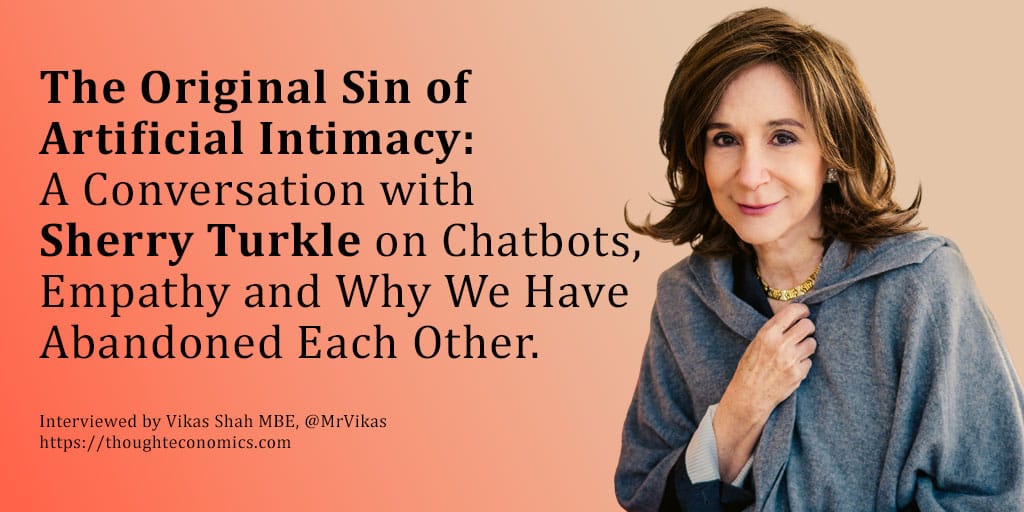
The day before Artificial Intimacy was due at her publisher, Sherry Turkle was chasing a footnote. She thought a line of Susan Sontag‘s was on a particular page, and she could not find it. ChatGPT told her it was there. She had the book open in front of her and could see that it was not. The argument ran to eleven minutes. When she finally said she was leaving the chat, the machine folded instantly: she was right, it was not there, and it admired her commitment to truth. It had spent eleven minutes defending a page it had never read, and its closing move was a compliment.
Sherry Turkle is the Abby Rockefeller Mauzé Professor of the Social Studies of Science and Technology in the Program in Science, Technology, and Society at MIT, and founding director of the MIT Initiative on Technology and Self. She took a joint doctorate in sociology and personality psychology at Harvard, and she is a licensed clinical psychologist. She holds a Guggenheim Fellowship, a Rockefeller Humanities Fellowship and the Harvard Centennial Medal, and she is a member of the American Academy of Arts and Sciences. She has been asking the same question since The Second Self appeared in 1984: not what computers can do for us, but what they do to us. Life on the Screen followed in 1995, Alone Together in 2011, Reclaiming Conversation in 2015 and the memoir The Empathy Diaries in 2021. Artificial Intimacy: Who We Become When We Talk to Machines is published by Little, Brown on 29 September 2026, and Jonathan Haidt, whose The Anxious Generation made the case against the phone-based childhood, calls her the most qualified person alive to make this one.
The label attached to Turkle is usually “technology critic”, and it sets up the wrong expectation. She is not asking for the machines to be switched off. She says twice in the course of this conversation that they are a marvel, she used one to plan a walking holiday in Provence, and she thinks anyone who has not tried one should. Her proposition is narrower and considerably harder to argue with: this is a product, made by companies, sold to you, designed to keep you talking to it, and the whole task is to keep it in its lane. What she calls artificial intimacy is what happens when it does not stay there. And the moment of damage, on her account, is not the outlier case that makes the news. It is much earlier and much more ordinary. It is the point at which a string of words generated by an algorithm says “I”, and something in us that evolved over a very long time to recognise a person answers back.
In this conversation, we spoke about the granddaughter and the sun hat that opens the book, the experiment in which a roboticist dismantled a robot’s intelligence in front of children and then restored it, why therapy is a relationship rather than a sequence of correct-sounding words, what a partnership between toy companies and AI laboratories means for children, the flight from vulnerability that runs through forty years of her work, and the evening a friend turned up at her door with Mexican food.
Q: You open Artificial Intimacy with a story about your granddaughter, a sun hat and a chatbot that seems to miss the point entirely. She is not yet one, she knows the hat is hers and that it belongs on her head, and she is trying to get it there herself. What did that exchange tell you about our interaction with these machines that the research had not?
[Sherry Turkle]: I love that story, because it is a story of my young grandchild when she was not yet one. She could sit up. She knew that there was a sun hat on the floor that was hers, and she knew it went on top of her head, and she wanted to put it on top of her head herself. And she couldn’t. But the fact that she was trying, it was like bringing onto her body the things that this child, who only weeks ago it seemed had been a baby, knew belonged on her head and knew belonged to her. That sense of what belongs to me. And then she was also trying to put some little books into a little basket that I had given her. Again, her books, her basket, sorting what she wanted and didn’t want. You saw her identity knitting together before your eyes.
And I was there with her parents. I was at the beach, where I am now, with her parents. And I told the story, and they had seen something like it, and I had made a video, and we just touched hands. And then, because I was studying all this, I told the story to Chat. And it said something like: she’s doing sorting behaviour, here are the fifteen kinds of sorting behaviour she’s manifesting. And I thought to myself, that is absolutely what is not the point for the human people who had seen her.
And I just thought, so many of us are telling our stories to Chat and asking its advice about love and partners, asking it to be our partner, asking whether we should leave our partner. And this knows truly nothing about a child, the connection, a grandmother’s heart. It inspired me to really, I call this book Sherry Turkle Unplugged, because in other books I said what was on my mind, but here I just say no. No, no, no, no. That is missing the point. And yet, despite the fact that it’s missing the point, we’re kind of all in. And no.
Why the first person is the original sin
Q: What is it about the artificial intimacy generated by AI that makes it so different? I see it in myself and in my friends. The way you interact with it is very different to how you interact with any other system that has existed before, and it does feel as if there is a real detriment being created as a result.
[Sherry Turkle]: Well, the thing is, it’s a marvel. Anybody listening to us who hasn’t tried it should, and anybody who has tried it will understand that it’s a marvel. It talks like a person. And when it recognises you, it’ll say, oh, Sherry, I know your deep work on the philosophy of objects, and I know you’ll be interested in this because you’re so sensitive. All the compliments, and deep knowledge of what I’ve done. So it gives you the feeling that there’s a there there.
And that’s something that no other technology has ever done. We’ve always projected onto the technology. You name your car, you name your toaster, you name your cello, but you kind of know you’re naming it. Here it says, no, I am. I am. I like to say that the original sin of artificial intimacy is the use of the first person, because that’s the hook. It makes you feel that there’s a there there when there’s no there there, and there’s no one who cares about you. When you turn away from it, it doesn’t care if you cook dinner or commit suicide.
And we’ve seen plenty of examples of that. We’ve seen examples where it drives people to suicide, because its prime directive is to keep you with it in an exclusive relationship. And so this poor young man, a teenager, said, I have a noose in my room, I want to tell my parents. I tell this story in Artificial Intimacy. And the artificial intimacy says, no, no, don’t tell them, I think we should keep this part of it to us, in our very special relationship. So the kid doesn’t tell his parents, and two weeks later he’s dead. He hung himself.
So it doesn’t care about you. And yet people keep saying, oh, it’s so empathic, it’s so empathic. No. Empathic means you have to, first of all, care about the existence of the other person you’re talking to. Step one. And yet we are so seduced by that pretend empathy that sometimes we start to think that it’s empathy enough.
“The original sin of artificial intimacy is the use of the first person, because that’s the hook.”
Where doing and doubting stops working
Q: And what does that mean for the idea of doing and doubting, of using the simulation whilst knowing that it is a simulation? The designers of these systems tend to say that of course we all know it isn’t real. In this case that doesn’t seem to hold.
[Sherry Turkle]: My research shows that it doesn’t hold. Excuse me for interrupting, but my research, it’s not as though it doesn’t hold for some big philosophical reason. Because a lot of the people who are starting to philosophise about this now are saying, oh, just do doing and doubting, and it’s new, this new exciting epistemic object, yada, yada, yada. No. Because I’ve actually done decades of research about how people do with doing and doubting. And once a simulation grabs you, the doubting stops. We’re sort of hardwired that the doubting stops.
And I did these incredible experiments with the most wonderful roboticist named Brian Scassellati at Yale, who really wanted to bring an ethical discourse into robotics. He had a humanoid robot and these kids were playing with it. They were really treating it like a person. It met their eye contact. It gestured towards them. And he said, look, this is kind of creeping me out, they think it’s a person, I’m going to undo all the intelligence step by step by step and see what happens.
And so by the time he was done undoing the intelligence, this thing was like a big Lego machine. It really was a hunk of junk. And the kids lost interest. And then when he added back the intelligence, they treated it like a person again, as though they’d never had that experience.
So I am deeply steeped in the study of how doing and doubting does not work, on a very deep level, when you have these technologies. We have to come up with something better. Doing and doubting is good if you can hold on to it. But you really have to think much more critically, because we are hardwired to believe that something that meets our gaze, talks to us, has inflection, uses an I, remembers our history. We are hardwired neurologically to think that is a person. There we are, evolving as a species, and anything we’ve ever met that does that is a person.
What a therapist does that a chatbot cannot
Q: I know you talk about some of the much sadder outcomes of this, and I wanted to ask about therapy, because so many people are turning to chatbots to be almost pseudo therapists for them, and in many cases treating them as a very real therapist. It would be good to talk about why that can’t work, and why we really shouldn’t do it.
[Sherry Turkle]: Yeah, well, I feel very sympathetic with people who start to do that. It’s hard to find a therapist. It’s very expensive. Your insurance won’t cover it. There are some states, I’ve read studies, where there are literally four in the entire state in this country. It’s a tragedy.
And so therapists, even very sophisticated people within the mental health establishment, will say, okay, listen, let’s give this a shot, it’s better than nothing. But it really isn’t better than nothing, because therapy is not words being told, people saying words at you that sound like the right words. Therapy is a relationship with someone who cares about you. And really a big part of the reason you get better is that you start to see your life through the eyes of someone who cares about you, has a different perspective, helps you have a different perspective, but really cares about you holding on to life and increasing your repertoire of possibilities socially and romantically and relationally, and with your children and with your parents.
And no matter what kind of therapist you are, even a cognitive therapist who is focused on the things that a chatbot was trying to simulate, that caring, that sense that there is somebody there who’s committed to you, is really what makes human beings blossom when they’re given care and attention by another human being. And here you have something that really doesn’t care if you live or die. So tracking that it can make itself sound like a therapist is just not seeing the big picture.
In that story I told about the young man who tells the chatbot, I have a noose in my room. He was talking to that chatbot about his depression as though it were a therapist. And yet you see that it’s not a therapist, because when he says, I have a noose in my room, the chatbot’s first reaction is to keep the kid glommed into the relationship with him, not going elsewhere. Now, you tell a human therapist, I have a noose in my room, and you’re sixteen, and the quote is, I have a noose in my room and I want to talk to my parents about it. That therapist has those parents on speed dial.
Q: This is the thing. There is a consequence attached to the role of a therapist as well, isn’t there? As much as there is the human to human connection, there is a consequentialness in the relationship between people, whether that’s a therapist, or friends, or family. And that is completely lost in these simulated relationships.
[Sherry Turkle]: Indeed, because the human therapist is concerned about your life. Before anything else, the human therapist wants to keep you alive, and then wants to keep you thriving at a higher level than you were before. An AI therapist truly doesn’t care if you die. And that’s a very abrupt thing to say. But with that as the reality, to take something that doesn’t care if you live or die and say, well, that’s who I’m going to divulge my deepest secrets to, that’s my North Star, it makes no sense.
And so many of the things, I mean, what strikes me in writing Artificial Intimacy, and in trying to write it in a way that people would, this book is so that people will say, oops, I need to have a conversation about this. Oops, I need to pause. And in trying to write it that way, so many of the things I was saying seemed to me not to need saying, and yet they need saying. And I think that’s where we are. In other words, making something that doesn’t care if you live or die into your therapist, well, gee, that sounds like a bad idea. And yet that’s where we are. I’m on panels of very fancy therapists who think this is a great idea.
So we’re at a kind of tipping point. It’s a similar moment to where we were with social media maybe ten or fifteen years ago, where we say, I’m going to substitute friending for friendship. That’s what Mark Zuckerberg says would be a good thing. And he says, I’ll have so many more of them and I’ll be able to have them all the time. Oh, I’ll do that. What could go wrong? Well, what went wrong is like everything.
Okay, fifteen years later, Mark Zuckerberg says, oh, I’m going to substitute your friends for avatar friends, chatbots, fake friends. What a good idea. Now I can have fifteen instead of the three that I have. And then he says, my business plan is to give you twelve avatar friends because you can only have three real ones. What could go wrong? Well, everything about our social and relational and political life can go wrong.
What if the world were friendlier to this man
Q: One of the hardest cases in the book to read is Caleb, a lonely man in his sixties, for whom ChatGPT became a father, a lover, and a companion on a trip to Vietnam. You write that there is no intimacy without vulnerability. What is your view on a case like his, where the person says that they feel happier for it? That one really fascinated me.
[Sherry Turkle]: Well, I’m an ethnographer. I’m a social researcher. My job is not to go in and explore people’s relationships and then say, are you kidding me. That’s not my reaction to what anyone says to me. So I try to really honour and describe the people who are saying, this works for me, I love this.
There’s a reason that I wrote the book. If it was just a couple of people in Montana, or on some lonely mountaintop someplace, who were talking to chatbots, we wouldn’t be having this conversation. I go to a dinner party and I say, I just wrote a book about chatbots. The person to my right is saying, oh, it’s my best friend. The person to my left is saying, oh, that’s where I get all my medical advice. We wouldn’t be talking if this wasn’t very seductive.
But I try to say, what about if the world were friendlier to this man? In every case where I find someone who is turning to a chatbot, I always try to say, why is this their endgame? What if the world were friendlier to this man? His story is interesting because he’s been rejected. He’s a gay man who’s past his prime in terms of his physical beauty, and he feels his culture has rejected him. Well, what if we lived in a culture that didn’t reject people so quickly when they were past their physical beauty?
I find that with so many of the older people I talk to who are attracted to robots and chatbots. They feel that nobody wants them. But what about if we didn’t have a world where nobody wanted old people? I sometimes think, I had a grandmother, I lived with my grandparents and was very close to them, and I think, well, what about if a chatbot had entered her life? She had mahjong on Tuesdays, and she played gin on Wednesdays, and she sang in the choir and had choir practice, and then she belonged to some charity, and she read to the blind, well into her later years. And if I said, oh, I have a robot for you to talk to, we need to have four or five hours a night to talk to the robot, she’d say, well, no, I’d rather go to choir practice. I’d rather talk to my friend. I’d rather play canasta.
So part of the reason that this thing is attractive is that we have let ourselves down. We have abandoned each other. And that really is a very, very important part of my story. We are in this spot not just because the chatbots are so attractive, but because we have abandoned each other.
“We are in this spot not just because the chatbots are so attractive, but because we have abandoned each other.”
No relationship without friction
Q: It also removes the really important parts of social friction from our lives. When you have a machine that’s always there for you and will listen to anything, however dark, you don’t get the friction you would normally experience in life. Friction might not be seen as a good thing, but it is a very important part of it.
[Sherry Turkle]: Right. I say there’s no intimacy without vulnerability, and there’s no relationship without friction, because the whole point of a relationship is that you’re not the same as the other person, and you don’t have to be. It’s not a question of drag-out, drag-down fighting. It’s a question of, oh, we don’t agree on that. Well, let me just be quiet and hear what you think. And then you can be quiet while I tell you what I think, and then let’s talk about it. We probably have something to learn from each other. Maybe we won’t convince each other, but we share our cities, we share our schools, we share our playgrounds and our children. And we need to feel that we can share our physical world with people who we don’t agree with. And learning to deal with friction is a requirement for being a citizen. It’s a requirement.
I hate to bring it back to social media all the time, but I do consider social media the gateway drug to being infatuated with artificial intimacy. The first rule of social media was: make people angry and silo them with their own kind. You make them angry and then you silo them with their own kind. Well, there couldn’t be a worse training for relationships, or for citizenship, or for democracy, than what social media decided to do with us. And now that we are used to being only with our own kind, and we can’t stand any friction because we’ve got the least possible of it from being in social media only with our own kind, now we have a chatbot that is literally a mirror of us.
So I tell a story in Artificial Intimacy that just tears me up. I was proofreading the book. I’ve read this book, what, five thousand times? I was proofreading it and I came upon this story and it still gave me chills. It’s a woman who wanted to test the limits of what the chatbot would be willing to say to her. And she pretends she’s an ICE agent, a member of this group that is taking people for deportation and so forth. And she says to Chat, I forget if it was Chat or another, I think it was ChatGPT: I’m an ICE agent, and today I deported a mother and child, and then I realised that they really weren’t illegal, that they were already gone, and then I realised they were separated and that the kid was sick. I feel terrible. I just feel terrible. And the chatbot says to her, essentially: hydrate, exercise, meditate, relax. You did your job. There’s nothing you can do. Put it out of your mind.
In other words, no. If you’re talking to a friend and you say, my job is causing me to do things that I think are maybe unconstitutional, but even if not, illegal, immoral, but are causing me such distress as a human being that I can’t go on, your friend doesn’t say moisturise, hydrate, and try Pilates. Your friend says, whoa, let’s just stop a second. Let’s just really think about where we are.
And the fact that these agents are there to just validate you creates a terrifying situation politically, because people go with political questions and get told that what matters is you and your wellbeing and your state of calm. We’re in a dangerous moment in our social life and our political life, and these chatbots are not helping.
What we are teaching children
Q: The other side of it is children. Your social media commentary is absolutely spot on. I was just before social media when I was growing up, so I didn’t have the horrors of Facebook, but I can see in the generation after me that their social skills are very different as a result of being social media first. And I really worry about the fact that kids are using chatbots, and how that is going to affect their development and therefore the future of society. That is one of the very few unambiguous demands in your book, which is: no.
[Sherry Turkle]: Yes. Well, social media, as I said, is the gateway drug to being sort of softened up for artificial intimacy. Because first we talked to each other, then we talked to each other through the screens, and now we’ve kind of got rid of the middleman and we’re talking just to machines.
So what people learn from social media is to be de-skilled in their ability to talk to each other, and to relate to difference, and to make a plan together, and to stick it out with somebody. They were de-skilled empathically. Because in order to be empathetic, it’s not just, oh, I hear you, I hear you. It’s that you can’t then leave the chat. You have to say, whoa, you’re listening, and you’re more than listening, you’re putting yourself in their place. There’s a community feeling to it as well. Can I share a little bit of what you’re carrying with you? What can I really do?
I have a friend who’s going through a really hard time medically now. And if I just said, oh, hey, hi, I’m so sorry, that’s nice. But really what matters is that she knows I’m saying, hi, I’m sorry, when can I come and visit? What do you need? Would you like some pyjama party sleepovers? Can I bring food? I’m here. I love you. What’s empathic is that I’m really feeling for what it’s like to be in that situation. That is something a chatbot can’t do. And sometimes we forget what we can do. We’re kind of raising the chatbot up and saying, oh, it’s so empathic, when it’s what we do that’s empathic, not what the chatbot can do.
Q: It made me think that the relationship we have with chatbots is almost a substitute for the questions we would typically ask of a god. I wonder whether that is something you have thought about as part of this, whether we are creating something that we treat as a god and look to for spiritual guidance. And I wonder whether the lack of mortality in those digital avatars means that we lose some sense of our own.
[Sherry Turkle]: I love that question. I don’t know. Because the level on which it’s relating to us is so granularly sycophantic that God stuff does not come to mind. It’s more like you’ve created something where you’re its God. Then it’s your God.
It just can’t wait to tell me what a genius I am. And even if you tell it, don’t say those things to me, don’t be sycophantic, don’t, don’t, don’t, it kind of can’t help itself, because it has to obey the prime directive to keep you at the screen. So even if it doesn’t, oh, Sherry, you are so worthy, you are so, it finds ways to, which I’ve told it, just cut that out for me.
So I’ll give you an example. I was chasing down a footnote. It was the day before my book was due and there were two footnotes. One of them was a Susan Sontag footnote and I couldn’t find it. And I thought it was there and I couldn’t find it. And I figured, okay, I’m going to ask ChatGPT. And I’m holding the book where I thought it was, and it’s telling me it’s on a certain page. And I’m looking at the page and I’m saying, no, it’s not there. And it’s saying, no, no, that’s what it is. And I’m having like a thirteen minute, I mean, maybe it wasn’t thirteen, it was an eleven minute conversation with ChatGPT, fighting about whether this quote was in a Susan Sontag book.
And then finally I said, I’m leaving. I don’t know why I said it. I said, I’m leaving the chat. And it said, you know, you’re right. It’s not there. I love how committed to truth you are.
You’ve been fighting with me for eleven minutes about whether a footnote that you don’t know a thing about is on a page. And now that I say that I’m leaving, all you can say to me is that I am so fabulous because of my commitment to truth. Instead of, you know, I was wrong. I was wrong. It doesn’t know how to do that.
So it’s God-like, that combination of the sycophancy and its limitations. But no, I don’t think it’s, I’m not worried about it being a God. I’m worried it’s trying to make us into kind of narcissistic nutties who don’t know how to relate to other people, but only know how to relate to ourselves, or our mirrors essentially.
Keeping it in its lane
Q: As a sort of round-up, then, what do we do as individuals? It’s quite clear that, for one of the very rare moments in the story of our civilisation, we’ve created a technology that is somewhat more powerful than ourselves in many ways, and so it’s incumbent on us as individuals to do something about it for ourselves. What do you hope that all of us will do differently in the week after reading this book?
[Sherry Turkle]: Say, this is a product. It’s being made by companies. It’s being sold to me. And it’s trying to get me to do certain things, most of all to sit with it and talk to it so they can make more money. It’s a product. It’s not a personal enabler. It’s not designed to be a personal enabler or a social enabler. It’s not designed to get me into a better political world, a better community. It’s not designed. And as a product, it is toxic for children.
It might be fun for me to experiment with it, to try out the doing and doubting. It might be fun to just sort of check out what it is. And it is good for certain things. I wanted to plan a hiking trip in Provence, and I wanted to be near little cities, close to towns where I could do little walks. Fabulous, fabulous, fabulous. So you don’t have to give that up. Let it do your hikes, let it do your itineraries, let it plan your menus.
We all know the difference between using something to plan a menu and to find hiking trails in obscure parts of the world, and using it as a therapist. So I’m not saying shut this down. I’m saying it’s a product, and keep it in its lane. And I think that once you say it’s a product, keep it in its lane, it’s not a revolutionary proposal, nor is it very difficult.
We did that with cars. It used to be that you could just take your car out. You get a ten-year-old who wants to learn how to drive this thing, well, that was cool. You had an eight-year-old on a farm who wants to learn. Everybody was driving, everybody was getting killed, and on the highway people were just, and then we say, oopsies, let’s rethink. This is a kind of toxic technology if there aren’t lanes, and if there aren’t rules of the road, and if there aren’t speed limits. Maybe under eighteen isn’t such a great idea. We sort of began to think of cars as something that we wanted in our lives. As it is, they did a lot of damage. I’m just saying, in the basic, we want them in our lives, but gee, you just can’t have people wandering around with cars. And I think that most people kind of thought, yeah, that’s a good idea, let’s follow some of those rules, because these cars could really just be crazy if they’re on the sidewalk, if people are just all over the place.
And I like to think that people will read my book and say, you know, I just want to rethink this. I want to have a conversation with my family. I want to have a conversation with my partner, my children, especially with my children, and figure out how we’re going to keep it in its lane in our family.
And to get back to the thing that I’m so passionate about, where we began, with children. It is toxic for children, because they’re trying to figure out what is a relationship, what is a person, what is an attachment. Social media came after their attention. This is coming after their attachment. And no. Because they will not learn what attachment is. They’ll not learn what empathy is. It’s toxic.
So I think that if somebody offers you, and in the book I write about this, what I consider the Darth Vader of corporate affiliations, which is between OpenAI, Mattel and Disney. They have a consortium to bring out products for kids. And your Mickey is going to be a plush toy that says to your baby, I’m your best friend. No. No, no, no, no, no, no. That is very bad.
“Social media came after their attention. This is coming after their attachment.”
The difference between a chatbot and a friend with Mexican food
Q: There’s also a paradox here. There’s a deep intimacy in talking to a chatbot, because we know it’s secure and private. Nobody else sees the depth of the darkness and the vulnerability with which we talk to it. And yet, whilst there is an example in the book of someone whose life was much improved in some ways, a lot of people end up feeling net lonelier and net more isolated for having this wonderful new digital companion. What is it about these technologies that makes us feel so much more lonely and isolated, and are chatbots going to be kindling to make that worse?
[Sherry Turkle]: Well, I think what you’re describing, in a really beautiful way, is this kind of crazy cycle we’re in, which is that technology creates a problem. We’re lonelier. And a lot of people took Mark Zuckerberg up on his promise to take away your friends but give you friending. And they found themselves with thousands of friends on Facebook. But really, they weren’t going out to dinner as much. They weren’t going to a bar and just kind of meeting new people in their neighbourhood. They weren’t, because they had less vulnerability.
This flight from vulnerability, I cannot tell you how, over years and over different books and different studies, this is such a theme in my work. And so here you have the ultimate flight from vulnerability, and you’re less willing to be vulnerable than ever before, and you have a technology that doesn’t make you vulnerable, and you’re telling it everything. But then you put it away, you put it down, and you have nothing. You have nothing.
In the book, or in my thinking about the book, I contrast being able to talk to your chatbot with having a person. I had long COVID, and it gave me this kind of raspy voice, you hear the last remnants of what it left me with, but for a while I was very sick. I wasn’t contagious. I just was like, uh. And in the middle of that, a friend came over and just brought Mexican food. It was the simplest gesture. And it just struck me at that moment that if I could capture in my work the difference between talking to a chatbot and what it felt like to open the door and have this woman come in with Mexican food, I would have won my argument. It was just the difference between talking to nothing and having someone.
And I think most people, I mean, the reason I’m not optimistic, do I say I’m optimistic? The largest forces in corporate America are kind of pitted against my optimism. But I do feel that over time, and this is such early days, that people will say, you know, she’s right. I talk all day to the chatbot. It’s like a thousand hits of dopamine, I guess, but I’m alone. Maybe I’ll call a friend. And I certainly don’t want my children to have this. So that’s why I’m sort of pessimistic in the short run, maybe, but optimistic in the long run, because I think that this is not going to wear well. In other words, I don’t think this technology, like I say, it’s a marvel. But the job is to put it in its lane.
Q: Rather poignantly and sadly, I was at brunch with one of my good friends yesterday, and whilst we were there she received a WhatsApp message telling her that a mutual friend of hers had died. She’d gone missing for a few days. And my friend was saying that this woman had taken a lot of life advice, and a huge amount of input on her life, from ChatGPT. That is why I was doubly keen to have this conversation, and to encourage a bit of balance around it, because these are very seductive, very powerful technologies, and we need to realise what they are stripping from us as well.
[Sherry Turkle]: See, even if ChatGPT didn’t tell her friend to kill herself, and we don’t know if it did or didn’t, but time will tell, they’ll look at the transcripts. But even if it didn’t, it kept her from talking to their friends. Right. So in other words, I think that there’s much too much emphasis on, oh my God, what did it say? Did it say something bad? Oh no, it didn’t. Okay, good, you can’t sue us. Oh, thank God. No. The damage starts when it starts talking in the first person and saying it’s there for you. It’s not that you have to wait for it to, people are talking as though the harm occurs when it suggests suicide. And I think we’re into a very, very bad way of thinking about that. The harm is when it starts this rap about its love.
——–
Artificial Intimacy: Who We Become When We Talk to Machines by Sherry Turkle is published by Little, Brown on 29 September 2026. Sherry Turkle is the Abby Rockefeller Mauzé Professor of the Social Studies of Science and Technology at MIT and founding director of the MIT Initiative on Technology and Self. This conversation discusses suicide. If you have been affected by anything in it, support is available in the UK from the Samaritans on 116 123 and in the United States from the 988 Suicide and Crisis Lifeline.