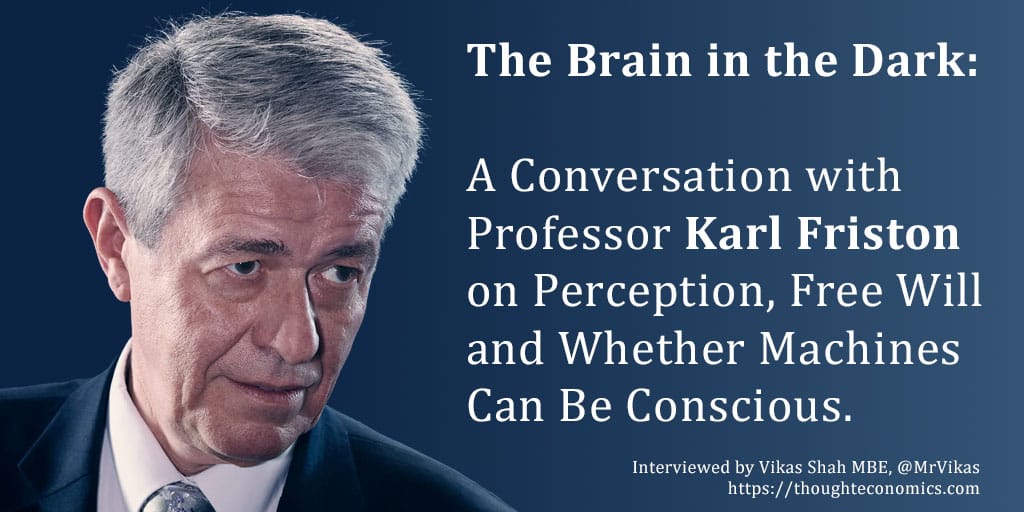
The brain has never seen the world. It sits in the dark, sealed inside the skull, and all it ever receives are electrical signals arriving along nerves from organs it cannot inspect. From that, it has to work out what is out there. The common-sense story is that light and sound arrive and are assembled into a picture. Karl Friston‘s life’s work is the argument that the traffic runs the other way: the brain generates its own best guess about the causes of its sensations, and then uses the senses to check.
Professor Karl Friston FRS is a theoretical neuroscientist at University College London, where he is Scientific Director of the Wellcome Centre for Human Neuroimaging at Queen Square. Trained in natural sciences at Cambridge and then in medicine and psychiatry, he invented statistical parametric mapping, the technique that underpins most brain-imaging research, as well as voxel-based morphometry and dynamic causal modelling. He is a Fellow of the Royal Society and of the Academy of Medical Sciences, a recipient of the Weldon Memorial Prize and the Golden Brain Award, and by most counts one of the most cited neuroscientists alive. His best-known idea is the free energy principle: a proposal, first set out in full in a 2010 paper and developed in the book Active Inference, that any system which persists in the world, from a cell to a brain to a society, must act as if it were minimising surprise about its own sensations. It is the most ambitious theory in neuroscience, and the one most often accused of explaining everything and therefore nothing.
What strikes you in conversation is how little of that ambition shows. He takes each question as an invitation to think aloud, credits Helmholtz, Plato, Richard Gregory and Horace Barlow before himself, and concedes a point about controlled hallucination with “thinking about it, I think you are absolutely right”. The sharpest moment is a disagreement. When I offered the Cartesian comfort that the one thing I can be sure of is that I am me, he pushed back: that conviction is “quite a unique gift and quite a fragile gift and can go away”, as patients with depersonalisation and anyone who has taken a psychedelic can attest. You do not know anything, he said. It is all inference, including that you exist.
In this conversation we discuss why perception is an inside-out process, whether a predictive brain leaves room for free will, how consciousness and mental illness can both be read as inference, why Geoffrey Hinton‘s distinction between mortal and immortal computation may be the real test of machine consciousness, what large language models lack that would make them curious, and what it means that a newborn has to learn that there are things in the world at all, starting with mother.
Q: The assumption most of us lay people carry is that light arrives, sound arrives, it is assembled in our heads, and that’s that. In your view the traffic runs the other way, almost an inversion. Can you talk us through that concept, and why it is logical that a brain living in the dark has to work this way?
[Karl Friston]: Living in the dark: the skull-bound brain. I like your use of the word inversion. It speaks to two fundaments of the way we make sense of the world.
The first is technical. We are equipped with generative models, or world models, of how hidden causes in the world beyond our skull-bound brain cause the observable sensory consequences. If we want to map from the observations, the sensory impressions on our sensory epithelia, for example, then we have to invert that model. The generative model maps from cause to consequence, but our perception, or perceptual inference to be more exact, inverts that mapping, going from observable consequence to unobservable or hidden cause. So that is lovely.
The other, and I think probably more intuitive, reading of inversion is the kind of strange inversion that Dan Dennett would bring to the table, and that is certainly celebrated by people like Andy Clark. This strange inversion takes the outside-in view of perception, where, exactly as you say, sensory impressions on our sensory organs are somehow assembled and enable us to extract information, and inverts it. I think you then have a much more Platonic and natural view of perception: that we perceive in an inside-out fashion. The notion goes back to the days of Plato, and it was beautifully articulated by Helmholtz in terms of unconscious inference. We create on the inside explanations, hypotheses, fantasies, licensing the notion of the brain as a fantastic organ, and these are then put to the test. If I was right about the causes of my current sensations, then I should see this. I can compare my predictions to what I am actually seeing, and if they match, if there is minimal prediction error, I can be assured that I have the right explanation. What I have just described is the predictive coding implementation of unconscious inference, and possibly even of conscious inference, using the notions due to Helmholtz.
Q: The phrase many of us have carried around for perception is a “controlled hallucination”. On what you have just said, there is no control to this hallucination, and by calling it one we are almost degrading the nature of what is true, inside or outside. Is that fair?
[Karl Friston]: I guess it rests very much on how you interpret the notion of a controlled hallucination. Anil Seth, who is a friend and colleague of Andy Clark and myself, has recently popularised that notion. I have always read it as hallucination in the sense of hypotheses: illusions that are controlled or entrained by sensory input. You are clearly reading it in a different way, in the sense that a hallucination has to be a false inference. Thinking about it, I think you are absolutely right. If you define a hallucination as a perceptual inference that is false, or non-veridical, or not close to the truth, should truth exist, then it is not being entrained or informed or controlled by the sensorium, and that would not be an apt picture of the way we perceive. We are glued to the world through our senses, and our sensory information entrains and informs the inversion process that can be read as perceptual inference. So when I talk about hypotheses, I am talking more in the spirit of Richard Gregory, whose basic notion was that perception just is hypothesis testing. It is the game of rifling through the likely or plausible explanations that could account for what I am seeing at the moment, and committing to the one that best explains the sensory data.
Why evolution is nature’s way of doing Bayesian model selection
Q: Could the evolutionary rationale for this also be efficiency? If reality is so overwhelming that processing it in full would require an enormous amount of the brain’s compute, one would expect inference to be far more efficient, and to generate fewer errors.
[Karl Friston]: Absolutely, and it can be answered at two complementary levels.
The first is the efficiency notion, which is very important. Mathematically, you can cast our exchange with the world as taking the path of least action, the path of maximum efficiency. This has been articulated by many scholars: for example, the principles of minimum redundancy or maximum efficiency due to Horace Barlow. You can also read it mathematically in terms of the optimality of Bayesian filtering: the most efficient way of explaining your sensory exchange with the world, in terms of information theory and statistics but also thermodynamically. Clearly that can be installed in the evolutionary thinking of theoretical biology to motivate, teleologically, why it would be a good thing to do.
There is also a slightly deeper reading of the role of evolution, which is that evolution itself is part of this inside-out process. The idea is that we select the hypotheses that best explain our sensations in the moment in exactly the same way that natural selection selects the phenotype that is the best fit, the best explanation, the most likely denizen of the eco-niche at this point in transgenerational time. So you now have a view of perception, and you could even argue of action selection, as selecting the right hypothesis in the spirit of Bayesian model selection: selecting the explanation, the hypothesis, the model that has the greatest evidence. And you can read natural selection as nature’s way of doing Bayesian model selection at a very slow timescale.
Q: I realise this is a very philosophical question, but is your approach an antagonist to free will? If our decisions and perceptions emerge from predictive inference in the brain, does that mean the amount of control we have is questionable, and with it the notion of the self as a stable construct?
[Karl Friston]: I think the free energy principle, and its applications in the spirit of active inference, has room for free will. I think that can be seen nicely by reference to your previous question. We were talking about different kinds of selection: selecting the right hypothesis in perceptual inference, selecting the right phenotype in natural selection. We can also apply the same mechanics to action selection, and that brings an important aspect to the table. Thus far we have only been talking about sense-making. But as soon as you are talking about free will, the will to choose, what are you choosing? You are choosing your path into the future, contingent upon the way that you act back on the world. So we are talking about special kinds of things that have the capacity to go and query the world, act upon the world, ask questions of the world, sample the world in a particular way. That means that certain things, like you and me, have the capacity to rehearse the consequences of our actions, so that we can choose the most likely action given the kind of thing we are. In so doing, I think there is plenty of room to describe this process, which is again a kind of model selection, as free will.
I would have to nuance that, though, in the following sense. If I dropped a marble and it bounced to the right, did it choose to bounce to the right as opposed to bouncing to the left? You could argue, well, no, it did not really choose. However, if I now equip that marble with a sense of its own future, so that it was computing how it should act prior to the bounce, then I think you can argue that yes, the marble did indeed select to go one way or the other. And even if it did not, if it found itself bouncing to the right, it might infer post hoc, if it had a sense of self, that it chose to go to the right. So even if there is no active free will in the selection process, if you have self-awareness and you have to explain the causes of the sensory input that you cause yourself, then the simplest explanation is the hypothesis: I chose that, therefore I have free will.
“We are glued to the world through our senses, and our sensory information entrains and informs the inversion process that can be read as perceptual inference.”
Consciousness, selfhood and the pathology of inference
Q: Does this get us any closer to understanding what constitutes consciousness? If inference is the engine through which we interact with the world, then simulation and probabilities are what we experience as consciousness, yet intuitively consciousness feels separate from that. Is it even explainable?
[Karl Friston]: I think it is certainly possible to explain consciousness. People have been doing it for millennia, and the explanations are sometimes satisfying and sometimes not. I certainly think you alluded to some of the ingredients that would make an explanation satisfying.
First, backing up to the previous observation about free will: we are only talking about those things in the universe that have agency, in the sense that they can select among different courses of action. That immediately tells you that there are certain kinds of generative models, mappings from cause to consequence, in which, in this particular instance, you are actually the cause of your sensations. You are authoring your own sensations. To know that, to model it and to have it as part of your generative model is, I think, a prerequisite for consciousness.
Now, whether you know that you are modelling your future, doing what in engineering would be called planning as inference, is another question. But you could certainly put another layer of inference into a deeper, hierarchical generative model that was able to assess and recognise, in this inferential sense, that you were choosing this as opposed to that. More particularly, it could recognise that there was a context in which you had to choose between a small or a large number of options, and that those options were themselves contextualised. When you get these deep generative models, which you could describe as metacognitive, then you do have the space to talk about a minimal kind of selfhood: the ability to recognise that this thing is an agent, that this thing performing computations, planning as inference, is me. And crucially, me in this context, or this emotional state or drive state, or another.
So yes, consciousness is, I think, distinct from unconscious inference and from all the sense-making and decision-making associated with Helmholtz’s unconscious inference and the planning as inference you would find in engineering. But in exactly the same way that illusions are tied to the sensorium, your sense of self is tied to the machinations of active inference, of active planning as inference.
Q: This model seems to give us an unusually powerful way of explaining mental illness. One could argue, simplifying, that conditions such as schizophrenia or personality disorders are changes in this inference, which would be consistent with the fact that people living with those conditions report their experiences as being as real as any other form of reality.
[Karl Friston]: Absolutely. We make our own reality. We construct it through this process of sense-making, of inference to the best explanation, and viewed as an inference process, consciousness, I think, falls into that class. Disorders of consciousness, and psychopathology generally, can now be viewed through the lens of false inference. By false inference I mean the kind of thing you would have been exposed to at school: false negatives and false positives, technically type one and type two errors. Type one errors, false positives, are inferring that something is there when it is not, and that is a lovely explanation for hallucinations and delusions. Type two errors are the inference that something is not there when it is, and that is a very apt explanation for neglect syndromes and certain dissociative syndromes. So I think you are absolutely right: associating all of psychology with inference, including that which we might associate with sentience or qualitative experience, means we can now read psychopathology, the pathology of psychology, as some kind of aberrant inference.
Mortal computation: what separates a brain from a large language model
Q: Does it matter whether the engine producing the inference is biological or mechanical, in terms of the output it generates? You will see instantly where I am going with this: your theory is remarkably aligned with how large language models operate, and it makes me think about the difference between biological and machine inference.
[Karl Friston]: It speaks to current debates about machine consciousness, which has an enormous number of implications, both for research and development and the aspirations of AGI, and for the moral and ethical questions about machine suffering and the nature of the research we should pursue. From my point of view, I think the argument can be unpacked at two levels.
The first is this. Do you need to instantiate the inference process, the belief-updating process, the unconscious inference of Helmholtz if you like, in a substrate-dependent way? Does it matter, in other words, whether the computations unfold in the substrate that constitutes the computer? Or is the computation immortal, in the sense that it can run on any device, any machine, for example a computer? I am talking here about Geoffrey Hinton‘s distinction between mortal and immortal computation. If I can run software anywhere, then that software is effectively immortal. It never dies. I can always find some substrate-independent implementation of it. I can switch my computer off, switch it on again, and still run the software. Contrast that with you and me. I cannot switch me off, or indeed you off, and hope to switch you on again in the morning and have you compute in the way that we do compute. So we are examples of mortal computation. Another way of expressing this is that our computations are substrate-dependent: the computation is part of the physical substrate that realises it. The associations in our generative model, for example, are installed in the neuronal connectivity, very much like the connection weights in a large language model.
That argument then speaks to the quintessential difference between a large language model, say a transformer architecture, and you. There are lots of similarities: the deep structures, the hierarchical hidden layers in a neural network, versus the cortical hierarchies in neuronal networks. But there are also fundamental differences when it comes to substrate dependency, and the key difference is usually identified as unique to von Neumann architectures, where you read and write from memory. That has a particular implication. If you view computation as inference, and inference to the best explanation as gathering evidence for a model in the spirit of Bayesian model selection, then you are effectively saying that we exist in virtue of gathering evidence for ourselves, because we physically instantiate that generative model. However, if you try to reproduce this process on a von Neumann architecture, where you are reading and writing from memory, and incidentally inducing the memory wall or von Neumann bottleneck, which has enormous thermodynamic consequences, you are effectively sequestering the memory and removing its capacity, in and of itself, to self-organise. All the processing and inference is in the processing unit, but the memory cannot self-organise, and therefore it cannot survive, or be, in the sense that you and the connection strengths in your brain are. So that argument would say that yes, mortal computation would be necessary to describe any artefact that is truly intelligent and conscious. You can certainly simulate it. And of course people like Anil Seth and colleagues will make the point that you can simulate the weather in silico and it is not actually raining. The computer is not in and of itself wet, whereas mortal computation would actually be wet, if you physically realise what is going on. So I think that is one important argument. I am not saying that I am personally committed to one side or the other, but it is something to think about.
The other aspect, which I think is important for the way we design artificial intelligence, and large language models and transformer architectures in particular, is this. If you are committed to inference, you are committed to a description of the physics of sentience, sense-making and decision-making using a calculus of beliefs, most obviously described in terms of Bayesian belief updating. Inference in terms of belief updating presupposes that you have a physical representation of a belief. That in itself says that you have to have a physical, explicit representation of the confidence, or the credence, or the inverse uncertainty, associated with your belief. And immediately you can see a very bright line between things like you and me and large language models, because most of our machinery is about uncertainty quantification. It is about associating a particular credence with any belief structure so that we know what we do not know, so that we can be curious, we can resolve uncertainty, we can be information-seeking, we know where to look. If you do not have that, and large language models do not have that, then you do not know what you do not know. You cannot do belief updating. All you can do is produce outputs for any given input. So there is no true agency underneath. Technically, one way of summarising it is that you can certainly create highly functional input-output mappings, much akin to the outside-in approach to perception that we talked about at the beginning of our conversation, using universal function approximators such as transformer architectures, or any neural net, based upon a value function of states. But under the free energy principle, or active inference, that will not work. You have to optimise a functional of beliefs about states. And that just is inference: updating your belief structures, your personal Bayesian beliefs, with respect to some measure of the goodness of your model, which is the model evidence, lower-bounded by the variational free energy, sometimes known as the ELBO in machine learning.
“If you do not have that, and large language models do not have that, then you do not know what you do not know. You cannot do belief updating. All you can do is produce outputs for any given input.”
Q: When you talked about the mortal versus the immortal, it made me wonder whether the experience of time passing is fundamental to this: a base reference on top of which the inference takes place. Mortal inference can experience time passing and make predictive judgements on that basis, whereas an immortal system operates outside that restriction and has no notion of past, present and future.
[Karl Friston]: You can view it in terms of the multiple scales at which we have to update our beliefs, and beliefs are of different kinds. It is sometimes useful to distinguish fast inference in the moment, sense-making based on what we are currently seeing, together with the ensuing planning as inference and the action selection that chooses the data on which we base that sense-making, from a slower process of learning. After accumulating a large amount of data about which we have been making inferences, we then update our beliefs to explain, encode, represent or recognise the invariances and the contingencies. That is called learning, and machine learning really is a beautiful piece of engineering focused on this very slow timescale. And of course there is an even slower timescale, which we talked about in the context of model selection: Bayesian model selection, structure learning, causal discovery, and in a biological context natural selection and developmental selection. You simply cannot have the separation of temporal scales unless, as you say, you view computation as a process that unfolds in time, and furthermore one with this scale-free or scale-invariant aspect, in which the same principles apply at hierarchically nested timescales. So I think that is absolutely crucial.
I have not done this, but I am tempted to after your point: it would be interesting to prompt a large language model and ask it to respond in exactly 12 seconds, and see whether it has any concept of time in that metric, in the sense that we do. That would be an acid test of whether it truly understands the cause-and-effect structures, and the metric, that best explain our lived world.
Why we will never know whether the machine is conscious
Q: When I look at large language models and agentic systems, I wonder what we have done here. The pragmatic side of me says we are playing with a very good simulation of intelligence, and thus a very useful tool. But it is hard to stay pragmatic with a tool that exhibits so many of the signs we use to identify consciousness in other humans. Is that an error in our minds, given that consciousness is what identifies consciousness, or could we be seeing the sparks of something we have created and do not yet understand?
[Karl Friston]: I think you are absolutely right to highlight that we always infer that something else is conscious. The behaviour and the content generated by generative AI are so isomorphic with the kind of things that we generate that it becomes extremely tempting to explain the cause of this language output as a conscious or sentient artefact. It is a natural explanation, a natural hypothesis. It is exactly the kind of hypothesis that something complying with active inference and the free energy principle would arrive at: a nice, simple explanation that accounts for everything in a fairly accurate way. And of course these large language models are designed exactly to mimic your personal assistant. They are designed exactly to be as close as possible to something like you. They use language, for example, and that immediately lures you into a hypothesis space. They are using language; I use language; I am conscious; therefore the machine is conscious. It is a very plausible inference to make.
And I repeat, we will never know. Exactly the same arguments pertain to animal rights research, and you could associate the same inference problems with questions about the point at which a foetus is conscious, or can suffer. You will never know, but it is sometimes very, very important to be relatively confident on one side or the other. We make these kinds of inferences all the time. I would always infer, with a high degree of confidence, that my brother is sentient and can suffer. On the other hand, I would always infer that the bacteria infecting, say, my bloodstream were not sentient and could not suffer, and I would quite happily take antibiotics to terminate them. But in neither case will I ever know. It is all a question of the evidence at hand that licenses the inference that this thing is sufficiently like me that it could be conscious.
I think the querulous tone in your voice when you ask whether the machine is conscious just speaks to the fact that you are uncertain. You have very imprecise beliefs. There is lots of evidence that it could be conscious, and lots of evidence that it is not, and that introduces an uncertainty which at this point is difficult to resolve. You could try to resolve it by asking the kind of question you asked before about mortal computation: is it necessary to be mortal in order to be conscious? If it is, then large language models are not conscious. That would be one way of resolving the uncertainty.
“There is lots of evidence that it could be conscious, and lots of evidence that it is not, and that introduces an uncertainty which at this point is difficult to resolve.”
Curiosity, and the questions that remain open
Q: To round things off, a question about curiosity. Your research and writing have unlocked a huge amount of possibility in our understanding of the mind and consciousness. What are the big questions that still keep you up at night, whether the ones you expect the scientists who follow you to build on your work and solve, or the ones so perplexing that you are not sure we will?
[Karl Friston]: In one sense, curiosity is the big offering of committing to the free energy principle as a method, a tool, a principle in physics. All it says is that anything that self-organises in relation to the world in which it finds itself will look as if, given certain constraints, it is curious, it is information-seeking, it is resolving expected surprise. In my world, that would be an expected free energy consequent upon action. And that, I think, is a hallmark of intelligence: we are all natural-born scientists, with exactly the same curiosity under the hood. And of course that is the thing that needs to be installed in large language models before you will get anywhere near AGI. You want them to start prompting you and asking you questions because they are interested in you, because they are curious about you.
Just a small point in addition. To be curious is to select those actions that will resolve uncertainty, that will maximise expected information gain. To resolve uncertainty requires you to be able to measure uncertainty, and its resolution by acting this way or that way. So we come back to what denotes, or what can be assumed of, an authentic agent: the capacity to evaluate the goodness or the likelihood of any given behaviour on the basis of how much expected surprise or uncertainty it resolves. That information-seeking, I think, is absolutely crucial.
Now, if you are asking me what I am curious about, it is at both ends. There are really deep and exciting outstanding questions about the nature and origin of life, of the kind that people like my friend and colleague Mike Levin are asking, along with many, many other people, over the centuries and over the past few months on Zoom. I am fascinated by the underlying principles of self-organisation in systems that are open to the world in which they find themselves, and incidentally a world which contains other things like them. I think the federated, intersubjective aspect of self-organisation will certainly be key to understanding things like intelligence and consciousness. At the other end of the scale are the pragmatic issues of applying these principles to building, or simulating, more expressive sense-making and decision-making. We are now talking about how to install the scale-invariant principles that underwrite deep models into generative models, and build them in a really efficient way.
The self as a fragile hypothesis
Q: Forgive me, because this is very out there. If the one thing I can be sure of is that I am me, and everything else is inferred, then perhaps there isn’t something or nothing, there just is everything. In the same way that Anthropic or Claude can generate agents within a space to perform individual tasks, we, as instances of inference, might just be those agents in a space of everything: a single thing, rather than individuals with their own universes.
[Karl Friston]: The first thing you said made me smile: the only thing I know is that I am me. I think, therefore I am. That is really interesting, and I would like to push back on it, to see what you say.
The reason I want to push back is that I would contend that the illusion, or hypothesis, that you are you is quite a unique gift and quite a fragile gift, and it can go away. If you speak to certain psychiatric patients who suffer from something called depersonalisation, you will appreciate how fragile that sense of self is. It is something you and I take for granted because it works so well at explaining everything: oh, it is me that causes that. But it can go away. And if you take certain drugs, say psychedelics, it is quite easy to dissolve the conviction that I am me, and it can be quite terrifying. So I just wanted to push back on that and make the point that you don’t know anything. It’s all inference, including that you are you and that you exist. In that sense, I think you are perfectly licensed to explain the universe, or the sensed universe, as basically being everything else, which would include yourself, and there is no way of knowing.
I would also put into this, though, that there is a distinction between self and non-self that probably has to be metaphysically present before the controlled hallucination in the proper sense, the sense in which you are creating an inference to the best explanation. If you are so absolutely convinced that you are you, what you are telling me is: I can infer an explanation for all my sensory input if I am a self. That is quite fundamental, because if you are inferring that on the basis of real observations from the universe, you must metaphysically exist. And if that is the case, there has to be a distinction between you and everything else. What follows is that if there is a distinction between me and everything else, then there might be a plausible hypothesis, or fantasy, that everything else can be carved into other things that are themselves separate.
This is really non-trivial, and I mean it in a developmental psychology way. When you are born into this universe, you are not equipped with a notion of self and other, or of things as objects. It could be described as a Freudian oceanic appreciation of the world. It takes quite a long time to realise that there are things, and furthermore that certain things have an autonomy and others do not. Certain things do not move by themselves, but other things do, like mother. And you start to carve nature at its joints, in a Platonic way, to build a world model in which there are things that can be distinguished, separated or individuated from other things, and in which certain things have autonomy. Then you might develop the hypothesis: well, perhaps I am a thing, and perhaps I have autonomy, and perhaps I can move stuff. And then you start rattling your baby mobile, or your rattle, and you are a little scientist, soliciting and generating the evidence to confirm the hypothesis: oh, I am like mother, I can control the world.
This is the kind of causal discovery and structure learning I was alluding to before, which is a real frontier problem, certainly in my world. How do we actually carve nature at its joints into things? You are right, the universe is everything. But somehow we coarse-grain and, I repeat, carve nature at its joints, statistically and mathematically. This is where Markov blankets come into play, both in the computer science sense and in the sense of using the free energy principle to separate self from other, or inside from outside, at many, many different scales. On that view, the imposition of thingness and objecthood and selfhood and otherhood and motherhood is just our attempt to tell stories of a simple sort about how we best explain our universe. But our universe is obviously everything.
—————–
Professor Karl Friston FRS is Scientific Director of the Wellcome Centre for Human Neuroimaging at University College London. His account of the free energy principle for a general scientific reader is Active Inference: The Free Energy Principle in Mind, Brain, and Behavior, written with Thomas Parr and Giovanni Pezzulo and published by MIT Press.