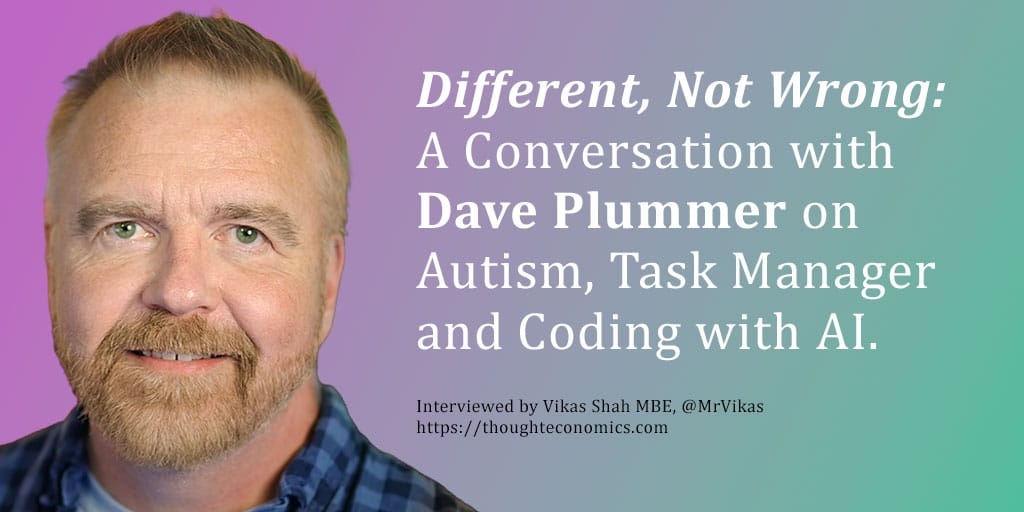
For three decades, the reflex of anyone whose Windows computer has frozen has been the same: Control, Alt, Delete, and a plain grey window listing everything the machine is doing, with a button to kill whatever has stopped responding. Dave Plummer began writing that program at home, for an audience of one, and Microsoft shipped it as Task Manager in Windows NT 4.0 in August 1996. A few years before that, a high school aptitude test had concluded that he was best suited to life as a chicken farmer or a mortician.
Plummer was born in Regina, Saskatchewan, in 1968, and met his first computer at 11, in a RadioShack where he helped the staff set up a machine he had never seen before. He dropped out of high school in his final year, wrote games for the Commodore 64, went back to finish school at 21 and graduated from the University of Regina in 1994 with high honours in computer science. By then he had already spent a summer as an intern in Microsoft‘s MS-DOS group. Over the following decade he wrote Task Manager, ported Space Cadet Pinball to Windows NT, built the ZIP folder support in the Windows shell and worked on Windows XP product activation. He left in 2003 to build his own software businesses, one of which, Xeriton, he sold to Support.com in 2009. Since 2018 his YouTube channel, Dave’s Garage, has drawn more than a million subscribers. Diagnosed with autism and ADHD in middle age, he wrote Secrets of the Autistic Millionaire (2021) out of the notes he began typing the afternoon he got the news. This year he released Task Manager OG for Windows, Mac and Linux, rebuilt from scratch with AI.
You might expect someone who learned his trade writing systems code by hand to be either dismissive of AI or giddy about it. Plummer is neither. He thinks AI, given a tightly defined task, is already a better engineer than he is, and that the writing of code is largely finished as a human job. What worries him is the apprentice. His image is Leonardo handed a CNC machine at 17, before he had learned to chisel, and he applies the same logic to his own diagnosis: he is glad he did not know he was autistic as a child, because he would have used it as an excuse. Both arguments are about the same thing, the value of doing the hard part yourself before anyone hands you a tool or an explanation. It sits alongside conversations in the archive with David Heinemeier Hansson on the end of hand-written code, Dame Stephanie Shirley on computing and autism, Steve Ballmer on Microsoft and Jaron Lanier on what technology does to us.
In this conversation we discuss what conventional measures of intelligence miss, why Microsoft’s interview process suited an autistic engineer, the gap between an explanation and an excuse, how Task Manager came to be written for its own author, the 107-page specification and the hospital week that produced its successor, what AI is doing to software engineering, why founders who are engineers struggle to let go, and why he cares only about the opinions of the people who know him best.
Q: As someone whose life in computing was built largely on things you made at Microsoft, I should start with thanks. You went from leaving school early to becoming one of the most recognised engineers in computing, then an entrepreneur and author. What do you think conventional measures of intelligence failed to see in you?
[Dave Plummer]: The standard cliché about education is that our system is built, effectively, to produce factory workers for the 1920s, and there are certain kids like me who don’t prosper in that environment. Every year in Canada we would sit the CTBS, the Canadian Test of Basic Skills, which is something like a high school graduation test, except that you take it in every grade, at that grade’s level, and it tells you whether you are reading at a third-grade level, for example.
In third grade I was always reading and writing at a seventh- or eighth-grade level, and doing science and the rest at much higher levels. But because I was autistic, my maturity hadn’t caught up yet. So you’re faced with a kid who is precocious and smart but isn’t developed enough yet to operate with the people he’s smart enough to talk to. You’re always left out. The kids your own age think you’re weird, the adults think you’re a kid, and you’re left to your own devices in a lot of ways, unless you find a good mentor.
So I went through the education system and put up with it, I guess. I didn’t do well until college, when I was doing things that I thought were important to me, for me. Everything up to that point had felt like forced, rote repetition.
Why Microsoft’s whiteboard interviews suited an autistic engineer
Q: You joined Microsoft as an intern in 1993, returned in 1994 and stayed until 2003. What was it about Microsoft that allowed you to flourish, at a time when few businesses understood neurodiversity?
[Dave Plummer]: Microsoft was a unique environment. I left in 2003, so I can’t speak to what it’s like today; I can only speak to Microsoft in the 1990s. At that time, you knew from the very first interview that things were going to be different, because it was a full-day interview, and that is a real challenge for somebody on the spectrum. You go through about five coding interviews, an hour each at a whiteboard with different people from different teams. There’s a lunch interview, and then there’s an evening social. So it’s a very full day, socially, for somebody on the spectrum.
But the beauty of it is that 90 per cent of it is spent with your nose to a whiteboard, writing code. So when you’re evaluating a candidate, it doesn’t matter what they look like, or their colour, creed, religion or anything else, because they’re facing the board and you’re reading their code as they write it. You’re trying to think as they think and understand their thought processes. Anybody who gets through that gauntlet is probably pretty smart and pretty productive.
Then they get in, and now they’re working at a company where, in my case, I had great imposter syndrome. I walked in and felt I had snuck in, that they hadn’t caught me somehow, and that I was the stupidest guy in the room, because at that time, especially in the 1990s, Microsoft was stocked with incredible talent. The guys who had developed MS-DOS hadn’t left yet. They had recruited Dave Cutler, Mark Lucovsky and the rest of the DEC Mica team over to Microsoft. There was no shortage of talent. So if you were somebody who believed in the meritocracy of coding, it was a good fit for you, and I very much was at the time.
An explanation, not an excuse
Q: You spent much of your life not knowing you were autistic. When you understood it, what did that change? I ask from my own experience: I’m somewhat on the spectrum myself, and I lived with anxiety for most of my life before I had the language for it. It made a massive difference when somebody said, you have this, and this is what it means.
[Dave Plummer]: There are two aspects to that for me. The first is that I always knew I was different, but I didn’t think I was wrong. I would get bullied for being weird, but I never felt, well, that’s my fault because I’m a s**z. I always thought it was other people not understanding me. So 40 years later, when I got a diagnosis, there were a lot of “oh, okay, that makes sense now” moments, whereas my wife says there were a lot of “aha” moments as we were learning about autism.
Q: A few years ago a psychiatrist put me through a full-day ADHD assessment, and when I told my friends the result, they said: of course you do. When you know yourself, you’re able to relate to others better. Is that something you’ve experienced?
[Dave Plummer]: Yes. I’ve had to make major changes in the ways I operate, or interoperate, with people. When I was first getting tested, I used to hang out at a mechanic’s shop, and there was a curmudgeonly old mechanic there. He has passed on now, but he was in his seventies, a Korean War or Vietnam War veteran, and a man of very few words. He was working on a carburettor with a cigarette hanging out of his mouth, and I told him I was going to get tested to see if I was a little bit autistic. He just looked up and said, “Just a little bit, huh?” So once I got diagnosed, everybody was unsurprised except me. I was shocked.
“I always knew I was different, but I didn’t think I was wrong.”
To go back to your last question, I think the big distinction is that I was not looking for an excuse, but it served as a great explanation for a lot of things. That’s the distinction I would make.
Q: In my limited experience, some of the most brilliant entrepreneurs, developers and technologists are autistic. Do you think it gives you particular advantages, whether in understanding complexity, in focus or in something else? Where has it really helped you succeed?
[Dave Plummer]: The biggest thing is this. The spectrum has many axes, so it’s hard to know what somebody means when they say they’re on the spectrum. But if you are autistic in the way that I am and, I don’t like to use the term, high-functioning enough to be intelligent enough to be a programmer at the same time, I think that combination makes for a very good software engineer. It doesn’t mean that being autistic will make you a great engineer. It doesn’t mean that being smart will make you a great engineer. But if you’re both of those things, there’s a good chance you might be a good fit.
For me, there’s also a certain level of obsession and dedication that comes with it. When I’m doing what they call my special interest, which would be cars or computers, I can spend 12 hours a day, six or seven days a week, at it until I’m exhausted. That kind of dedication isn’t something I have to will myself into. It just happens, and so it’s a gift for me. If you’re trying to fake that and compete with somebody who does it naturally, good luck.
Writing Task Manager for an audience of one
Q: Most of us spent the early Windows years pressing Control, Alt, Delete into your software to work out what had gone wrong. Of the things you’ve built that have become part of all our lives, what are you most proud of?
[Dave Plummer]: There are a lot of hidden pieces of code I’m really proud of that nobody will ever see. In terms of the visible pieces of Windows, I would say Task Manager and Pinball are probably the two that stand out, because they came about for very different reasons.
Task Manager came about because it didn’t look like the rest of Windows at the time. I was writing it largely based on having used top and ps on Unix in the past. I thought, I want to bring some of that experience and combine it with the way Windows does things with a GUI, and create a top for a GUI, basically. That became Task Manager.
I think the reason it flourished and did well is that I wasn’t writing it to a spec, or for an imaginary customer. I was writing it for me. Generally that’s a terrible idea, because I’m a computer scientist, an engineer. I want things to be complicated and to expose lots of nerd knobs and widgets. That’s a terrible idea for a paint program. But it works well for a task manager, because I’m trying to see all of the internals, gather a snapshot of the system state and see what’s going on in my machine. I want to be one with the machine, if you prefer. I need that information, and it presents it in a very straightforward way. Because it was doing exactly what I wanted, and that need overlapped with a lot of other people’s, it has been great: very popular, and long-lasting.
Q: What sparked the idea of rebuilding it from scratch? What have three decades in software taught you that made you want to approach it again?
[Dave Plummer]: It started with a friend who also worked at Microsoft at about the same time. We were having coffee and talking about AI coding, and he made the rather bold assertion that you could vibe code Office now, or Word, or Excel. I said I thought the spec for Word or Excel would be huge, just to tell the AI what to do, unless you were telling it to clone the existing app and use it as a template. If you had to describe all of Word or Excel, that’s a huge, multi-month project in itself. So I thought, what about a smaller project? What about Task Manager? I understand Task Manager well enough that I could write a detailed spec for what it should do, hand that to the AI and see what came out.
So I did that as an experiment. The spec was 107 pages, so it was fairly detailed. I gave it to the AI, and it cranked out a horrible mess. It all worked, but it wasn’t something you would want to use.
Then, by random coincidence, my son had to have his appendix out. I took my MacBook and sat in hospital waiting rooms for about a week. I had all this time on my hands, so I started tinkering with it: prompting it, refining it, changing the spec. Then he had to have a second surgery and a blood transfusion, so he was in there for quite a while. Fortunately, he’s all great now. But at the time there was a lot of downtime, and I could do nothing else but distract myself from the day’s problems by coding.
So I went through and added everything I thought a task manager should have: things I hadn’t thought of, things people have said to me, ideas other people have had over the last 30 years. And computers have come a long way in those 30 years. If your bar is that you don’t want to use more than two to three per cent of the machine to tell you about the machine, that’s a thousand times more information than I could show you 30 years ago, because machines are simply that much more powerful. We have GPUs, so you can do different visual styles and effects and phosphor bloom. So I decided to go back and rewrite it the way I would write it today. That’s really the short story of it.
What AI is doing to the craft of software engineering
Q: When I started in computing there was an apprenticeship through code, learning it the hard way. It felt as much a craft as chiselling a sculpture out of marble: a craft and a science together. Has this absurd amount of computing power, and now AI, made programmers better engineers, or less disciplined? Or has it changed the craft in ways we could never have predicted?
[Dave Plummer]: I think it’s the latter. It’s such a fundamental change in the way software is going to be produced that what we call a software engineer today is not going to mean the same thing in five years, and it almost already doesn’t. Right now, I would say that AI on a constrained task is a better engineer than I am. If you sit it down and say, here’s a very well-defined task, think about it for 30 minutes and give me your best shot, it’s going to produce something very good.
Once you get into the complexity of large architectures and complex systems, keeping track of things, compatibility and all the other things that come with real software, you need humans in the loop to guide it. Maybe one day you won’t, but today you still do. So what you’ve got is software engineers now being selected for their programme management and design ability. You still need to be an engineer to do AI coding effectively, but now you need taste, which you didn’t have to have before. You could rely on your programme managers to provide that, but if they’re providing it, they might as well just prompt the model. So you really want that one person who is something of a dilettante, who can understand the architecture, guide the AI in how it does its implementation, and write and define the tests, because the writing of the code, I think, is largely past.
Q: In some ways the software engineer is being elevated into an architect, with agentic layers doing the work. But there is still a whole set of skills around QA, knowing whether it is even doing what you want, and understanding the implications of what it delivers. What does it take now to be a great software engineer, or architect?
[Dave Plummer]: My secret recipe is to learn coding from the basics, practise it for 30 to 40 years and then have AI be invented at that point, because I think it’s going to be really complicated for people coming in now. How do you learn the craft? How do you learn to chisel those small strokes if you’ve got a CNC machine that can carve out the Venus de Milo for you? You get my point.
“Right now, I would say that AI on a constrained task is a better engineer than I am.”
So I don’t know how you would learn it effectively today, because you don’t get the luxury now of the grunt work: sitting down and hand coding and debugging for ten years, or whatever it takes you to get good at it. It wasn’t a luxury before, it was a need. Now it would be a luxury, if you had the time to do it, and I don’t think we do. So how people learn those fundamental skills, I don’t know. To go back to my art example, if you were going to give Leonardo da Vinci a CNC machine, would you do it when he was 17, or would you wait until he had already learned the craft? I think I would wait.
It’s the same with autism. It was good to know that I had autism, but I’m glad I did not know as a kid. I’m not giving that as advice for anybody else. But I think as a kid I would have used it as an excuse: well, I can’t do that, because I’m autistic. Kids are like that. Eventually, by the time you’re 25, your frontal cortex develops and you take some personal responsibility, so maybe that’s a good age to find out. That’s unless you’re really impacted, of course. If you’ve got a kid with autism in grade school today, there are accommodations that can be made. Thirty years ago, you just put up with it. So I can’t really speak accurately to the school situation today, but I think you want to be very careful about using autism as a crutch.
Q: Is that about resilience? When I learned about my own mental health later in my career, I was also glad I hadn’t had a word for it earlier, because it meant I fought harder. I could never say I can’t do this. I had to find a way.
[Dave Plummer]: I have ADHD as well, and I didn’t know until I was diagnosed with both at the same time. I knew that I had executive function issues. I knew I couldn’t track 15 items and give them all the attention they needed, that I wouldn’t start things in the right order, that I would leave it too late to start things, and all the things you tend to do with ADHD. Had I had a reason for being like that, I probably would not have tried as hard not to be that way, if that makes sense.
Q: What compelled you to write your book, Secrets of the Autistic Millionaire? I think it will inspire a lot of people who are thinking about their own neurodiversity. What did you hope readers would take from it?
[Dave Plummer]: The biggest thing was that when I got my diagnosis, we came home that very afternoon and I was somewhat shell-shocked by it. So I sat down at my computer and just started to write how I felt. I did that for a couple of hours, came back to it the next day, expanded it and added the story. Then I realised I was revealing a lot of information to myself that I wish I had known before. There had to be other people who would benefit similarly from the insights and amazing revelations I was experiencing through this diagnostic and education process, which I could summarise for them: here’s your list.
Chicken farmer or mortician
Q: I want to talk about drive. Most betting people looking at the start of your journey would not have predicted where it ended, and the same was true of me as a kid. What has been the thread that drove you, through Microsoft, your own businesses and your life?
[Dave Plummer]: I guess it’s some combination of resilience in a small domain, an obsession with finishing things, and not caring about other people’s perspective. I don’t want to say you get bullied so much that you stop caring what people think, but it’s something like that.
I remember in high school we had to do aptitude testing: coordination tests, intelligence tests, all kinds of things, like when you join the army and they’re trying to work out which peg you fit. My results came back as chicken farmer or mortician. I wasn’t really interested in chickens or dead people. But looking back, these are two careers where you don’t spend a lot of time talking to other humans. You get to do a complex job, and you get to do it by yourself for several hours at a time. It probably would have been a good fit. Or maybe I would have gone to truck driving school, for all I know.
When they told me these things, I just thought: huh, that’s interesting, but I like computers. They didn’t say I should be a systems analyst. They didn’t say I should be a software engineer. They didn’t say I should be a coder. They said I should be a chicken farmer. And I said, no, but I like computers. So I just kept doing computers. That willingness to ignore sometimes good advice has helped me in a number of ways too.
Q: We tend to remember technology companies through the charismatic founder, like a band’s frontman, but Microsoft, like Apple, was really built by armies of engineers whose names people don’t know. What do we misunderstand about how innovation happens in businesses like that? And how did it feel to be part of that process?
[Dave Plummer]: Bill‘s social status has shifted over the years. When I first went to Microsoft in 1993, we were getting married in the Catholic Church, and a nun came over and chastised me because she had heard that Bill was going to buy the Catholic Church. This was an urban legend going around at the time. But she didn’t appreciate it, she was quite angry, and she’d heard I was going to Microsoft, so she came and tore a strip off me. I just stood there and said, okay. So opinions varied, even at the time.
“That willingness to ignore sometimes good advice has helped me in a number of ways too.”
In the tech industry, though, he was considered a visionary and a very brilliant guy, and he is both of those things. But we weren’t sitting at our desks waiting for the next message from Bill to tell us what to do. Teams, especially in those days, had a lot of autonomy, and we went off and created things he never knew about. He’d find out about them later, in meetings. Task Manager wouldn’t have been big enough to register on his radar, but it’s not as though we asked for permission. That was just something I did, and then we wound up checking it into the product. I think you probably don’t have that level of autonomy at an Apple, or even at a Microsoft, now. It was a different time, but it was a good time to be there.
Q: Did you take anything from Microsoft, good or bad, into your own entrepreneurship, whether in approach or leadership style?
[Dave Plummer]: You would think so, but I failed to take the advice I’ve just given you. The story I’m telling you is that you don’t need a cult of personality. You need a whole lot of talented engineers working together, with good communication and collaboration, to produce a great product. When I had my company, I thought, yes, I’m going to do that, but I want to make sure they’re doing it. I’m smart. I want to make sure they’re doing it the way I think it should be done. So I would always insert myself into the technical decisions, when I really should have stepped back and said: you’re smart, I hired you for the right reasons, go and do your magic. But because I was an engineer as well as a founder, the engineer was hard to suppress, and I always tried to get involved in the technical issues.
Q: Your career has run through the PC revolution, the internet and smartphones. Something about this moment with AI feels different, perhaps as significant as the early internet. How significant is it, in your view?
[Dave Plummer]: I think, and I have thought for many months, or a year now, that this is as big as or bigger than the internet itself as a revolution in computing. This is not a small bump. It’s not just an inflection point. It’s not the change from punch cards to paper tape to magnetic tape to disk drives to floppy drives to hard drives. It’s a much bigger leap, and it’s changing everything about the way we do things. It may or may not change that much about the software that users consume, but in terms of the production of that software, it’s going to be radically different, for gaming especially. And for SaaS companies whose bread and butter is, oh, we’ve got these pools of engineers who go off and write little pieces of code, you don’t really need those guys any more. I’m pretty sure AI can crank out a SaaS extension pretty easily.
Q: When I interviewed David Heinemeier Hansson, he told me the latest version of Omarchy, his Linux distribution, was built almost entirely with agents. My last question is one I ask most guests. When you think about the impact you’ve had, through Microsoft, your businesses and your book, is legacy something you think about? How do you think about the echo you leave in the world?
[Dave Plummer]: Generally, I only care about the opinions of the people I care about. That’s something I’ve learned through a lifetime of being autistic: there are going to be haters, and it doesn’t bother me in the slightest. What matters to me is the perception of the people who know me best, and I’m comfortable standing on that without worrying too much about public opinion. I want the public record to be accurate, and there’s a Wikipedia page if you really want all the details. But I’m not trying to craft a grand story so much as get stuff done. If the stuff I get done along the way turns out to be noteworthy, that’s my reward. Not the personal acclaim that comes with it, but the “I made that, and you like it?” That’s a good rush for me.
—————————
Dave Plummer’s book Secrets of the Autistic Millionaire is available now. His rebuilt Task Manager, Task Manager OG, is available for Windows, Mac and Linux, and his YouTube channel is Dave’s Garage.