For most of medical history, obesity was treated as a failure of character — a moral problem dressed in physiological language, to be solved by willpower and self-denial. The class of medicines now traded under names like Ozempic, Wegovy, Mounjaro and Zepbound does something more radical than reduce body weight: it dismantles that framing. What we are looking at is not really a drug story at all. It is the story of a gut hormone — glucagon-like peptide-1, or GLP-1 — discovered in a Copenhagen laboratory in the 1980s, that turns out to sit at the centre of a wider physiological network linking the small intestine to the brain, the immune system, the cardiovascular system, and the metabolic regulation of nearly every major organ. To understand why, we must turn to the physiologist who helped place it there.
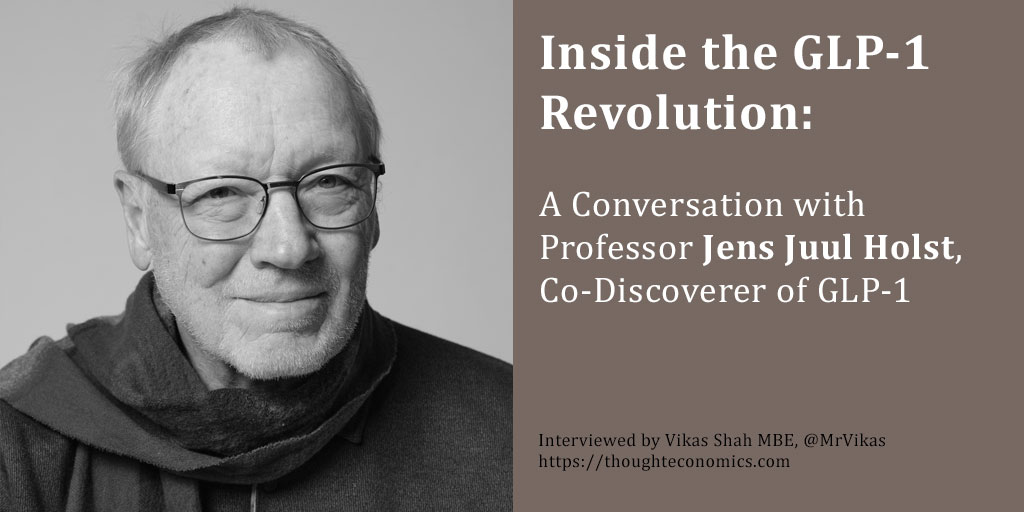
Professor Jens Juul Holst, MD, DMSc, is Professor of Medical Physiology at the University of Copenhagen and Senior Group Leader at the Novo Nordisk Foundation Center for Basic Metabolic Research. He is one of the original discoverers of GLP-1, the gut hormone that underlies semaglutide, liraglutide, tirzepatide and an entire generation of metabolic medicines. He is a recipient of the Warren Alpert Foundation Prize (2020), the Banting Medal for Scientific Achievement (2021), the Canada Gairdner International Award (2021), the VinFuture Prize (2023), the Tang Prize (2024) and the Princess of Asturias Award for Technical and Scientific Research (2024). He is also the lead author of The Story of GLP-1: A Historical Journey in the Treatment of Diabetes and Obesity (Elsevier, 2024, with Sten Madsbad, Jens Meldgaard Bruun and Mads Krogsgaard Thomsen). I spoke with him about how a single hormone became the most consequential drug class of the early twenty-first century, what we have learned about the gut as a metabolic and immunological organ, and the uncomfortable questions raised by mass consumer use of a therapy designed for disease.
[Q] Vikas Shah: People talk about GLP-1 as a kind of drug story, but actually it does seem the real story is about the gut, and how it operates almost as a neurological organ — a second brain from the perspective of metabolism. What is its mode of action, and what has this new class of drugs taught us about the body?
[A] Jens Juul Holst: The real physiological role of GLP-1 — which is what you are asking — is that we have these L cells sitting in the distal small intestine, and they are excited by food intake. They then signal that there is food in the distal small intestine, where there shouldn’t be any, so you had better stop eating. That signal is transmitted via the vagus nerves to the brain, telling it to stop eating. It also signals to efferent vagal fibres that inhibit gastric emptying, pancreatic secretion and gastric secretion. So it is, in fact, what we call an enterogastrone hormone — an ileal brake hormone — that sends the signal that enough is enough, stop. And probably also adjusts intake to the digestive capacity of the gut.
Then there is a caveat. We have a hell of a lot of these L cells in the colon as well, and honestly, nobody understands what they are doing there. They are obviously sitting there releasing GLP-2 as well as GLP-1. GLP-2 is perhaps a repair hormone for the intestinal mucosa, and GLP-1 co-acts with GLP-2 in those actions. So what we have in the colon may actually be a kind of defence system regulating the mucosal integrity of the body.
But on top of that, there are also so-called intraepithelial lymphocytes in the gut, and they express the GLP-1 receptor to a very large extent — really an impressive expression. The idea is that once you have GLP-1 released, it will also activate those lymphocytes, which means you have an entry point into the immune system. That is when you start taking care of immune reactions and setting that system in motion. That is what we know about it.
[Q] Vikas Shah: If we skip back, what was the moment on the journey when you realised the real transformational power of this class of medicines? Was there a classic scientific moment of excitement, or was there a hypothesis around this class of drugs that led to their discovery in a much more linear way?
[A] Jens Juul Holst: That is a long story. It started in 1973 with a demonstration that cholecystokinin would inhibit food intake in rats. From then on, people were thinking that satiety could be elicited by food in the small intestine — that gut hormones might do something to this. The cholecystokinin story is probably true, but is more or less dead because it was not possible to use the signal for any drugs. And then came ours: GLP-1, which could also apparently inhibit food intake.
The reason for looking for it was that the idea was already there. Cholecystokinin could do it, so let’s have a look at whether GLP-1 can also do it. It could. That was nice. Then came a formidable problem: side effects. It was clear that the effect on food intake was dose-dependent, but the more you gave, the more side effects you would also have. So you had to balance the two. The concept was that, in fact, the effect was not very large — just a few kilogrammes, three or four or five. That was not enough to change the world. It was not enough to please patients, not enough to satisfy their wishes and needs, and too small for anybody to think of making money on it.
What changed that was some brave experiments at Novo Nordisk, where they first looked at liraglutide and managed to give increasing doses, because it had been found in the meantime that by slow up-titration you could get up to higher doses. They did that, and eventually had larger weight losses — now we were at 7 to 8 per cent. That became Saxenda, the 3-milligramme dose of liraglutide, which was the first approved drug of this kind for obesity. So this was, in fact, a major milestone — but it was not a success, because 7 to 8 per cent was better, but not really enough.
In the meantime, we had developed semaglutide — I was there myself, so it was very interesting — which was obviously a better compound than liraglutide, given weekly. After the registration studies, we were standing there with a 6 to 8 per cent weight loss, just like Saxenda. It was better, of course, but not really exciting. So again a dose-response study was done with increasing doses, given every day to avoid the problem of large doses causing side effects. By that, it was possible to get up to 0.4 milligrammes per day, and all of a sudden there was a 14 to 15 per cent weight loss. That changed the whole picture. That gave the background for doing the STEP trials with 2.4 milligrammes of semaglutide per week, with a slow up-titration to avoid problems — which eventually resulted in 18 per cent weight loss in the STEP trials. And that changed the world.
[Q] Vikas Shah: Would it be fair to say that this drug class has changed our medical relationship with obesity?
[A] Jens Juul Holst: Yes, completely. Nobody in the beginning believed that it was possible to create an obesity treatment with this kind of drug. Nobody would pay for it. Everybody would say, “oh, it’s their own fault — they can just eat a little bit less, that’s all.” So nobody would pay for it, nobody would support it, no government would help; no reimbursement, no nothing. No company would dare to do this — except for the “stupid” Novo Nordisk company, who felt it was actually possible. And with the launch of Saxenda, they also launched a worldwide campaign lobbying for the use of these compounds for obesity therapy. They were everywhere, all over the globe, trying to convince people this was a good idea. A very difficult job, because there really wasn’t the support for it — until the good results with semaglutide came along.
[Q] Vikas Shah: What are some of the most exciting routes you are seeing for the application of this drug class — cardiovascular disease, sleep apnoea, kidney disease? It seems as if this new class of metabolic treatments is something quite unlike anything we have had before in medicine, with applications across many of our most chronic diseases.
[A] Jens Juul Holst: This was unexpected. The expectations came from the DPP-4 inhibitors, which had been around since 2006, when we were entering the period in which the FDA demanded cardiovascular outcome trials. So we had the first ones of those. SAVOR-TIMI with saxagliptin was the first to come out — and there was absolutely no cardiovascular benefit. On the contrary, there was an increased risk of heart failure in that study. People were fighting back and forth about this for a long time, until TECOS, the trial with sitagliptin — which was the largest and the best of those trials — came out with a completely flat result: there was neither an increase nor a decrease in cardiovascular risk. This was a GLP-1-based therapy, mechanistically, that did not influence cardiovascular risk. Then the first one of the GLP-1 agonists came out: the ELIXA trial with lixisenatide. That one was not negative — there was no increased risk, which was why the FDA demanded these tests — but there was also no benefit.
So the expectations immediately were that there was no harmful effect of the GLP-1s, but also no beneficial effects. Then, in 2015, came the SGLT2 inhibitors, with a demonstration of the formidable effects on cardiovascular risk with those. So it was extremely exciting to see the LEADER trial coming up, which was presented half a year later in the United States. The expectation was that nothing would happen. But the result was almost the same as with the SGLT2 inhibitors. There was a very significant effect in the LEADER trial, and that again completely changed the game — from no expectation to a positive expectation for a reduction. And that has remained ever since. Actually, it is still quite difficult to understand why the exenatide-based drugs are not really showing a cardiovascular benefit, because they aren’t — but that’s a different matter.
[Q] Vikas Shah: What therefore is the development pathway? Are we talking about next-generation drugs based on the GLP-1 principle for specific metabolic conditions? Or are we looking at next-generation drugs that preserve muscle, or avoid more of the side effects — a more standard development pathway?
[A] Jens Juul Holst: What happened after the LEADER trial was that everybody scratched their head and asked: how is this possible? Because this was unexpected, as I said. The immediate thing to do was, of course, a mediation analysis of the results — to see if anything in the database could explain the beneficial action. The only thing that came out as something remotely reminiscent of an explanation was A1c — the improvements in glycaemic control. But this would contradict a lot of clinical studies that had been done until then. So that was not really it. Then they tried to look at weight loss as the mediating factor. And again, no, that didn’t seem to be the case either.
Slowly — and very slowly, because this is liraglutide, which is not extremely potent, so it was not easy to find the really important things — they made progress. The risk of hypoglycaemia was lower. Blood pressure was lower. The use of rescue drugs, or drugs in the control groups like insulin (which is dangerous, of course), was reduced with the GLP-1. So these were the kinds of explanations people put up. They also started to look at the lipids and saw some improvements. Was that it? No. But searching everywhere, eventually people started looking at CRP — C-reactive protein — and then things started to roll in the direction of the immune system, of the inflammatory and anti-inflammatory actions of the compounds. That is today the major pathway people think this is acting through.
[Q] Vikas Shah: I want to come to the lifestyle part in a moment, but when we consider the impact of obesity on diabetes — now a massive area of study for you — have we really, given the relatively short time GLP-1s have been broadly on the market, understood the impact this is going to have on reducing the medical load of conditions like diabetes and obesity-linked conditions in the future? Because in some ways this functions as what would previously be considered a preventative for some of these conditions, which place massive burden on health systems globally as a direct result of obesity.
[A] Jens Juul Holst: All of this was unexpected, as I said. The entire development was unexpected. Nobody could really believe that this would happen. It was impossible to predict, given the information that was available at the time. This has really developed beyond — I must say — beyond everybody’s expectation.
[Q] Vikas Shah: What have been your views on the more widespread consumer use of it? At one end, there are people prescribed it because they are very obese, and it really helps. But we increasingly see — perhaps it’s the wrong phrase — GLP-1s almost treated as a lifestyle medicine in many areas. What are your thoughts on those applications, and is this something where we need to rethink our relationship with medicine, or do you think there are risks?
[A] Jens Juul Holst: Now that we know more about it, it is easier to see where it fits in. And where it fits so incredibly well is in what we used to call the metabolic syndrome — what today we call the cardio-renal-liver-everything metabolic syndrome. That is because we now know GLP-1 has an influence on all of these conditions, and that these conditions are associated with what we think is a generalised low-grade inflammation, which is harmful. Here we have a compound that quite surprisingly addresses this very effectively. Where we previously said, “OK, there is kidney disease, there is liver disease,” and so on, now we say there is a metabolic complex — a problem with a common root, namely low-grade inflammation, and other metabolic disturbances common to all the tissues, and vascular problems common to all tissues, to the brain, to everything. And we have a compound here that, as one of its main functions, really addresses precisely this.
The first thing it does, of course, is reduce the adiposity that causes some of the problems. Then it remedies the inflammation and the toxic consequences of obesity. That is what it does, apparently. Which means there is a big group of people for whom this is a good solution. That is point number one. And that will have, as we have talked about, life-saving and complication-saving consequences, which is really amazing.
On the other hand, it is also a powerful regulator of food intake, appetite and reward — which, by the way, is one of the mechanisms by which it reduces food intake. So if somebody develops obesity and is very unhappy about it, deeply depressed, then there is something you can do about it. It also works for obesity viewed in isolation. If an individual considers it a problem, then there is a solution. Amazing — but that’s the fact.
[Q] Vikas Shah: My worry is that when a treatment is this effective, it sometimes almost becomes part of celebrity culture, of lifestyle culture — and it’s very difficult to moderate how consumers interact with medicine.
[A] Jens Juul Holst: The important thing is that you can really do something about these problems that are out there. But that is why I still think it should remain a prescription drug — that you have to see your health provider to get a prescription, because you need instructions at the same time on what to do and how to do this. There are two very important instructions. The first is to adjust the diet — for several reasons. It supports the weight-reducing effect of the treatment, but even more importantly, it maintains your lean body mass, your muscle mass. You need sufficient protein and vitamins and all the compounds where there is a risk of shortage because of the decreased food intake — and it is a major decrease in appetite and food intake.
The second is that you need to exercise a little bit. You need to maintain your physical activity. The good thing is that you can do it, because it is easier — you weigh less, your joints feel better, everything is getting better. So you can do it. But it is just as important, again, to maintain the muscle mass. And the older you are, the more important this aspect is — so you do not end up as a kind of cripple because you have lost your muscle mass. You will lose muscle mass because of the weight loss. There is no specific additional muscle loss with these compounds, but there is the loss of lean body mass associated with the weight loss. So it is very important that you get these instructions and that they are followed up.
You also need to know: you should not stop. You should not stop taking your therapy, because if you do, you will regain the weight — not as lean body mass, but as fat. Then you may end up worse off than you were before. Those are the very important aspects you need to address.
[Q] Vikas Shah: One of the fascinating parts of this journey for me is the long time between the basic discovery and the drug being ready. I wonder what you have learned about that — because so much of the pressure on drug discovery right now is about immediacy and speed, whereas so much of the discovery aspect of GLP-1s was really couched in basic physiology.
[A] Jens Juul Holst: You have to realise that there were no expectations from these compounds at all. There was no pressure to move fast or do anything, because nobody expected anything. On the contrary, we had these formidable problems with side effects that had to be solved. That was one of the reasons for the many years it took to get anywhere with this.
I was an advisor to Novo Nordisk on the phase two trials, and we were so afraid of the side effects that we advised them to use doses that were too small. So the entire phase two programme was unsuccessful — there were no side effects, but there was also no effect of the drug. They had to make a completely new phase two protocol, a new study, which was pretty expensive. They didn’t like us in those days. Those were some of the problems.
Another formidable problem was with the C cells — the thyroid C cells, with the calcitonin production and the tumours that arose that way. This was a drug that caused tumour formation in two species. It is unheard of that you can approve a drug like that. So it took quite a while to make sure that there was a difference between the species — that humans and monkeys did not have a stimulated C-cell secretion and did not develop the tumours. Fortunately, that story is dead. There isn’t any risk in people from that. But it took years.
Then came the pancreatitis and pancreas cancer business, which delayed the whole thing for years — people saying this is causing pancreatitis, this is causing cancer, this is so dangerous. And all the lawyers in the United States were trying to make money on it. So these were some of the big fights that had to be fought, until this was successful.
[Q] Vikas Shah: Right now there is such negativity in the public domain around pharmaceutical businesses, but I think GLP-1s are one of the best recent case studies of why you need the scale and reach of the big global pharmaceutical companies to enable a real breakthrough drug like this. Do you think that was a key factor — and how can we learn from this about the positive role those global businesses can play?
[A] Jens Juul Holst: As I said, the beneficial cardiovascular effects were unexpected. You cannot really give credit to anybody for this discovery, because it was unexpected — it came as a relief, yes, but actually as a surprise. So it is difficult to predict what you should have done to promote it if it comes as a surprise. I don’t know what to say. Otherwise, this is not the only field where there are major advances and breakthroughs occurring in medicine. There are many, many other fields of importance. It is just that this one has such a big part of the population as potential customers that it is incredibly huge as it is.
[Q] Vikas Shah: A roundup question I ask all my guests is about legacy. When I look at your career and the impact your work has had on literally millions of people around the world — that is a huge impact. But when you think about the impact you are making in the world, your own legacy, what do you think your legacy is?
[A] Jens Juul Holst: What I have provided is physiology — and I have provided it to the pharmaceutical industry. That is what I have done all the way through. I am still a physiologist. I am not absorbed by the pharmaceutical industry. I am not paid by them. I do not have shares in any company. What I have done is stuck to my laboratory, to the science, and then tried to explain that to the companies — to say, look here, this is interesting.