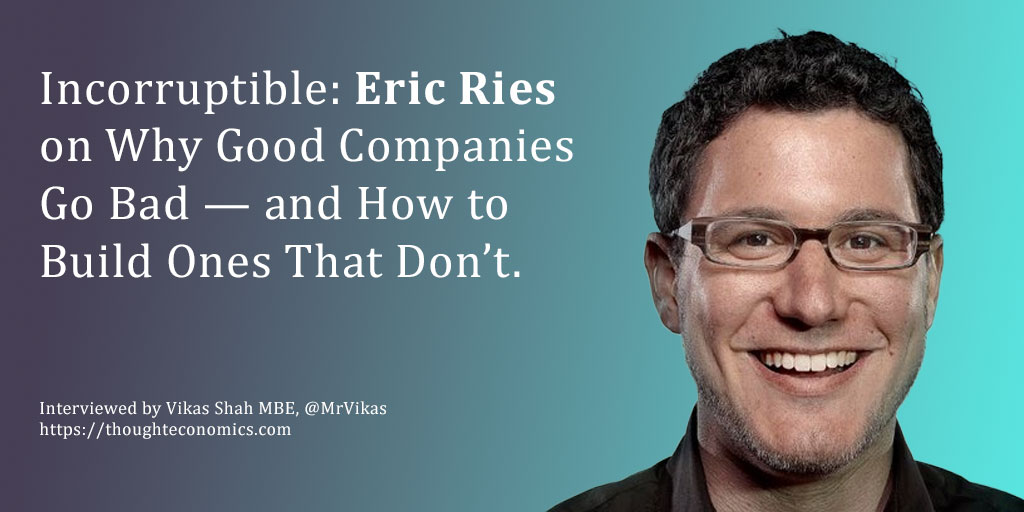
Eric Ries transformed the way a generation of entrepreneurs built companies. His New York Times bestseller The Lean Startup gave founders a rigorous methodology for turning ideas into products and products into viable businesses: build, measure, learn, iterate. The book became a global phenomenon, influencing not just Silicon Valley but corporate innovation programmes, government agencies, and university curricula worldwide. But in the years that followed, Ries watched with mounting horror as many of the companies he had helped build were, in his words, “surgically deboned”. Founders were ousted, missions abandoned, and products hollowed out, not because the businesses had failed, but precisely because they had succeeded. Success itself had made them targets. That reckoning led Ries to build the Long-Term Stock Exchange, the first new exchange to both list and trade stocks since the creation of NASDAQ fifty years ago, and to co-found Answer.AI, an AI R&D lab. As an entrepreneur, investor, and former entrepreneur-in-residence at Harvard Business School and IDEO, Ries has spent two decades at the intersection of innovation, governance, and institutional design.
His new book, Incorruptible: Why Good Companies Go Bad… and How Great Companies Stay Great (Authors Equity, May 2026), is the product of that reckoning. Ries argues that corporate corruption is not primarily an ethical failure but a structural one: the predictable result of companies that were never designed to withstand their own success. He introduces the concept of “financial gravity”, the invisible force that pulls successful companies toward short-term extraction, and offers a concrete blueprint for resisting it: the “spiritual holding company”, a governance architecture already used by some of the world’s most enduring organisations, from Novo Nordisk to Patagonia, Costco, IKEA and Cloudflare.
What gives the argument its force is that Ries is not an outsider throwing stones. He wrote the manual. A generation of founders built to his specification, and he has spent the decade since watching what happened to them next, in many cases from a seat on the board or a chair across the table. The book is closer to a confession than a critique: an admission that the methodology told founders how to build something worth having and said almost nothing about how to keep it. His answer is deeply unfashionable. Not better people, not stronger values, not culture. Structure. Drawing on data showing that mission-controlled companies are six times more likely to survive to their fiftieth year, he makes the case that governance is not bureaucracy; it is the most important product a founder will ever design.
In this conversation, we spoke about why success is the real threat, what a Danish physician with a fatal diagnosis worked out about corporate structure a hundred years ago, why the amorality of investors turns out to be a gift, why profit should be redefined as the maximisation of human flourishing, and why the structures we build around our organisations matter more than the intentions we bring to them.
The Paradox of Success
Q: You argue that companies don’t fail because they struggle, but because they succeed and then lose their way. Why does success trigger the very behaviours that undermine what made the company great in the first place?
[Eric Ries]: I was talking to someone the other day and they were telling me about one of their favourite brands. They said, “Man, I hope they make a lot of money. I hope they’re successful.” And then they paused and said, “Actually, no. I hope they’re successful enough to make money, but not so successful that they get taken over by private equity.” They didn’t want the company to go public. They didn’t want it to be acquired. They just wanted it to be able to make a living serving them and making an awesome product, without selling out and the product ending up terrible.
That experience is so universal today that we hardly even know what to call it. What we’ve done is create an economy where there are many, many ways to make money without creating any value at all. We have these vultures, people captured by this force I call financial gravity, who are constantly looking for opportunities to take something beautiful, something that’s working, something that’s making money, and squeeze cost out of it to make a little more money.
The problem is that we have an economy that rewards people for cost-cutting but doesn’t hold them accountable for the consequences of that cost-cutting. When they make the product disgusting, as long as people still buy it, we celebrate that. They get to make tons of money. So we’ve created this environment where every company is under tremendous pressure to turn extractive, to turn away from value creation and towards what’s called shareholder primacy, squeezing money out for its investors. And so, yeah, we have to stop that.
In the book, I use the parable of the goose that laid the golden egg to explain this dynamic. The more golden the goose, the greater the temptation to butcher it. Success makes you a target. It makes you something worth capturing. If you don’t reckon with that, you are almost guaranteed to lose control of your company.
The book tells the story of Sol Price, who founded FedMart in 1954 with a radical philosophy: cap margins, pay workers double the prevailing wage, and treat customers as clients you’re duty-bound to serve. By 1975 he had forty stores and annual sales north of $350 million. But his investors saw those principles as missed opportunities to make more money. They ousted him. Then, driven by their new ethos of greed, FedMart spent $150 million trying to replace his philosophy with conventional practices. By 1982, all forty-six stores were closed. Eight thousand workers lost their jobs. The investors killed their own golden goose.
And that pattern, I call it the “enlightened capitalism” fallacy, has repeated for more than two hundred years. Entrepreneurs like Sol Price and Robert Owen before him at New Lanark Mills in 1800 discover that treating employees, customers, and communities well creates exceptional financial results. They assume the market will reward and protect what they’ve built. And then they watch helplessly as what they’ve built is systematically unravelled. The cruel irony is that these companies don’t fail in the marketplace; they’re often thriving at the very moment they’re dismantled. From FedMart to Polaroid to Cadbury to Whole Foods, the pattern is identical. The Whole Foods story is actually the most devastating case study in the book: a company that was profitable every single quarter, right up until the end, yet John Mackey still couldn’t protect it because the governance structure left it defenceless.
Redefining Corruption
Q: You redefine the very notion of corruption. We think of it as bribery, “I’ll give you fifty quid if you do this for me”, but you’re arguing there’s a whole different type of corruption happening under our noses that we don’t take seriously.
[Eric Ries]: We don’t see it. Our grandparents and great-grandparents would have seen this very clearly. I think it’s actually a very recent development that the word corruption has had its meaning narrowed beyond all recognition. Insider trading has been almost completely legalised. We have betting markets, all kinds of legalised gambling. We’ve turned the stock market into a casino. There are so many places where we’ve replaced investment with speculation. Our grandparents would have been super clear that this is not just morally dubious; a lot of those things would have been crimes in their time.
Stock buybacks were illegal until the 1980s. It would have been a crime to do a stock buyback. In the 19th century, if you tried to take over a company that was chartered to do a specific thing, run a railroad or dig a canal, it had every right to resist you. Today, we say boards of directors have a fiduciary duty to liquidate the second someone wants to buy. But in the 19th century, it was obvious that of course that’s not appropriate.
And if you succeeded in taking a company over and tried to change its corporate charter from “make a railroad” to “maximise shareholder value”, that would have been seen as a crime. The courts would void your charter as ultra vires, beyond the scope of what was originally chartered. So this is a very recent development. I think we absolutely have to reclaim the word corruption to apply to any way of making money without creating value.
The Founder’s Illusion
Q: Is this where founders get it wrong? As an investor in startups, I’ve seen the illusion of control as companies scale. What’s your message to founders who simply don’t understand that they’re probably not in control as much as they think they are?
[Eric Ries]: If you follow the best practices that your lawyers, investors, and bankers recommend, there’s an advisory industrial complex of people who will tell you there’s only one option for how to structure a company. And that’s already a tell that they’re trying to deceive you, because how could it be the best if it’s the only? If you follow those best practices, you are almost guaranteed to lose control of your company.
There’s a Harvard Law School study that showed that for companies with standard governance among venture-backed companies, only about 20 per cent of founder CEOs will still be CEO three years after an IPO. Every founder thinks, “Well, I’m in the 20 per cent.” And I’m like, good for you. But the problem is, I’ve been the Cassandra warning these companies. I just saw the news about what’s happened to Allbirds. I remember sitting with them being like, “This is coming for you.”
But what happens is founders talk to their bankers, advisors, VCs, board members, and they all say the same thing: “Oh man, Eric is such a downer. If he really believed in you and your vision, he would realise you’re going to be the exception.” Because they’re always pumping founders up and telling them what an exception they are. And it’s no sweat off their back when the company is betrayed; they generally make a lot of money when that happens.
I tell a bunch of stories in the book about companies like this. One went public. I warned the CEO. He was replaced within five months. Did he make mistakes? Sure. Was there something wrong with the business model? Almost undoubtedly. But had he really earned so little grace after having built this company up from nothing over years of his life, not even six months? That’s what passes as a best practice.
Most founders are terribly naïve about this and are almost setting themselves up for failure because they’ve been told that success will protect them. Just get product-market fit. Just make money. Once you have success, success will give you power, power will give you freedom. Which is true, but there’s a countervailing force that people do not understand. The more golden the goose, the greater the temptation to butcher it. Success makes you a target. It makes you something worth capturing.
The New Governance: The Spiritual Holding Company
Q: You argue it’s not product, strategy, or culture, but governance that’s the most underdeveloped muscle in business. Why has governance been so neglected, and what are the core pillars that need to be in place from the beginning?
[Eric Ries]: In the book I argue for what I call the new governance, which has four pillars: compliance, purpose, coherence, and integrity. Rather than go through it theoretically, let me answer by way of a story, one of my favourites in the book.
It’s about a woman named Marie, Marie Krogh. She lived in the 1920s in Denmark. She was one of the first women to become a physician, a big advocate for education, particularly for women. She happened to be married to August Krogh, who won the Nobel Prize in Medicine. So she gets the good news that he’s won the Nobel Prize pretty close to getting the bad news that she’s been diagnosed with diabetes, at a time when diabetes had no known cure.
Despite having the fatal illness, her husband convinces her to accompany him on a lecture tour of North America. At one of the dinners being hosted in his honour, she meets another scientist who tells her about these Canadians who have figured out a way to isolate insulin. She convinces her husband to extend their trip to Canada to meet these researchers. They see the breakthrough for themselves, realise its life-saving potential, and ask: can they license the technology and bring it back to Denmark?
The Canadians say yes, but all four people involved that day share a concern. If you embody this life-saving cure inside a for-profit company, there’s going to be a problem down the road. If you have a drug that someone needs literally to survive, of course you should charge a fair price. But what if one day you say, “Wait, if your life depends on this drug, can’t I charge you anything I want?”
So they came up with a solution. They would license the technology and embody it in a for-profit company, but that for-profit company would be a subsidiary of a non-profit foundation responsible for overseeing its scientific mission. What I call a spiritual holding company: an entity that embodies the spirit of the founders’ intention.
That structure has lasted for more than a hundred years. This is, of course, the story of Novo Nordisk, one of the largest companies in the world. That structure has proven itself resilient against every kind of golden goose activity. There was even a time when the for-profit subsidiary wanted to liquidate itself to make a few dollars and the trustees of the foundation had to intervene. That intervention, I know this sounds like an exaggeration, but you can check the data, literally created more than $500 billion of shareholder value. From non-profit trustees. And it’s still going. It’s a publicly traded company, trading a million shares a day on the New York Stock Exchange.
Whenever someone is starting a company now, I ask them: “Look, you’ve talked to your lawyers, your bankers, your VCs. They’re all very credentialed. But are you sure they’re smarter than a Nobel laureate?” Because August and Marie figured this out a hundred years ago, and it worked. It’s not just Novo Nordisk; their breakthrough is part of a whole class of companies structured this way. Such companies are six times more likely to survive to year fifty: a 60 per cent probability versus 10 per cent for conventional companies.
Governance has become very convenient for a lot of people to hide behind by making it sound boring, complicated, and not really related to the things we get excited about: mission, product, culture. But my contention is that if you don’t get the governance right, in the long run nothing else you do will matter, because you won’t be the one making the decisions.
And Novo Nordisk isn’t unique. In the book I tell the story of Grundfos in Denmark, founded in 1945 by a toolmaker named Poul Due Jensen who made a water pump for a local farmer. By the 1970s, he was in his sixties and worried about what would happen to his life’s work. He didn’t want to sell, didn’t want to go public, didn’t want to saddle his children with an obligation. So in 1975 he transferred majority ownership to the Poul Due Jensen Foundation. He died two years later, but the foundation has steered Grundfos for nearly half a century since. Today it has over twenty thousand employees and more than $4.5 billion in revenue. The foundation structure allows them to invest 5 per cent of revenue in R&D, maintain a 68 per cent equity ratio, and invest counter-cyclically during downturns when competitors retreat. The same pattern shows up at IKEA, Bosch, Zeiss, Rolex, and even Anthropic, the company behind Claude AI. As Airbnb CEO Brian Chesky once told me: “The greatest product Steve Jobs designed was Apple. Your company is the most important product you’ll ever design.”
Persuading the Investment Layer
Q: How do you persuade the investment community that alternative governance structures are not a drag on value creation, but an amplifier of it? A lot of founders are scared to even suggest this to their investors.
[Eric Ries]: Oh my God, investors can be very, very annoying about this. I actually have a whole section of the book called “How to Talk to Your Investors About It.” This book took me more than two years to write, and during that time I just wrote down every single objection that every company I was helping heard from an investor. I had a long list. And then I wrote: here’s how you answer every single one. We were able to overcome them all.
Because at the end of the day, if you’re the founder, it’s your vision. I love these bold contrarian VCs who are like, “We love bold contrarian founders!” but then say, “But you don’t want to be too different from other companies, you might not be able to raise money.” It’s like, oh, my kingdom for a bold contrarian. Now I should be like everybody else?
The good news is, and this sounds like a criticism, but it’s not, most investors are frankly amoral. They just don’t care. They’ve been told this is the best practice and they don’t want to embarrass themselves in front of their partners or their LPs. But at the end of the day, they just want returns. They don’t look that closely at how the returns are gotten.
I used to find that infuriating. But I realised over time that the amorality of these investors is actually a gift. It means we don’t have to convince them of our values. They’re not opposed to what we’re trying to do; they just don’t care. So what you have to show them is that this is good for returns, and you’ll generally get them there.
In the book, we have so much evidence that this is the case. Studies of tens of thousands of companies showing that some of these techniques exhibit dose response: a little bit is good, but more is better. In terms of pure economic returns: revenue growth, profitability, investment in R&D, counter-cyclical investment, Tobin’s Q, all these financial metrics are shown to be superior for these kinds of companies. If an investor isn’t willing to be convinced by that evidence, you have to ask yourself: are they really the right partner for you?
I describe something in the book called the three laws of financial gravity. The first law is that gravity overrides direct authority: a National Bureau of Economic Research study of 401 CFOs found that 78 per cent would intentionally cancel profitable projects if it meant hitting analyst targets. That’s executives knowingly destroying the value they were hired to create. The second law is that gravity works through perception: it doesn’t matter what investors actually want; it’s what employees and managers perceive that they want. And the third law is that gravity is a function of size imbalance: the larger the resource disparity, the stronger the gravitational pull. So a single big client or a single large investor can warp the entire behaviour of an organisation without ever asking it to change. These laws operate whether we acknowledge them or not, like physical gravity. The only question is whether your structure is designed to withstand them.
Why the Exceptions Remain Exceptions
Q: Given how viable these models are, and given how much more value they create, why have the exceptions, Patagonia, Costco, Novo Nordisk, remained exceptions?
[Eric Ries]: This is a very common argument. Someone emailed me after reading a draft of the book and said, “Look, this is very simple. If it was really true that mission-driven companies had a competitive advantage, then just through Darwinian natural selection, they would dominate. Therefore, it must not be true.” That sounds so clean and has the scientific rigour of natural selection. There’s just one problem with it: it assumes that the market selects for value creation.
This is one of the biggest myths that we are all taught as entrepreneurs, and it is manifestly untrue. We started with the reason it’s not true: there are too many ways to make money by destroying value. Could you imagine a policy regime in the future where the market did select for value creation? Of course. But that’s not the world we live in today.
Unfortunately, there is tremendous class solidarity among the incumbents. You want to study solidarity and collective action? Don’t study unions, study banks. They understand how to close ranks when the time comes. And if they feel their prerogatives are threatened, they can be very ruthless. I give a lot of examples in the book of companies that were at the height of their success and were dismantled. They call them “unusual failures” because the failure was caused by the success, by the temptation that success drove.
Even good investors turn bad when the temptation is high enough. This is a structural, systemic thing. The biggest tragedy to me is this mutual distrust: increasingly, founders are avoiding investment altogether because they view taking investment as a form of corruption. Like Patagonia, they refuse to do it. I don’t want to live in an economy where the most mission-driven companies can’t take outside investment and therefore grow more slowly, while investors are unable to access those companies as a source of future growth. We have to create structures that make it safe, so that the vision and the mission can be protected even when investors are involved.
Redefining Profit as Human Flourishing
Q: You argue that the word profit isn’t bad, but we need to redefine it as something multi-dimensional, not just cash.
[Eric Ries]: Profit is one of the most important things in the world. I think profit is good. But you have to define profit properly. If you take an economics class, you’ll learn that our conventional definition of profit has massive problems. It doesn’t account properly for deferred liabilities. It doesn’t account for negative externalities. It doesn’t properly account for unit costs of production because of all these intangible costs that can be absorbed. And of course, we have lots of products that cause the destruction of a human life as a side effect of producing them. That’s not accounted for.
So my view is: if the conventional definition of profit is so bad, why do we have to use it? Let’s just change it. We’re allowed to change it. These things are not inscribed on stone tablets. In fact, in our modern economy, most public companies publish their own definition of profit anyway. They don’t even agree amongst themselves. So it’s not that radical to say: let’s pick a good one.
My view is that what it means to make a profit is to maximise human flourishing. It just means that you left the world better off than you found it, and you gained some profit for yourself in the process. But we have to build organisations that can take that definition seriously, otherwise they’ll be warped by financial gravity into the more extractive definition we use today.
Trust: The Most Underrated Asset in Business
Q: How do we adapt legacy businesses, big organisations already locked into conventional structures, to think about profit and mission differently?
[Eric Ries]: These organisations have to choose: adapt or die. If we start to build startups that have this structure and gain this competitive advantage, it creates pressure on everybody. Not all the techniques in the book are harder to adopt later. Some things any leader can adopt at any time.
Take, for example, this question of trustworthiness. I view trustworthiness as the most underrated asset in business today. Companies that can be trusted get all these unbelievable benefits: customers are more willing to buy their product, the cost of acquiring those customers is lower, the cost of retaining them is lower. They’re more likely to try your new product. They’re more likely to stick with you after you make a mistake. Employee loyalty is much higher. Contracting costs are lower when partners can trust each other. Trustworthiness is an incredibly valuable asset.
But unfortunately, the things that build trustworthiness, when you stack rank them by ROI, always stack rank as ROI-negative, by definition, because trust for most companies is an intangible benefit, but the costs of acquiring it are very tangible. Because we have an economy that rewards cost-cutting but not value creation, we miss these opportunities.
In the book I have a bunch of leadership techniques for how to cause your organisation to become more trustworthy. I always ask people: “Tell me, who would you rather die than betray?” Is there anybody on that list, or is it just shareholders? If it’s just shareholders, don’t expect anybody else to trust you. But for most people, there are people on that list they’re very serious about. By making those commitments, by teaching employees how to follow them and how to make trade-offs more intelligently, you can become much more mission-driven.
I call this principle “harder is easier”. It sounds counterintuitive, but the companies that choose the harder path, capping margins, paying above market, giving away premium features, end up with less friction, not more. Costco still sells its hot dog and soda combo for $1.50, the same price as in 1985, even though it costs them money. When their former CFO told co-founder Jim Sinegal that they were losing money on the hot dog and needed to raise the price, Sinegal’s response was: “If you raise the price of the hot dog, I will kill you.”
That $1.50 hot dog is proof of character. It’s a daily demonstration to every customer that Costco takes its commitments seriously. That proof of character is why Costco is a $400 billion company. What looks like an irrational cost is actually their most powerful competitive advantage. The hard path, the one that depletes short-term profit, is actually the one that builds unshakable loyalty. The easy path, the one focused on maximising every transaction, is the one that creates all the friction: turnover, distrust, employee disengagement, customer churn. Companies get to choose which kind of hard they want. There isn’t an easy way.
Innovation, Crisis, and the Right Pace of Change
Q: Does this mission-driven approach with a spiritual holding structure actually set better guardrails for innovation, performance, and big decisions, particularly in an era of AI and relentless quarterly pressure?
[Eric Ries]: That’s what the evidence shows. I wanted to put a lot of this research in the book, and I had to stop because the research is all the same. There are hundreds of case studies and meta-studies that look at companies with these different structures. And they all say the same thing.
During a recession, such companies are more likely to raise wages than cut wages. They’re more likely to hire people than lay them off. They’re more likely to invest counter-cyclically. As a result, when the crisis passes, they’re better equipped. They grow faster because they actually invested in their future growth instead of having a knee-jerk reaction.
They tend to be both more responsive to conditions when real things change, but less likely to be knee-jerk, jump-with-the-herd companies. It’s a very distinctive combination: they’re capable of rapid response and they’re also capable of deliberative action. It’s not that they never make mistakes; it’s that they have a system for addressing those mistakes and improving, rather than jumping with the herd.
You’re going to see this with a lot of companies now that missed the AI wave and are scrambling to play catch up, throwing stuff at the wall to see what sticks, laying people off left and right. You can just feel the lack of integrity as they run with the herd rather than think for themselves.
Ethics, AI, and Organisations as the First Artificial Intelligences
Q: Does mission extend to businesses really thinking about ethics and morality, the philosophical parts that have been largely ignored in modern capitalism? Especially in the age of AI?
[Eric Ries]: It’s absurd how we teach this today, as if ethics is an afterthought, when I feel like it’s one of the most important parts of business, period. AI really brings these contradictions to the fore. I view AI not necessarily as something brand new, but as an amplifier of trends already underway.
I think partly because organisations are the first artificial intelligences that humanity ever created. They’re in the same philosophical category as generative AI. They’re emergent intelligences. That’s what they are. Emergent intelligence has emergent properties. And people have really slept on the extent to which this matters. In the book I describe a fascinating 2024 study from the Weizmann Institute where researchers gave individual ants a puzzle, moving a T-shaped object through narrow slits. Individual ants were terrible at it. But when they tried larger groups, something extraordinary happened: the ants developed collective memory, learned from failed attempts, and found solutions no individual ant could discover. Some groups of ants even outperformed individual humans. Scientists call this emergent intelligence. MIT researchers found the same thing in human groups: teams develop measurable collective intelligence, their own moral compass, and decision-making patterns that persist across leadership changes. Organisations are superorganisms. They’re every bit as alive as you or me. And if you don’t design their character intentionally, they’ll develop one on their own, one that may have nothing to do with the founder’s values.
If customers can’t trust you, all these problems come into the fold. Companies that have no ethics or moral core are fundamentally untrustworthy. I can’t tell you how many people I meet in business who say, “Business is already so hard. I can’t get my employees to do the right thing. Customers are so fickle. Partners abandon me at the drop of a hat.” And then they say, “Now you want me to do extra? It’s already too hard.”
And I have to say, with all respect: is it possible that part of the reason you find business so hard is because nobody trusts you? What if they did trust you? I work with companies in that trap, and I also work with mission-driven companies. Every conventional company is the same: “Oh, it’s political, it’s difficult.” But the mission-driven companies are like, “I don’t know why everyone complains about this. People say Gen Z doesn’t work hard? Our Gen Z people work really hard.” If you’re mission-driven, people love being in the office. It’s not a drag to work there. What’s that worth? Most companies are incapable of quantifying it.
Every organisation is actually a little bubble of utopia. It’s somebody’s idea of the proper power relations between human beings. It’s a work of political philosophy, whether the person was aware of it or not. Unfortunately, business today is attracting people who revel in being unreflective, who brag about how little morality and values they have as if that’s a source of strength. We’ve built a baseline set of very sociopathic values into our financial system. But it doesn’t have to be that way.
You Are Traffic: Consumer and Employee Power
Q: What can individuals do? As consumers, employees, citizens, how does standing up for our own values create the conditions for systemic change?
[Eric Ries]: Don’t just wait for someone else to solve the problem. Incorporate your values into your decision-making today. One of the craziest things about living in the era of surveillance capitalism is this: every decision you make, even if you keep it a secret, even if you never tell a single human being, every decision you make is some middle manager’s bonus target. It’s in somebody’s OKR and performance plan. There are probably multiple managers out there who have the responsibility to either get you to do it or do the opposite. So every time you make a choice, that action sends gravitational ripples out through the whole economy.
In the book I call this chapter “You Are Traffic”, because you’re not stuck in traffic, you are traffic. Companies spend untold millions trying to decode what they call your “willingness to pay”. Will customers pay the extra three cents for the healthier ingredient? Should we add features or remove them? Raise prices or lower them? The analysis almost always comes down to one thing: what will you do? Every click, every swipe, every like, every purchase fuels their algorithms. And the same obsession appears everywhere: employment brand, customer retention, switching costs, capital inflows, customer lifetime value. They all boil down to the same question: what will you do?
A lot of these companies are addicts. They’re obsessed with you. They’re desperately trying to figure out what you’re going to do. They constantly sit there like a miser: “What can I get away with? If I do this, will they still buy it?” They’ll squeeze and squeeze. “What can I do to my employees before they’ll quit? Will they put up with this?”
I’m not saying you have to burn the office down. But if you just stand up for your own values in all the things you do, big and small, you create the conditions for the possibility of collective action. It’s a simple choice, but I think actually a more courageous one: to try to live in integrity with yourself, and see what happens.
The Cloudflare Story: When Mission Creates a $70 Billion Company
Q: In all your research, was there a company you came across where on the outside we’d think it’s just some big money-generating machine, but in reality there was genuine mission and beauty in how it ran?
[Eric Ries]: Quite a few, actually. We live in such a cynical age that when companies are big and make a lot of money, people reflexively assume there’s something nefarious going on. There are a bunch of companies that people understand to be exceptions to the rule, but they don’t really know why. Costco is a famous example. People love Costco, but the same person telling you how great Costco is, if you ask them, “I’m thinking about taking my company public, do you think I should?” they’ll say, “No, public companies are always evil.” And you’re like, “But isn’t Costco a $400 billion public company?” “Oh yeah, I guess so.” It’s very odd.
One of my favourite stories in the book is about Cloudflare. The founders were very anti-mission at the beginning. They were like, “We’re just putting a firewall in the cloud. We don’t want to hear about mission and values. No consulting speak here. We’re just engineers.” But about two years in, the team was having lunch in Palo Alto. No agenda, no strategic planning session, just eating and talking. And one engineer said something unexpected: “I’ve never worked somewhere where I feel like I’m really helping build a better internet.” The table went quiet. Then others began echoing it. Week after week, the phrase kept coming back. Eventually the founders recognised what their employees had been telling them. This was their mission: to build a better internet.
One of their company values is to be principled in decision-making. So a junior French engineer went to the CEO, Matthew Prince, and said, “Isn’t our mission to make a better internet?” He said yes. “Okay, but didn’t you just tell us the other day that our best-performing feature, the one that causes people to upgrade from free to paid, is web encryption? You said it makes sense to charge for it because encryption is really expensive. But wouldn’t an encrypted internet be a better internet? Shouldn’t we give encryption away for free?”
Most founders would just say, “Are you kidding? It’s our number one feature. Get out of my office.” But Matthew Prince told me, “Once I saw it, I couldn’t unsee it.” The logic was airtight. So he didn’t just give it away. He echoed the same words that Costco’s Jim Sinegal used: “Figure it out.” He drove his team really hard to figure out a way to make it economically viable to do the right thing.
They didn’t know if they could pull it off technically. For months they attacked the root causes of encryption’s high costs: certificate fees, computational overhead, IP address allocation. They called every certificate authority and all of them said “No way.” One engineer rewrote their compression algorithms in assembly language, freeing up enough processing power to handle millions of free users. They rebuilt their systems to share IP addresses across certificates. Then they found the breakthrough. They discovered that serving certificate validation traffic globally was a significant burden for the certificate authorities, so they proposed a trade: Cloudflare would handle the CAs’ bandwidth costs in exchange for offsetting the expense of millions of certificates.
On 27 September 2014, they pushed the button and gave encryption away to everyone. They doubled the size of the encrypted web in a single day, from two million to four million encrypted sites overnight. Today we take it for granted that almost all websites are SSL encrypted. Cloudflare’s sacrifice is a big part of the reason why.
And yes, customer conversion rates from free to paid did go down. Many companies would have panicked and reversed course. But the lowered conversion rates were more than offset by an “order of magnitude” increase in sign-ups. They’d earned the deep trust of the developer community. And where developers trust, enterprises follow. Their principled stance created a magnetic pull that continues to compound. Today Cloudflare handles 20 per cent of all web traffic. Billions of people rely on them daily. Like Costco’s $1.50 hot dog, Cloudflare’s free encryption became proof of character. The trust that action generated is why they’re a $70 billion company today. That is what I mean by “harder is easier”.
—–
Incorruptible: Why Good Companies Go Bad… and How Great Companies Stay Great by Eric Ries is published by Authors Equity. Ries is the founder of the Long-Term Stock Exchange and co-founder of Answer.AI. More of his work can be found at ericries.co.