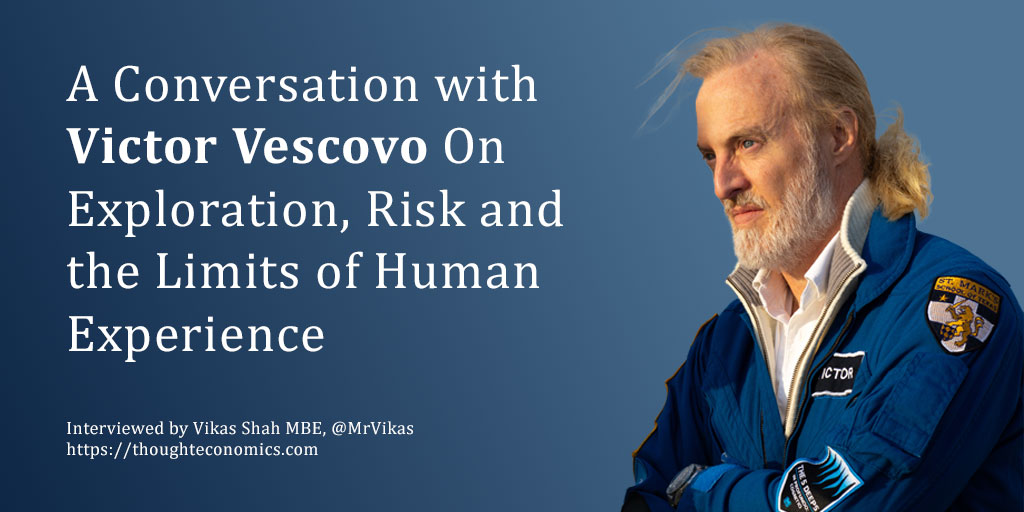
Victor Vescovo changed history. It was often said that more people have walked on the surface of the moon than have descended to the deepest point of any single ocean. As Vescovo himself puts it: “That used to be true, but since we started diving, it is not anymore. I took 13 other people down, so I took down more people to Challenger Deep than the Apollo program took to the surface of the moon.”
Victor Vescovo, explorer, retired US Navy Commander, private equity investor and pilot, has now been to all five of the deepest points on Earth. In 2019, as leader of the Five Deeps Expedition, he became the first human being to reach the deepest point in each of the world’s oceans, including a record-setting solo dive to 10,935 metres, a depth subsequently verified in a peer-reviewed paper by NOAA, in the Challenger Deep of the Mariana Trench in his custom-built submersible DSV Limiting Factor. Before turning his attention to the abyss, he had already completed the Explorers Grand Slam: climbing the Seven Summits (including Mount Everest) and skiing the last degrees to the North and South Poles. In 2022 he flew to space on Blue Origin’s NS-21 mission, becoming the first person, and one of just two alongside Vanessa O’Brien, to have stood at the highest peak, dived the deepest trench, and looked back at Earth from above the Kármán line.
Vescovo studied political science and economics at Stanford, defence and arms-control studies at MIT, and earned his MBA at Harvard Business School. He co-founded the private equity firm Insight Equity Holdings in 2000 and served twenty years as an intelligence officer in the US Navy Reserve, retiring as Commander in 2013. His expeditions have produced the first detailed sonar maps of vast stretches of seafloor and have located, among other wrecks, the USS Johnston and USS Samuel B. Roberts, the two deepest shipwrecks ever identified.
What is striking in conversation is how little of this sounds like appetite. The public version of a man with that list is an adrenaline story, and Vescovo tells almost the opposite one. Half the high-altitude mountains he has climbed, he did not summit on the first attempt. On the Five Deeps Expedition he handed the authority to abort any dive, at any moment, to his captain and his expedition leader, over himself, the man paying for everything and piloting the submersible. The discipline he keeps returning to is not nerve but the submergence of ego: the capacity to want something enormously and still say, not today. Coming from someone who lost two friends aboard the Titan, it does not read as philosophy. It reads as the thing that kept him alive.
He spoke with me about the genetics of curiosity, the moving line between acceptable risk and recklessness, Zen Buddhism and the dissolution of ego at extreme depth, artificial intelligence as a new frontier of human capability, the disciplines of building teams for missions that may fail catastrophically, and what it means to live a life in which, as he puts it, there is no such thing as mundane.
Q: Victor, it’s a real honour to meet you. You’ve led an extraordinary life, and I know you’re only just getting started. You’ve said before that you never grew out of your dreams, that you’re drawn to filling those blank spaces on the map. What does that really mean for you? Where does the drive come from: curiosity, restlessness, something else?
[Victor Vescovo]: I think it’s a mixture of all those feelings, and I think a large component of it has to be genetic. I’ve spoken at length with doctors and scientists on some of my long expeditions, and I think they agree that there is certainly a genetic component to it. It makes sense that in human civilisation we all follow a bit of a normal distribution curve, where there are some people who are, let’s just say, much more reticent to experience new things or take significant risks, and then you have people on the other side of the distribution who are very curious and have a greater disregard for their own safety. I’m definitely in the latter category, and humankind needs both of those types of people to fulfil different functions.
I think I’m very privileged that, where I am now in my life, I understand much more clearly that that is my nature, and that is what I’m here to do. That is, to push technological boundaries, physical boundaries, and to operate as safely as possible within them so that I can come back to the tribe and tell the story, and tell them what I’ve learned.
So I think there’s partly a genetic component, but I am also insatiably curious. Many times, still, I feel like when we were children, when we’re very curious. We have wide eyes. We go into a grocery store or a library and it’s almost a place of wonder because we haven’t seen something like that. I never grew out of that feeling, and that’s what the world to me is like. I just became more experienced, and got a lot more resources to go to even more extraordinary places, but the same feeling exists in me. I never really grew up, just the expense and sophistication of my toys.
Q: Do you believe that a curious spirit can be cultivated? Is it something people are naturally born with, or can the spirit of exploration be developed in all of us?
[Victor Vescovo]: I think to some degree it can. As people get older, they get more responsibilities; they become, unfortunately, maybe a bit more cynical, and they lose that wonder. It can be beaten out of people. Whereas children, I think, naturally have unabashed wonder. Some children have a whole lot of wonder, like I did, and some less so. But I think it can be cultivated by exposing people to different environments, to wonderful books, to any number of things that can ignite their imagination and show them that there are positive and wonderful places and things to do in the world, and that it’s not all about responsibility and negative interactions, and not to be weighed down by the inevitable bad things that happen to all of us.
Q: One of the things that has really fascinated me is the diversity of careers, for want of a better phrase, that you’ve had. You’ve worked in naval intelligence and private equity, you’ve run deep-sea and high-altitude expeditions, and to me those are all also leadership domains. What leadership instincts do you think you’ve cultivated from having that variety, and those extremities of human experience? And do you think there are transferable leadership instincts between all of those domains?
[Victor Vescovo]: I don’t think instincts can be transferred. I think training can be transferred, and lessons. One is innate and one is learned, and the best situation is the combination of the two. But yes, you’re right, and it’s not something I ever aspired to be, to dominate an expedition or to be a leader. I’m a reluctant leader in many respects, and I’ve learned how to be a leader from some of the best. I think that’s the first point of departure: to have a willingness, and to some degree a humility, to say: I need to learn a new skill.
Leadership can be an acquired skill that can be enhanced by personal characteristics: having some degree of humility, being able to actively solicit the opinions of others and take them into account, but also being decisive. That is critical. It’s one of the first things they teach you in command school in the military: you must make a decision if you’re a leader. You will never have perfect information. You can paralyse an institution by constantly asking for more information, when life is a series of decisions you make with imperfect information, and then carrying it through with conviction, while at the same time looking over your shoulder to make sure the rest of the team is coming along with you. And if they’re not, asking why that might be the case.
Different situations require different leadership styles at the margin. One leadership style is not perfect for every situation, and I think many leaders forget that. So I’ve also tried to adapt my leadership style depending on the situation I find myself in, whether in the military previously, or in business, or on an expedition. They all have to be tuned a little bit differently. I think where people get into significant difficulty in their careers or in their lives is that they think one leadership style is always the correct one, and then they are mystified when it doesn’t work. I’ve definitely seen different leadership styles work in different situations, and you have to be adaptable. That, after all, I believe is the greatest quality of Homo sapiens: our extraordinary adaptability. And that applies to leadership too.
[Editor’s note: Vescovo served twenty years in the US Navy Reserve as an intelligence and targeting officer, retiring as Commander in 2013. He co-founded Insight Equity Holdings in 2000 with Ted Beneski; over four funds the firm raised in excess of $1.5 billion in equity capital, investing primarily in industrial, asset-intensive businesses across the defence, aerospace and electronics sectors, with Vescovo serving as Chief Operating Officer.]
Q: With that in mind, there are environments where you see leadership and decision-making happening at pace, situations that demand quick decisions, but there is also, in intelligence work or in investing, the need to slow the leadership system down. I was really curious how you adapt to those environments, because on the expeditions you’ve run, and in business, we all act with imperfect information, but the consequences of those decisions in some of the environments you’ve been in can be pretty severe.
[Victor Vescovo]: Right. You never want to put yourself into a situation where you’re working with extremely limited information in a very dangerous place. You should not allow that situation to be constructed around you, and if you are approaching that area, you should always have the ability to have a plan B, a way to get out. That’s where a lot of people get into trouble in extreme physical situations, or even in investing: not having an exit avenue. Even if it gets you singed on your wings, it’s not catastrophic.
So I think a big element, as you were alluding to, is the time element. You can always use more time. Certain situations don’t allow for more time, but as a leader you can construct situations where you can give more time to the team or to the problem, if you can afford it, knowing that at a certain point you will have to make a tough call. Managing the time that you give a problem and your team is one of the arts of leadership. For example, I was on a call just the other day where I was trying to figure out how many years to allow for a research and development project. I can make it whatever I wish, but it can’t be ten years; that would be useless. It can’t be ten days either. So where’s the happy medium? You don’t want to give people too much time, because then they don’t get the performance enhancement from being a little bit under pressure. It’s an art. Again, there’s no steadfast rule for how to manage the time element in decision-making, or how much information is enough. Is 99 per cent of what is knowable the threshold, or is it 20 per cent? It depends on the situation.
One specific example: I was given the opportunity to invest in SpaceX about a year and a half ago. I had virtually no financial information; it was simply not available. They didn’t provide it. It was basically, do you want in or not at this price? I quickly pulled the trigger and said: that price works for me. Now, of course, I’m glad that I did since I’m likely to make millions on that one, rapid decision made with, one could argue, extremely limited information. That’s just an investment example. You’re constantly adapting to the situation to make these decisions, and sometimes you have to live to fight another day.
Q: I want to come on to risk in a moment, but the decision-making point is really interesting. At the extreme of human experience you want to achieve this goal of reaching the bottom, or the top, or whatever it might be, there is a mission that becomes so embedded in who you are as a person. But if you have to make that pragmatic call and say, no, we can’t, or no, we won’t, there is a lot of psychological torment involved. How do you make sure you’re able to maintain that pragmatic voice on one shoulder alongside the mission? If we look at OceanGate as an example, one could argue that the “we will do this no matter what” overcame the “but it’s not safe”.
[Victor Vescovo]: Well, I made this comment on the Shawn Ryan interview, where I said: “Never get into a vehicle where the fear of failure is greater than the fear of dying.” People nod and they say yes, but unfortunately that often happens.
I think the key is that it’s about the ego. I’ve been a Zen Buddhist since my early twenties, and a core aspect of that set of teachings is the submergence, if not the elimination, of the ego. Now, having no ego, I think, comes with some risk, because then how do you have purpose in life? How do you get up out of bed in the morning and do something extraordinary? But I think it’s important not to put the mission at such a level of importance that it jeopardises your life or the lives of other people. Is it really going anywhere? Can you try again later?
Half of the high-altitude mountains I’ve climbed in my life, I did not climb on the first try, because I have a pretty intense survival instinct, even though I do very dangerous things sometimes, where I will look at the situation and say: Not Today. I’ll come back. That is very difficult to do, especially with something like Everest that takes a year to train for, and an enormous amount of money and commitment to do. But you have to have that combination of self-discipline, and the ability to submerge your own ego and the desire to fulfil the mission. You’re just delaying it. You’re going to get better, as I did on Everest. I trained for another two years, I did it slightly differently the second time, and I was able to summit. And I didn’t endanger people around me, I didn’t endanger myself. I think that’s the best way to try to live: don’t get so mission-obsessed that you create a journey into the “reckless zone”, rather than operating in the “mitigated-risk” zone.
[Editor’s note: Vescovo’s framing of OceanGate carries an unusually personal weight. In the catastrophic implosion of the Titan submersible in June 2023, he lost two friends: Hamish Harding, whom he had taken down to Challenger Deep and with whom he had flown to space on the Blue Origin NS-21 mission a year earlier, and Paul-Henri (PH) Nargeolet, the veteran French maritime expert with whom he had worked closely on deep-ocean dives. In a public tribute, Vescovo wrote that “deep ocean diving is very safe when industry standard certifications and procedures are followed”, pointed language given that OceanGate’s Titan operated outside the conventional independent classification regime to which his own submersible, Limiting Factor, was certified by DNV GL.]
Q: At this point, in everything you’re doing, whether it’s investing or whether it’s an expedition, there’s a boundary layer between acceptable risks, reckless risks and necessary risks. I think it’s interesting to understand how you might think about those. If I think of myself as a layperson, and I was about to embark on a mission to Everest after some training, I would probably find it difficult to internally differentiate between a risk that’s acceptable, one that’s reckless, and one that’s necessary.
[Victor Vescovo]: That’s where experience comes into play. If you don’t have experience, that’s why it is so critically important that your travelling companions in life do know what they’re talking about, do have that experience, and that you listen to them.
For example, and it was unconventional, on my Five Deeps Expedition to take a submersible to the bottom of all five oceans, I gave abort authority of any mission, at any time, to my captain of the ship and to my expedition leader, over me, who was paying for everything and was the pilot. I deferred that capability to them because I knew it would instil a level of responsibility and discipline, and these were people who knew things I did not know about operating in the deep ocean and with a complex organisation. They might see something I did not, and I had no right, nor should I have the right, to overrule their vastly superior experience.
So that line you describe, between acceptable mitigated risk and recklessness, is actually a very thin line. And it’s even more dangerous because it moves. It moves based on conditions, it moves based on your own capability, it moves based on what other people are doing. You have to be constantly evaluating the situation; it is not static. Therefore you just have to, over time, build the experience base and be around people who are self-disciplined and have experience, so that you all stay on the correct side of that line. OceanGate, unfortunately, is a textbook example of a situation where that was not done. And people die. They shouldn’t have.
Q: I wonder whether that same logic applies to other frontiers. If we think about domains of exploration, one could argue, and I realise it’s a loose argument, that the way humanity is progressing into domains such as AI is a new frontier of exploration of our own capabilities. I do wonder whether we’re taking that same approach between the acceptable risks of technology, the reckless risks of developing come-what-may, and the necessary risks we take.
[Victor Vescovo]: It is a risk, of course it is. But I think one has to look at the grand sweep of history, and I love history and read an enormous amount of it. This is, to me, yes, a seminal development in human experience, artificial intelligence, but we’ve had other major developments in our past that have been potentially equally destructive.
I love the tale of how the Pope tried to ban the crossbow when it was invented, because here we now had a relatively simple tool that allowed a peasant to kill an armoured knight. Only bedlam and apocalypse could follow from that, or so was thought. Or the printing press: the ruling classes thought, how can we possibly allow the ability to disseminate anything written, to anyone, at any time? One could argue that was an even more potentially destructive force, but also a positive one, than AI. Or, finally, the last example: automobiles. People saw these devices that could speed down a highway with reckless abandon and kill a pedestrian instantly by someone you don’t even know guiding it. At least a horse is relatively slow. It is still one of the leading causes of death in industrialised nations, and yet we’ve accepted a certain level of risk with certain guardrails, with regulations written in blood.
Artificial intelligence, I believe, will be similar. It can have major negative impacts, but it can also have extraordinary positive ones as well. As human beings, you can’t put technology back in the bottle. We will mitigate it as best we can, unfortunately, probably through a bit of trial and error.
Let me give you a counter-example. There are now tools being tested where AI can do things that human beings cannot, in terms of drug discovery. You can feed into an AI what is effectively a multi-dimensional training set of how peptides work, how individual molecules work, how tissues work. A human brain can’t work that multivariate pattern-matching recognition, but an AI can, where it could end up creating solutions to diseases, to cancers, to any number of things that we would perhaps never be able to do in a thousand years. But AI could just kick out the answer. How do you even value the benefit of something like that? It’s extraordinary. But on the downside, a rogue AI could take down an electrical grid and cause thousands of deaths. You just don’t know. It’s both. It’s a very, very sharp double-edged sword.
Q: Changing tack slightly: I want to come to your own resilience in a moment, but one thing I’m really curious about is team-building in these situations. Without downplaying the role of the individual, clearly when you’re on an expedition, or building a business, there’s a whole team behind you. What have you learned about building teams, and about the role of mission in teams, when you’re building teams for missions that could be catastrophic, or are very high risk, or very unlikely to succeed? I think that has massive applications in frontier technology and in business as well.
[Victor Vescovo]: Right. Three things come immediately to mind, because I’ve thought about them quite a bit.
The first is that you really do have to have a very clear, tactical goal that is very attractive to people who want to participate and who are very good at what they do. Having an audacious goal, like building the most advanced deep-diving submersible and taking it to the bottom of all five oceans, when we’d only been to the bottom of one, was an audacious goal that attracted the best in the world who wanted to work on the project. I benefited from that.
The second is: when you start assembling the team, make sure everyone feels like they’re part of it, even people who are not doing the most glamorous or the most notable parts of the project. Show them at least some degree of personal attention as the leader. Know their names, know about their families, involve them in discussions. The small act of paying attention to people is extraordinarily rewarding to every member of the team, and it’s amplified in an inverse way from their level on the hierarchy. So you make the investment, as a leader, into the people, and know that your job is in many respects supporting the team first, while you’re at the top. It’s not a command-and-control exercise, not when you have a high-performance team trying to do something high-performance.
And then the last thing I have to mention, and it’s an important one, is that if someone is not working out on the team, they must be replaced very quickly. It is human nature to want to be kind, to try and work through a problem or an issue, or a development plan. But after being on this planet for some time, I’ve learned that 90 per cent of the time, development programmes don’t work, and you know very quickly whether someone is working out or not. I tell a frequent joke that everyone laughs at, because it’s true: think of your own situation, how often have you thought about someone you have replaced or terminated, and later you’ve come back and said, “You know, I wish I had just waited a little longer?” No one says that, and it’s because we know quickly who’s going to work out and who’s not. We just don’t want to pull that trigger.
But you have to, because it does them no favour. It certainly does you no favour. And the other members of the team, it doesn’t do them favours either. You have to be somewhat ruthless. That’s why one of my heroes of exploration, Roald Amundsen, was notorious for allegedly being sometimes short-tempered or severe. No, he understood that you have to make those decisions quickly and decisively. And he made his expeditions look straightforward, where people didn’t get killed.
[Editor’s note: The submersible Vescovo refers to here, DSV Limiting Factor, was built in partnership with Florida-based Triton Submarines under principal design engineer John Ramsay, with Patrick Lahey leading the build, and was independently classified by DNV GL, the first and only crewed submersible ever certified for repeated dives to full ocean depth. Vescovo has elsewhere described the Five Deeps Expedition as having between sixty and a hundred people working on it at any one time, comparing the management challenge to running a venture capital start-up.]
Q: Which is a great North Star on an expedition, let’s be honest. I was fascinated when you mentioned Zen Buddhism. Buddhism often gives us this notion of dissolving the illusion of separateness, and I wonder, when you’ve been at high altitude, deep in the ocean, or in space, and oftentimes you’re there almost on your own, do you feel more separate from the world, or do those experiences make you feel more completely a part of it?
[Victor Vescovo]: Definitely the latter. I think that’s partly my nature. While I tend to be introverted by nature, which surprises some people, I truly am. In these extreme environments I feel more connected to the outside, the universe, even other people. That’s just what it does. I think operating at the extremes of personal experience and environment, for me, dissolves the boundaries more. That’s just my own personal experience.
Q: Is there a meditative aspect to being in those environments as well, which brings about a sense of stillness? Or is that almost over-romanticising it? I remember, many years ago, I got to interview Buzz Aldrin and I asked him how it felt, and he said very plainly, to be honest, we were busy. I only really thought about it afterwards. Is that your experience? Or are you able to find the moment to really appreciate what’s happening, as a result of the Buddhism?
[Victor Vescovo]: Yes and no, and I’ll give you the three answers, because I often describe them as the three points on the triangle: going to space, climbing Everest, and going to the bottom of the ocean. All three are ultimately extreme environments, but they’re all very different, and they’re all similar.
Going to space was just like going to the most insane, fun rock concert ever. Like Buzz Aldrin said, you’re kind of busy [flying in space], but we were mainly just enjoying ourselves. And it was so brief. I was only up in zero-G for about three minutes. It felt like a long time, but it was amazing and wonderful. There was a bit of that feeling of the Overview Effect, of feeling completely connected to the universe, but it was very sharp and too brief.
Climbing Mount Everest, it was difficult to feel that communion, because we were being assaulted by the elements: the cold, the wind, the noise. But standing around in the mountains on a calmer day, lower down, you did get a sense of that feeling.
I felt that feeling most, though, at the bottom of the ocean. I made a recent analogy that for some reason works: it’s very difficult to describe what being in a submersible at the very bottom of the ocean is like, because it’s dark and very unusual. You can only see about twenty or thirty metres. You feel safe in this titanium capsule, but you’re looking just outside of a portal at an environment that is one of the most hostile on planet Earth. It’s almost like you’re standing on a very dark plain, and right in front of you, crouching, is Godzilla. Just looking at you, not doing anything, but just motionless, its eyes closed. That’s what it felt like. You knew it was there, you felt this immense power, and yet you were okay. Not safe, but quietly surviving. In a way, it felt peaceful, because you were in the presence of something very, very powerful, existing with it, not against it.
And then, of course, you slowly back away. You go back to the surface where it’s nice and safe, but you do remember what it felt like to be in the presence of such an ominous force that really didn’t even acknowledge that you were even there. But it did allow you to, temporarily, be there. That was a very special feeling, but different from the other two, yet related.
[Editor’s note: The three reference points: Vescovo summited Mount Everest in 2010, completing the Explorers Grand Slam. His record dive to Challenger Deep took place on 28 April 2019, reaching a depth later corrected to approximately 10,935 metres, the deepest crewed descent in history, and the first of fifteen dives he has now made to that point. His suborbital spaceflight was on Blue Origin’s NS-21 mission, on 4 June 2022, alongside fellow passenger Hamish Harding. To date he has personally explored seventeen deep ocean trenches.]
Q: And do you think you are more able to understand that as a result of the teachings of Buddhism that teach you not to feel ego? Because, if I follow the logic trail, if I went into that situation with an ego, that ominous presence might be perceived in a much more fear-inducing way, as opposed to a dissolution of ego, which allows me to perceive it as a benign but ominous force.
[Victor Vescovo]: Oh, it’s even more deep, pardon the use of the word, and the pun. It’s not even a duality. By that I mean, to use my Godzilla analogy, it almost got to the point, spending many, many hours at the bottom of the ocean, where I wasn’t separate from Godzilla. We were part of the same thing. We were part of existence. It wasn’t me versus it; it was us together in the environment. It was allowing me to exist, and I was, in some respects, acknowledging its existence, if that makes sense. But when you start getting into these concepts, language can sometimes fail.
In that respect, you do have this dissolution of the boundaries of your own vessel, and feeling more connected to the environment and everything around you. It was such an unusual feeling for me, especially since I dove solo to very deep places on multiple occasions, where it wasn’t just the cold water environment with the pressure outside my submersible, but the machine itself, this highly engineered technical creation of human beings, and then my own flesh-and-body self. All of it started mixing together into a feeling of unity, where, in normal reality, there are these sharp divisions between this and that and the other.
So going to these extreme places, in extreme vehicles, and having the training that I have had in Eastern philosophy, martial arts and other things, maybe helped provide a small doorway to be able to experience it in a deeper way than I think most people perhaps would. So I feel very privileged in that respect.
Q: And then how did you adapt back to, for want of a better phrase, civilian life? I’m always really fascinated, because even when I’ve talked to former military leaders who have gone to war, or explorers, there is the adaptation to real life, which, as we saw with Neil Armstrong, doesn’t go well for everybody. Even Buzz Aldrin spoke to me about the fact that, after his lunar mission, what else is he going to do in life? He dove into alcoholism for a long time, as we all know. So once you’ve completed a mission like that, where you’re seeing something that, in a way, as humans we shouldn’t see anyway, how do you then adapt to the mundane normality of life as a human in this world?
[Victor Vescovo]: I think I’ve been very fortunate that I’ve been exposed to the thought, and to other people who have taught me, that there is no mundane. The word itself, I think, is a non-word. It should not be a word. To me or any Zennist, there is no mundane.
Yes, it’s exciting and wonderful to go up into space, but when you can reach a point in your own psychology and your life where you can have almost the same amount of satisfaction on any given day from going into space as sitting on a bench and just looking at a tree, that’s a very Zen concept, but that’s the state of mind you want to be in, where everything is special in its own way. They’re just different. I have striven for that my entire life.
And I’m very fortunate that not only do I have that mindset, as best I can as a human being, but I have combined it with my curiosity and the resources I’ve been able to amass to put myself in situations where that feeling can become more accessible, so that I’m not constantly chasing the next high, the next more extreme environment, or going back to something like actual warfare to feel that sense of camaraderie or extreme environment where everything else seems mundane. I’ve been able to intellectualise it enough where I can make the everyday also feel special, and also appreciate when I do something extra-special. Because how many times have you heard the expression, it’s not the destination, it’s the journey? Well, yes, that’s true. I derive perhaps as much satisfaction from the development of the submersible that went down to the Challenger Deep, and all the wonderful times we had when we figured something out, as from the actual act of doing it.
Q: I love that, and I wonder how we can apply this in our lives. There’s being able to live these experiences through the lens of hearing from an explorer such as yourself, but there’s also the necessity for all of us in our lives to take some element of your secret sauce and engage in some exploration, in whatever form that may be. So how do you think we can apply some of these principles in our lives, where we are actually able to start being explorers, if that’s not too twee a way of putting it?
[Victor Vescovo]: Well, I would redirect it, by saying that exploration, and I hope this doesn’t sound too trite, starts with exploring yourself. There’s so much temptation for everyone to seek answers outside of themselves, or to blame conditions or other people, when peace and leading a fulfilling life starts with self-knowledge and self-reflection.
So to directly answer your question, I would say the first step of exploring is not to go chasing a photo safari in East Africa, or diving to a deep ocean trench. Start by slowing down. Being quiet. Putting your phone away. Enjoying a very simple meal in a park with a dog, and being present in that moment and appreciating it in slow time. When you’ve mastered that simple act and are happy in that act, one can grow beyond that. Then start going external for more exotic experiences that push your own mental and physical boundaries.
But doing that is not the route to having a more peaceful and rewarding life, or you will end up in the situation where you’re constantly seeking the next thing. You’re like what ancient Indian culture called the Hungry Ghosts: souls who were constantly running around in a version of hell, always seeking something, never satisfied. People live their lives that way, thinking they’re accomplishing things. They have this litany of bucket-list items that they’ve checked in. I could be accused of doing that as well, but it starts from a place of also being completely happy with who you are, and being able to be very happy doing what you referred to as a “mundane” thing.
Q: Did your experiences make you feel more or less about the significance of humanity? You mentioned that ominous presence at the bottom of the ocean, and being one with it. Often, when confronted with geological timeframes, and with those sorts of things, it would be easy for our minds to go, well, what’s the point, we’re very insignificant, yet those experiences often do the opposite.
[Victor Vescovo]: In going to space, it was easier to take in the relative significance of humanity. You couldn’t see individuals, just a continent. (By the way, you also see white sun on a black sky, because there’s no distortion from the atmosphere, I discovered, so it doesn’t look yellow. That surprised me, which was interesting. I didn’t expect that. That was cool.)
In space, you feel both very small but also very expansive. You feel at one with the expanse that’s laid out in front of you, and so you get both of those feelings. Humans, however, are not insignificant. While physically we may be tiny compared to the Mariana Trench, we have these extraordinary minds that can literally move mountains, that can explore the far reaches of the solar system. We are more than we appear to be. Therefore I have hope for humanity.
And like so many precepts of so many religions, what is important is balance. There needs to be balance in one’s own life. There needs to be balance in ecosystems. We need to pay attention that we don’t let things get too unbalanced in any one direction. If you don’t, then the laws of physics, the laws of ecology, they will eventually come with a bill that needs to be paid, and it’s not pleasant.
Q: As a final question, I’d like to ask about legacy, because I’ve had this immense privilege of being able to speak to people like yourself who have achieved amazing things, and I sit there and read your bio and your list of achievements and there’s a sense of awe that comes with it. But one thing I’ve noticed, when I was on the opposite side of the interview table, the impact I thought I was making on the world was very different from the impact people thought I thought I was making on the world. Is legacy something that you ever think about? And if it is, what do you think your legacy is going to be on this little blue marble?
[Victor Vescovo]: I think any human being always thinks about legacy, because the moment we’re born we are condemned with eventual mortality. One would not be human if one didn’t think of, well, what’s my purpose here, and how will I be remembered after I go? So of course I do think about it, but I also try and temper it with the humility of: How can I leave the world better than I found it?
For me, just my own predilection, it’s not to be a spiritual example, not to be a great father, obviously, because I’ve never had children. It’s about technology and exploration, pushing the boundaries of human capability. My team and I built the first submersible that could repeatedly and safely go to the bottom of any point on the sea floor. That had never existed before. That I’m very proud of, because I think history is kind to the people who are first to a place, as they should be, but they are also respectful of those who created a capability. That’s a more enduring, and quieter, legacy, but it also fits my own personality. I like being a builder.
I had the privilege of not just being able to help build and enable the creation of the technology; I got to test-pilot it. In the arc of my life, the other experiences I had with mountaineering or flying were contributing factors to my ability to do that large thing that hopefully will be remembered. But even if it’s not remembered, the technology cannot be uninvented. I know, until I die, that we did that, and I was a key enabler of it.
[Editor’s note: Vescovo’s point about history being respectful of those who created a capability has since received a formal endorsement. In January 2025, US Secretary of the Navy Carlos Del Toro announced that the second ship in the US Navy’s newly designated Explorer class of ocean surveillance vessels would be named USNS Victor Vescovo (T-AGOS 26). The first ship of the class is named for Captain Don Walsh, the US Navy officer who, with Swiss oceanographer Jacques Piccard, made the first descent to Challenger Deep in 1960, and who was aboard Vescovo’s support vessel for the modern depth record in 2019. Walsh died in November 2023.]
——-
Victor Vescovo led the Five Deeps Expedition to the deepest point of all five oceans and has now made fifteen dives to the Challenger Deep. In January 2025 the US Navy announced that the second vessel of its new Explorer class of ocean surveillance ships, USNS Victor Vescovo (T-AGOS 26), would be named in his honour.