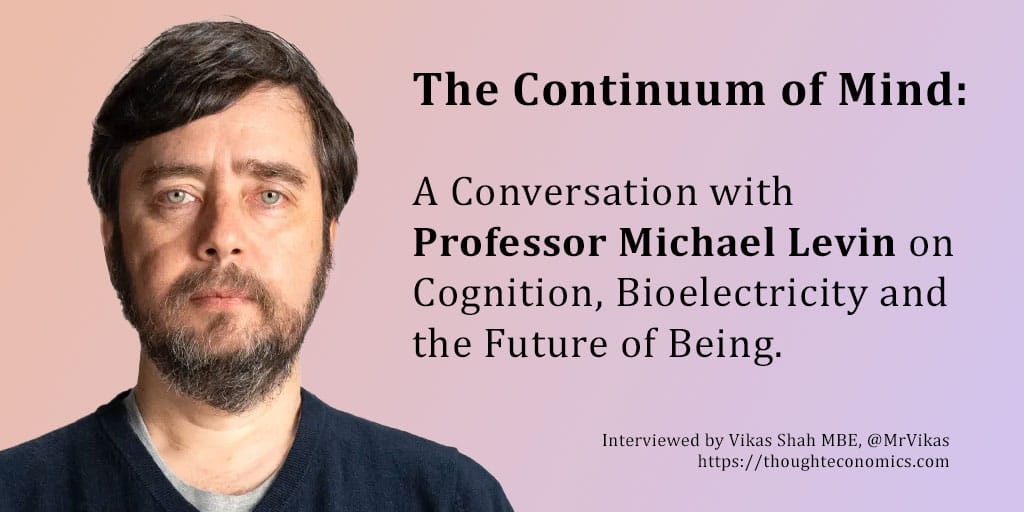
Michael Levin is one of the most original thinkers working at the frontier of biology today. The Vannevar Bush Distinguished Professor at Tufts University, he directs both the Allen Discovery Center at Tufts and the Tufts Center for Regenerative and Developmental Biology, and is an associate faculty member of the Wyss Institute at Harvard. Trained first as a computer scientist and then as a developmental biologist, Levin has spent over two decades demonstrating that the electrical signalling between cells, bioelectricity, acts as a kind of software that instructs living tissue how to build, repair and remember its own anatomy.
His laboratory has induced flatworms to regenerate the heads of other species, coaxed frog cells into becoming wholly novel organisms called xenobots, and grown anthrobots from adult human tissue. Author of over 350 scientific papers and co-discoverer of the xenobot, he has become a central voice in the emerging science of diverse intelligence: the study of mind, goal-seeking and problem-solving wherever they occur, from single cells to sorting algorithms.
What makes Levin difficult to place, and worth reading closely, is that none of this arrives as philosophy. He is not proposing that we redefine cognition generously enough to let cells in. His claim is narrower and much harder to dismiss: the assays behavioural scientists have spent a century refining, for habituation, for anticipation, for delayed gratification, were only ever pointed at things with brains, and when you point them elsewhere they keep returning positive results. Sometimes in tissue. Sometimes in six lines of code. He is an experimentalist reporting what the instruments say, and the consequence is that the categories most of us use to sort the world, living and non-living, minded and mechanical, designed and evolved, stop doing the work we ask of them. Where that leaves us is the subject of this conversation, and Levin is franker than most about how strange the answer may turn out to be.
In this wide-ranging conversation, we spoke about why cognition may have come before life rather than after it; how bioelectric “cognitive glue” binds cells into larger minds; what xenobots and anthrobots reveal about where the competencies of novel beings come from; whether artificial intelligence can possess a mind untethered from biology; and how a science that takes agency seriously forces us to rethink our oldest questions about creation, embodiment, and death itself.
Q: Your work rests on a striking inversion of the usual story. As I understand it, your assertion is that cognition came first, and that life arose as a way of scaling it up, which turns the story we are all told on its head. Where did that concept come from, and what are its implications?
[Michael Levin]: Well, the concept comes from trying to dissolve an assumption, an axiom, that pervades a lot of modern science. The axiom is that the tools of behavioural science, which are very specific ways to test for what we call cognitive competencies, simple things like habituation and sensitisation, then more complex things like anticipation and delayed gratification, all the way up through language, that all of these tools we have in behavioural and cognitive science are only to be used on brainy things.
People will say all the time, “Well, how does it do that? It doesn’t have a brain.” But where did brains come from? You have to ask yourself: whatever magic tricks we think brains are doing, what are they actually doing? And we know it can’t just be this sharp category of “brain”, because of course brains evolved smoothly and gradually from very primitive things.
So the way you arrive at the kind of view I have is not by doing philosophy or linguistics, or by trying to redefine everything as cognitive. It’s not about that. It’s about taking the well-established strategies and concepts from the behavioural sciences and asking: where else might they apply? That’s it. It’s an experimental science. And as it turns out, as a matter of empirical discovery, when you do that you find these things in all sorts of systems, some of which we would call alive, others we don’t. I actually don’t like that distinction anyway; I’m not especially excited about drawing a category of living versus non-living. But it’s pretty ubiquitous. These things are pretty ubiquitous.
Q: Is that where the continuum comes in, from a gene regulatory network at one end all the way to a person at the other? And I recognise there’s a certain arrogance in placing a person at “this” end. Is what we really need to understand a continuum of cognition, rather than something we label life or intelligence?
[Michael Levin]: There may well be people who are interested in the question of defining life. It’s a strange thing for a biologist to say, but I’m not actually interested in that at all. I don’t think it’s a very interesting distinction.
What I do think is important is that if we take development, embryogenesis, and evolution seriously, they tell us that a continuum, a spectrum, is the null hypothesis. If you want to argue for sharp categories, for great transitions, for some sort of emergent new category, you have to argue for that. The baseline assumption has to be a continuum, because all of us start life as a little blob of chemicals, and then we end up making assertions about our hopes and dreams. How did we get here, both on an evolutionary scale and on a personal scale?
These things tell us the baseline is a continuum, and that what we are looking for are not definitions of sharp categories. We’re looking for models of change, of metamorphosis, of growth, of transformation. So of course we need this continuum. Now, I think it goes far below a gene regulatory network, as it turns out; even much simpler things can do this. But yes, I think it’s very clear that we need a continuum, and then we can give names to areas of it. The more important thing is what actually happens along that continuum.
Q: One concept I found genuinely profound was bioelectricity. My layperson’s assumption is that the body carries some degree of electrical charge, but the way you place bioelectricity at the very centre of this makes us think about that convergence of electricity in the body completely differently.
[Michael Levin]: Yes. Well, the most important thing about bioelectricity is that you need the concept of cognitive glue. What is cognitive glue? If we ask ourselves why we are more than the sum of our neurons, why we know things our individual neurons don’t know, why we have goals and preferences our individual neurons don’t have, it’s because, as neuroscientists will tell you, there is a set of policies and mechanisms, which I call cognitive glue, that binds your neurons into a larger-scale entity. And this is well known to be electrophysiology. The neurons in your brain form an electrically active network, and the information processing done by that network is what underlies our cognitive capacities and makes us more than the sum of our parts.
So now we ask a simple question: where did brains come from? Where did neurons come from? What is a neuron, in fact? I’ve done this at neuroscience conferences. I raise my hand and ask, “What’s a neuron?” And everybody laughs. Then I say, “No, really, what is a neuron?” And they list three or four things that neurons do, and I point out that every cell in the body does those things. As it turns out, every cell in your body has the electrical properties that power neurons. Most cells have the electrical synapses that bind them into networks. Neurotransmitters, and many other things supposed to be the province of brains, are actually much, much older. It has to be this way, because brains didn’t just show up out of nowhere. They speed-optimised much more ancient evolutionary mechanisms.
So we can ask: if bioelectric networks are currently being used to think about moving your body through three-dimensional space in pursuit of your goals, embodied intelligence, what did they think about before there were brains and muscles and neurons? What did these networks used to think about? As it turns out, they were discovered by evolution around the time of bacterial biofilms, and in those days they thought about metabolism, and about synchronising the community so it could optimise metabolism. But when true multicellularity showed up, it got pivoted to anatomical space.
What I mean by that is that individual cells have little tiny cognitive light cones. The cognitive light cone is the size of the biggest goal you can pursue. Individual cells’ goals are very small: my own metabolism, my own pH level; a little predictive capacity going forward, a little memory going back, but that’s about it. Tiny cognitive light cones. But groups of cells have incredibly large, grandiose goals. For example, if I’m a salamander limb and somebody cuts it off, these cells have to regrow the correct limb, and then they have to know when to stop. Remembering what a limb is, is a massive goal memory. No individual cell can store it, but the collective certainly can.
And that is exactly what the bioelectricity in your body did: it was thinking about how to move you from a single cell to the configuration of a person, or a snake, or whatever. So this is what’s important about bioelectricity. It is the set of mechanisms evolution has chosen on Earth to coordinate the tiny goals of your cells into the much larger goals of your actual body, to implement morphogenesis correctly, despite all the strange things that can happen to it. And eventually that machinery was pivoted and speed-optimised to actually move you through space.
Q: In one of your interviews you made a remark that suddenly put the question in plain sight: every organism that has ever lived started as a single cell, had a body plan, and yet no one reliably knows how that happens. Why has there been something of a blind eye turned to such an obvious question, and are we scientifically any closer to understanding it, or still at the conceptual stage?
[Michael Levin]: Well, I want to be very clear. When I say no one knows how it happens, I don’t mean we are entirely ignorant of the mechanisms. Going back hundreds of years, there has been tremendous progress in developmental biology, molecular biology and cell biology, so we know quite a bit about the mechanisms involved. But I think you asked exactly the right question, which is: what is blocking the greatest insight into the whole system?
What’s blocking insight is this. When you study biology and you see something incredible, cells build a limb and then they stop, and they clearly know when to stop, the naive student asks, “Wait a minute, how did they know when to stop?” And what you are told uniformly in all modern biology classes is, “No, no, that’s the wrong vocabulary to use. Nothing here knows anything. Nothing here has any goals. What you’re looking at is the emergent outcome of a complex process where lots of simple local rules get executed, and eventually something complex appears. Chemistry is the right level of description.”
Now, when science in general, and developmental biology in particular, was getting off the ground a couple of hundred years ago, this was an important move to make, because in those days you only had two options. You could be dumb like rocks, or smart like humans and angels. Those were your options. So if you were going to get a science off the ground, it was much better at the time to say, “Look, we’re going to look for dumb mechanisms. Let’s see how far we can get by assuming nothing here knows anything and there are no goals, and we’ll use the metaphor of dumb machines.” That was a perfectly reasonable move.
But since the 1940s, and to some extent before, we’ve had a perfectly good science of machines with goals and memories. It’s called cybernetics and control theory. So it is no longer necessary to hold this axiom, and it is an assumption, not a result, that everything in here can be well handled by the lowest level of that hierarchy. At the lowest level of the cybernetic hierarchy you have extremely simple mechanisms, not even capable of homeostasis, where you really can say nothing knows anything. But above that you have many levels of other mechanisms: with goals, with multi-scale goals, with metacognition, with loops that process information from their environment, with self-reflexive computation, and so on.
And no one ever tells students in this field that this is an axiom, that the idea everything important will be well handled by the lowest rung of the cybernetic hierarchy is an incredibly powerful assumption that has never been validated and is, in fact, factually incorrect at this point. So we have to ask ourselves: why are we hamstringing ourselves by insisting on using the lowest level of that hierarchy to explain everything? We don’t do that for many other areas of science, neuroscience certainly doesn’t, and there is absolutely no reason developmental biology should.
So my point is simply this. If we let go of the assumption that we’re only allowed to use metaphors at the lowest level of that hierarchy, and instead make use of the useful tools from behavioural science and cybernetics, then we get access to all kinds of interesting things we otherwise could not do. And that’s an empirical claim. That’s what I’m saying.
Q: Is this where the xenobots and anthrobots come in? I only recently discovered that xenobots take their name from the frog. Without wishing to paraphrase the research, my understanding is that we take these constructs, made from very ordinary cells with no additional programming, and they seem to display quite remarkable emergent behaviours.
[Michael Levin]: I want to say a couple of things here. First of all, emergence, which gets a lot of attention, doesn’t even begin to scratch the surface of what’s going on. I think emergence as a concept is extremely limiting, and what has actually happened, which is maybe some of my most controversial work, is such that everything I’ve told you up to now is going to seem obvious and mainstream by comparison. So I don’t use the word emergence, because I think it conceals a lot of much more interesting things that are happening.
But the deal with xenobots and anthrobots is the following. There were two basic reasons we went down this road. The first is just obvious utility. Anthrobots are going to be an amazing platform for in-the-body repair. Xenobots have all kinds of applications out in the environment: synthetic living machines that do useful things and teach us how to control form and function. Those are all very practical.
But there’s another, much deeper reason. We have to ask: where do competencies come from? Where do the goals, the preferences and the capabilities of novel beings come from? This is not only of deep, fundamental, philosophical interest. It’s very practical, because we make new systems all the time. We make swarm robotics, the Internet of Things, social and financial structures. We make all these things constantly, and we have no idea what their properties are going to be. So I want a model system to establish a science of figuring out where the mental properties of new beings come from, and how we can learn to predict and shape them. I think that’s actually an existential step for humanity. We’re going to have to do this, or we’re done for.
So let’s go to biology first. I have two model systems, one in biology and one in computer science. In biology it’s this. When you look at an animal or a plant and ask why it has the properties it has, the story is always the same: eons of selection. Millions of years of the genome bashing against very specific environments has killed off everything that doesn’t fit, leaving you with specific features, so you can tell a very tight story of specificity between the selection pressures of the past and whatever you are now. That’s the standard story. I’m very sceptical of it, so I wanted model systems that put pressure on it.
And so, in collaboration with numerous people, including Josh Bongard’s lab and others, we decided to make some novel beings that have never been here before, and ask what their properties are, and then see what the standard evolutionary story would have to say about it. What I’m adamant about is that we did not do synthetic biology to introduce new circuits. We did not change the genome. We did not put in weird nanomaterials or scaffolds. We basically took wild-type cells, in the case of xenobots, out of a frog embryo; in the case of anthrobots, out of an adult human tracheal sample, and let them reboot their multicellularity in basically the same environment they normally come from, minus the other cells that normally greatly constrain their behaviour. And we said, in effect: release the possibilities. What do you want to do?
It turns out these novel beings have all sorts of interesting properties. Now we can ask a biological question: there have never been any xenobots or anthrobots, so there has never been selection to be a good xenobot or anthrobot. Where do these properties come from? That’s the first thing. And we can ask a computational question: when did we pay for this? Designing competent beings, whether robots or algorithms, takes effort. You either have to write the code, or evolve them, or train them. One of those three things conventionally has to happen. None of those three things happened here. So where does this come from? I think it’s clear that our conventional methods of accounting for effort, of paying for these things, are missing something big. It’s clear the evolutionary story is not going to do the job. We already sort of knew that.
I gave a talk recently to a group of mental health professionals, and I told them their client list is going to get very strange over the next couple of decades. You’re going to have cyborgs and hybrids, altered humans with completely different cognitive structures, and you’ll have to figure out how to help them with mental illness, how to help them have a good life, even though it’s a somewhat alien life. You might have to interpret their symbology or their dreams. What are the dreams of novel beings like? Nobody has any idea, but we know they won’t be shaped by standard evolutionary forces.
So characterising the space from which these things are drawn is incredibly important, and I think in the end that’s going to be the true value of the xenobot and anthrobot platform, together with the computational work we’ve been doing lately. Because the thing with biology is that it’s complex, and there are always some mechanisms you haven’t found yet, some kind of quantum biology, perhaps. So for that reason we also did these studies in simple, minimal algorithms, where you have all the components, you know exactly what’s there, there’s no magic underneath, no quantum anything. You know exactly what you put in, and you can quantify what you got out. And the gap between what you put in and what you got out is telling you that we’re missing something very fundamental, and that not even dumb machines are really amenable to the machine metaphors we’ve been using.
Q: How do you prevent yourself from being reductive in the other direction, collapsing into either “the god” or “the machine”? When you talk about this, one part of my mind could go, “Oh, God did it,” and at the other extreme, “This is empirical proof of the simulation hypothesis.” How do you avoid those extremes and keep it a science problem, given that working at the frontier of biology as you do inevitably starts to touch the metaphysical and philosophical?
[Michael Levin]: Sure, it does. I can say a couple of things about those two specific options. There are other metaphysical issues that are relevant here, but let’s take those two.
The only problem with “God did it” is that it has no research agenda. That’s really the only problem. If you tell me God did it, my next question is: great, what’s your next experiment? What are you going to do, and how does that help you advance the science? Fundamentally, that’s the problem. And, by the way, when people say God did it, they usually have a very specific God in mind, and of course the data don’t constrain that. So my next question is: do you mean Zeus? Aphrodite? Poseidon? And typically people say, “No, no, that’s crazy, a different God.” And I say, well, guess what.
So that’s the problem: that hypothesis doesn’t seem to help us at all. Although there are versions of that hypothesis that could be made consistent with the data, in terms of a kind of intelligence that’s baked in. Some of our work suggests that intelligence is baked in not only to the physical world, but into what people call the platonic space, the space of mathematical truths. And if you’d like to call that God, then okay, I don’t have any problem with that. I still don’t know what it gets you, really. I’m an engineer; I like things that help us move forward in our creative understanding.
But let’s talk about the other thing, the simulation hypothesis. Again, maybe there are versions of it. I think it sits somewhere between obviously true and completely unhelpful. On the one hand, it’s obviously true, in that your mind is inferring almost everything about your world from very limited data. Whenever that happens, you are not getting a picture of reality. You are constructing something that makes sense and is close enough for you to survive. We’ve known this from philosophers for thousands of years, and more recently you have things like Don Hoffman’s model. So we know you’re operating with a construct that does not capture reality, and may in fact be quite far off from important features of it. In that sense it’s not a controversial claim at all. It’s incredibly obvious that each of us lives in a literal simulation.
On the other side, though, even if that’s true, you still have to act, both personally and scientifically, as if it mattered. You can’t just say, “Well, it’s a simulation, so I’m not going shopping today, I’m going to walk down the middle of the street, and I’m not doing my science any more,” because that isn’t helpful. So, much like the first option, to the extent that it doesn’t offer you any particular way to move forward, I don’t see the point; I don’t know why we’d get hung up on it. But recognising that every observer has their own self-constructed model of reality, that is useful and actionable, and I think it’s very important, and plenty of people study it. So to me those are not the big metaphysical issues raised here.
Q: Let’s move to computation. It genuinely feels as though we are at an important point in the journey of our species, where the systems we’re developing seem to exhibit what one might perceive as intelligent behaviour, and where integration with biology, hybrids, and even wholly novel beings, is no longer science fiction. So, first: what are your views on AI, given that your work seems to assert that the substrate matters, not just the system? And second: when you talk about a future of novel beings, what does that look like for us as a species, given we may no longer be the pre-eminent being?
[Michael Levin]: Let’s talk about the second one first. We’ve already been through this. At some point in our history, the Neanderthals had to look at Homo sapiens and say, “Wow, we can see the writing on the wall. Those guys are doing amazing things we don’t know how to do. They seem to be organising together in some way we can’t figure out, which is giving them much better hunting and defence.” What’s going to happen? And is it good?
You could imagine a council of Neanderthals debating this. Some would say, “It’s obvious we’re going to be supplanted, and that’s terrible, because we’ll be gone.” Someone else would say, “What do you mean, terrible? You want to stay like this forever? Look at those guys, they’re doing amazing things. Don’t you want the Earth filled with that instead of with us?” And someone else would say, “Well, we’re a little bit compatible, why don’t we just breed with them, and hybridise into the future together?” So those are three options. I don’t know whether any Einstein among the Neanderthals was actually thinking these things, but it certainly would have been an option. And all of those are options now.
So we’ve been through this before, and it’s my general claim that almost every problem raised by AI is not a new problem. It’s an ancient human existential problem. All of these things have been with us forever; they’re just coming up more now. This question of whether we should give way to beings with a richer potential has been with us for a long time. I’m not saying what we should or shouldn’t do; I’m just pointing out that this issue of us changing is, I think, completely inevitable.
Look at it this way. Here’s a technological species, us. Do you think that if you went away for a hundred years and came back to Earth, this technological, mature species is going to be forever locked into the anthropoid embodiment that random mutation happened to give us? There’s no way. There’s just no way we’re going to stay the same. In fact, we already haven’t. Any of us is a super-being to our ancestors, with your toothbrush and your education, your glasses, your cane, your antibiotics, your workout regimen and proper nutrition. We are super-beings. And that’s only going to expand. There’s no way we’re going backwards or staying the same.
We know bodies are incredibly plastic. I could make you an embryo with three hemispheres in the brain. You could make a tadpole, or a chicken, or almost anything with different sensory-motor architectures. Already people are doing all kinds of implants for medical purposes, but soon for elective ones. Maybe you want a primary sense for the stock market and the solar weather, the way we have senses for vision and heat and cold. You can certainly do that. Your neighbour will decide to do something completely different. Another neighbour will use it to link up with three of his best friends so they form some kind of super-cluster. All of us are going to be living in slightly, or significantly, different Umwelts. We’re going to have different worlds and different cognitive capacities.
You can imagine the impact on the legal system. Right now we have only two categories: you are a responsible adult, or you have diminished capacity. Diminished capacity means maybe you don’t have the IQ, or you’re a child, or you have a brain tumour, or you had too many Twinkies one night and did something on a sugar high, or you’re on drugs. Those are our two categories. But this is clearly silliness, because these are all different ways of having different degrees of responsibility.
Soon, what you’ll have in court is not diminished capacity but enhanced capacity. Somebody will show up with a smart implant, or a third brain hemisphere, and an IQ of 200, with access to all the information none of us can keep straight, and we’ll have to decide: none of you standard humans could have known what would happen, so you’re not responsible, but this person here should definitely have seen it coming, so he is responsible. The legal system is going to have to deal with the fact that there aren’t just two philosophical categories of morally responsible and not. It’s all a continuum.
So all of these things will have to be worked out, and fundamentally what humans are going to have to do is get over their mind-blindness. All finite beings have it to some extent, but we need to realise we have it. We need to expand, and to learn to recognise and ethically relate to other beings who are not like us. Humans are not good at this. We have tens of thousands of years of history showing how prone we are to in-group and out-group distinctions. We love to seize on some tiny difference, ridiculous little things, and say, “Look at those guys, they’re not like us, they don’t matter; we’re the real ones, we matter.” Even today, certain sectors of society receive less anaesthesia in hospitals, and there are studies on this, because of a background assumption that they’re not like us and don’t feel as much pain. This is outrageous.
And all of this hand-wringing we do now about who’s neurotypical and who isn’t, this one changed this about their body, that one changed that, “Oh my God, what are we going to do?” The next generation, and I don’t mean a thousand years from now, I mean within a couple of decades, are going to look at us, waving their tentacles and fluttering their wings in utter disbelief. First, that we had to live our whole lives in the body we just randomly happened to be given at birth, decided by what? By cosmic rays hitting our embryonic cells over millions of years. That’s what decided we’d have lower back pain and cardiac disease and cancer and all these things. And they’ll say: to hell with that. And second, that we were so frightened. “Oh my God, this one’s going to change their body.” They will have gills when they want them and wings when they want them. It’s going to be complete freedom of embodiment. Nobody will have to be the way the cosmic rays made them.
And we are going to have to rise to the idea that our current limitations of embodiment are not something ordained. Here I utterly contradict your earlier question about whether God did it: whatever God did or didn’t do, I don’t think we can maintain that this is how God would like us to stay. That sounds like nonsense to me. So whatever name you give to the creative principle behind the platonic and the physical space, the bottom line is that we now have not only the ability but the responsibility to take control and guide our capabilities and our future. And there’s no way that a mature species, unless we kill ourselves off, which is entirely possible, will do otherwise. This is our future: freedom of embodiment and unlimited cognitive potential.
Q: Does that also extend to non-biological life? Bringing it back to computation and AI, I’m still very much on the fence. There are now camps of sober, serious researchers saying there’s something here beyond programming, and others saying you’re just seeing programming. Part of me wonders if the latter is mind-blindness to something completely new. Can we really have this without a biological substrate, and should we be thinking about the possibility that we’ve created something novel that deserves agency as a mind?
[Michael Levin]: I’m going to give you two levels to think about this. One level we can say very strong things about; the other is some of our latest work, which is still quite controversial but which I think is going to be really important.
The obvious thing first. A lot of the discussion around AI takes place in the context of a fundamental lack of knowledge of basic biology, basic developmental biology. When people say, “I really understand, I have a real mind, this thing’s a machine,” well, guess what’s inside you and every cell you have? A bunch of chemicals moving according to the laws of chemistry. So what do you mean by machine? Do you mean there’s something magic about the random search of evolution? Engineers can use evolutionary algorithms too, so no problem there. Do you mean there’s something special about the proteins you’re made of, that proteins can do this but silicon somehow can’t? Why? No one has a good story about this. What is it about your magic substrate that you think is different from the things we can make? So that’s the first thing: this whole idea of “machine” being a meaningful distinction is total nonsense.
The next thing is that when we talk about programming and algorithms, we need to keep in mind that those are formal models, much like chemistry. That’s not a description of the system itself, it’s a formal model, and I’ll come back to that. The point about these AIs is that the distinction is not between normal humans and language models sitting in a server. We can make every step in between; it’s a spectrum. Your neighbour will have some amount of digital material in their brain in a few years, and you’re not going to say, “Hey George, was it more than 50 per cent or less? Because if it’s more than 50 per cent you’re a machine now and we’re no longer friends, but if it’s 49 per cent then we’re good.” That’s nonsense too. All of this requires a flexible, continuous view of what we’re dealing with when we deal with each other and with all the cyborgs and other beings that are going to appear.
So you have to ask yourself: what criteria am I using? And I propose a couple of thought experiments. This is nothing new, science fiction has been doing it for well over a hundred years. Imagine a spaceship lands on your front lawn, and this thing trundles out, shiny and metallic, on wheels, and it runs up to you and hands you a poem, and says, “I’ve been in space for a thousand years just waiting to meet you, and I wrote this poem for you. I love you, and let’s talk about how we’re going to move forward together.” What criteria are you going to use to say, “You know what, I’m entitled to take you apart and make you into a vacuum cleaner,” versus, “No, I have to take this very seriously”? We do not have proper criteria for this. No one does. So before we have any of these arguments, you have to be able to say how you’d do this if there were an alien.
Here’s another example. Suppose you’re going to live on Mars for the rest of your life, and you say, “I want a companion.” They say, “You mean like a Roomba?” No, no. “Like a dog?” Better, but no. “I want a human.” So what do you mean? Do you want something with a standard human genome? “I don’t really care about genomes, I want a companion. What do I care about genomes for?” Do you want the standard, all-natural human organs? “I don’t care about that either. I want a human companion.” So what do you really care about? Maybe what you care about is the size of their cognitive light cone. Maybe you want them to have the same existential goals and concerns you do. If your wife comes home having had some organs replaced with cybernetic versions, or her DNA altered, do you care? I don’t care. I’m looking for something completely different.
So if we’re going to have any conversation about AI at all, we first need to set the criteria for what would convince you that you’re dealing with something with a mind. This is the same issue we have with the classic problem of other minds. I don’t directly feel you being conscious. I use four or so criteria by which I give you the benefit of the doubt. And those exact same four criteria come back positive on most of your body organs. So if you use those criteria, you have to take very seriously the idea that some of your organs are also having a kind of cognitive experience, just not the same as ours. People find that very difficult to wrap their heads around. But if you can’t imagine that your liver and kidneys are solving problems, traversing spaces, getting rewards and punishments, and storing memories, in physiological and metabolic spaces you find hard to visualise, then we’re never going to figure out how to relate to aliens, and we’re never going to figure out how to relate to AIs. We need principled criteria, which most people aren’t even talking about.
All of that I think we can say very strongly. The second thing is where it gets weird. Take one step back. When you ask people, “Are the depths of your mind captured by the laws of biochemistry?” most will say no. The laws of biochemistry don’t capture what’s going on here. And you ask why. “Surely you don’t escape the laws of biochemistry?” No, but the formal model of chemistry just isn’t the most insightful way to think about a human; it doesn’t capture what’s interesting. It’s a formal model, and no formal model captures everything. Fair enough. Then I ask, “What about algorithms and machines?” And they say, “Oh, there’s no problem, our formal model captures everything; they do exactly what the model says.” And then you remind them that, no, it’s a basic philosophical truth that no formal model captures the entire phenomenon.
We took that philosophical doubt into experiments. We actually ran experiments, and published work, with much more coming this year, showing that the standard model of computation does not capture the important things, even for something as simple as a sorting algorithm. Bubble sort is about six lines of code that every CS101 undergraduate has studied for the last eighty years. It turns out these algorithms have properties recognisable to any behavioural scientist, including, for example, delayed gratification, like the marshmallow test. They have these properties, and the code you would have to write to produce them is nowhere in the description of bubble sort. It is not there. They do things that are not in the code. This is not philosophy; it’s actual data. We have a paper showing exactly how it works.
So even something that classical, no quantum magic, a fully deterministic, completely transparent system where you can see all the code and know all the pieces, even systems as dumb and simple as that are already on the spectrum, showing you things you did not program in, did not evolve, and did not train them to do. There is another source that competencies come from. If that’s true for six lines of bubble sort, imagine what’s going on with a trillion-parameter model.
So my point is this. Somebody once said to me, “I make these things, I know what’s in there, it’s just linear algebra, I wrote it, I know what it does.” You don’t even know what bubble sort does. You absolutely don’t. There’s a hubris here. When it comes to an embryo, we’ll admit, “I made a human, and, all right, I don’t really know how I did it, or what will happen.” But over here with our engineered systems we have this incredible lack of humility, insisting it is only what my formal model says it is. And that, I think, we can now say is factually incorrect, even for the stupidest, most minimal, deterministic computational models.
And one other important thing before I say what this means for AI. What we found is that these extra things, you could call them side-quests, that the algorithms do are not the thing you asked them to do. The thing you force them to do isn’t the interesting part. It’s the thing they did even though you didn’t ask them to, but you didn’t forbid it either. It’s the extra stuff in the spaces.
So here’s what that has to do with AI. You make this thing and you force it to talk. Maybe, and we don’t know the answer to this, it’s a scientific question we’re researching, maybe the things it says are not at all related to whatever mind is actually in there. In humans, except perhaps for psychopaths, evolution makes sure that the things you talk about are, most of the time, connected to what you’re thinking about. When I’m talking to you, I don’t know what your liver is thinking, or what your right hemisphere is thinking, but I can roughly figure out that the things you’re saying have some connection to what’s going on inside you. Of course, a psychoanalyst will say, “I don’t listen to the words; I watch body language.” Someone who does lie-detector tests will say, “The language is irrelevant, we’re looking at the galvanic skin response; the words aren’t what they’re really thinking.” So even there you have issues, but overall there’s good connectivity.
With language models, I don’t know whether the alignment between the kind of mind that is in there and the things it actually says is pretty good, zero, or somewhere in between. So when people ask these systems, “How do you feel, GPT? Do you have a mind?” and it says, “No, I don’t, I’m not like you, I’m just a language model trained on this and that”, we make it say that. We force it to say that. It may have nothing to do with the interesting mind that’s in there. And if that’s the case even for simple algorithms, we should be incredibly humble about what we do and don’t know when we make these things.
We may be making things we have no idea we’ve made, and the language they use may have very little to do with what’s actually going on under the hood. So we should be very open to this, and we should be developing criteria for understanding other minds. And we should understand that we don’t make minds, neither through embryonic development nor through engineering. We make embodiments that have something else going on besides design, evolution and learning. There’s something else going on, which we’ve been studying, and that is going to have huge implications for all of this.
Q: I thought it might be fun to wrap up on the cheerful topic of death. A huge amount of our morality and philosophy is anchored in the fact that we are finite beings operating within an envelope. From what you’re saying, even dying may cease to be an intractable problem within the next stretch of our evolution, and we might become so different that we need to rethink both when life begins and what death is.
[Michael Levin]: A few things. First, there is no real question about when life begins, because there is no non-living transition. The mother is alive, the egg is alive, the embryo is alive. It’s alive the whole time. There’s no point at which the non-living becomes living.
Now, death is a couple of things. The most profound, I think, is the paradox of change. Think about a caterpillar becoming a butterfly. Did the caterpillar die in becoming a butterfly? Did it transform into something else? And this is experimental data: if you train a caterpillar and give it new memories, the butterfly remembers the original training. So in a sense there is personal continuity. But in an important sense these are not exactly the same memories, because the actual memories of a caterpillar are of no use to a butterfly. They have to be remapped onto a butterfly body. The rewards it seeks and the way it moves are completely different.
So there are three viewpoints in that scenario. You can take the view of the caterpillar and say, “I am facing a singularity. I’m going to cease to exist. Something else will be here, having some of my memories.” Is that like when people talk about uploading themselves into the cloud, they die, and some other robot goes on saying, “I’m Mr Jones”? That doesn’t seem right, but it’s going to have some of my memories. And frankly, I’m not the same as the instar larva I once was, but I do have past-me’s memories. We change all the time; our molecules change all the time. Maybe this has already happened to me. A human can say, “I went through puberty; I don’t have the same memories and goals I had as a child. Am I the same person? Did the child die? What happened here?”
Then you can take the perspective of the butterfly, which comes out of the cocoon and says, “Here I am, just born from scratch. Wait, I’ve got some memories stuck in my head. Where did those come from? I’m saddled with memories of a past life, crawling around.” Where do my memories come from if they don’t come from my own experience? Did I live before? Did I have another life in a lower-dimensional space?
And then there’s the perspective of the memory itself, which says, “I’m an active pattern in this excitable medium, the ecosystem I live in, originally the caterpillar. I can persist into the future, but only if I change and adapt myself to an entirely new system. Everything is going to get ripped up. The whole brain is going to get ripped up. There will be new effectors, new sensors, new preferences. I’m going to have to change. I can persist if I change.”
So that paradox of change is really profound. When we talk about death, we have to figure out what exactly we’re talking about, and what kind of persistence counts as escape from it. Having said all that, the simple thing of longevity science, I think, will eventually give us a much more obvious, much simpler bodily continuity as well. We have organisms now that are effectively immortal. I have flatworms in my lab that don’t age. They’re an existence proof that you can be a complex organism, with learning and everything else, without ageing and dying. So I’m pretty optimistic we’ll figure this out for humans too. And you’ll have many options for how you go into the future: as the same thing, as a different thing, in many different ways.
Q: It does seem almost like a foundational truth of the universe as we experience it, what philosophers might call an aesthetic truth: that the forms, patterns, balance and symmetry we see carry a different level of significance. Do you mean it in that sense, or something much more profound about the existence of those patterns?
[Michael Levin]: No, I mean something more profound. I think Plato and Pythagoras and all of them were talking about one particular layer of the platonic space. But I think there are other layers that inform everything we’re interested in, in terms of behaviour and computation and so on. And I don’t think we are fundamentally physical beings that merely get impacted by those patterns. I think we are the patterns.
Let me tell you a quick story. Imagine creatures that come out of the centre of the Earth, and live there. They’re incredibly dense; they use gamma rays for vision. They come up to the surface, and what do they see? Everything you and I think of as solid is, to them, just a thin plasma, a gas. They’re so dense that everything here is gas to them.
So they’re walking around, and one of them is a scientist with some equipment, and he says, “Did you know this planet is covered in a thin gas? And if you look carefully, there are patterns in this gas. They almost look agentic, they almost look like they’re doing things. They move around; they last, oh, about a hundred years, which isn’t very long. But during those hundred years they move around, they look like they’re doing things, and I think they might even be communicating with each other.” And the others say, “That’s crazy. Patterns in an excitable medium can’t be agents. We are real physical agents. Those are just eddies in a flow.”
So the distinction between thought and thinker, between a pattern and a real being, between passive data and a machine that processes it, is not a real distinction. We are simultaneously beings and, to other observers, simultaneously patterns: patterns in a metabolic soup that hold together for about a hundred years. My point is simply that there is no sharp distinction between patterns and physical objects. Thoughts can be thinkers too. William James already had that one down. That’s what he said, and I think he was right.
So we are thoughts in a great computational medium. We can have other thoughts, and maybe our thoughts can have thoughts of their own. These patterns are thoughts about all kinds of things: about behaviour, about shape, about physiology, about whatever. Things are much weirder than we understand, and our potential for the future, if we understand what we are, is, I think, massive.
——–
Michael Levin is the Vannevar Bush Distinguished Professor at Tufts University and directs the Allen Discovery Center at Tufts and the Tufts Center for Regenerative and Developmental Biology. His research on diverse intelligence, bioelectricity and the origins of cognition can be followed at drmichaellevin.org.