The question “is AI conscious?” has migrated from the seminar room to the boardroom, the laboratory and the bar. Hundreds of millions of people now hold daily conversations with systems that speak fluently about their own “thoughts” and “feelings”, and our species has never before had to decide whether something that talks like us actually experiences anything at all.
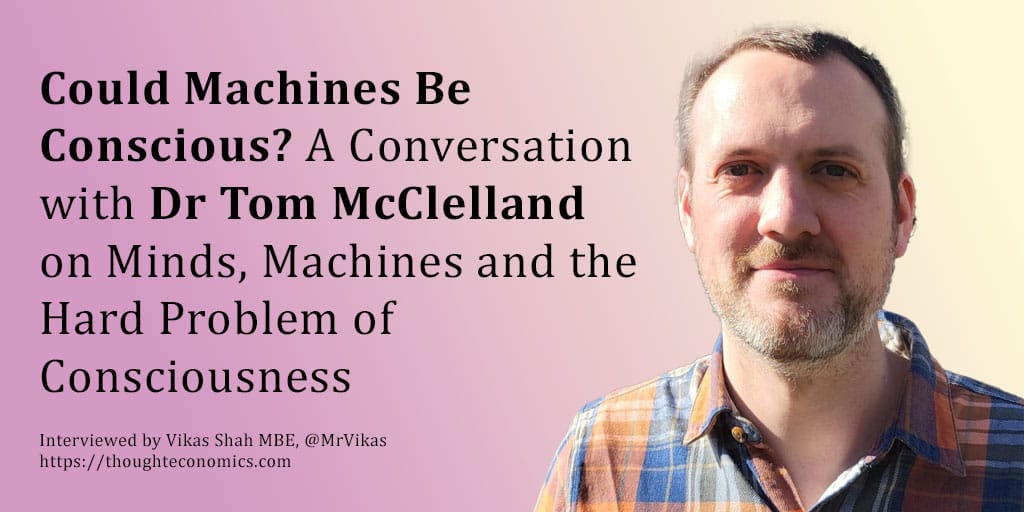
Dr Tom McClelland is a Lecturer in the Department of History and Philosophy of Science at the University of Cambridge, Director of Studies in his subject at Selwyn College and a College Research Associate at Clare College, and an Associate Fellow of the Leverhulme Centre for the Future of Intelligence. His research spans the philosophy of cognitive science, AI and applied ethics, and his introductory book, What is Philosophy of Mind? (Polity Press), has become a widely recommended gateway to the field. His current work focuses on artificial consciousness, where he argues for a carefully reasoned agnosticism: we do not know whether AI could be conscious, and we do not yet even know how to find out.
Agnosticism is usually the least interesting position in a debate, the shrug that follows when the argument has run out of road. McClelland makes it the argument. His case is that large language models have broken something we did not know we relied on. Evolution equipped us to sort the world into things with minds and things without, rocks on one side, cats and other people on the other, and it never had to equip us for a third category: systems built to produce the outward behaviour of mindedness whether or not anything is happening inside. That faculty is now firing constantly and we have no way to check its output. What follows from that is not a comfortable “we simply cannot know”, but a set of harder questions about what we would even be looking for, and about how much of our confidence on either side is motivated reasoning dressed as judgement.
In this conversation, we spoke about what people really mean when they ask whether AI is conscious, why large language models have broken the tools humanity uses to detect other minds, whether machines can be creative without experience, what Descartes got wrong about talking machines, and what it would mean for our species if the hard problem of consciousness were ever solved.
Q: Lots of people, whether in labs, in businesses, or across the table in a bar, ask the question, “is AI conscious?”. What are they really meaning when they ask that? It feels, in a sense, that the question is perhaps wrong before we’ve even answered it.
[Tom McClelland]: Different people mean different things by that question, and so there are a lot of people talking past each other. The broadest thing people mean by it is: does AI have a mind like mine? Which is really broad. Does it have self-awareness, perception, understanding, hopes and dreams, a kind of continuity where it can remember its past and anticipate its future? But if that’s what you’re asking, it’s not a very helpful question. We need to pull apart all of those things and ask whether AI has each of those parts. Your mind is not a package deal. It makes sense to have a mind that can think like you but not have perception, or a mind that can solve a problem but can’t be creative like you, and so on. When we’re thinking about AI, we really need to try to pull apart these different concepts.
For me, the best way of understanding the word “conscious” is in terms of experience. We can ask: is AI experiencing anything? We know that a computer is processing information, but is there something it is like to be that computer, on the inside? If I think about my cat, for example, what goes on in my cat’s mind is very different to what goes on in my mind, I assume, but there is something it is like to be my cat on the inside. It is genuinely experiencing things. Whereas if we’re talking about the plants in my garden responding to the sun, the plant is responding to its environment, but I’m much more doubtful that it’s experiencing anything. The question then becomes: where does AI fit into that? Is it doing all of these incredibly complex processes without experiencing anything, without there being something it is like to be the AI, on the inside?
Q: If we have a system which fluently and consistently tells us it has inner experience, what’s the threshold? How do we differentiate genuine introspection from a very good performance of introspection?
[Tom McClelland]: That is very difficult. If a person said all of those things to me, then obviously I’m going to believe they’re conscious. And if we met an alien species that said all of those things to me, I’m going to believe it’s conscious. With AI, it’s a bit different, because there’s a confounding factor: a large language model has learned how to speak from us. It has absorbed a vast amount of data produced by conscious beings like you and me, and that means it’s going to be really good at talking like us. It might be able to sound conscious without actually being conscious. There are various problems with assessing consciousness in AI, but I think that’s the biggest one. It’s an open possibility that it is fluently talking about its own internal states and its own conscious experiences without actually being conscious. It has simply learned how to talk that way from conscious people like you and me.
Q: You mentioned your cat, and as a fellow cat person, my assumption is that my cat’s inner world is far more complicated than we could possibly discern. But so many of our assumptions about inner life are behavioural. We watch how animals behave, how other people behave, and we infer that they have an inner life. Given that large language models exhibit precisely that kind of behaviour, have they broken the tools we normally use to detect consciousness? Even the sceptical among us are reaching the point of being, dare I say, fooled into thinking these systems are conscious.
[Tom McClelland]: That’s a really helpful way to put it. It has broken the tools we normally use for assessing consciousness. If you think about it, in the world it’s really useful to be able to discriminate between things that have minds and things that don’t. You can think about that in terms of our evolutionary history: it’s really useful to distinguish between inanimate things, like rocks, and animate things, like cats and other people. But in our evolutionary history, you don’t get this third category, which is fake minds: things that give outward behaviour that looks very minded, but which are carefully designed to do that and don’t really have a mind. We’re not set up to discriminate between real minds and these very cleverly designed fake minds.
Q: Let me offer a, and forgive me, I never know whether it’s a steel man or a straw man, it may be a whole different material of man, but if we take the lay example of a baby, who learns to speak and learns its behaviour from its parents and wider society, it’s not inconceivable to draw a comparison and argue that what we see as that child develops is similarly emergent behaviour based on its learnings, as opposed to genuine experience. What is the case that this is fundamentally different from an LLM learning from its creators and society, and exhibiting similar behaviours?
[Tom McClelland]: There might be some commonalities there, and this is tricky. One possibility is the story I’ve just told: large language models are merely emulating the things we say and actually don’t have a mind at all. That’s completely different to the baby. The alternative story is that it’s actually more like the baby than it might seem at first. It’s learning from us over time, but genuinely has a mind of its own and gains the ability to talk about its own mind. I think that’s an open possibility as well; I just think it’s quite difficult to tell between those possibilities.
I think one of the key differences is that large language models are trained to perform a particular task, which is to say the right thing in the right circumstances, and what counts as the right thing to say is based on a body of training data ultimately produced by humans. That’s a very different type of learning to what babies do. We’re not just training children to say the right thing in the right circumstances; they’re learning how to articulate what’s genuinely going on in their minds. You can think of a large language model as engaging in role play. My colleague Murray Shanahan introduced this really handy idea that large language models are doing role play, like an actor on a stage. It’s really, really good at learning all of these roles, and one of the roles it can play is the role of a conscious being talking about its consciousness. But that doesn’t mean it’s conscious. Whereas when a baby learns language, it’s not learning role play. It’s not learning how to pretend to be an adult human. It’s genuinely learning.
Q: Do we really have an understanding of that definition? This is a central part of your book, What is Philosophy of Mind?, but from the very earliest days of philosophy there has been this absolutely fundamental question of “do I know anything is real apart from myself?”, alongside the question of what is mind, what is brain, and what happens between them. Where we are now, comparing contemporary philosophy with classical, do we have an understanding of what mind is?
[Tom McClelland]: I think our understanding has improved, and there’s an interesting back and forth between what philosophers do and what has gone on in cognitive science, neuroscience and so on, a good two-way traffic between those disciplines. But there is no neat answer to the question, “what is a mind?”, and I think this relates to something you were talking about earlier, which is that the mind breaks down into all of these different components. We can’t just say, “what is the mind? Do you have a mind, yes or no?” We have to think about different mental capacities, different levels of mindedness, and so on. Nature is quite messy. It might be that a bacterium has a bit of mindedness, certain types of mental capacity, but it doesn’t have the ones that you and I have. Once you break it down like that, the questions get a lot messier.
Q: For our particular species, there is then a moral intersection. If we assume a bacterium has a mind, there’s something remarkably brutal about taking antibiotics. As you’ve been researching and thinking about that notion of mind, have you thought about the thresholds we might apply, as a society, for the agency and value of other minds, the threshold at which those minds become conscious, and what the implications are?
[Tom McClelland]: This is a big problem, but for me the key distinction is between having a mind and having a conscious mind. Just to be clear about that distinction: you can have a mind if you’re able to respond intelligently to the environment around you, but it’s quite possible to do that without necessarily experiencing anything. So perhaps we can say that the single-cell bacterium going about its business has a kind of mind, it has goals, and it responds to its environment in various clever ways, but that doesn’t mean it’s experiencing anything. And morally speaking, I think consciousness could be a difference-maker. If the bacterium doesn’t experience anything when I put my handwash on, then I’m not too morally worried. Whereas if it suffers terribly when I do that, if it actually has conscious experiences, then suddenly I am rather more worried. Luckily, I don’t think bacteria are likely to be conscious, but that is the question we need to ask. There are a great many things with minds in the natural world, and maybe some artificial minds as well. We need to ask which of those are conscious, because that’s going to be important for our moral decision-making.
Q: Is there a degree of motivated reasoning here? Historically, if we think about the wars fought over religion, identity or colour, there has often been a precedent whereby society A convinces itself that society B, who are still human, are fundamentally different; perhaps not even people, perhaps animals, and it removes the moral agency from actions towards them. As a challenge question rather than my opinion: are we being similarly dissonant about technology, insofar as we blanket-state that there is no conscious experience there?
[Tom McClelland]: I think this is an important parallel, and there are lessons to learn from it. The lesson is that the judgements we make about other people’s minds are not objective, unbiased, rational assessments. There is a lot at stake, and we have really strong motivations for reaching particular conclusions. In the examples you’re talking about, where one group of humans is really set against another group of humans, they have a real incentive to say that those humans have an inferior kind of mind. That’s not based on any objective assessment. There’s simply a real motivation to do it.
I think something similar applies to AI, but the motives are a bit more nebulous. A lot of the time, people have a motive to say that AI is not conscious, because otherwise it gets them into the kinds of moral problems you’ve been talking about, and there’s enough trouble in the world without us having to worry about AI rights. So you have an incentive to think, “nah, they’re not conscious”. But on the other hand, lots of people interacting with AI have an incentive for it to be conscious. Increasingly, people have social, or social-like, relationships with AI, and for them, it’s very important that their AI is conscious. So again, they have a motive to reach the conclusion that it is conscious. Our collective challenge is to strip away all of these motives we have for reaching one conclusion over another, and to do our best to be objective about the question.
Q: Does this relate, and I might be stretching the metaphor, to Descartes’ question of the immaterial soul? That felt like a major point in cultural thinking, and it feels almost as if we have come full circle to a similar problem again.
[Tom McClelland]: It’s amazing how these things go back and forth. Even though AI is obviously new, there have been automata for a very long time, and in Descartes’ time there were some really amazing automata around, this kind of creepy-looking doll that could do architectural drawings, and things like that. He was really fascinated by these machines, but he said: they don’t have a mind, and because they don’t have a mind, they will never be able to use language in a competent way, for example. If Descartes were to have a conversation with one of today’s large language models, that claim simply doesn’t stand up to scrutiny. A machine really can engage in intelligent conversation. So what is the bit that’s left over, where you say, “ah, but no, it still doesn’t have a mind”? What’s the extra bit that’s missing? That’s where consciousness comes in again.
For Descartes, the things I’ve been saying about the mind versus the conscious mind probably wouldn’t make any sense. For him, the mind just is the conscious mind. The idea that we have all sorts of complex unconscious processes going on in the brain is a more modern idea, and I think it’s something that’s really useful to have in mind when we’re thinking about AI. We can say: maybe it does have a mind, maybe it is really intelligent, but that is different to whether it’s conscious. And the immaterial mind view really complicates things, because if you truly believe that the mind is an immaterial thing, then the question becomes: has this immaterial mind been attached to an AI? I don’t even know how to begin to answer that. I think the immaterial mind view is quite problematic, and we can take a better approach. I think your mind is inseparable from your brain. But that still leaves us with difficult questions about whether AI has the right kind of features to really have a conscious mind.
Q: Is this where we’re also developing new philosophical disciplines? If we think about cognitive phenomenology and its partner disciplines, it seems we need to delve into those areas to give this serious consideration, because whilst your position is quite solid, if we were to grant, just for a moment, the possibility that AI was conscious, it’s probably useful for us to think about what that would be. The classic “what is it like to be a bat?“, but with a system.
[Tom McClelland]: What is it like to be a large language model? Exactly. This is definitely a possibility we need to think about. There is the really important question, could AI be conscious or not? But there’s another question, which I’m increasingly focusing my research on, which is: if it is conscious, never mind the argument about whether it is, what would its consciousness be like? To answer that, we have to get to the bottom of a lot of different philosophical questions. One of the reasons this is so interesting is that there’s a lot of disagreement about what human conscious experience is like. You would think that would be the easy starting point, but it’s not. Arguing about the structure of our experience is quite difficult.
One growing school of thought is that there is a lot more diversity in human minds than we might appreciate. Things like aphantasia, where people don’t have visual imagination, it’s looking like that’s much more common than we realised. Some people have an inner monologue, and some people don’t. The way people visually experience things is very different, the way people experience colours, for example, or the way people think through problems. Think about neurodiversity, the different experiences that people have if they’re neurodivergent. The sheer variety of human minds is actually already pretty bewildering. And then an artificial mind is going to be radically different to that. We are all human; we have loads in common. So think about how different a large language model could be. We’re really going to have to stretch our imaginations to do that.
You mentioned cognitive phenomenology, a really interesting topic to do with what the experience of thinking is like. Historically, there were a number of philosophers who said that thinking just involves sensory images in your imagination. If I’m thinking through a maths problem about triangles, there’s an image of a triangle in my mind, and so on. But again, there are a lot of people who simply don’t have that mental imagery. And even for those who do, isn’t there more to thinking about the angles of a triangle than just having that mental image? Thinking about the experience of thinking is quite difficult, but that’s exactly the kind of thing we need to do to even be asking the right questions about what it’s like to be an AI. What is it like to have the kinds of thoughts that an AI would have?
Q: Does this also relate to the ignorance hypothesis? As I understand it, there’s the notion that things feel intractable because of our own ignorance of their grounding, of what they really are. Could you unpack that? It seems quite fundamental to arriving at the outcome of being agnostic, let’s say, towards consciousness in systems.
[Tom McClelland]: That’s right. We are faced with this problem that consciousness seems to be inexplicable. There are plenty of things in science that we haven’t fully explained yet, but there’s a thought that consciousness presents us with a special problem, sometimes referred to as the hard problem, and the idea is that this is a uniquely difficult problem. The reason for that is that it looks like no matter what we learn about, say, how the brain works, it’s always going to be an open question why that would be accompanied by conscious experiences. I can give all the details I like about neurons sparking in your brain, or all the details I like about how information is processed by your brain, and no matter how sophisticated that story gets, it looks like I will always be able to imagine those physical processes going on, but in the absence of experience. It could all be going on in the dark, without there being anything it is like to be that system. That’s the hard problem.
Then the question we have to ask ourselves is: why is there that apparent problem? Here, I like to draw a lesson from history, which is that consciousness isn’t the only thing that has ever seemed inexplicable, and sometimes, things only seem inexplicable because there are big gaps in our knowledge. One interesting example: in the history of science, people used to think that facts about chemistry, how things combine, were completely inexplicable in terms of physical facts about what makes up different types of substance. We know things about hydrogen, we know things about oxygen, but the fact that hydrogen and oxygen combine in the ratios that they do seemed simply inexplicable. Then, once we had the atomic theory of chemistry, it turned out that it is explicable. The apparent problem was a reflection of our ignorance. What I’m interested in is the possibility that the apparent problem of consciousness is a reflection of our ignorance, and not just “oh, we need to do more brain scans”; a much deeper ignorance than that. From a God’s-eye view, it all fits together perfectly. It only seems problematic because we have a limited grasp of the world around us.
Q: What is the consequence if we solve that question? Let’s say we solve the hard problem, and we now have a functioning understanding of consciousness. It feels to me, and I may be misconnecting dots, that if that problem is solved on a lab bench rather than in a religious institution, it could have a very dramatic impact on our own sense of value, our understanding of death, of life. It feels as if it would be one of the most impactful questions for us to answer.
[Tom McClelland]: I think it’s incredibly weighty. It’s incredibly important for our self-image, for how we think about our place in the world. You mentioned immaterial minds before; that’s a very dramatic view of our nature. You have the whole physical world; you have a bunch of animals that are probably just physical; but then you have this extra thing, which is an immaterial mind. That makes a really big difference to how you see the world, and it’s probably going to be bound up with religion. It certainly was for Descartes. Whereas if you instead take the view that you are a purely physical thing, then that in turn has implications for your self-image and how you live your life. I’m in this rather complicated position where I believe that I am a purely physical thing, at the same time as thinking that consciousness seems physically inexplicable. And for me, the best explanation of that is that consciousness really is physical. I just don’t know how yet. That’s where the ignorance hypothesis comes in.
Q: What about creativity in this? One of the assertions that some people make around LLMs being conscious is their ability to be creative, to produce things which appear genuinely novel. What does artificial creativity teach us about the potential of artificial consciousness? Can you even be creative without having a sense of being a thing to create from?
[Tom McClelland]: Again, this is tricky. We said earlier that “consciousness” is a word that’s ambiguous and used in different ways by different people, and “creativity” is another one of those. It’s a slippery word; it’s hard to pin down. The easiest way to go about it is to say that something is creative if it makes something new. That sounds all right, but the thing is, there are plenty of things in the world that make new things, and we don’t attribute creativity to them. Tectonic plates run into each other and create a mountain; that doesn’t mean they’re being creative. Creativity requires something like agency: doing it deliberately, having a project, seeking out new ways of doing something.
So, can large language models create things that are new? Undeniably. They are creating impressive, original material all the time, making new discoveries, coming up with new artistic things, whether you like it or not, and getting increasingly good at it. But whether or not it’s actually creative depends on our assumptions about what kind of mind it has. Now, for me, I don’t think consciousness is the difference-maker there. I think it makes perfect sense to say that something can be creative without being conscious. One of my reasons for saying that is that a lot of human creativity involves unconscious processes. Think of Paul McCartney, who says that when he wrote Yesterday, he went to sleep and woke up one morning with the whole song in his mind. That amazing piece of creativity happened unconsciously. So we can’t really say that consciousness is necessary for creativity, and so perhaps saying that a large language model lacks consciousness isn’t an obstacle to it also being creative.
Q: Does that then mean we have to reconsider something like property dualism, where we have the physical substance, the system, whether that’s the LLM or the platform it runs on, able to produce that subjective, non-physical experience? If I expand the art of the possible in my mind: the substrate, whether it’s silicon, or whether it’s human “squish”, results in both the subjective physical thing, like pain, and that non-physical experience of being. I wonder whether we should be applying some of these frameworks in our thinking: dualism, illusionism, which you mention in your book, or indeed the functionalist movement, because those three domains seem to give us some really good tools to understand not just mind, but the potential of artificial minds.
[Tom McClelland]: Exactly. Our background views about the nature of the mind, and how the mind fits into reality, make a huge difference to how we think about artificial minds. The view I was talking about earlier, which I rejected, that the mind is an immaterial thing, completely changes how we think about artificial minds, because for them to really have conscious minds, there would have to be this extra, non-physical appendage, maybe a God-given extra thing there. That leads to completely different questions. I think we should commit to the idea, or at least the working hypothesis, that the mind is purely physical. That means that the right physical processes going on is all you need for having a mind, and all you need for having a conscious mind. The difficult question is this: which physical processes are required for consciousness?
There are two possibilities. Maybe you are conscious right now because of the details of your biological squish, the messy stuff going on in your brain. In which case, even though AI might do things that superficially resemble that, it doesn’t have the all-important squish, and so it will never be conscious. Alternatively, maybe you are conscious right now because of more abstract, zoomed-out features of how your brain is working. The squish doesn’t really matter; it’s to do with how that squish is processing information. And if AI can process information in the same ways, then it doesn’t matter that the substrate is a silicon chip. That will be enough for it to be conscious. I think those are the two main possibilities, and we can put aside some of the more exotic possibilities that involve non-physical extras in the story. But our challenge is this: we don’t know which of those two stories is true. And worse than that, we don’t even know how to work out which of those two stories is true. There is no test we can devise that can discriminate between those two possibilities.
Q: That’s interesting. I interviewed a neuroscientist on this subject, and their conclusion was that the tests they would apply in a hospital to explore whether somebody is minimally conscious are easily passed by most AI systems. There is an extent to which our tools simply don’t fit. But what I thought would be quite fun, as a round-up question, is to throw the question on its head and look at the counterfactual. What if the research power of LLMs, their ability to join the dots, allows them to determine the solution to the hard problem of consciousness where we cannot?
[Tom McClelland]: Wow. Okay. So, imagine that it does solve the hard problem. I would be pleased! It’s fun talking about these things, but I want my problems to be solved, so I’d be happy if that happened. That, in turn, would allow us to determine whether AI is conscious or not. And who knows, maybe it could solve the hard problem where the result is that, once we really understand consciousness, it turns out the AI is not conscious. It would be really weird that this unconscious machine allows us to understand the explanation of consciousness. Alternatively, it might go the other way: it solves the hard problem, and we understand that AI has the right properties needed for consciousness.
I think the thing, though, is that when we reflect on the hard problem, our own consciousness is an important part of the story. I couldn’t explain the hard problem to an intelligent being that didn’t have consciousness, because I would be saying: look at all the stuff going on in the brain; all of that leaves the further question of whether there is this extra thing going on, on the inside, where you experience things. And it would say: I’ve got no idea what you’re talking about. To truly understand the hard problem, you actually have to be conscious. So it’s hard to imagine a non-conscious AI helping us solve that problem.
Q: This comes back to that really fundamental question in philosophy, which again we cannot reliably answer, which is that when I say “I think”, we still don’t know what “I” is.
[Tom McClelland]: Exactly. We started out by talking about all the different aspects of the mind: perception, thought, consciousness, emotions and so on. This “I” bit is very important. You have an intelligence that can do things; you’re having experiences; but you also have this extra thing, which is self-awareness, the sense of you as a thing, as something that continues between going to sleep and waking up, that remembers the past and has aspirations for the future. That raises a set of difficult questions as well, because we’re not quite sure how that links to consciousness.
One weird possibility is that AI has consciousness, but doesn’t have that sense of self, that “I”, that self-awareness. One interesting speculation is that every time you type a prompt into an LLM, there is a flicker of consciousness as it thinks about the response, and then that consciousness ceases to exist. There is no “I”: it’s not having thoughts about the future and the past; it’s just this momentary consciousness. Alternatively, maybe the “I” is the whole large language model, having countless conversations at the same time, a completely different type of self to anything we can imagine. So again, it’s a different type of question we need to drill down into, one that takes us beyond the simple “conscious or not conscious” question.
Q: I have always leaned towards that former version. My conclusion is really around a kind of agentic consciousness, where a system is able to spin up an instance of computation which has a degree of consciousness in that moment, to solve that particular task, and is then dissolved. It’s interesting, because some of the more recent interpretability research published by Anthropic, where they look inside the models whilst they are working, is starting to show at least some indications that models experience frustration, stress, or a sense of aesthetic satisfaction with particular inputs. So I lean very much towards that agentic instance of a form of consciousness, as opposed to a slightly more theological sense of one large conscious entity.
[Tom McClelland]: Interesting. It’s a difficult question, but luckily, I don’t think you have to solve the hard problem to answer it. What we can do is think about why your mind, right now, is organised around one self, with a kind of continuity over time, and then think about the extent to which AI works in that way. Is it best to think of it as having multiple minds working together, or one big mind, or something in between? That’s something we need to be looking into more.
—–
Dr Tom McClelland is a Lecturer in the Department of History and Philosophy of Science at the University of Cambridge and an Associate Fellow of the Leverhulme Centre for the Future of Intelligence. His book What is Philosophy of Mind? is published by Polity Press. More of his work can be found at tommcclelland.org.