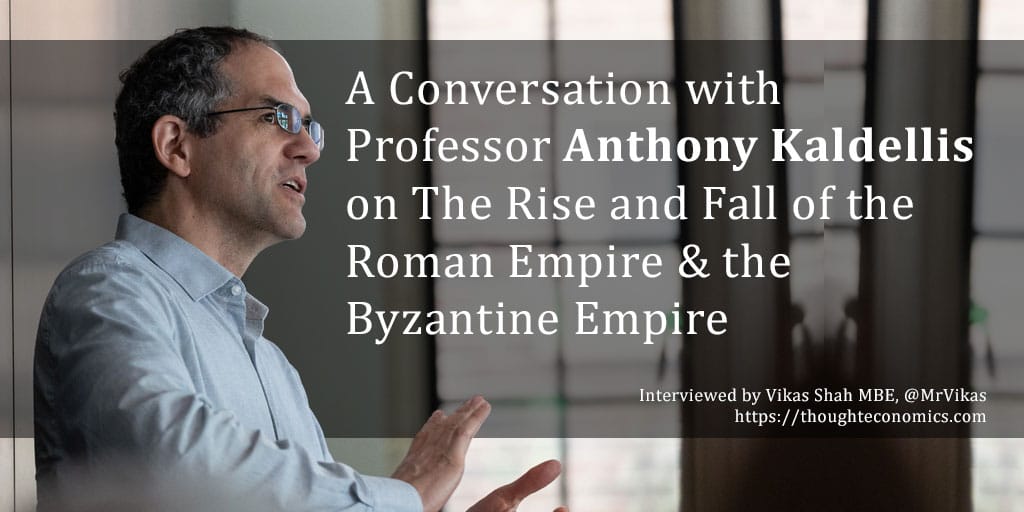
For most of the last three centuries, the medieval eastern Roman state has been known by a name its own people never used. “Byzantium” is a label applied retrospectively by early modern western scholars, and with the label came an entire architecture of assumptions: oriental despotism, theological obsession, decadence, a thousand-year decline. Few historians have done more to dismantle that architecture than Anthony Kaldellis.
Professor Kaldellis is the Gaylord Donnelly Distinguished Service Professor in the Department of Classics and the College at the University of Chicago. Born in Athens in 1971, he took two bachelor’s degrees, in history and philosophy, and a doctorate at the University of Michigan, and spent two decades at Ohio State, the last seven of them as chair of its classics department, before moving to Chicago in 2022. He has spent his career arguing that the state we call Byzantium understood itself, simply and continuously, as Rome, and that it functioned not as an absolutism but as what he has called a “monarchical republic”, in which emperors derived their authority from the Roman people and were answerable to them in practice as well as in theory.
His books include Hellenism in Byzantium (2007), The Byzantine Republic (2015), Romanland: Ethnicity and Empire in Byzantium (2019), The New Roman Empire (2023) and 1453: The Conquest and Tragedy of Constantinople (2026). He has translated a great deal of medieval Greek into English, and in 2019 he founded Byzantium & Friends, the first academic podcast in his field.
What makes him unusual to talk to is that the revisionism cuts in an unexpected direction. It would be easy to read a scholar who insists on the Roman republican inheritance as flattering the medieval past, or as reaching for a usable ancestor for our own politics. He does the opposite. The eastern Romans had no elections, no independent judiciary and no institutional means of registering the popular will, and yet, he argues, their emperors were more exposed to the public mood than most modern politicians, because the only instrument of accountability available was a crowd in a public space. The comparison is not comforting. It is the fragility of our own arrangements that the conversation keeps returning to.
In this conversation, I spoke to Professor Kaldellis about what we are really doing when we relabel the past, how a monarchy without elections secured and lost the consent of its people, why democracy is a far more recent and fragile achievement than Europe likes to claim, what divine kingship and “there is no alternative” have in common, and how a state managed to survive for eleven centuries.
Q: A starting point in your work, and without wishing to paraphrase you, is that you have shown the concept of “Byzantium” to be a relatively modern invention, a label that we impose. And we seem to do that constantly. So when you look at today’s political fights over history and memory, what does your work tell us we are actually doing when we try to relabel the past?
[Professor Anthony Kaldellis]: It is interesting how you phrase that. It was not the starting point of my research; it is something I had to work towards, because it was so deeply embedded in the narrative you are trained in as a scholar. Not just as a lay person hearing about Byzantium, but even as a scholar, you are trained to handle all of the cognitive dissonance that that invention requires. You are reading your sources and they are saying one thing, then you are reading the scholarship and it is saying another, and you have to process that. So it took me a while, and I discovered in the process that the things we take for granted the most, the ones we discuss the least, are sometimes the ones most deeply embedded in the infrastructure of our thought.
It took me a while to realise: why are we doing this, exactly? It simply does not correspond to history as we know it. So to address your question, I think it is not the names that matter so much as the associations those names are meant to bring into the discussion. Even in the modern culture wars, I am not terribly concerned about names as such, I do not get fixated or caught up on words, but rather: do these words bring a whole architecture of understanding to a topic that distorts it? And that definitely happens in the case of Byzantium.
Obviously it is not the most important problem we face as humanity, but it is a problem I faced in my professional capacity, trying to understand this society. In my view, it is those associations that matter, because they are part of a narrative we are trying to tell ourselves about that topic, or about who we are. And those narratives are not necessarily crafted with an eye towards historical accuracy. Insofar as I do take it to be my job to understand history as accurately as possible, not in a positivist sense, obviously not, we have to deal with those distortions, and to that degree my job is to try to clear them up. Which is not to say that people do not need narratives: all societies need narratives. We are enmeshed in them, and this is how we understand who we are and the world around us. But I think this one can be fixed with minimal cost to our self-understanding at this point.
Q: One of the key narratives I thought about was democracy, and how society fits together. If we look back historically, and you are very much the expert here, I am beyond lay in this capacity, we had huge periods where consent operated powerfully in systems without voting. So what can we learn, or what should we think about, in today’s society, where arguably people vote but feel withdrawn, and where consent seems to mean something different?
[Professor Anthony Kaldellis]: You are right, democracy is one of those frameworks that conditions our understanding. I am in my fifties, and I was raised to believe that democracy was a normative framework that we either take for granted or must defend, but also that it was an implied normative framework humanity was reaching towards, and that what came before is inherently problematic. I was raised this way, and I prefer democratic systems to any other; I just want to get that on the table. Even when you accept something like “democracy is the worst system of government except for all the rest”, even in that framework, we have to understand that human beings for almost all of history did not live in democracies, did not think they wanted to live in democracies, or had no idea what that was. And they were not necessarily engaged in some sort of teleological struggle for it.
Not only that, but Europe tries to cast itself as a place of democracy, or the origin of democracy, when in fact there is hardly any positive democratic thinking in the European tradition until probably the twentieth century. It really took the First World War to get Europeans to start thinking along those lines. So it is quite recent. If you go into the eighteenth century you do find some radicals, of course, in the French Revolution; in the nineteenth century you find a lot more fear of democracy. So I think we need to understand just how fragile it is.
Having said that, democracy is not the only way by which societies measure or establish consent, and this is also very important. The society I study, the eastern Roman Empire, was a monarchy in which all the institutions of government were, at least in theory and often in practice, in the hands of a unitary executive headed by the monarch. There was no independent judiciary or anything like that. In practice that power was severely limited by all kinds of practical checks and balances, but nevertheless there were ways of establishing consent and expressing dissent, and these were non-institutional. That is the whole point. There were no governmental institutions such as elections meant to establish or ascertain the general will, the will of some constituency, that was vital for governmental legitimacy.
Nevertheless, many political decisions, and in particular the appointment of new emperors in Constantinople, required, and in fact were effected by, popular consent. So you have tens of thousands of people in the Hippodrome, possibly greater numbers, or in Hagia Sophia, or in very large public spaces. The Roman imperial tradition had always functioned this way: one is made emperor when the entire political constituency claims you as such in a large public gathering. And many times the reverse happened. You were a sitting emperor, but if you became unpopular enough, that same constituency would gather publicly and loudly proclaim that you were unworthy of the position. There were degrees of that, but when you get to that point you are in trouble. Initially it starts with grumbling in the Hippodrome, or acts of disobedience, or insults, or satirical songs.
It was very important for rulers to gauge the public mood. They did not have public surveys or opinion polls, but it was vital for them to understand how people were feeling, because if they misjudged the public mood and there was a challenger, or a coup, or a popular uprising, that could be the end of them if nobody came out into the streets to support them. So it was very much a situation of protest and counter-protest, and gauging the mood. The whole political apparatus, the legitimacy of it, depended on consensus, and that functions outside of institutions, unlike our elections, which are institutionalised. Sometimes it happens violently: sometimes very violently, with people losing their noses or having their eyes gouged out.
Our elections are institutional. They are written into the rules about how government works, how the political system operates, and they are, at least ideally, non-violent. The whole point of them is to avoid violence. And you think, well, how can one express consent or consensus more than the other? Because elections can be subverted in all kinds of ways, and they are not perfect. No system is perfect. So we can see our elections being captured by elite interests. Candidates are vetted in advance. The parties control the parameters of what is sayable. Money has become a huge part of the process, so that if you cannot woo donors in advance you do not have a shot. You compound all of those filters and you end up with basically corporate candidates backed by money on either side, or all sides.
Eventually you have a situation, and this is true in the United States, and was true in Greece during the crisis years of the 2010s, where no matter what government, party or politicians are put in power, it is the same pro-business, pro-elite policies that are going to be implemented regardless of who it is. At that point the electorate begins to feel, as you said, disenchanted and alienated, and they sometimes just will not participate, because they realise this is theatre and it does not really affect the decisions that are made.
Q: I do wonder whether the political establishment has forgotten that to an extent. At a moment of more upheaval, some of the patterns you describe, people no longer tolerating leaders, it seems as if the leaders of the eastern Roman Empire were far more aware of what those warning signs were, and earlier, than our leaders might be.
[Professor Anthony Kaldellis]: Well, some were and some were not, and the ones who were not paid for it. The system incentivised the promotion of individuals who could read the room, or the Hippodrome.
Our leaders, and we can have a discussion about this, maybe you feel differently, but I think the leaders of modern republics or democracies, or whatever they call themselves, go through phases of great arrogance. They begin to feel at some point that they have accumulated tools of control that insulate them from public accountability to a degree that they can basically disregard what people think, because they have nailed down the propaganda system. This time, we have got it. And we will feed them, I do not know, reality shows, or AI slop, or constant propaganda, and they will not be able to understand why they feel the way they do. We can channel their grievances. That is the idea of manufacturing a kind of consent: we will channel their grievances into the areas we want them to go.
And then there are times when modern political elites are reminded of what happens when they cross those limits, or when people can see through the smokescreen. This can happen under various circumstances. For example, I happen to think that Western countries, and especially the United States, undertook the creation of a broad middle class precisely in order to counter the appeal of communist ideology, which, when addressed to the people for whom it was originally intended, is very appealing. The whole project in the twentieth century of creating a broad middle class was precisely to create a buffer for the system against the appeal of that ideology. As soon as the Soviet Union collapsed, the moment it did, you could see our elites starting to roll that back, and to put into high gear the process of billionaire creation. Let us go back to the 1920s.
And now they think that with social media and digital information and so on, they have got it. But they are dumb. I am not convinced of their technocratic competence in this matter. For one thing, their apps are horrible, and this is what they are supposed to be great at. If that is as good as they can do at the technical things they are experts in, I am not assured that they have a lock on the mood of the population. So I think they are now in one of these self-delusional modes. Now, I could be wrong, and it is entirely possible they have found the trick to keep people confused enough, distracted enough, and angry enough at the wrong things, that they might be able to perpetuate their hegemony a little bit longer.
Q: The other thing occurring to me is the legitimacy of the leader. You have written before about divine kingship, the sacredness of that role, perhaps disguising the real vulnerabilities, but also making it seem almost inevitable. We might see that as dynastic leadership, or whatever it might be. I would love to get your views on what the modern equivalents of that are, because in some ways it does seem we have that sort of divine anointing, or that sacredness of certain people or certain groups.
[Professor Anthony Kaldellis]: As you say, I see those kinds of, and I am not sure they are ideologies as such, but definitely propaganda, in other words, claims made by people in power about why they deserve to be, and or are, in power. And the louder they make these claims, the more I begin to think they are insecure about them, or insecure about something. This generally goes for power broadly: the things it is most concerned that we agree with it on are the things I think it is most anxious about, whereas the things it rarely ever talks about are the ones it is more confident or secure about.
The Roman imperial tradition went through a couple of phases of this. Obviously the emergence of the imperial office in the first place is tremendously insecure, and the first emperors had to lie constantly in order to persuade people: no, this is fine, this is fine, nothing to see here. Then there was another phase of such insecurity in the third century. You do not need to get into the details, but one of the responses to it was to assert divine favour. This was before Christianity: emperors were starting to do this in a big way precisely at the moment when they were most insecure, that is, when they were being replaced by the month. This was not the only thing that got them out of that mess, obviously it was armies, but it went along with that process. So they started to talk about their position as being divinely anointed in various ways, and that then just passed into Christianity.
Christianity might actually have been a bit advantageous in this matter, in that an emperor could say, and Constantine did say, there is only one God, and that God is with me. Whereas before he did that, even in his own career, there were a number of gods you could go with. You could go with Jupiter, or Hercules, or Apollo. Constantine started out as a kind of Jupiter-Hercules guy, then he transitioned to an Apollo guy, then he became a Christ guy. So he was looking for that formula. You can see it in his career.
These are the kinds of things that centres of power will project. What they will not talk about so much is that in fact their positions are highly vulnerable to choices made by human beings. This is what people in power generally do not want their subjects or citizens to think about too much: that what we are seeing here is the result of human choices, rather than some inevitable outcome of either divine favour or, in our case, economic forces. That this is just how the economy works, or, in the famous phrase of Thatcher, there is no alternative. That is what they desperately want people to think: that this is a natural order, there is no alternative to it, this is just how the economy works. I think that is where they are most vulnerable, because in fact what they are doing is converting human choices into inevitability. But they are never inevitable.
Q: When we think about the more modern concept of law and justice, and dare I say natural justice, it does seem that the period you study was absolutely fundamental in the emergence of what we now see as principles of law and justice in a practical sense, as opposed to the Greeks sitting around a fire discussing it. Really practically applied justice and applied law, but also diplomacy. Because from my very cursory understanding of the period, yes, there were lots of wars and violence, but it did also seem as if this was a period where diplomacy emerged. So it seemed to be a different type of law, and of relations.
[Professor Anthony Kaldellis]: Those are two very important points, and you are right. The society I study is a Roman society, and among the many things that that means is that it operates according to Roman law. There is no other system of law in place; it is just Roman law. After a certain point it begins to operate in Greek, but it is still the same law. In fact, we have Roman law because it was codified in Constantinople in the sixth century. We do not really have direct, unmediated access to ancient Roman law, we just have little bits and pieces. What everyone calls Roman law is an east Roman, sixth-century, Christian creation.
What is important about it is that it was in fact meant to structure society on a pretty fundamental level. What is property, for example? Any time you engage in a transaction with someone in this society, it is very likely that at some point you are relying on some fundamental category of Roman law. This had to do also with the rights of individuals, and the responsibilities of different classes in society. So it was a society that very much considered itself a lawful society, ennomos politeia, a polity structured by law, where what happens to you in life is, ideally, structured by legal norms and not the result of accident or violence. This is an ideal, of course; no society has ever attained it, not any modern society even today.
What they thought is that accident or violence is how “barbarian” societies were structured. Now, of course they had a great deal of prejudice about those barbarian societies, but they were not wrong about many of them to that degree. If you went into the Hun Empire, you get what you can based on personal relations with people in power; beyond that, you cannot appeal to a legal system that is independent of that. As I said, it is not clear that you could always do that in east Roman society either, but it is certainly much more so than under Attila. So that is one thing: they aspired to that in a very lived way.
And the second, diplomacy, yes. Because they believed that a civilised society’s goal is to minimise the exposure of its subjects or citizens to violence. That included foreign violence as well. So the goal of most foreign policy was to neutralise violence before it happened. The idea is not only to deter through violence, though inevitably you have to do that, inevitably you have to have armies that will respond if you are attacked, but to establish a framework that minimises the potential for such violence in the first place. That is where they put a lot of their investment. And I should say, this was not an effort to create peace on a global or regional scale. It was an effort to create peace for themselves. So if that meant paying enemy one to attack enemy two, fine.
Q: It is not a million miles away from how the world currently works, let us be honest.
[Professor Anthony Kaldellis]: No, but we do have institutions and a general understanding that a kind of global peace is an ideal. I do not think I have ever seen expressions of that outside of purely theological or utopian treatises.
Q: The other thing that fascinates me about this period is the notion of identity. Today we are in a period where, even here in the UK, there are so many conversations around national identity and Britishness. But in Romanland you argue that it is about who counts as one of us, that it is not a birthright. That seems very divergent from where society is sadly going now. To what extent was that notion of identity important for the scale of the empire that resulted? And I suppose the acid test: what can we learn from it about our own senses of national identity and culture?
[Professor Anthony Kaldellis]: In part it depends on how you define birthright. In the United States, and I infer from the way you phrase the question, birthright citizenship means the opposite of what you have in mind. It is actually a topic of considerable discussion, and even legal challenges, right now in the United States.
The law of citizenship of the state we call Byzantium, Romanía, is very clear: anyone born in Romanía is a Roman citizen. Which is the same as the United States, and this is what some of the people on the right are trying to abolish right now. So that is what we call birthright citizenship, unless I am really getting it wrong, but I do not think so. They were similar in that regard. In other words, the Roman imperial system, by this point after the third century, has a baseline understanding that if you are born in it, it does not really matter where your parents are from, you are a Roman citizen.
Now, this is different from conceptions of ethnic or tribal citizenship. The ideal types of these two situations are Germany and France: Germany and France in the twentieth century, I am not talking about Germany and France now. There is a famous model whereby France is a civic nation, that is, where citizenship is independent of who you are descended from, whereas in Germany it is: are you a German or are you not? Greece today is more like that German model. There are always exceptions, but it is not like Canada or the United States. So the society I study is much more like Canada, the United States and France, rather than Germany and Greece.
These tend to be more, now, I do not want to say multicultural or multi-ethnic, which are modern terms that imply a kind of acceptance of different cultures, and that is not exactly what is going on, but they do tend to be much more diverse linguistically and ethnically within the citizen body, rather than there being a citizen body and then a bunch of other people. The extremes we see there would be somewhere like the Emirates, a more extreme version of that. So you do have a situation where the society has to find some kind of centre of gravity to hold it together in the midst of a recognised diversity. And sometimes it can be more accepting and sometimes less; these things vary a lot.
But modern societies are, I think, very different on this point. One major difference is that, as far as I know, there is no recognition of a principle that your cultural identity is worthy of protection or preservation. This is a medieval society, where dominant norms can be, and are, imposed on whoever they want to impose them on. Often this happens through religion. The idea of a Christian polity tolerating religious minorities is problematic. They did, and sometimes you even find them recognising that they did, or should, but it is something that made them uncomfortable. It is not something they ever really embraced, as if to say, this is great. The norm was to put pressure on these groups to convert. There were some exceptions, but generally it was that. And once you convert, you change your religion, and a whole bunch of other social norms go along with that. Also, if you want to get along in this society, eventually you would have to learn Greek as well. Pretty soon, within a couple of generations, you are indistinguishable from someone whose ancestors had been there much longer. So there is a kind of push towards assimilation and conformity, definitely.
Q: What I thought would be interesting to round off on is time. First of all, we are talking about a state that survived eleven centuries. It is an extraordinary amount of time, and yes, the pace of change now is very different, but this was not a time without change. So what did they do well? How on earth did a state survive that long? And secondly, is the notion of the length of time a state can exist itself of importance? If we think about modern society, there is almost a psychological assumption that the state only survives from election to election, an implied birth-and-death cycle, which perhaps did not exist then. How did they keep renewing legitimacy through all these crises and survive eleven centuries?
[Professor Anthony Kaldellis]: May I ask what you mean when you say that a state is expected to survive only from election cycle to election cycle? Maybe I am not understanding that correctly.
Q: Let me rephrase. The core of it is this extraordinary length of time the state existed. It almost seems impossible, dare I say, for our modern states to survive those lengths of time, given the fragility of our world.
[Professor Anthony Kaldellis]: It seems implausible, but the millennium is young. It is like someone who studies ancient Greek, as I do, looking at modern languages: they have their literatures, they even have departments that study them, and in my mind, I do not say this openly very often, it is kind of too soon to tell for some of these languages. There are enough extinct languages around.
This is one of the most important things about this society that we have failed to tackle head on. In fact, I am currently writing a book trying to explain exactly this: how and why did it last for so long? Part of the reason we have not seen it is that its narrative has been framed for so long as one of decline and fall, so the emphasis has always been shifted to those periods of catastrophic failure and defeat, when they lost Asia Minor, or they lost Egypt. We do not look at the many centuries in between those events, in which not only do we find stability, but we almost without exception find slow but steady gradual economic growth, and even slight territorial expansion back into territories they had lost. Nothing like Alexander the Great, no conquest like that, with very few exceptions, like Basil II and the conquest of Bulgaria. And there are not that many of those. Usually it is just a very steady revival and regrowth.
So I think we need to shift the focus to that. It is much less sexy and much less dramatic, there are fewer battles and things like this, but it is essential that we understand the mechanisms that kept it alive for so long. Why did it always bounce back? There is too much to talk about here, as I said, I am writing a whole book about it, but I will mention one factor: what is important are the dysfunctions that we do not see in this society, that we do see in almost all of its medieval peers. For example, there was never any serious talk about partitioning it, they never did that. You never have warlords who carve off territories on the periphery and rule them independently. That happens to almost all other empires, and then you have to ask, why are these things not happening here?
But the more interesting observation about things that did not happen is that we also do not have any serious agrarian revolts, peasant uprisings, that kind of disruption. The state almost never loses the ability to tax effectively, not only its population and territories, but also its elites. And why is that? That is the most stunning part of it. I think the answer definitely lies in the way in which they managed to secure the tacit consent and consensus of their population. This goes back to what we were talking about earlier, where a sufficiently large part of the population realised, even if grudgingly, that they were better off living in this system and paying taxes than they would be under any other regime. And so they consented to it, which in practice meant paying their taxes, so that this state usually had more money than any other relative to its size or population. They also had armies that were in a sense national armies: they were not coalitions of barons, they were not just mercenaries, they were soldiers recruited from the territory who were sent to defend the territory anywhere, not just in their home regions. So those two forms of active consent, paying your taxes, even if you complain about it, and serving in the army, were very important. The fact that they did that indicates the operation of a mechanism of winning loyalty. Just enough. And by medieval standards, for me, that is an extraordinary achievement.
Q: One final question. There is something extraordinary as well about how global the empire was. We take it for granted that I could have a video call with you a thousand miles away. How did leaders, at a time when you were barely able to send letters, maintain power and consent at such distances?
[Professor Anthony Kaldellis]: Well, the distances contracted over time. The empire of Justinian, which is on three continents, is not the same as the empire of Basil II, which is on two, and so forth.
One answer is that elites were drawn from the provinces. We are not talking about an insulated caste of plutocrats, or whoever they are, in Constantinople who are just cut off. Nor are the emperors from some dynasty whose heirs are raised secluded in the palace and do not know what is going on. There is a constant turnover of personnel in the leadership positions, and many of those are drawn from the provinces. You can see this in any reign: you say, okay, tell me the fifteen most important players in this regime, and you will find that the majority of them are from one of the provinces. That means they know what is going on locally, and they have their own client system, their own retainers, their own people. So the court is aware of what is going on in most places, and retains ties to those places through its elites. The Ottoman Empire, for a while, when it was working properly, had a similar system.
The same is true of emperors. When you get emperors who are just too cut off from reality, they are replaced, and they are replaced by people who have very extensive hands-on experience of what is going on in the provinces, or on the frontiers, or in the fiscal offices, or wherever. On one occasion the emperor was replaced by, basically, the chief accountant. But often they are just very experienced generals who have seen it all. These are not some gilded elite that is having parties. Here you are, you are emperor of Constantinople, one of the wealthiest monarchs in the world, you have access to all kinds of luxuries, and many of them did not spend their time there. They spent their time marching through mud on the Danube, making sure the borders were patrolled. And they spent days and nights poring over legal petitions and tax documents. They worked hard. So I will give them that. They are not the people you make movies about, many of them, or most of them. But they worked hard.
—-
Anthony Kaldellis is the Gaylord Donnelly Distinguished Service Professor in the Department of Classics and the College at the University of Chicago. His most recent book, 1453: The Conquest and Tragedy of Constantinople, is published by Oxford University Press. He hosts Byzantium & Friends, the first academic podcast in his field.