On 13 March 1930, a truck sped into a Munich intersection, headed straight for the front passenger door of a chauffeur-driven car. The passenger was Adolf Hitler. The chauffeur accelerated, the truck missed, and the twentieth century took the shape we know. Jared Diamond opens his new book with that near-miss because it poses, in its crudest possible form, the question that has occupied historians since Carlyle and which almost nobody has been able to answer with evidence rather than instinct: how much does one person actually change?
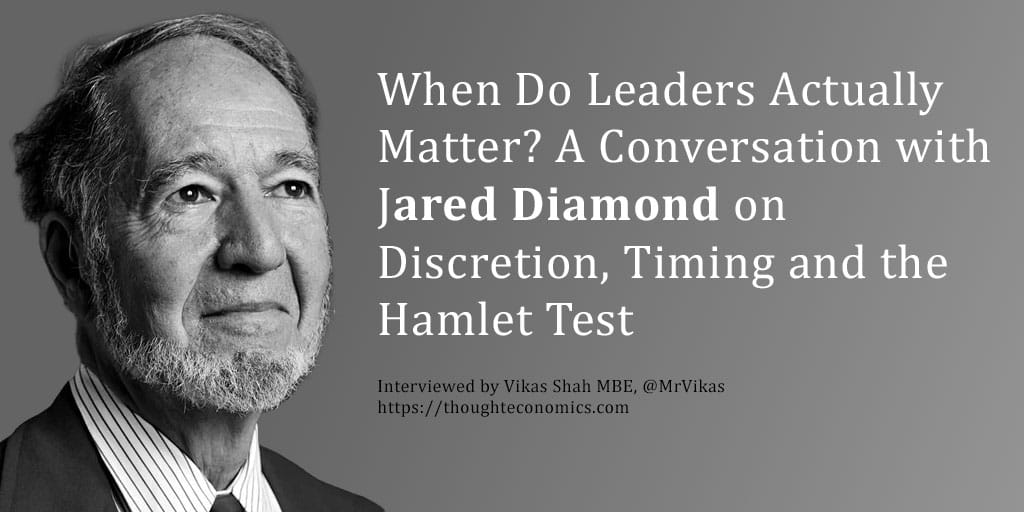
Diamond is the Pulitzer Prize-winning author of Guns, Germs, and Steel, the seven-million-copy bestseller named by Time magazine as one of the best non-fiction books of all time, together with Collapse, a No.1 international bestseller, The World Until Yesterday and Upheaval. A professor of geography at UCLA and a noted polymath, he trained originally in biochemistry and physiology, and his work has been influential across anthropology, biology, ornithology, ecology and history. He holds the US National Medal of Science, the Tyler Prize for Environmental Achievement and a MacArthur Fellowship. For more than three decades his name has been attached to a single, unfashionable proposition: that the broad shape of human history was set far less by great men than by the accidents of geography.
His new book, Profits, Prophets, Coaches and Kings, narrows the lens without abandoning the proposition, and it is the narrowing that makes it interesting. Rather than asking whether leaders matter, a question Diamond regards as badly posed, he asks under what circumstances a particular individual changes an outcome, and he insists on testing the answer rather than asserting it. That means natural experiments: comparing the 83 heads of state assassinated since the Second World War with the far larger number who died in office of cancer and heart disease; counting the Elizabethan playwrights who were not Shakespeare; asking why an athletics department can lose $150 million sacking coaches with winning records. What emerges is a quietly deflationary argument delivered by a man who is plainly delighted by the exceptions to it. Diamond does not think leaders rarely matter. He thinks we are systematically bad at telling the cases apart, and that the cost of getting it wrong is paid in bonuses, in buyouts, in votes and occasionally in millions of lives.
In this conversation we discuss the five factors that determine whether a leader makes a difference, why discretion matters more than charisma, the Hamlet Test for irreplaceability, why 90 per cent of success may be timing, how assassination became social science’s most uncomfortable natural experiment, the hidden cost of firing coaches, the trade-off buried inside every guardrail we build, and why the deepest flaw in dictatorship is not cruelty but the absence of feedback.
Q: A lot of leadership thinking assumes either that leaders matter enormously, or that they are, as Tolstoy had it, history’s slaves. I wanted to get your view: was there a single pattern, or a single thing, that you found about when leaders actually change outcomes? What was the characteristic?
[Jared Diamond]: Right away we encounter what most frustrates people who interview me. I have a standard response. When anybody asks me, “What is the single most important thing?”, my response is: life is complicated, and usually the single most important thing is to avoid looking for the single most important thing.
In the case of leadership, I can tell you about five single most important things. Timing and place are important. That is one. A second is discretion: how much power a leader actually has. A third is what I call the Hamlet Test, whether there are other people qualified to do the same thing. A fourth is whether the leader has able followers who could step in. Clement Attlee, the British Prime Minister after World War Two, probably changed Britain more than any Prime Minister in modern times. Nevertheless, he had several able colleagues who could have done what he did, and so we don’t speak much of Clement Attlee. And then finally, there is the leader who gets the public to do what it doesn’t want to do. FDR got the US public to prepare for World War Two, although the US public didn’t want to prepare for World War Two.
So those are five things, not one thing, that are important in leadership.
Q: If we start with discretion, this is a really interesting one, because at one end you have, let’s say, the CEO of a giant shipyard who can shape almost nothing, versus the perfume CEO who has a great deal of control. I have to say I hadn’t quite grasped this until I saw you set it down. So how much of what we credit to leaders is really just a function of the envelope in which they are allowed to operate, and how should we think about discretion?
[Jared Diamond]: Sometimes we give too much credit, or too much discredit, to a leader, because the leader is really not in a position to influence things. Sometimes the leader is in that position.
To give you an example: in my city of Los Angeles, an election for mayor is coming up, and the incumbent mayor, Karen Bass, is running for re-election. She had the misfortune to be overseas at the time of the enormous Pacific Palisades fires, and so many people blame her for being away. Well, for heaven’s sake. She had the misfortune, and the mayors of US cities don’t have much power anyway. They tend to get blamed for things that really are not their fault.
Similarly, in sport, coaches of American college teams have a lot of power, because they are there for a long time and the players are there for just four years. Whereas with professional coaches, the players may be there for a long time. Bill Belichick, for example, is often considered a great coach of American football, but for heaven’s sake, Tom Brady was there for 20 years. Professional coaches we tend to overrate, and with mayors we tend to neglect the fact that their power is limited.
Q: Expanding on that slightly, sometimes the governance structures around a leader effectively set their envelope. In your view, is a characteristic of great leaders that they push that discretion boundary?
[Jared Diamond]: Certainly one characteristic of greatness is that they are in a position where there is not much in the way of a boundary, and they don’t have to push the boundary. But another characteristic of great leaders is that they are in a situation where there are boundaries, and they push successfully against them. Charles de Gaulle, for example, pushed against the weak powers given to the president of France, and he was in a situation where he was able to push and to rewrite the constitution.
Q: If we then look at the phrase I love, the Hamlet Test, as an adopted Brit and a Shakespeare fan I enjoyed this one. You call it almost a natural experiment. Can you talk us through the Hamlet Test, and why we need to think seriously about that counterfactual?
[Jared Diamond]: Yes, this is an important subject. In many, maybe most, situations in life, you cannot point to one person in a country of 340 million people in the United States and say that this one person is the only one of the 340 million who could have done it. Yes, Bill Gates was talented, but what about the other 339 million?
But there are situations where only one person, or a few people, are in a position to do it. I refer to the Hamlet Test because there is a clear case there. Could any other Elizabethan playwright have written Hamlet? Well, we know who the alternatives were. We know all the other outstanding Elizabethan dramatists, like Ben Jonson and Christopher Marlowe. We know what their plays were, and we know that their plays were not nearly as good as Hamlet, so that if Shakespeare had died of smallpox when he was a baby, that would not have allowed Ben Jonson to write better plays. We can judge the other 25 Elizabethan playwrights.
In the case of the business world, the American pomegranate industry is a Hamlet-like case, because there were only 22 pomegranate growers in 2002. One of them had lots of money and had motivation; the other 21 didn’t have much money, and they were traditional farmers. So the Resnicks passed the Hamlet Test. They were the only people who could have developed the pomegranate industry, and who did develop it.
But in the case of Bill Gates: yes, I know Bill Gates, and he is a very talented people person, and people admire him a lot. But out of those other 339 million Americans, can one say that there was no one who could have done what Bill Gates did? No, you can’t make that argument. So Bill Gates was a very successful leader, but he doesn’t pass the Hamlet Test.
Q: You mention Lynda Resnick there, and in the book you talk about the family succession challenges the Resnicks face, which resonates with a founder like Mark Zuckerberg. If we think about the Hamlet Test, what separates the genuinely irreplaceable leader? Many would argue Steve Jobs might be one; in contemporary times, whilst he is a controversial figure, some might argue Elon Musk is, versus the founder whose company was coming anyway. So how can we apply the Hamlet Test to the business world?
[Jared Diamond]: I’m hard pressed to think of a situation in the modern business world other than that of the Resnicks, and theirs is an unusual case, because there were only 21 other pomegranate farmers.
Take social media. Could one say that Mark Zuckerberg was essential to the development of social media? Heaven’s sake, no. Again, there were 22 million other college undergraduates. Mark Zuckerberg happened to be at Harvard at the right time. But if he hadn’t done it, the fact is that there were other people who developed social media before him, and others after him. He put his stamp on social media. No one could say that he was the only person who could have done something important with social media.
Q: That is a good link to timing, because you argue that 90 per cent of success is timing. From that angle, how much of great leadership is choosing a moment, versus the luck of being there when the moment chooses you? And do you think timing can be part of a skill set, or is it something that simply happens to leaders?
[Jared Diamond]: Both. There are three ways in which timing comes in.
There are people who recognise that the time is right and act on that moment. Bill Gates, in January 1975, saw the cover of Popular Electronics that announced the new Intel chip, and he immediately rushed over to Paul Allen and said: we have got to act now, because this is the right moment. So Bill Gates recognised that the timing was correct, and he chose the timing.
A second example, of someone who recognised that the timing was correct but who had nothing to do with choosing the timing, was Winston Churchill. It was not that Winston Churchill caused World War Two and stepped in. Instead, World War Two arose, and Winston Churchill recognised: this is the moment for which my whole life has prepared me. I couldn’t bring about the moment, but now that the moment has come about, this is what my life is devoted to.
And then the third case is where one can’t recognise the timing at all. Take the great Mongol conqueror Genghis Khan. Why did Genghis Khan conquer all the way from China to Poland? Was it that he recognised the moment was ripe? No. It is only in the last ten years that dendrochronologists have looked at the tree rings on pine trees in Mongolia, and they realised that Genghis Khan happened to have been born at the wettest time in the steppes in the last 2,000 years. He was born at the right time. He was born at the right place. If he had been born 20 years earlier and 200 miles to the south, nobody would ever have known about Genghis Khan. So his timing was perfect, although he didn’t know about it.
Those are the three ways in which timing can play out.
Q: With that in mind, we also look at another characteristic of leaders. People use this awful word, charisma. Right at the outset you talked about able followers, and about the ability to make the public do what the leader wants. Those two characteristics do seem to link to the notion of the charismatic founder, or the charismatic leader. And if we look at today’s world, whether it is leaders doing good or, dare I say, bad, that ability to have followers, and to lead people to do what you want, seems key. What were some of your findings on that?
[Jared Diamond]: A finding that I have on that is to push against the rationale with which business schools get students to pay $50,000 a year to enrol for two years. Business schools often teach that what is essential for success in the world of business is charisma. But the fact is that there are many ways to be effective at leading.
In the case of politics, for example, Hitler unfortunately had charisma, and Winston Churchill had charisma. But there were other leaders who were powerful in other ways. Nobody has suggested that Augusto Pinochet, the dictator of Chile, had any charisma. He was devoid of charisma, but he terrified other people. Similarly with Joaquín Balaguer, the president of the Dominican Republic: nobody has suggested that he had charisma, but he, and Stalin, were good at terrifying people.
Other ways to be an effective leader, besides charisma, are to be good at guiding discussions. John Kennedy was, and Winston Churchill was also great at that. Still other ways are to be able to motivate followers. So charisma is one way to achieve success but, despite what business schools say to get you to pay your $50,000, there are other ways to achieve success.
Q: But selection matters there, doesn’t it? If you go to a business school and pay your $100,000 to do an MBA, you would hope the teaching faculty had been appointed well. And then you talk in the book about hereditary monarchy, which almost always drops the wrong person into a very high-discretion role. So I wonder whether there is a sense that how we select leaders matters more, perhaps, than the leaders themselves.
[Jared Diamond]: So, in defence of business schools. I said that on the one hand business schools take your $100,000, and then they teach you charisma, and that’s not nearly enough. But, and this is really interesting, sport is one of the areas of leadership. Why is it that Argentina lost the recent World Cup? A coach makes a difference, but there are other things that make a difference too.
And who are the leaders in understanding the reasons for coaches being successful and not successful? They are not so much sports writers. They are professors in business schools. The reason is that professors in business schools have recognised that sport is a much more easily judged arena for leadership than business is, because the game is played every week, the score is there, and the coach is jumping up and down on the sideline. Whereas in the business world the leader is often invisible, and the business gets judged every five years.
So in fact the methods for understanding success in leadership in the business world have been developed especially by business school professors looking at the world of sport. Sport provides the methods that then work well in business.
Q: The sports coach analogy is really interesting. I might be paraphrasing, but I remember you saying that firing a sports coach is a bit like throwing dice. It raises the question of when we sack leaders, and sport is a great example. How often are we punishing randomness and calling it accountability? We do see that sometimes in the business world and other worlds, where people are punished for things which are random.
[Jared Diamond]: Absolutely. And here, because I am at the University of California, Los Angeles, which had the greatest basketball coach, and perhaps the greatest sports coach in recent American history, John Wooden. My university, after John Wooden, who achieved great success and won ten national championships, has fired, I believe, every basketball coach that we have had since then, and we have had to buy out their contracts.
It has been enormously expensive. Yes, you fire the coach, but you have got to pay him for the rest of the contract. So my school’s athletic department is now in debt by $150 million. Really: $150 million. Think how many classics professors and how many physiology professors you could pay for with $150 million.
And that is because our coaches have had good records, winning records of 60 to 70 per cent, but that is not equal to John Wooden. So we keep firing them, and we keep having to buy out their contracts. And we don’t recognise that a sports coach is not in a position to control everything. If you win 70 per cent of your games, be satisfied, and don’t buy out his contract. But the chancellors of UCLA have never in their wisdom seen fit to ask my advice about firing the sports coach. So we always do it, and the result is that we are $150 million in debt.
Q: The other thing which I find really interesting about sport, but which we also see in all domains, is this great man thinking: the founder worship, the hunger for that one decisive individual. I get the impression from the book that you are almost trying to educate us that we are systematically over-rating the individual, and that this creates an error which has consequences for how we see people. Would that be right? Do you think that founder worship, and this revival of great man thinking, is causing us problems?
[Jared Diamond]: In some cases leaders do make a difference. I regret to say that Hitler unfortunately really did make a difference. Hitler was an unusual person. He was ultra-charismatic. He was ultra-skilled at deceiving people, even his fellow Nazi leaders. He was a risk-taker. So Hitler really did make a difference.
But mayors of American cities, and CEOs of public utilities, and CEOs of railroads, often do not make a difference. And so if the CEO of an American railroad puts a request to the board of directors, pay me $2 billion, like Elon Musk, because I make a difference to the railroads, the board of directors should push back and say: well, for heaven’s sake, once you build a railroad it is there for the next 70 years, and a CEO cannot make a difference. No, there are other CEOs who can do an equally good job, and we are not going to pay you $2 billion.
In other words, in some cases, in many cases, as in the case of a mayor or a professional sports coach, we overpay. But in other cases the leaders really do make a difference, either for the good, like John Kennedy in 1962, or for the bad, like Idi Amin in Uganda.
Q: If we look at the dictator examples and the authoritarian examples, someone like a Hitler, or someone like an Idi Amin, or a Pol Pot, or any of the people we could put into that bucket, I wonder about something. If we think about Hitler’s Germany, yes, Hitler was exactly that: a very unique character, for the bad of the world. But do we ascribe too much accountability to that single individual rather than to a system? That unique evil genius archetype ironically concentrates accountability in one person rather than diffusing it across the system.
[Jared Diamond]: It depends upon who is the “we”. The public may often overestimate the role of leaders, but historians tend to underplay the role of leaders. The prejudice of historians tends to be that leaders don’t have much effect, and that it is all very complicated, and that we historians are uniquely in a position to explain why it is very complicated. So historians tend to be unreceptive to the view that leaders can have a big effect.
Q: That is a really fascinating historical aspect, because I think the public view is very similar. When you look, for example, at India during the fight for independence, it is easy to say, “Oh, Gandhi did it.” But the minute you read a history book you see the many thousands of people who were part of the independence movement. And it is something I think we need to think about more as a society: who really takes credit, and how we therefore spread reward, and how we spread remuneration.
[Jared Diamond]: Right. In the epilogue to my book, after I discussed the role of leaders in politics, business, sport and religion, I looked to the future and asked: where else is the time now ripe to look at the role of leaders? An obvious place is generals, military leaders. But another obvious case is social protest, and Gandhi is an excellent example.
I am not aware of a natural experiment looking at Gandhi, but it seems to me, and I remember the shock of it, because I was born in 1937, and I remember my parents coming in and saying that Gandhi had been assassinated, that Gandhi did a brilliant job of dealing with an excruciatingly difficult situation: namely, a Britain that was determined to hold on to India, and that had the military power to do so. Gandhi recognised that he could not challenge Britain militarily, but he was great at leading a social protest movement. Now, that remains to be tested by a natural experiment, but I would say that Gandhi is a good example of someone about whom a biographical argument could be made that he really did make a difference.
Q: Only because you mention the word assassination, in Chapter 5 of the book you have the chapter Shoot the President! (If She Doesn’t Die of Cancer First). It made me think, because the absolute event of a leader being assassinated reveals what you describe as the trade-off between strong-leader systems and dispersed-leader systems. If we think of that assassination as the natural experiment, what have we learned from it? Because I think it links to that central thesis of whether leaders matter or don’t.
[Jared Diamond]: That’s right. If I were a physicist or a molecular biologist in a laboratory, and I wanted to perform a manipulative experiment to test whether leaders make a difference, I would go around the world experimentally killing this leader and letting other leaders live. Well, that is not feasible, and it is not moral.
But history has performed that experiment for us. Since World War Two there have been about 83 leaders who have been assassinated, and there have been something like 140 leaders who have died natural deaths. They have died of cancer or heart disease. Harold Holt died of drowning. There was a leader who fell off a horse, and a leader who got hurt. But there are even more leaders who did not die, so we have got the natural experiment without our going around killing leaders. We can compare leaders who did die with leaders who didn’t die, and the numbers are sufficiently large that one can draw statistically significant conclusions about leaders on average promoting or not promoting the economy, and so on. And we can even identify the outliers, and say that this leader did make a difference, and this leader made less of a difference.
It is also a practical matter, because there are leaders who appear to be really bad leaders. Should one want to assassinate them? Well, the reason not to assassinate them is that if one has a culture of assassination, the world falls apart. But there are extreme examples. Claus von Stauffenberg attempted to assassinate Hitler, and his attempt failed, and he was killed. But if von Stauffenberg had killed Hitler on 20 July 1944, which was ten months before the war actually ended, millions and millions of people would have survived. Members of my family would have survived. And so I would argue that Stauffenberg is a rare case where an assassination was justified.
Again, in America we have had only one proto-dictator. It was Huey Long, governor and then senator from Louisiana. Huey Long was assassinated by a man whose father-in-law had been maligned by Huey Long. So Long was dead, and we did not have another dictator after that. What it means is that the assassination made a difference. Overall, one should not assassinate, because the world works better as a result of not assassinating. But in the case of Hitler, or in the case of Idi Amin, where the attempt to kill Idi Amin failed, half a million Africans would have survived if that hand grenade had killed Idi Amin.
Q: Wow. And it also makes me think a bit about guardrails, because, looking at my notes, I found myself thinking that individuals matter most exactly where power is least checked. The book would assert that leaders can be catastrophic or brilliant, and where that took me was that the guardrails we build to contain bad leaders might conversely prevent great ones. We are at a time now where we have this insane new technological change with AI and so on, so leadership guardrails, and the guardrails around how leaders operate and what they can and can’t do, with the impacts on civilisation, seem more relevant. But are we in effect pricing that trade-off wrong?
[Jared Diamond]: Guardrails mean that the power of good leaders is unfortunately limited, but the guardrails also mean that the power of bad leaders is limited.
Can one make any generalisation? The one generalisation I would make is that the intrinsic disadvantage of a dictatorship is that a dictator does not get feedback, and so there is not a chance to make corrections. In the case of Mussolini, dictator of Italy from about 1925 onwards, the saying in Italy became Il Duce ha sempre ragione: Mussolini is always right. And Mussolini was brilliant in doing some things, but in other things he was disastrous, and he plunged Italy into a World War Two that it was not prepared to fight.
So I would say that the general disadvantage of a dictator is the absence of the possibility for correction. Whereas Churchill, during World War Two, incredibly, faced a vote of confidence in the middle of the war. He won the vote of confidence, but there was plenty of criticism of Churchill, and he listened to the criticism, and the criticism resulted in his not doing some bad ideas.
Q: Does the work in your new book also relate, because it does feel to me that it relates quite foundationally, to Guns, Germs, and Steel, where you argue that geography, not heroes, shapes the future of continents? What in your view would be the bridge between the conclusions you have come to in your latest book, and some of the learnings you had from the geographical aspects of Guns, Germs, and Steel?
[Jared Diamond]: Sometimes that is thrown at me in the form: Jared, you wrote this book, Guns, Germs, and Steel, which is about the effect of geography, and leaders don’t make a difference in Guns, Germs, and Steel. And now you are writing a book about the effect of leaders, and there is not much about geography. Have you changed your mind?
No, I have not changed my mind. Instead, these are different sorts of problems. For problems about history over the past 10,000 years, over entire continents, one leader cannot make a difference, and geography counts for everything. Whereas in the case of events of the last 30 years, if you try to understand why North Korea today is a terribly poor dictatorship, and South Korea is a first-world country, that has nothing to do with the geography of North and South Korea. It has everything to do with individual leaders and systems.
So geography has a big effect on long-term, large-area history, whereas leaders have a big effect on short-term, small-area history.
Q: As a sort of rounding-off, I thought I would ask about the counterfactual, because for a great number of years you have looked at societies in New Guinea, and at leaders, and at leaderless villages, and really gone under the skin of this. We have spent the conversation talking about leadership, but what about where there is no leader? Do we even misunderstand why we have leaders? And do you think that we can effectively work without them, or is that almost hardwired into what we need as a culture and a society?
[Jared Diamond]: We can work without leaders under certain circumstances, and we have to have leaders under other circumstances. The magic factor is the size of the population.
In New Guinea I had this incredible experience of being in a village where there was a discussion, there was no leader, and anybody spoke up when they wanted. That worked because the village had a population of 150. But as human societies got more and more numerous, it became impossible to function without a leader. And if you look at human history, when did you start to get powerful chiefs? It was with the rise of agriculture and of populous societies, where you just can’t do it without a leader.
So I would say the same is true today. Take my own laboratory group at UCLA. I had six postdocs. I was, in quotes, the leader of the group, but my students didn’t hesitate to say: Jared, you don’t understand what you are talking about. Things have changed. We young students understand, and you don’t. That works in a laboratory group of six, but in a laboratory group of 250 it doesn’t work.
So in short, where you need leaders is simply where the group is so large that it is impossible to function without leaders.
——
Jared Diamond’s Profits, Prophets, Coaches and Kings: (When) Do Leaders Make a Difference? is published in the UK by Allen Lane in September 2026, and in the United States by Mariner Books under the subtitle (When) Do Leaders Matter?