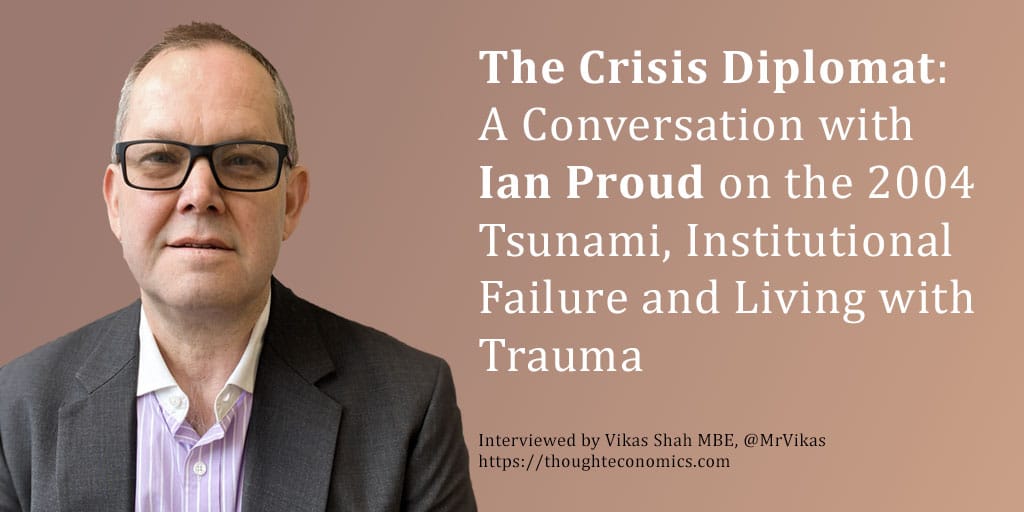
On Boxing Day 2004, Ian Proud heard about severe flooding in southern Thailand as he drove to a cinema in downtown Bangkok. During the film, his phone rang: the British Embassy, calling him in for an emergency meeting with the Ambassador. Within two hours he was in a car heading south on a nine-hour drive, with almost no information, towards a disaster that would eventually be confirmed to have killed more than 225,000 people across fourteen countries. The Foreign Office’s own account puts the British dead at 151, of whom 131 died in Thailand.
Few British officials of his generation have stood closer to more of the last quarter-century’s catastrophes. Proud was a member of His Majesty’s Diplomatic Service from 1999 to 2023 and became one of the Foreign Office’s most accomplished crisis experts. He was involved in the response to the Gujarat earthquake, 9/11, the 2002 Bali bombing, the 2004 Indian Ocean tsunami, the Arab Spring, the New Zealand earthquake and Japanese tsunami of 2011, the 2018 Salisbury nerve agent attack, and the global repatriation of British citizens during COVID.
Alongside that record sits an unusually varied diplomatic career. He served in Helmand Province as Head of Strategic Communications during the most intense period of the fighting, organised the 2011 London Conference on Libya and the 2013 G8 Summit at Lough Erne, wrote and launched the Preventing Sexual Violence in Conflict initiative, and spent nearly five years at the British Embassy in Moscow as Economic Counsellor and Chair of the Crisis Committee, the subject of his first book, A Misfit in Moscow. He finished his career as Vice Principal of the Foreign Office’s International Academy, and he speaks fluent Thai.
But it is Thailand that has never let him go. As Head of the Political Section at the British Embassy in Bangkok, Proud was the first to deploy to the disaster zone and the last to leave it, working thirteen days before taking his first break. What emerges from a conversation with him is not the practised discretion you might expect from someone who spent twenty-four years representing the British state. It is anger, still, at a system that was slow, distant and bureaucratic when it needed to be fast and human, and something harder to name underneath it: the recognition that even had the system worked perfectly, he could not have made anything better for the people standing in front of him. That is the insight the interview turns on, and it is the opposite of the one crisis work usually teaches. His novel, Searching: A Love Story, published in June 2026, is drawn from that experience.
In this conversation, we spoke about what a state owes its citizens when catastrophe strikes abroad, why institutions reach for process when they should be reaching for judgement, what breaks people in disaster work, and why a diplomat who spent a career writing telegrams chose to write a love story instead.
Q: Boxing Day 2004. You are at the cinema in Bangkok, and within two hours you are in a car heading south, nine hours, almost no information. Take us back to that. What did you think you were driving towards, and what went through your mind as you crossed the Sarasin Bridge?
[Ian Proud]: Thank you, Vikas, and firstly, it is really lovely to talk to you. It is always nice to meet new people. That is the great thing about diplomacy: it is an opportunity to connect with people you would otherwise never encounter.
The day itself began completely ordinarily. I first heard about severe flooding in southern Thailand as I was driving to a cinema in downtown Bangkok, and during the film I took a call from the Embassy calling me in for an emergency meeting with the Ambassador, David Fall. He told the handful of staff still around at Christmas that a tsunami had struck. The news was scant, but it was already clear that many people had been killed and that the airports were closed to civilian traffic. Within two hours I set off with David, the incredible Khun Amnat from the Embassy’s Thai staff, and a driver, facing a nine-hour journey. I had woken at eight that morning. I would get my first brief sleep forty hours later, around midnight on 27 December.
If I am being completely honest, my first thought in the car was: what on earth am I going to talk to David Fall about for nine hours? I am sitting next to the Ambassador, we have a perfectly good relationship, but the week before I had performed a spoof This Is Your Life skit about him at our Christmas party.
Very quickly, though, we realised we were simply going to be incredibly busy, because the phones never stopped ringing. This was 2004. Amnat, our excellent Thai colleague, had a cardboard box filled with fully charged Nokia block phones. Whenever one phone ran out of battery, we just moved the SIM card into another handset that was fully charged. It sounds crazy now, but that is what we had.
We did not really know what we were heading towards, except that large numbers of people had died. When we left, the figure was in the hundreds. By the time we got there, it had gone over a thousand people confirmed dead.
My only real thought was that this is our job. This is our responsibility. That is why I suggested to David that we had to get in the car and go straight away. I had been involved in the response to the 2002 Bali bombing, where we sat on our hands for two days, not deploying anybody to the scene, and thirty-two British people had been killed there. We were rightly criticised in the press for that. So I said, look, we need to act right now. British people need our help. Let’s go. The airports are shut, we are going to have to drive, and that is all we are going to have to do.
That is genuinely all I thought about, driving towards the Sarasin Bridge.
I phoned my parents on the way. My late mum picked up the phone and, in quite a brusque way, and I loved her dearly, I said, put Dad on the phone. That is all I said to her. I’m okay, put Dad on the phone. Dad had been in the British Army. He would understand. I told him I was fine, that we were going into the disaster zone, not to worry about me, and that I would call in a few days. And that was it. Once that was out of the way, family business done, it was straight into the job at hand.
Q: You have written that the UK response was the failure of a system, one that was ill-prepared, with staff in London who were disconnected from the reality. What does a state realistically owe its citizens when catastrophe strikes abroad, and why do rich, capable governments so repeatedly fail to meet that obligation in the first hours?
[Ian Proud]: We have a consular responsibility to help British citizens overseas. Of our three core strategic national interests, one is obviously our prosperity, the second is our security, and the third is keeping British people safe wherever they are in the world. You can look at any set of Foreign Office objectives and there will always be a key objective on keeping British people safe and helping them overseas. This is our job.
But sometimes people lose sight of the immediacy of the circumstances, of the devastating circumstances that people face in natural disasters, after terrorist attacks, and so on, and they do not apply sufficient grip to the situation, because they are far away from it. It was Boxing Day. People were still getting over Christmas Day. Lots of people were on holiday.
So a wait-and-see mentality creeps in, where people in London sit back, look around and say, well, let’s calibrate with the Europeans, let’s see what they do; let’s have a chat with the Americans and see what they do. And all that time, people are dead, injured, missing, without possessions, grieving, helpless, desperate for somebody to come and help them. And all that time we are sucking our teeth and looking around.
We are missing opportunities to show intent and to deliver capability: to give British people not just the help they need, but the help they deserve, and which it is our responsibility to provide.
Our actions as an organisation relentlessly gave the impression that we did not care about the plight of Britons who had suffered so terribly. That was our responsibility as an organisation, and it was our duty as diplomats. We were lions led by lambs.
It is a mentality thing. That is what it comes down to.
Q: There was that extraordinary example where you requested a military aircraft from Krabi and were told to submit a business case. Even under extreme pressure, institutions seem to reach for process rather than judgement, which is precisely the wrong instinct in an emergency.
[Ian Proud]: You are absolutely right. In terms of the command-and-control structure, insufficient control is given to the people on the ground. We are reliant on people who are far from the scene making the big calls, when we should be far more empowered to make those calls ourselves, or at least to have real influence on them from the ground.
Bureaucratic inertia sets in. We fall back into old bureaucratic habits of how we do things. We are not equipped for dealing with the far more urgent, far more pressing, far more immediate calls that have to be made in the circumstances of a devastating event. And it is a real failure.
The C-130 is a good example. We had enormous military capability in Afghanistan at that point. We are just really slow, and it cripples us. And of course, people conclude that we simply do not care enough to act now.
London showed a complete lack of grip. Several colleagues told me they had phoned the Office begging to fly out to Thailand and had never received a call back. It was two whole weeks before a rapid deployment team arrived.
You can never fail in a crisis if you just act now, if you just do it, and think about the cost later. Think about the billions we pumped in to save dodgy banks after the global financial crisis. It would cost hardly anything by comparison to just act now when these things happen. Ditch the spreadsheets and the process to one side.
Q: You have written that the colleagues who broke down were often the ones carrying the pressure of trying to make bereaved families feel better, and that it created a kind of helplessness. What did you learn from that? There is something in it about empathy becoming dangerous to the person offering it.
[Ian Proud]: Exactly right. What British people want, what anybody wants in that situation, when they are helpless, when they are lost, when they have lost a loved one, when they are injured, is two things: compassion and practical help. That is what people want from us, and nothing else.
They feel terrible. We cannot make them feel better. What we can do is ensure that, through our actions, through our kindness, through our practical help, we do not make the situation a great deal worse for them.
But of course, if you are an official on the ground, you are meeting people. In one case, a colleague of mine took under their wing two young children whose parents had both been killed in the wave. Of course that person would have felt incredible empathy and care and love for those desperate children. I have got kids. It makes me emotional even talking about it now. But what they were experiencing at that time was that they just wanted to make them feel better, and you cannot make them feel better. You cannot make people feel better in those circumstances. You can be kind. You can help them. You can give them the practical things they need right then.
I think people lose sight of that, because they feel the brokenness and the emotional pain, and they just want it to go away, and they cannot make it go away. In my experience it becomes overwhelming, and it breaks people emotionally. So many staff had emotional breakdowns.
The biggest insight I took from the colleagues who suffered breakdowns was the pressure they placed on themselves to make bereaved relatives feel better. Their inability to alleviate another person’s pain produced a feeling of helplessness they could not escape from.
I have thought about this a great deal, as you can imagine. It always comes back to the same thing: you provide the compassion, you provide the practical help, you do the best you can to help those people, but do not expect that it will do anything other than avoid making their situation any worse than it already is. That is my maxim in crisis work. Acts of kindness and practical assistance can help people get what they need when they need it, but they cannot make them feel better. Callous, insensitive handling, on the other hand, can make things a great deal worse.
Q: What about you as the leader? You are not isolated from those same emotions, and you walked into the most extreme end of what anyone could be expected to see. How did you cope at the time, and afterwards, because you have been very open about how hard the recovery was?
[Ian Proud]: When you are leading, I think the worst thing you can do is project your anxiety, and particularly your stress. I do not really tend to get angry at work, I do not tend to lose my cool, but people leak, right? We are emotional carriers. The last thing you can do as a leader in that situation is to show that you are struggling, or to project your stress onto the people you are working with.
Your job is really to lift them up: make them feel empowered, make them feel valued, try to help them when we are getting utterly battered from every side by the press in terms of negative coverage, because we did get it wrong. We did not send enough people. We were not quick enough. I get that. But all the people on the ground were doing their very best, and it was my job to lift them up and say, come on, just focus on what we are doing. That is the best that we can do.
So many colleagues had mental health breakdowns during that time, including my own PA and a Thai member of my team. The American therapist they eventually sent out to help us withdrew before long with emotional exhaustion. And I suppose the bloody-minded part of me was determined not to show any weakness at all. That is why I was the first to deploy to the disaster area, and the last to leave it.
But of course, while you are doing that, you still have all those emotions, as you say, and they mount up. And when you are doing it in the office, you are also doing it outside of the office. So you have this veneer of it’s fine, let’s just do what we are doing, do the best we can, make a difference. But you cannot talk about how badly you feel, and I did not want my family back home worrying that I was falling apart inside either. So that becomes a habit. Quite a negative habit.
So you do other things instead. When you get back to Bangkok, you sit in your apartment and you drink all night and chain smoke, because that is what you have found as your way to cope.
And that is PTSD. That is what it is. It is a feeling of intense loneliness and isolation and helplessness that can only be resolved by negative habits which you believe will take away the pain, but which don’t.
Q: This feels like one of the hidden aspects of diplomatic tradecraft. What do you wish people understood about the reality of diplomatic life? The image is pink gin at an embassy reception, when the reality is that when a crisis hits abroad, your teams are the ones going in first.
[Ian Proud]: It is not a nine-to-five job. It is a lifestyle more than a career, and by lifestyle, I do not mean a pink gin-sipping lifestyle. It is a commitment to public service. It is twenty-four-seven at times.
Believe me, if you have been to one reception you have been to them all. The novelty of Ferrero Rocher and free wine wears off very quickly when you are at your fourth reception of the week.
But it is when things happen that it matters. You just have to step up and go, right now. There is no room for well, it’s not very convenient, I’ve booked a spa treatment, I’ve got a nice meal tonight. You just have to go and do it. That is your job. And that is what makes it invigorating and exciting, because you are there to represent your country, the United Kingdom, and to help British people. If you are not driven by that sense of public service, then it will not be for you.
It is not nearly as glamorous as people believe, but it is a hell of a career, because you get to do things that really matter. I was in Moscow when the Salisbury nerve agent attack happened. There was the tsunami. I was in Helmand Province during the most intense period of the fighting. These are the moments that matter. That is why you do it. It is about serving your country. It is a terrific career.
Q: What did you learn about the best of humanity? These are the situations where you see how different cultures respond to crisis.
[Ian Proud]: I grew up overseas as a kid, and I spent a lot of my adult life living overseas as a diplomat. My best friends are Buddhists. My longest-standing friends are Hindus from the East African diaspora that came to the UK in the 1970s. For me, people are people.
In any society you get racism and intolerance and all of these dreadful things, which I absolutely detest. But when something really bad happens, all of that goes away. None of it matters. The only thing that matters is people, and people connect with other people’s fears and worries and the strife they find themselves in, and they help them as people, irrespective of the colour of their skin, their religion, their sexuality. None of that matters.
I think, sometimes, things like racism emerge out of boredom, where people just do not have enough in their lives, where they do not get out of the house enough to really see what the world is actually like.
Amidst all the death and the grief, I witnessed the best of humanity. Race, religion, gender, sexuality, upbringing: none of it matters when people are thrown together in the most harrowing circumstances. People talk to each other and try to help each other in ways they simply would not in peacetime, and real, lifelong bonds of friendship are forged out of it.
Well, when the tsunami happened, you really got to see what the world is like, and how powerful humanity can be in connecting people in the most difficult of circumstances.
Q: I am curious about the journey into writing. After a career of diplomatic telegrams, what prompted Searching? And what does a novel let us understand that a documentary account could not?
[Ian Proud]: There are a couple of aspects to that. The first is that I have always needed, not wanted, but needed, to write about the tsunami. And of course it is now twenty-two years down the track. Writing a memoir or a documentary account of it would frankly be a bit stale by now.
I did consider a memoir. But as I was still a serving diplomat, that would have required me to resign, and despite everything I still felt a great commitment to public service. The characters in Searching are entirely fictional; I have not drawn on the experience of British or other victims to create them. There is one small exception: a British Embassy official called Nick Evans, who appears occasionally, and who is a lightly fictionalised rendering of me.
The second connects to the tsunami itself. One of my ways of healing and finding catharsis, even today, is engaging with romance movies and literature. I am not saying Searching is cheesy, but that is where it comes from. My wife and kids joke that whenever Katharine takes the children to see their grandparents in Weston-super-Mare, I just binge-watch romance movies on the telly.
Not long after the tsunami, the Nicholas Sparks adaptation The Notebook came out, and I just loved it. It is a properly old-fashioned love story. I personally find that very healing.
Why? Because when I was at my most broken, my mum had died, I was still drinking too much, my life had no direction, I fell in love with my wife. Having that kind of stability in life is one of the best ways to heal and to live your life to the fullest: through the memories you create, through the habits and the patterns, through the joy you get when the kids come along and everything you do with them.
Searching, ultimately, is about searching for how you find inner peace in your life. For me, that came through loving relationships: with my wife, with my family, with my two beautiful children.
So when it came down to it, writing the novel was really about writing two people who loved each other so much that they could endure the worst, come out the other end, and just about figure out how to piece it all back together again after a devastating ordeal.
Q: Is that something you saw in people there? A friend of mine was in Thailand at the time; his friends and their family died. He talks about the ignition of something in people searching for loved ones, and a complete mental reset about what actually matters. Did you observe that, or is it something you noticed later, in yourself and others?
[Ian Proud]: I think it changes people. I think everybody who experienced it would probably come out of it feeling their lives were lesser in some way afterwards, but they still have a life to live.
Events like the tsunami are so tragic because they take away, through death or through despair, the people who form part of our mental health ecosystems. They steal our emotional certainty and our stability. Humans are essentially social beings; we gain strength and support from being around others.
We had a colleague who was killed with his three children, survived only by his wife. This is not in any way linked to the novel, but I know through friends who know her that she has figured out ways to continue to live her life. Part of that is through the friendships she has, which have been able to support her through an ordeal that I frankly cannot even imagine the horror of.
It changed so many people. But ultimately, in terms of healing for a lot of people, it comes back to a question: what are the loving relationships you have that can support you? And at the time it was about how people were expressing their love, not romantic love, but human love, through the things they did to help you right then.
When you are in a difficult time, it always comes back to that. Basic humanity. Caring for our fellow men and women, whatever their background and circumstance. That will always be the core theme for me.
Q: Is that what you hope people take from the book? One of the things I took from it is that the things we think matter usually don’t, and that it is sad we so often have to wait for the worst to happen before we understand the true value of the person in front of us.
[Ian Proud]: Most people just want to be happy. You grow up, life is tough, life is short, it is brutal at times, you go through some awful things, but underneath all of it, we all just want to be happy. That is true almost everywhere you go, and whoever it is you happen to be talking to.
The media in particular gets obsessed with wars and enemies and people we do not like and should try to defeat in some way. We have children dying in Gaza. These are somebody’s children. We have had schoolgirls killed with a Tomahawk cruise missile in Iraq. I have got friends who are Jewish, friends who are Muslim, whatever, but these are just people.
We have a war going on in Ukraine which, by all estimates, has killed or injured over two million people. Two million people, over four and a half years. And our narrative gets stuck in: well, we have to win, we have to beat the horrible people. Why not try to talk to them instead, and ask whether we can find a way to coexist peacefully, because people’s kids are dying while we sit back and talk about how we can win.
Nobody is winning in this situation. Humanity is not winning. We are all losing from it.
People need to step back and say: these are somebody’s kids. These are somebody’s parents and grandparents. These are somebody’s friends. And remember that war serves nothing at all, except to make a small number of people richer while making millions of others much worse off. That is all it achieves.
I suppose a natural disaster or a terrorist attack is a kind of microcosm of that. And the question is the same in both cases: how do you come out of that situation in a way that helps people as best you can?
Q: As an interlocutor, a word I very rarely get to use, how do you cope with a sense of powerlessness? Many of the situations you have encountered are far beyond the control of one nation, let alone one individual. And in war you intersect with a political reality that does not much care what you say about children dying on the ground.
[Ian Proud]: You have to try your best to influence from within. I am a firm believer in that: speak out for what you think is the best policy route forward. Everybody will have a different perspective on it, of course, but you have to raise your voice and make it heard in an inclusive way, listening to other people’s views too.
Ultimately, I think a lot of these problems come down to the fact that we simply do not care to listen to another point of view. People view what is happening in the Middle East differently. People view what is happening in Ukraine differently. The only way out is to listen to both sides and to engage in dialogue.
But how do I cope? It is about always having that at the front of my mind: there is always a different way of looking at this. My view will not be decisive. It is not the only way that people are interpreting what is going on. The only way out is to reach a common understanding about what we actually want from this, and that ultimately has to be peaceful coexistence between people, in which innocent people are not being harmed and people’s boundaries are not being invaded.
So focus on the strategic issue at hand. I think too often these days in foreign policy terms, and in the media especially, we forget the question of why are we doing this? Why do we care about this situation? What are we trying to achieve? We quickly lose sight of that as we focus in on the glamorous videos and photographs of bombs exploding, and somebody winning and somebody dying, and we’ll prevail in the end. We lose sight of what it is we are actually trying to achieve.
So I always try to focus on: what am I here for? What is my job? In the tsunami, what was I there for? I was there to help British people. That was my number one priority. Focusing on those questions is what helps you cope with some very difficult situations. It narrows the problem down to something you can actually act on, rather than something that simply overwhelms you.
Fundamentally, there is nothing complicated about crisis work, however harrowing it is. It is about having the right number of staff, with the right skills, deployed in sufficient numbers to meet the challenge at hand, and keeping a close eye on everybody, to manage the mental health risks. The tsunami response was the failure of a system that was ill-prepared, with staff in London who were disconnected. I determined never to let that happen again in any crisis I was responsible for.
Q: How can the rest of us understand this? There is an odd consequence of relative peace and stability in the UK, no war on our shores, nothing on the scale of the disasters you have seen, which is that people do not appreciate how fragile peace and stability actually are. How do we convey that without people having to live through what you have?
[Ian Proud]: Travel. Visit countries you would never think about visiting. One of the great damages COVID did to humanity was closing off borders and reducing the possibility for people to interact with people from other countries.
Go to Iran. Go to Russia. Go to China. Pick the country you least want to go to, and go there, and talk to people. Break bread with them. Have a meal. And then, when you come back, think about it: are they really any different from you in terms of what they want from life?
Watch Race Across the World. I cannot promote that BBC show enough. Realise the joy you get from connection with people who are completely different from you and yet somehow just the same in terms of what they want: happiness, love, family, all the rest of it. We are all just the same when it comes down to it.
You see that after a natural disaster, when everybody is in exactly the same boat. When people realise that, they find a human connection that is wonderfully positive and uplifting.
I used to go to refugee camps along the Thai border with Myanmar. Those people had nothing. Everything they had was provided by international NGOs: the materials to build their houses, the medical care, the micro-business support in terms of setting up sewing and textile work, even the religious provision. And with nothing at all, you still saw kids smiling and playing happily with each other. Because at the end of the day, when you are a kid, the most important thing is having your mum and dad around. These are the basic human needs that we so often forget about.
And I hope readers are reminded that the best curative in life is love and human connection. If you meet a traumatised person, an act of kindness and compassion will matter far more than you realise, and they will never forget it. Even if you find them distant, the real person is probably still inside, desperate to feel well again and to discover the life and the love they yearn for. Your kindness will offer them an emotional lifeline.
——-
Searching: A Love Story by Ian Proud is published in paperback and ebook. His account of British diplomacy in Russia, A Misfit in Moscow, is also available. He writes on international relations at The Peacemonger, and more about his work can be found at prouddiplomat.com.