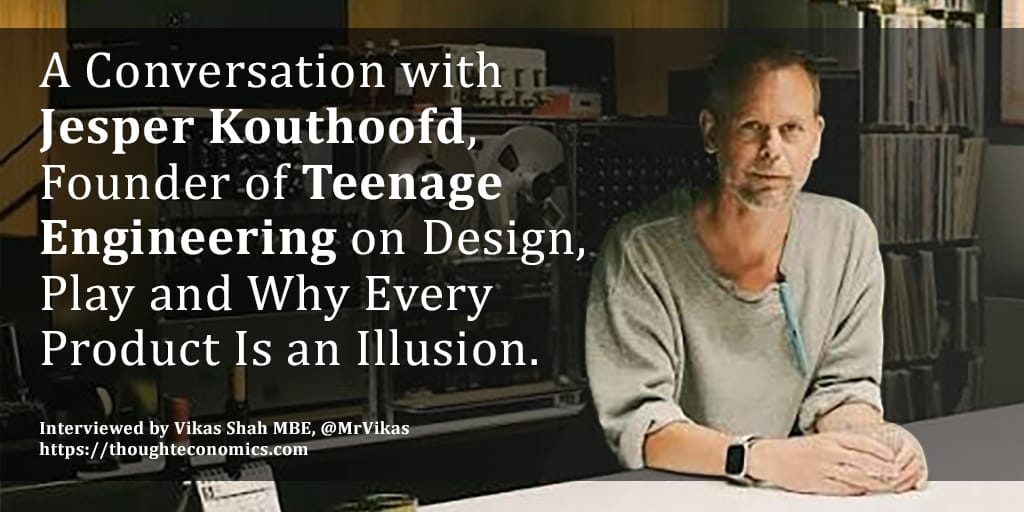
In 2024, the entire staff of a Swedish electronics company put on costumes and went to a medieval festival. They had spent two years building an instrument, sampling hurdy gurdies, bowed harps, bagpipes, battle toms, chain rattles and coconut horse hooves, and they had a launch film with a horse in it and a good deal of fire. The machine was called the EP-1320 medieval, and its maker billed it, in Latin, as the world’s only instrumentalis electronicum. Its inventor had to force it through his own company. Nobody else wanted to make it. That, he says, was how he knew.
Jesper Kouthoofd began designing record sleeves in Stockholm at fifteen, moved into advertising in the early 1990s, and in 1996 became one of four founders of ACNE, the Swedish creative collective whose initials originally stood for Associated Computer Nerd Enterprises and which later produced the fashion label Acne Studios along with film, digital and advertising arms. He directed commercials for a decade before founding Teenage Engineering in 2005 with David Eriksson, Jens Rudberg and David Möllerstedt. The OP-1 followed in 2010 and rearranged what a portable synthesiser was allowed to look like. Since then the company has made the Pocket Operators, the OP-Z and OP-XY, the EP-133 K.O. II sampler, the EP-40 Riddim built with reggae producers King Jammy and Mad Professor, a wooden choir of singing dolls, and a record player that engraves discs. It designed the Playdate handheld console for Panic, the audio for Nothing‘s first earbuds, the Rabbit r1, and the FREKVENS range for IKEA. The OB-4 radio he made with Virgil Abloh is in the collection of SFMOMA.
What is striking about Kouthoofd is how little of the standard designer’s account of himself he is willing to give. He does not want the title. He does not do user research, does not read design magazines, and stays off Pinterest on the grounds that everyone who reads the same things makes the same work. His company holds no presentations, on the theory that the people who rise in a studio are then the ones who are good at presenting rather than the ones with the ideas. And his central claim about his own trade is not a flattering one: a product does not really solve your problem, it sells you an illusion that it will, and the only interesting thing a designer can do is admit that and carry on. It is the reason, he says, that Teenage Engineering has as many people who hate it as love it. He seems entirely content with that ratio.
In this conversation, we spoke about creativity as a survival tactic learned from bad clients and no money, designing for yourself instead of for a market, why he thinks artificial intelligence is the greatest illusion in technology history and cannot find its soul, how you keep a company naive after twenty years, the discipline of controlling what you let in, and what it would mean to have a legacy the size of the Renaissance.
Q: One of the main reasons I reached out was that I find the way you have approached design, particularly at Teenage Engineering, really interesting. I had read that you described creativity as positive thinking. In your view, what is creativity really? And what do you think it was that meant you retained that instinct to play and experiment, when so many people seem to lose it?
[Jesper Kouthoofd]: If you start with this positive thinking idea, first I started with record sleeves and graphic design when I was quite young, fifteen or so. And then I went into advertising and directing and so on. When you are young, first of all you have to meet a lot of really tricky clients, and projects that are doomed to fail from the start because of many circumstances. Bad client, bad taste, low budget. So to survive when I was young, I tried to come up with ideas so that I had a good time, and to find ways around it. That is what I learned when I was young, that I had to apply an extreme degree of positive thinking, because everything was so bad.
I did not have money to print things. So I had to come up with other things. Maybe I only had one colour, but I wanted to print it in three colours. That forced me to think a little bit out of the box. And I remember that I imagined that if I had a budget for something, I visualised a pile of money on my table, and what I would do with it if I was free to do anything. That was everything from bad scripts for commercials to logos for a client with a very strong taste that was the opposite of my own. So that is one part of the positive thinking. I just learned to approach creative projects in that way since I was young, because I had to use what I had, on a very, very small budget in many, many cases. To survive.
Q: Is that also connected to something else I had read, and I might be wrong here, which is that you approach design as something you do for yourself, rather than relying too heavily on user research? I found that really interesting because it seems to run in the opposite direction to so much of the design orthodoxy, and to how we are taught design should be led now.
[Jesper Kouthoofd]: Yes, and I also think that I really did not want to become a designer. My father was an architect, so I kind of grew up with it. It was natural for me to work with shapes and stuff like that, colours. So I think it is because I do not want the title. I still do not want it. I do not feel comfortable using the title designer.
And also I was quite shy when I was young. My wife said to me, maybe it was your language, to use your hands instead, to understand and communicate with the world. And I think that is quite true. That is how I communicate. I communicate through design rather than long interviews like this. I hope the story is told through the objects.
Sometimes when I look at objects that have been designed, I can feel it: look, I am a designer. You can see that kind of communication shining through. I really want to be a designer, look what I did. Instead of solving a problem or starting a dialogue. So what I feel is that it is many times a monologue. It is one-way communication, and I think it should be two-way communication. It is more like I try to ask a question, solve a problem, and then maybe ask a little question, because I am curious what the receiver thinks about it, and why did I do that.
Enough money for the next project, and nothing more
Q: If we turn to Teenage Engineering, the products are really incredible and I think the design is just extraordinary. I want to talk through the origin story, because it is an unusual market. It is dominated by a few big global players who take almost all the revenues in music production and creativity. What was the spark that made you want to create this business? And what do you think is the defining factor that has made Teenage Engineering so well loved by the creative sector?
[Jesper Kouthoofd]: Again, you have the market, right? And you think of a product, and you make it because you want to make money. We more have this philosophy that we do not need a lot of money. We just need enough money to do the next project. Which changes a lot of parameters, because you can avoid a lot of things.
You see that in the world today. Because China has become such a huge market for Western companies, you see how car design has changed to what they speculate is working in China. This kind of minimalist, functional European design, you cannot find that anymore in European cars. It is very rare. Instead you have seats with massage chairs, a lot of LED lights in the interior and all that, which works in the Chinese market. So a lot of people, when they create an object, do an analysis of what will sell, rather than what they believe in themselves.
We try to be very, very down to earth. So, for example, one of our methods in our studio is that we do not have presentations. We have tables where we put prototypes, and everyone in the office can pick up a prototype or a model, and we look at each other, or monitor when people gravitate towards a certain object, and then we start: okay, this might be worth working on. I learned that in advertising, where some creative people are really, really good at selling their ideas. And the selling is more important than the idea itself. It is a little bit like if we look at agencies today, they make money on presentations, not on creative ideas. And that is a little bit the same in the whole world. It is kind of backwards nowadays, I think.
So I guess we are more focused on what the idea is, what kind of problems we solve, or what areas we are curious about right now.
“We do not need a lot of money. We just need enough money to do the next project.”
Why every product is an illusion
Q: With Teenage Engineering, then, what do you think is the problem you are solving in that business? And what is it that you are enabling people to do?
[Jesper Kouthoofd]: One thing I have been thinking about a lot, and I mean, we are quite an old company now, we have been around for almost twenty years. One thing I remember spending a lot of time thinking about when we started was this. You live in an illusion that a product solves a problem. But it creates some kind of presence instead. I am not sure how I should explain this.
Let us say a product is an illusion, like this phone, that this helps you and makes you super efficient. Instead of selling that illusion, we are more honest that it is an illusion, and that it is okay. If you are honest about it, then it is okay, and then everything shifts.
The first product we made, the OP-1, the synthesiser, is a great example of that. It is based on my brother. He used to work in a music store and sold a lot of synthesisers in the eighties. He never made music on them, but it was a kind of therapy to sit at the synthesisers, and the whole community around it. So the OP-1 is more a way of saying yes to that, instead of trying to look super professional. If you look at music instruments, they can be made in cheap plastic with a really, really bad interface, but still look like they come from a professional studio. You see that it is a lie.
So we just try to be more honest about it. This is what it is. If you like it, you like it. If you do not like it, you will probably hate it. So we have a lot of haters as well, because we break that illusion. It is a kind of conflict. And a lot of the things we do are to remove the bullshit and say, it is okay to talk about this product as a toy. It is okay, but you can actually make music. It takes down the barrier for some people, because especially people who are new to electronic instruments, or whatever, feel more invited.
Q: I think that is a really remarkable part of your design, because if I look at the OP-1, or in fact any of the products in the portfolio, and I compare it against a similar product from, let us say, Yamaha or Roland or whoever, those products are almost overwhelming. You look at them and see how sophisticated they are, and all the different things you might have to set up. But there is something about your products where they have the complexity and yet they invite users to play and experiment. Was that deliberate? And do you think it is also inspiring a different type of creativity in the people you have seen use them?
[Jesper Kouthoofd]: Yeah, 100 per cent. When we made the OP-1, which set the tone for the whole company and everything we did after that, first of all it was: let us do a machine that is completely free from how the rest of the machines are. Let us rethink what a musical instrument is, also based on new technology. Of course they could not make a synth like this fifty years ago, because it is based on mobile phones and all that. So that was the opportunity for us, that we could use new technology. And that is also one little ingredient we always use. Oh, now we can add a tiny motor in this. Now we can do this. That adds something new to something that is already known, and we can make the user interface more inviting. From a design perspective, it opens up a lot of opportunities.
But again, it was for ourselves, right? We did not speculate that people would react to it. We thought this is an extremely fun way to do a synth, combining everything we like into one product. You can see traces of things. I grew up with Game & Watch. The knobs come from my father, the architect, who used Copic pens. So everything has a connection. And we tried to be pure, naive. I mean, we are naive still, I hope, and we just explored freely.
“If you like it, you like it. If you do not like it, you will probably hate it. So we have a lot of haters as well, because we break that illusion.”
Q: How do you encourage that in your team as well? Because at the beginning there is a naivety of newness in a business, but then the business grows, you get customers and so on. How do you keep your team in that mindset of naivety and creativity and exploration, without falling into the trap of just becoming standard industrial designers?
[Jesper Kouthoofd]: I would say that is constant hard work. And I think that is my main role at the company. Okay, never repeat yourself, right? We have done that. This is a safe zone for us, so let us move to an unsafe zone and do something new. Many times people get very, very scared and feel insecure at the office just by moving in a tiny new direction. It shakes up the company almost every six months. People are like, okay, why? But they see now, after twenty years, people get used to it. So they know some kind of surprise will be introduced.
We also have a very open office culture, so when someone comes up with something that feels inspiring, many of us get triggered by that. Not everyone. Some people only want to make synths. But most of us, that is a big trigger. Oh, this was new. Often in combination with some kind of new technology, and a new way to use technology.
Where is the soul?
Q: Your products are very physical, and I think there is a real beauty to that. But we are also in an era where people are very fascinated by this new toy and this new tool of AI and creativity. I thought it would be great to get your views, because people have started to apply it in music and all sorts of sectors. Is it something you are using with your team? What do you think about the role of AI in creativity?
[Jesper Kouthoofd]: Lately I thought it was quite inspiring when it came, and there was a lot of promise around it. And I still force myself to have an open mind about it. There are a lot of things.
First of all, I think that is the greatest illusion in technology history. It is sold as something that it isn’t. And what I miss with that technology is that it does not have any soul. That makes it completely uninteresting, I think. It solves a lot of problems. But even early computers, they had souls in some way. AI feels very, very soulless. I do not know why.
Maybe it goes back to limitations. It feels so unlimited, or the idea is sold as so unlimited, that there is nothing next, there is nothing you can do without it. You can do everything, so then basically you can’t do anything. It is weird. But lately the only feeling I get, my question is, where is the soul? And I did not feel that with computers when I grew up. I felt a lot of soul. I do not feel any soul now. So to me that makes it a little bit uninteresting. However efficient it is, it is almost like a spreadsheet software. It is doing it really well, but yeah.
“First of all, I think that is the greatest illusion in technology history. It is sold as something that it isn’t. And what I miss with that technology is that it does not have any soul.”
Q: Do you think this is a really important aspect of why, whether it is ACNE or whether it is Teenage Engineering, that element has been true through a lot of your design? Those are businesses where you can see where the human was in the product. Do you think that has been a success factor in the businesses you have been involved in?
[Jesper Kouthoofd]: Yes, I think so. I think people miss that a little bit in the world today, this strong personality, which can be odd, does not have to be beautiful, can be ugly. It probably started with the internet, when you could find everything, right? But still not everything. So nowadays I feel I need to travel even more than I did before the web came, to really find things and get inspired.
But design to me is everything. It is values, it is communication, it is soul, it is a lot of things, politics. So I think it is super important to have that input yourself. You have to input stuff, then you can output. The output comes naturally, right? But you can control the input.
So, for example, I do not read any design magazines, or these kinds of walls you have on Pinterest when you make mood boards. I stay away from that and sit in my room and work with my hands, and try to draw, and listen to weird music. I learned that when I was in art school back in the late eighties. I remember one day at school, one of the first days, when back then everyone read The Face magazine that was designed by Neville Brody. We had a presentation in the classroom and everything was Neville Brody, because everyone read The Face. I was like, oh, I need to have another input. I do not want my next work to be exactly similar to the others in the class. So I started back then to change my input, and I think that helped a lot.
And you see it especially with young design students. They tend to read the same magazines and look at the same things. And I think even what we do at Teenage Engineering now maybe becomes a little bit too influential. Young people get the wrong input from our stuff. They should stop having us as input. That is what I feel. Find the reason why we did it. Everything has a reason. Try to figure out why we ended up with this design. It is so much more, it is not about aesthetics, it is based on something else in most cases.
The one nobody wanted to make
Q: I love that, because if I look at the Riddim, the layering machine, and I look at the font choices and the colour choices, if I had just read the design press it would be a gloss finish white minimalist box with everything in perfect fonts. But I love the mess. I love the icons and the unusual font and the colours. It almost distracts you into wanting to interact with it.
[Jesper Kouthoofd]: I really love to surprise even our followers, the people who say, oh, I like Teenage Engineering. Okay, then I want to make you hate us. If you are into this design a little bit, Apple style, whatever, then I am so drawn to do something completely opposite to that. So it is medieval, and Riddim.
Q: The medieval box, honestly, is my favourite one. I know it sounds sweet, but of all the things I have seen you produce, I just think that one is brilliant.
[Jesper Kouthoofd]: Yeah, I love that machine too. I had to push that through the company, because nobody wanted to do it. The idea started with, I read a lot of Mad magazine when I was young. That was my favourite, I subscribed to it. And I started with this idea: why don’t we make an electronic instrument from medieval times? I thought that was such a crazy idea that we just had to do it. So it started, and I started to talk about it at the office and people were like, yeah. I mean, we have been together for so long that we have the same kind of humour. But when people laugh and say, no, we can’t do it, then I know we have to do it.
Q: Exactly. This is the thing. I remember seeing that and just thinking, this is incredible. And on the video there is the horse and the fire, and it is brilliant. But it is a serious instrument as well.
[Jesper Kouthoofd]: When you have a silly idea like that, you do it all the way. So we did costumes and we went to a medieval festival. The whole company. It was fantastic, super, super fun. But we took it seriously. Let’s do it, we recorded all the medieval instruments, and we spent about two years on that machine. When you do stuff like that, you also have to do it all the way, so it does not become a gimmick. We actually learned about all the scales, and even the graphic design, and how it was done with the Bible pages and all that.
That is what I want to do every day. If I am stuck in industrial design, when you create things, you get tired of your own voice, right? And your own expression, you get tired of that. So you want to see, is there more in you? What happens if you? So I always try to search for that, or explore areas where I am super bad, and then I go there and explore that.
“When people laugh and say, no, we can’t do it, then I know we have to do it.”
A legacy the size of the Renaissance
Q: As a bit of a roundup, I want to ask a question I try to ask everybody, which is about legacy. When I have interviewed people in design and creativity before, there is a mix between people who do not want their products to last forever, people who want their products to become an echo that creates other things, and people who want to create a legacy. Is legacy something you think about, in terms of the permanence of what you are doing, or what you would like your echo in this world to be?
[Jesper Kouthoofd]: It is not a purpose, why I do things, to become remembered. But I really like hard tasks, or big challenges. And I am also super naive, so I think it is possible to do it.
A lot of designers who are on a big level want to be remembered for iconic design. The big ones, from Sony to Bang & Olufsen and all that. But I had this vision the other day. What happens if your legacy was that you created a new era, like the Renaissance? That would be cool. Very, very ambitious, but super fun to explore. And almost impossible, because maybe it is out of your weight class.
That was one idea. And I remember many, many years ago I had this idea: what could I design that could be useful on the other side, when you are not on Earth anymore? Just to open your mind a little bit. Okay, maybe design is something else than just an object. Maybe a tool could be a tool for the brain. It looks like a scissor or whatever, but actually it is a tool for the brain.
So I experiment with thoughts and ideas like that, and I think that also shows sometimes in why the objects we design are designed in a certain way, that there is something else I am looking for. It is a question. Can we do something like this, or can we create a new era? I had one idea. Sometimes when you buy super cheap electronics, they are basically useless, the interface and everything. And I toyed with the idea that maybe we should design objects that are super hard to use, with a one button interface and a super tiny display, and a micro USB to charge it, when you don’t have micro USB cables anymore. Stuff like that. You add everything that annoys you into one product. Stuff like that makes me smile, and then I want to go to work and explore that. I think I am a little bit restless, and want to have a good time. And I hope you can see that in our products.
Q: Absolutely. And you know what I was thinking? Something like the medieval, but with classic video game sounds, because everyone knows the sounds from Street Fighter and Mario and all these different things. Doing one device oriented around cult gaming would be amazing.
[Jesper Kouthoofd]: Yeah, I mean, there is so much we can do. I still think it is fun to go to work and I enjoy it a lot. But lately, more and more, I am going back to hands. Drawing by hand and building things with your hands. It is super fun. I also bought a sewing machine, so maybe I can get new ideas from that.
————
Jesper Kouthoofd is the founder and head of design at Teenage Engineering, based in Stockholm. Its products, including the OP-1, the Pocket Operators, the EP-1320 medieval and the EP-40 Riddim, are available at teenage.engineering.