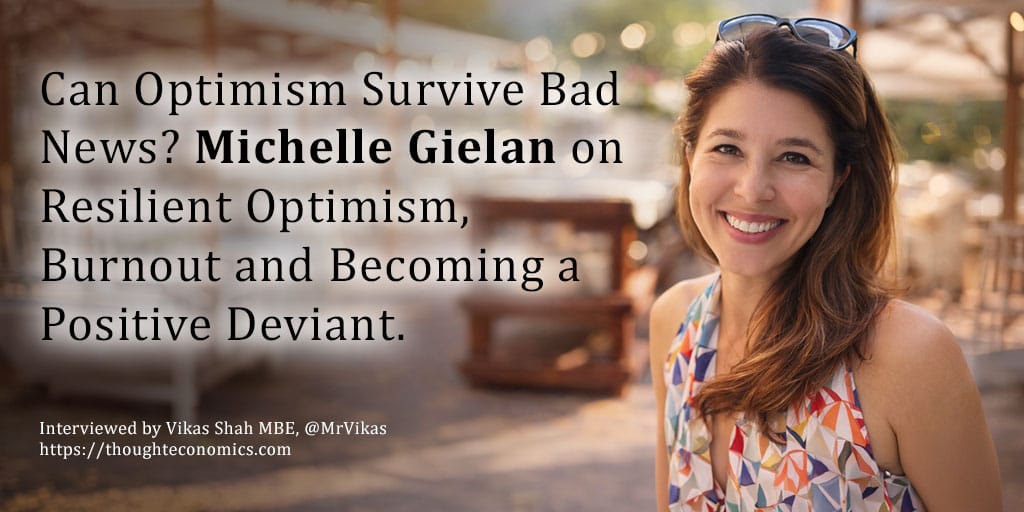
A chief executive once offered Shawn Achor a lift to the airport after a talk on the power of optimism. Achor got in and clipped his seatbelt. The chief executive got in and did not. When Achor asked, thinking he was making a joke, whether he did not wear seatbelts, the answer came back: I saw your talk, I’m an optimist. Michelle Gielan, who is married to Achor and who tells that story against the entire genre she works in, has a flat response to it. Optimism does not stop cars from hitting you.
Gielan arrived at positive psychology from two places you would not expect. She read computer engineering at Tufts University and worked as an engineer in Boston while privately wanting to be a broadcaster. She got there the hard way, El Paso to Chicago to New York in three years, and ended up anchoring the CBS Morning News as the Great Recession hit, airing stories of foreclosure and lost retirement savings morning after morning. Then she left, took a master’s in applied positive psychology at the University of Pennsylvania, and has spent the 15 years since running research inside corporations, hospitals and schools. She is the author of Broadcasting Happiness, an executive producer of The Happiness Advantage on PBS and a featured professor in Oprah Winfrey‘s happiness course. Her new book, Resilient Optimism: The Science of Sustaining a Positive Mindset in Tough Times, is published by Harvard Business Review Press on 22 September 2026.
What is striking about her is how little of the conversation is about feeling better. Gielan’s argument is that optimism is not a temperament and not a mood, it is a set of behaviours you can run whether or not you feel like it, and it is measured by what other people can observe. The evidence she keeps returning to is unglamorous: a text sent to her husband before bed listing three good things from the day, of which there are now more than 1,200; an intensive care nurse who keeps a folder of notes from patients’ families and reads it after a shift in which two people coded before noon; her own 50 days in a neonatal intensive care unit beside a daughter born at three pounds seven ounces, whose whole hand closed around the last section of her finger. None of that told her the outcome would be good. What it did was keep reminding her brain that her behaviour mattered while the outcome was still unknown.
In this conversation we discuss the news habits that quietly set the tone of a working day, why toxic positivity is a form of irrational optimism, the triage system that gave one therapist six hours a week back, the finding that people who take 11 or more days of holiday are 30 per cent more likely to be promoted the following year, what an 11-year study of more than 25,000 professionals reveals about the gap between calling yourself an optimist and behaving like one, and where she thinks the chatbot fits into a life that still depends on a handful of trusted people. It sits alongside earlier conversations in this archive with Tali Sharot on habituation, Robert Waldinger on the Harvard Study of Adult Development, Laurie Santos and Arthur C. Brooks on happiness, and Angela Duckworth on perseverance.
Q: Michelle, thank you for your time. I wanted to start with the shape of your career, because it is an unusual one. You studied computer engineering, went into engineering, then went across to CBS, and then went on to study positive psychology. I love the fact that you still call yourself an engineer, and I am going to have to steal that for myself. But what was the mental thread you were following? What wove those disciplines together and brought you to where you are?
[Michelle Gielan]: There is a through line, I promise. I was originally a computer engineer working at a company in Boston, dreaming about being a journalist, and in particular about being a national news broadcaster here in the United States, broadcasting from New York City. But if anyone has friends in journalism, you know you don’t start your career in New York. You start anywhere they’ll take you. So I ended up landing a job in El Paso, Texas, and I actually went from El Paso to Chicago to New York in three years.
When I got to CBS News I was still full of the hope and optimism of the good work we could do. Meanwhile, very quickly, it became the height of the recession, and I was watching the newscast and how we were airing emotional stories of people losing their homes and their jobs and their retirement savings. It was during that time that I asked deeper questions about what was happening on the news, and how we could leverage it to actually help people make the best decisions of their lives and have the information they need to do so.
So I pitched this idea called Happy Week. My producers thought I was nuts. But the idea was that in the midst of the recession, as people were experiencing so much fallout from it, let’s take back control of our happiness instead of waiting for the external world to improve. We aired solutions focused content. If your home is facing foreclosure, what do you do? If you’re fighting with your spouse over money, how do you have better conversations? Segments like that.
We got the greatest viewer response of the year, and I was flooded with amazing stories. One guy writes in from Oklahoma. He says, my home is facing foreclosure, I have no one to turn to, I have a brother and that’s it. He lives just a few miles away from me, but we haven’t spoken in 20 years because we got into a fight over money and we cut contact. So there’s nothing he can do, he feels. Then he hears through the town grapevine that at the same time his home is facing foreclosure, his brother’s is as well. He does nothing. Then he turns on the news one time, he’s flipping through the channels, and he comes across the segment on rethinking financial challenges. He ends up reaching out to his brother. They patch things up, they pool their resources, save one of the homes and move in together.
So I became completely engrossed with this question: how is it that some people have access to that next step, that mindset that allows them to see progress and possibility, to be able to change their actions and create these positive outcomes? I left CBS. I went to get a master’s at the University of Pennsylvania in positive psychology, the scientific study of happiness and human potential. Since then, which has been about 15 years now, I’ve been working with professionals across corporations, healthcare organisations and schools, on how they can apply positive psychology to drive business, health and educational outcomes.
The information that sits upstream of your day
Q: I want to stick with the news for a moment, because there was a statistic that three minutes of negative news in the morning leaves people 27 per cent more likely to report a bad day eight hours later. We are all guilty of fairly extreme news consumption now, and for the readers of Thought Economics, who are often business leaders and C-suite and founders, you do have to stay engaged with what is happening in the world. But the world is not exactly fun at the moment. So do you think there is a way to remain engaged and still protect ourselves from that impact? How do we actually manage it?
[Michelle Gielan]: First of all, I think journalists do an immense service, because they are highlighting the challenges in the world, and we cannot ignore those, because we will make terrible decisions about how we move forward through them.
My husband came back from a talk one time. He’s a positive psychology researcher also. He gave a talk on the power of optimism, and he said that the chief executive afterwards said, I love this research, I’ll give you a ride to the airport, let’s talk on the way about how we can use it at my company. Shawn gets in the guy’s car and clicks on his seatbelt. The chief executive gets in and doesn’t put on his seatbelt. If you’ve come across my husband, Shawn Achor, he’s very, very funny, and he has a wildly popular TED talk. So he sees that the seatbelt bell is going off. He thinks he’s making a joke. He turns to the chief executive and says, oh, so you don’t wear seatbelts? The guy’s like, nah, man, I saw your talk, I’m an optimist. And it’s, no, you’re not.
So optimism doesn’t stop cars from hitting us. It doesn’t stop reality from negatively affecting us. What I study in the research is rational optimism. It’s how you take a realistic assessment of the present moment while maintaining a belief that your behaviour matters, especially in the face of challenges.
For business leaders, for all of us, we need to know what is going on in the world, and I think the news helps us do that. But we also need to recognise that the information that’s upstream of us is incredibly important in predicting how we process the world, whether we see progress and possibility, and whether we have a sense of agency that there’s a way to overcome those challenges.
In very practical terms, what I try to do when I’m staying up on the news, but also navigating it in a way that leaves me not depleted, is I highly recommend bolstering your own positive resources before you get caught up. What that could practically look like is listening to a podcast that fills you, writing down things that are good that are happening in your life, or taking a look at your calendar from yesterday or the day before and looking at all the moments of progress you have had. When you get your brain into a more positive state, you’re able to understand what’s happening in the world without letting it so deeply negatively affect you.
“Optimism doesn’t stop cars from hitting us. It doesn’t stop reality from negatively affecting us.”
And then the other piece is that it’s imperative we remind our brain regularly of the ways in which our behaviour matters. When it comes to the news, the way we do that is to accept that there are going to be some stories you absolutely cannot do anything about in this moment, in your capacity at work or whatnot. That’s just something we accept. But there are stories you can do something about. Whether it’s becoming more deeply informed about the solutions you can engage in, or raising awareness, or donating, or volunteering, there are things you can do. Even if you just pick one story, one cause, once a month, and get deep with it, get deeply informed in it, and then ultimately do something, that reminds your brain that when it comes to the challenges the world’s experiencing, there are things we can do.
You mentioned the study with Arianna Huffington that I did. The follow-up study speaks exactly to this. When we don’t just expose our brains to problems, but we go on to expose them to solutions, we become 20 per cent better on creative problem solving tasks. What that means is that if you get your brain to think about the problem, be real about it, but then also think about what you can do about it, you’re smarter and better at whatever you’re doing later on in the day.
Why toxic positivity is a form of irrational optimism
Q: How do we balance this with what I think is a genuinely problematic narrative, that everything should be positive all the time? Particularly on social media, we are presented with the idea that we should always be happy, always be moving forward, always be optimistic. But life does not work like that. So I would love to dig into your research, and the many people you have worked with. How do we accept that pain and suffering and negativity are part of life, without falling into the trap of assuming everything should be wonderful, and still maintain enough optimism in the face of those things?
[Michelle Gielan]: Toxic positivity is basically an example of irrational optimism.
Q: It is also a great name for a band. Sorry, I interrupted your flow.
[Michelle Gielan]: One hundred per cent, that is a great name for a band. Toxic positivity aims to edit out the problem. That’s the seatbelt guy again. We’re making poor decisions, we don’t understand what’s going on, and we just try to skip over it. The reason coming at someone with toxic positivity is an example of being a bad friend is that you’re not giving them a chance to emotionally feel what they’re experiencing. We need to have that time, and we need to move forward.
When I was, so we have two children, and with my second child, our daughter, when I was seven months pregnant my water broke. It was obviously unexpected that early. What ended up happening is that I get to the hospital and they say, listen, we want to keep you pregnant as long as possible, every day matters for the health of your baby. Six days later I end up with an emergency caesarean section. She was born at three pounds seven ounces. Her hand was so small that its entirety wrapped around the last section of my finger.
During that time I’m thrust into this 50-day journey through the NICU. I’m listening to the beeping, the monitors with the data, and trying, as a scientist, to synthesise how this is all going to turn out, what’s going to happen with her lungs, the next scan, all that stuff. It was so hard. It was during that time that I started to understand on a different level what optimism can really look like. I’m grateful that I’d been steeped in the research at that point for about ten years, because I was able to apply it.
What I took away from that experience was that you need to be able to hold two truths at the same time. Yes, this is difficult, and there’s something we can do here. Yes, I don’t know how the story ends, and I believe that my behaviour matters in this moment. What it looked like for me is, yes, I’m exhausted, and I can learn to take care of this teeny tiny baby. Those kinds of things.
We’ve known for decades now that optimism fuels every single business, health and educational outcome that we know how to track. It not only improves our wellbeing, it improves our performance. But imperative in keeping an optimistic mindset strong is the behaviours, and that’s what my whole book wraps around. Optimism is the expectation of good things to happen. Resilient optimism is optimism that is built on a set of behaviours and stays strong when it’s tested. I had the opportunity during that experience in the NICU to apply all of the research through behavioural tools, and I saw that it doesn’t tell you that everything’s going to be okay. What it does is continually remind your brain: your behaviour matters, there’s progress being made here. If we keep looking at opportunities to put one foot in front of the other, we will overcome this challenge and keep our brain moving forward through that messy middle.
What was good in today
Q: Is this where some of the practices come in? One of the things I found fascinating is the Best Moments texts. I think there had been over 900.
[Michelle Gielan]: We’re up to 1,200 already. By the time I submitted the manuscript to now, it’s been another few hundred.
Q: Already? You will need to go through and correct each copy of the book by hand, with a pen. But when I interviewed Tali Sharot, the argument was that the brain systematically stops responding to what doesn’t change, and that’s why Mondays are thrilling and Fridays are boring. So what do you think a daily gratitude practice actually does, and why does it seem to be so consistently effective? If I take a straw poll of my colleagues, a lot of them still think gratitude practice sits in the woo box. How would you persuade the doubters, and does the research support it as part of building resilience?
[Michelle Gielan]: This tool, Best Moments, sat within the context of recalibrating your perspective. Our brains are so good at cataloguing the negative: the stresses, the hassles, the complaints. We have limited brain resources. So if we are not continually getting our brain to focus on the meaning embedded in the work that we’re doing, the things we’re grateful for, the relationships we have that are life-giving, we’re missing out on the value of that information and what it can do to fuel our optimism.
Recalibrating your perspective can look like this. I met a nurse from the ICU. She’s obviously dealing with a lot, because she’s seeing patients when they’re in very serious situations medically. The day I met her, two patients had coded before noon. One of them didn’t make it. She said what she would do is keep an in case of emergency folder, full of nice notes from parents and patients and caregivers and their families. There were lots of pictures in there. She would look at it to remind her brain of the times in which her behaviour has made a positive difference. Those stories of success in the ICU coexist with the real heartache and the challenges she experiences as well. So what this does is not tell her that everything’s going to be fine in the ICU. Instead, it sends her back to the floor with a more balanced picture of what’s actually happening there, and ultimately strengthens her as she returns to her patients.
For me, I did Best Moments, which was writing down in a text message to my husband each night three positive things or more. Now it becomes many more than that. Three positive things that happened during the day. It was during the pandemic, during the busy blur of it, where I was so busy I don’t think I was recording anything in my memory. We had two children at home. We were trying to keep the business going. There was a lot of stuff to contend with. And what I love about that practice is that it doesn’t ask, was today good? It asks, what was good in today? So no matter how terrible your day is, there were bright spots. The better your brain is at recognising them and keeping hold of them, the more you’re benefiting from everything optimism has to offer.
“It doesn’t ask, was today good? It asks, what was good in today?”
Triaging commitments, not becoming more efficient
Q: Could you also talk through that process of triaging? If I think about a typical day in my life, and in many of your readers’ lives, we are addicted to busyness, we are permanently busy, there is the inbox and the notifications and so on. But I loved the concept you propose around triaging commitments, rather than just becoming more efficient. The reason I liked it is that it grated on me, even though I know it is true. So persuade me.
[Michelle Gielan]: Perfect. This came out of my own life and the busyness of life, and now I’ve walked hundreds of professionals through the process and I’ve seen incredible results.
We are addicted to busyness, to your point. So many of us fall into the urgency trap. This seems urgent, and I’ve got to click through my to-do list, and I’ve got to answer all those emails. But you are at your job because of a really important mission that you personally have and then your company has, and you need to be really clear about what that is. I also think it’s very good to be very clear about our values. Do I want to be spending more time with my children and make it to their baseball game? Do I want to have time to actually take a holiday where I’m not answering emails on my phone behind a potted plant, like the guy I wrote about in the book?
When we have our true north, we can look at what is actually moving the needle. What activities? How do I spend my time, and how does that help make progress on the things I actually care about and that are important?
So very practically, I say, put your stuff in three lists. This is an iterative process. You’re going to make these lists and then you’re going to recognise more things that can go on them. The first is the core list. This is what you do, what is important to you, and the tasks that support that. Then there’s a not-to-do list, which is probably my favourite one. These are things you shouldn’t be doing. AI can do them. Someone else would be so excited to do it if you delegated it to them, maybe a newer team member. Or they’re antiquated, and they just somehow made it onto your to-do list and you can get them off there. And then there’s the middle ground, which is activities you need to do because they keep the lights on, and it’s maintenance, and it just is what it is. I’m sorry, and I have those too.
The more we’re clear about those three lists, we go to the first one, the core list, first. When we have our energy, when we have mental clarity, we’re getting through some of those activities and showing our brain progress in those domains. And then we do all the other stuff, we fill it in. So it’s not that you just open up your inbox first thing in the morning and let other people set your agenda.
I walked a therapist through this practice. She leads a therapy practice with a number of people in it, and she knows that her core list is seeing patients, who are teenagers, and then writing content for workshops for the parents. That’s it. Anything she does outside of that is not serving her core mission. We went through and she made her three lists, and she got rid of quite a bit. She also delegated some stuff. She streamlined, and she got back six hours to her working week, every week. Dramatic.
Resilience is how you recharge
Q: One of the things I noticed from the book was the brain needing a rhythm between focused activity and unfocused mental space. What is the importance of that unfocused space? It does feel as though a lot of the practices you have described actually do encourage us to have it, because it feels almost wrong, particularly when you are in a high performance career, to allow yourself that room. But it is really important.
[Michelle Gielan]: We wrote an article based on some research we did with Harvard Business Review a handful of years ago, and it’s the article I see popping up all the time on social media. People are continually sharing it. It expresses this idea that resilience is not how you endure, it’s how you recharge. If you want to be resilient, you have to give yourself these opportunities to fully recharge, whether it’s during the course of your workday or going on a nice holiday.
We studied holidays. If you’re thinking about taking one, here’s the absolute performance reason for why it’s valuable. We found that people who get holiday days as part of their benefits package, if they took 11 or more of them in a year versus ten or fewer, came back to work and there was a 30 per cent increased likelihood of receiving a raise or a promotion that next year. To me this is a no-brainer.
But we don’t need to go to Santorini to enjoy the benefits. I think we need to be taking these regular breaks, and it can show up in something as simple as getting your hands off your keyboard for two minutes and watching your breath go in and out. We did this years ago with folks at IBM, and we saw that their stress levels were reduced, their productivity went up, they had mental clarity.
What we’re doing in those moments is aiming to get our brain from a task positive network, TPN, to the default mode network. That’s where we have opportunities to restore. We get greater mental clarity. We also have higher levels of creativity. But you can’t do that if the notifications are constantly coming to your phone, if you’re not giving yourself a chance to unplug, if when you’re on holiday you’re checking your email first thing on Monday morning, thinking, I’m just going to check a little bit, it’s no big deal.
I get it. Sometimes there are fires and that happens. But wherever we get the opportunity, the research is really clear on this. Take your holiday, but take your holiday. Totally disconnect and give yourself an opportunity to see the world differently and come back stronger.
When there may not be a happy ending
Q: The other thing I noted is that resilient optimism rests on the belief that our actions matter, which I think is a really important anchor. But there are so many periods in life where the evidence around us suggests the opposite. At one end you have people living through the floods in Nepal, or war, or instability, through to economic insecurity, illness, business being hard, whatever it is. How do we make the case for optimism to ourselves when there genuinely may not be a happy ending, or when we are not getting the evidence points that tell us our actions matter?
[Michelle Gielan]: You’re asking, I think, the number one question these days. Everyone has their challenges, and yes, some are much greater than others. When we can’t see how the story ends, it’s incredibly hard sometimes to be able to move through that period.
That said, within nearly anyone’s experience right now there are small things they can do, and it might just impact the next minute of their experience. If they’re deep in trauma, this becomes more of a work for a psychiatrist and a whole support team on that side. But I think that within negative experiences we can, even if it’s just the next minute or the next hour, remind our brain that our behaviour matters, by engaging in a positive practice, by reconnecting with somebody, by doing the things I talk about in the book. It’s not that this is going to cure everything, but it keeps us moving forward. The more our brain perceives progress and possibility and gets a win, the more compelled we are to continue that upward spiral. It has to start somewhere.
So sometimes, if we’re not seeing that information about the good things that are happening in this moment, or the people who love us and care about us, or the resources we can tap into, we need to go and find that information, or find somebody trusted, somebody we love, who’s going to help remind our brain of it. It takes somewhat of an active process, which I know is really hard. When we’re burnt out it’s not easy to engage in this. But it’s about picking one thing.
One thing we found really interesting in the data. I’ve run an 11-year study, and we’ve surveyed more than 25,000 business professionals worldwide. We found that people who are highly optimistic are three times more likely to be highly engaged at work, and five times less likely to burn out. I think that burnout piece is really interesting. Sometimes we fight so hard against the negative. But if we can bolster the positive, we can sometimes get to the same place. So if we build our optimism, as opposed to trying to deal with our burnout, sometimes we can lift ourselves up, or our teams up, out of a really challenging circumstance.
The 8 in 10 who call themselves optimists
Q: I love that. I thought we could close out on one of my favourite phrases from your book, which is becoming a positive deviant. It was a really interesting concept, because if I think about different groups even in my own life, there are social groups and organisations where there has become either an institutionalised negativity, or where circumstances have quite rightly produced a culture of despondency, which is also one of my favourite words. Can you talk through that concept of becoming a positive deviant? Because it implies that one person engaging in behaviour change can actually have the power to influence the whole culture of an organisation.
[Michelle Gielan]: Absolutely. We are more influential than we often give ourselves credit for. There was a phenomenal study done at the University of California, Riverside. They had groups of three people sit in a room in silence for two minutes, and they tested their mood and mindset before and after the experience. What they found over and over was that the person who was most non-verbally expressive in the room actually influenced the mood and mindset of the other two people. So if they were arms crossed, scowling and otherwise seeming negative, they made the other two people feel more negative. Meanwhile, if they were relaxed or smiling, they made the other two people feel more positive. That’s in two minutes in silence. Imagine what happens when we speak up.
There’s study after study that shows us that we are continually changing other people. What happens oftentimes is that we forget how powerful we are to do that, because we see the negative guy on our team and how much he’s influencing us. He comes into the room and he just turns the entire climate negative.
In that 11-year data set I mentioned earlier, I just did a reanalysis and I found something fascinating, which is that eight in ten people over time still call themselves optimists. That has stayed steady state. But their behaviour is telling a different story, and specifically it’s along expressivity. When someone presents a new idea, people are significantly less likely these days to say something positive and encouraging. When they think something optimistic, they’re less likely to tell anyone. And when they start conversations, they’re less likely to start with something positive.
Why I think that is unfortunate, and very meaningful, is that optimism isn’t just a private belief. It is information that we are sharing with other people that becomes evidence of progress and possibility. If we’re thinking good things and we’re not saying it to anybody, we are not positively impacting the culture. Think about it. If someone presents a new idea at work and you’re thinking something good, you’re thinking, well, it’s not a perfect idea, but we can build upon it, I see some potential here. If you do not speak up, your optimism has no effect on the room. Meanwhile the guy next to you is saying, I’ve got 12 reasons why this is not going to work. Now that’s the conversation, and that’s the starting point.
“If you do not speak up, your optimism has no effect on the room.”
So what I would say is, become a positive deviant in your office, with your family. The way we do that is by continually, where socially appropriate, pointing out the good things around us. It seems so simple, but it has transformative effects. With positive deviance, usually you look back and you find who was the catalyst there, what did they do. This gives us an opportunity to look forward and be intentional about how we communicate with other people, whether we’re asking positive leading questions. Tell me what worked on that project. Why was your effort so successful? What did you do that got us to this positive solution? And then spread positive gossip. Hey, Mark said the nicest thing about you, did you hear about it? Be the conveyor of that information. When you start to do these small things, it transforms not only how you show up, but people’s perception of you, and it changes the culture around you.
Where the chatbot fits
Q: One more question, on AI. As you were talking about sharing positivity, it struck me that people now share huge quantities of their lives with chatbots, reaching into the chatbot ether for their advice and counsel. When you think about positive psychology, where do AI platforms come into this? Do you think they are helping, or hindering? Because I am unsure.
[Michelle Gielan]: I don’t have a definitive answer just yet. The jury’s still out. I think in the moment, sometimes sharing something going on with a chatbot to gain other perspectives can be good, can be beneficial. I have found that different chatbots have different personalities, if you will. And I have heard stories of people where the chatbot basically agreed with everything they were saying, and it led to emotions getting bigger and bigger, and I’m not sure that was actually the right direction for that situation.
But I will say one thing I’m very clear on, which is that if you look at the research, social connections are the greatest predictor of long-term levels of happiness that we have. It doesn’t mean you need to have a million friends, but a handful of trusted confidants you can talk to when challenges strike, and you can go to and celebrate the good things. You have both of those. So my concern with turning to a chatbot is that you’re going through something significant in your life, and this is a great opportunity to build connection with somebody else in a meaningful way, and we’re denying ourselves that. I would say it’s one of those proceed with caution moments. We’ll see.
That said, on the flip side, I have heard, and there’s obviously lots of experimentation with this, that there are coaches and therapists using AI where they’ve trained the tool, so it’s a kind of closed circuit, and they’re finding great results. So, mixed bag right now.
Resilient Optimism: The Science of Sustaining a Positive Mindset in Tough Times by Michelle Gielan is published by Harvard Business Review Press on 22 September 2026 and is available here. Further resources, including the Optimism Challenge and a book club guide, are at resilientoptimism.com.