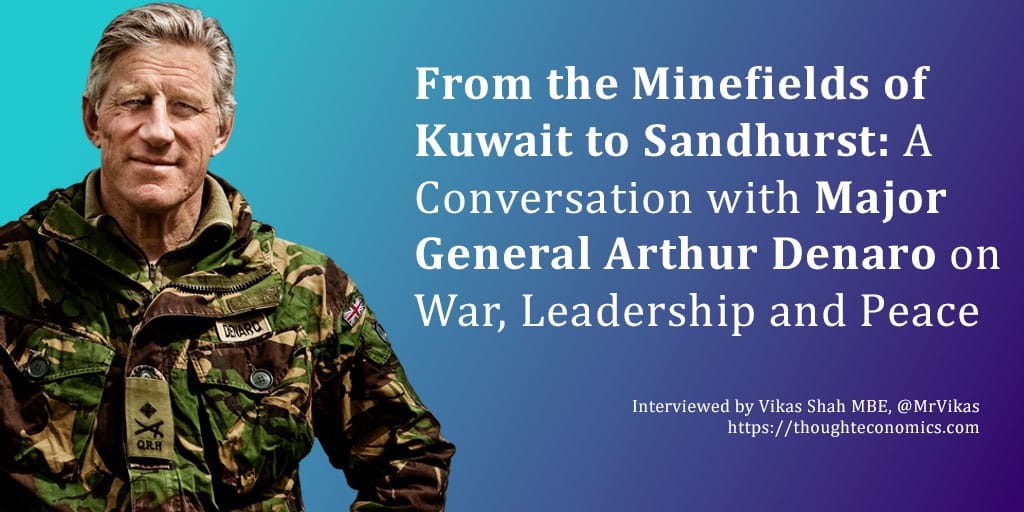
Major General Arthur Denaro CBE DL spent forty years as a British soldier. Born in Malaya and raised in County Donegal, he was commissioned into the Queen’s Royal Irish Hussars in 1968, served as a young officer in the war in Dhofar in southern Oman alongside UK Special Forces, and commanded his regiment in the war to liberate Kuwait, leading the British division through sixteen kilometres of Iraqi minefield in the opening hours of the ground campaign. He was appointed OBE for the Gulf War in 1991 and CBE following his service in the former Yugoslavia, where he was Chief of Staff of some 44,000 multinational troops at the headquarters of the United Nations Protection Force.
He went on to become Commandant of the Royal Military Academy Sandhurst, and until his retirement in 2003 was Middle East adviser to the UK Secretary of State for Defence. He was a trustee and council member of The Prince’s Trust from 2000 to 2008, adviser to the Crown Prince of Bahrain, and a senior adviser to the court of the Hashemite Kingdom of Jordan and other governments in the Gulf. He formed an advisory board to the UK Ministry of Defence on Middle East issues which ran until 2020, and now works with Forward Thinking, a non-governmental organisation working in the UK and the Gulf-MENA region to resolve conflict through inclusive dialogue. He is an Extra Equerry to His Majesty The King and a retired Deputy Lieutenant for Herefordshire.
What emerges from a conversation with him is not the voice you might expect from a man who has spent a career in armoured warfare. It is a quietly insistent argument that war is a failure of communication, that the rules of warfare are not sentimentality but strategy, and that the most consequential lesson of his forty years came not from a battlefield victory but from a young Omani soldier who stood up in an ambush to say his prayers.
In this conversation, we spoke about the night before battle and the burden of choosing who leads, what politicians misunderstand about the use of force, the cruelty of the Balkans and the limits of peacekeeping, whether drones and robotics make war easier to enter, how conflicts actually end, and whether leadership can be taught or only refined.
Q: The starting point for me, because I was trying to think about learnings from your world that could be interesting or relevant to people who have never been in it, was that moment: the night before an operation, the night before a battle. Most people simply have never experienced that. As a leader, on that night, what goes through your mind? How do you make sense of what is about to happen?
[Arthur Denaro]: You are quite right to pick on it as one of the main issues for any leader, regardless of whether they have done it before or not. In my case, I had been into battle before, but at a much lower level and on a much smaller scale. None of my soldiers had. None of them had been into battle.
We had sat out in the Saudi desert for about five months, working ourselves up, and frankly most of us never really expected to have to go to war, because it was madness on Saddam Hussein‘s part to take us on. He had seen enough of what was ranged against him early on, and had he negotiated carefully and pulled back, he would not have suffered what he did suffer.
So from our point of view it was, I suppose, the culmination of something we had prepared for enormously well. We had huge self-confidence at that time as an army, I would suggest. Schwarzkopf was a great leader. We had Peter de la Billière running our side of it, and our outstanding divisional commander, Rupert Smith. And then Patrick Cordingley, our brigade commander, was full of everything we Irish Hussars really loved in a leader. He was a good communicator. He was fun, but he was also very professional. So we had real confidence in our leadership.
The other striking thing was the support we felt from the nation, and that was critical in this war. You asked me later on what lessons were learned, and that is one of them. The nation was behind us. Not just the nation: we were getting messages of support and goodwill from Irish people all over the world, right across the piece. That was very good for morale.
The other thing that was great for morale was that our whole logistical system within the military was working really well. We had not only been incredibly well supported and supplied by the logistics team, we had also practised what we were going to do and trained very hard for it. So all of that made the crucial part, going into battle, going through those sixteen kilometres of minefield in the right order, at the right time and with the right support, fall into place.
As the boss, of course, I was entirely focused on it, and anxious. It would have been foolish not to be. But I had also had to make the difficult decision of who would lead my regiment, because we had been selected, the Irish had been selected, to lead the British division. And the British division was leading the whole of the American sweep round to the west and then in. So it was critical that we did it well and got on with it.
Being selected for that was in one sense a considerable honour, and in another a genuinely demanding task. I had to pick my best squadron, and that was difficult, because so often the best man is the one you have become a great friend with. You knew his family; you knew he had children. I also knew that the lead squadron would be susceptible to the highest number of casualties. When we talked it all through early on, they had been talking about twenty per cent casualties on the first day. A lot of men. As it happened, there were mercifully not that many, but choosing the man to lead into that was difficult.
Q: And from that decision-making, from that command chain, there is of course a political element to it too. You have worked with secretaries of state and with governments on when military force should be used, and you were in the unique position of also serving as a military officer. What do politicians misunderstand about war? And what do you try to impress upon them when they are talking about using force?
[Arthur Denaro]: It is a difficult one to answer, because politicians are different people, and some of them are brilliant and some are less so. But at their level, war is a win-or-lose issue. How it is done in detail is not their problem. In some ways that makes it easier for them, and in other ways much more difficult.
I have come to know John Major well as a result of all this. Only a year or so ago I heard him speak at a book festival, where he reflected on his first few weeks as Prime Minister, when he came out to see us in the desert. The changeover had happened whilst we were out there preparing to go in. He came out, and he looked at us, and there was a tear in his eye. He looked at his soldiers standing there and realised that seventy or eighty per cent of them were much the same age as his son. And he suddenly understood that if he deployed us, a number of us would be killed.
I was very touched when I heard him speak like that. I have great respect for him, because although he was not a flamboyant leader, he had great integrity.
Others, dare I say it, barely listened to their military advisers. That was very much the case when I was Middle East adviser before the second Gulf War. I always talk about our Gulf War as the war to liberate Kuwait, and I know we will come back to that in a moment, but as a result of bad decisions by politicians at the top end, in the second Gulf War and subsequently, we have left a shocking legacy in the Middle East.
Q: With that in mind, I remember when we talked about that liberation of Kuwait, exactly as you said at the top, there was very widespread public support. People saw it as the noble and right thing to do. But we have subsequently had decades of conflict and change in the region. Do you understand that original liberation of Kuwait differently today, seeing what has happened? And what do you think has been so different about the Middle East theatre, that means things have gone so off plan, for want of a better phrase?
[Arthur Denaro]: It is a very important question, and it leads back to the whole issue of what I call just fighting: fighting in a just cause. There was absolutely no question that the liberation of Kuwait was a just war, which is why we had international support, and why our families at home were almost proud that their kinsmen were out there fighting in a just cause. So different. So different from the next one.
By the time we went into the second Gulf War, I had been the Middle East adviser, advising strongly against it, and bringing back from the region, because that was part of my job, the views of those heading those Middle East countries, where there was absolutely no appetite for a war.
But I remember, as Colonel of the Regiment, going to see my lads going off to Iraq, and I was torn. What would I say? Because I knew this was an illegal and unjust war, that it was quite likely to lead to a lot of casualties on our side, and that there was no proper exit strategy. There were none of the critical elements that those of us experienced in this business always maintain are essential, which is why the latest Iran episode is so crazy.
What I said to my soldiers was: just do your duty. Your duty is to serve our nation. Our nation has decided to go in. You have to go and do your duty. I would have said something considerably different had I been talking to the Prime Minister at the time.
Q: If we look at a different type of conflict, and I know it is jumping across, but it feels relevant now, the Balkans, where you were Chief of Staff of 44,000 multinational troops in the former Yugoslavia. That was a part of the world that descended into the most extraordinary brutality, and relatively quickly. What did that teach you about the emergence of that kind of unrest and that kind of war, but also about how quickly what we would see as apparently civilised societies can break?
[Arthur Denaro]: To be honest, I am still puzzled and dismayed by it. I remember flying in when I first arrived. It was midwinter and the snow was everywhere. As we flew over the little villages of central Bosnia, perfect little villages, almost every other house had what I initially took to be a black roof. The others had snow on them. The reason they appeared black was that they had no roof at all. They had been burnt out. Every other house, almost.
I talked to a great many people about how families who had lived peacefully together, from the different sectarian groupings, who had in many cases intermarried, suddenly started tearing each other apart. It is still unimaginable to me. That made soldiering out there particularly difficult, because we had gone as United Nations troops. And that is absolutely right, in my view. I think the United Nations should intervene. If they are properly structured, trained and commanded, they should intervene more often in these conflicts, because they can keep sides separate and allow time for political and diplomatic endeavour.
But going out there to keep a peace that did not exist was immensely difficult for my soldiers, particularly those who witnessed some of the worst atrocities. A number of the British battalions faced appalling intersectarian killing. Murder. Cruelty. I always say it was the cruellest war I have ever been involved in.
It was important that we were there. What we failed to do, despite my efforts, was explain to the populations why we were there. They did not realise we were trying to do our best to save them both. They simply thought we were interfering, in many cases ineffectually, and in some cases corruptly. And keeping a handle on so many different troops from so many different nations, which I think you mentioned in one of your questions, was particularly difficult. Not least because I had a Russian brigade that was meant to be keeping the peace. Meant to be.
Q: That is an important point, actually, because from my lay research there were more than thirty nations in that group you were leading, different languages and cultures, very different military traditions, and also very different national interests. How, as a leader, do you create common purpose and trust amongst people who perhaps do not see the world the same way?
[Arthur Denaro]: It was immensely difficult, and an incredible challenge, which I welcomed, but further up the line one was dismayed, because one was not getting the support I needed. For example, I tried to spread our message to both sides by leaflet drops and the like. That idea was immediately discarded, because it was considered a psychological operation. Well, of course it was. That is simply the wrong word for it. It was not a psychological operation. It was good communication.
So many of these things, Vikas, come back to good communication. I spent most of my days there communicating with people, because quite apart from all the troops from different nations on the ground, each contributing nation was entitled to supply somebody on the staff. As a good many of them did not speak any English, that was a real challenge. But one got round it by visiting, and talking, and laughing with them, and sharing their concerns. It was a real challenge, but an interesting one.
Q: In your experience, how do conflicts finally approach resolution? Historically we have seen so many occasions where there comes a point at which you have to get across the table from the person you may regard as immoral or murderous, or who has done awful things to your own troops or nations. And it does seem often that this is an inevitable conclusion of war, with the exceptions of theatres like Rwanda, where in many ways they ran out of people to kill.
[Arthur Denaro]: It is a really important point. Almost every conflict I have been in has eventually been resolved by people talking to each other. And one has to start from the basis, and this touches on a question you asked right at the end, that the majority of people in this world do not want war.
The vast majority. They do not want the worry of watching a partner go off in the morning not knowing whether they will come back. Of children going to school and fearing they might be bombed. Of going to the market themselves and never coming back. These are things the vast majority genuinely do not want.
If you start from that basis, then there is room for debate. Reconciliation is another topic altogether, but there is room for debate, even with the hardest commanders. If they have any humanity in them, they must know that their people want peace. Everybody wants peace. It is a crazy, war-torn world that we are in.
Q: It seems in many ways, and this is something that occurred to me as you were talking, that the human consequence of war is itself a deterrent to entering conflict. And I wonder whether the new theatres of conflict change that. We talk about cyber, about drone warfare where somebody sits in a shipping container in Vegas and drops something like a video game in the Middle East, about robotic warfare and autonomous and unmanned drones. Do they change the consequences? Because it feels as if it is removing a level of distance from conflict that maybe, dare I say, makes war seem more palatable or easier.
[Arthur Denaro]: I have been watching it all with interest, and with dismay. Robotics and drones do in one sense mean that it is safer for some elements of an army to fight, because they are not putting themselves in harm’s way. But as you say, that alters the nature of warfare.
What is not really understood, as all these technocrats drive towards high-tech war, is that if you are fighting, you must presumably be fighting either to defend yourself or to take ground from someone else. And the only way you can actually secure ground is by having men on it: people on the ground, in their tanks or in their foxholes. The only real way to hold ground in the long term is by having humans standing on it. Presumably that is what you fought for in the first place.
There is an interesting analogy. When I was a young officer fighting in Oman, in Dhofar, with the SAS, our task was to assist the civilian development of the country, which seems a curious thing to send fighting troops in to do. What we worked out was the best way of going about it was to go into enemy country and attack and secure a village. As soon as we had secured it, we made clear that we would stay and be their security. We then brought in a rig to drill for water. We brought in a small shop. We brought in a medical facility. We even brought in vets to help them with their cattle, sheep and camels.
Once that had become established and had become the status quo, you could see that the enemy were sitting in a wadi, in a cave, with a Kalashnikov, whilst their friends up on the jebel were enjoying rather a nice life. It is a very simple exchange, but that is exactly what we did.
Q: It also makes me think that in those theatres, and in the Middle East theatre in particular, there is an asymmetry of consideration of the rules of warfare. Allied troops broadly, and I think rightly so, will observe the general rules of warfare when engaging. But you are up against enemies, whether insurgents or other groups, who do not, or who will not, or who do not even know such rules exist, or who see death as a noble thing as opposed to a tragic thing. How, as a leader, do you deal with that asymmetry? It feels extremely complex, but also relatively new, because on my cursory reads of even the Second World War and onwards, in many of those conflicts at least both sides observed the basic rules of warfare.
[Arthur Denaro]: It goes back to the point I made at the beginning about just fighting. Once you have the thumbs up that you are fighting in a just cause, that gives you the right to fight. And then the next question is: how do we fight?
There are the rules of warfare. There are the rules of discrimination and of proportionality. There are the rules governing the care of, and respect for, the enemy once captured. Just as an aside, I remember at the very end of the Gulf War watching my soldiers caring for and medically treating Iraqis they had been trying to kill barely an hour before. It all seems so completely mad.
But the difficulty you have put your finger on is when one is fighting people who simply do not obey those rules. We have seen it. We have seen it in Ukraine. We see it all the time in Gaza. It dismays all of us who sit back and ask what on earth is happening. Because once those basic rules are ignored, a kind of barbarity enters the equation. And that is simply appalling.
Q: I want to talk about leadership in a moment, but it feels an apt point to reflect a little philosophically on humanity, because I get the sense that even after four decades around war and politics, you still maintain a strong degree of faith in humanity. Has that come as a result of what war and leadership have taught you about humans, and about our basic needs and what we all want? Or is it something that has been instilled in you, to keep that faith? Because it must be very difficult.
[Arthur Denaro]: The simple answer is yes, it has. As I have grown, dare I say, wiser and more experienced, I have realised that killing the enemy is not the best way of winning a war. You need to bring them over to your side, in one way or another.
A small example. Again, fighting in Oman, I was lying up with my own SAS men and with a group of the young Omanis we were training. We had lain in an ambush for two days when the enemy came into the killing area. Just before I gave the order to open fire, one of my young Arabs stood up and started saying his prayers. Of course the enemy saw him and ran. Mildly irritated, I shook him by the throat and asked him why he had done it. He said: because one of them was my brother.
Literally two days later, that whole group surrendered and came over to our side. And I realised, and it was such a good lesson, that killing the enemy is half as effective as recruiting him.
I took that into the Gulf War, telling my soldiers: we are going to hit them very hard as we go in, but the moment they start to surrender we take their surrender and we treat them considerately. And some years later people asked how Schwarzkopf had won that war so quickly and so convincingly. Well, because we did not kill too many people.
I make the point that an army is designed to defend its nation. If that involves going out to fight beyond your own boundaries, that is a foreign and Commonwealth matter. But we are there to defend our nation. And soldiers do not like killing. Of course we are trained to do it effectively and properly and professionally if necessary, but far better to win and defend our country in a better way.
Q: I worry that some of the conflicts we have in the world now have almost crossed the point of no return. If I think about the world of the intensely studied Second World War, it took a nuclear bomb to make people realise this was all a bit silly and that we should probably talk. And I worry that the current conflicts in Ukraine, elsewhere in the Middle East, and in the African theatre will require something extremely silly to happen like that before people decide to talk.
[Arthur Denaro]: It is difficult to know quite how awful that might have to be. Perhaps Mr Trump’s sanctions, though I do not think so.
That whole business of bringing a halt to fighting and then seeking some form of reconciliation, which has to be part of any reconstruction. As you know, I am somewhat involved in reconciliation, and I have always felt this. My strong view is that if the fighting has been barbaric and the cruelty has been awful, then reconciliation becomes very, very difficult.
People should recognise that, and this comes back to just fighting, people should recognise, before they enter a conflict, that there has to be an end state. There has to be, first of all, an exit plan, which will depend on what your aims are in the first place. If you have no aims, it is difficult to see how you come out of it at all. But with a clear aim, and an understanding that life must be better afterwards. Otherwise you are fighting and losing so many people for nothing.
How can the Russians possibly think things will be better after that invasion than they were before, which was pretty good? And there will be no reconciliation, never any reconciliation now between Russians and Ukrainians, in my view. Which is tragic, because they are two great countries.
Q: As a bit of a round-up, I wanted to come to leadership. You eventually became the Commandant at Sandhurst, which is probably the pre-eminent institution producing leaders. In your experience, can that true sense of leadership really be taught? Or are you refining qualities that are already there? And how do you ensure that rank and power do not distort judgement in the leaders you are creating?
[Arthur Denaro]: There are two separate issues there. I will deal with the first, which is in my view the easier one, although it is the constant question: are you born a leader, or can you develop into one? My strongly held view is that there has to be a spark of leadership within somebody. An enormous number of people simply do not want to lead. It is not in their makeup. And although they may well be courageous, and I know you wanted to touch on courage, somebody with no desire to lead can of course be, and very often is, an extremely courageous person.
The young person who comes to Sandhurst has been very carefully selected, through a stringent selection system tried and tested over time. So when they arrive, they are desperately keen to become good at their job, because they know that within a year they could be leading soldiers into battle. My answer is that there has to be that spark of leadership. And leadership is such a personal thing, and so different from one person to the next, but you take on board everything we taught them.
A great deal of it comes back to the values and standards we would constantly stress at Sandhurst. I was quite often asked why we were training the despotic leaders of foreign nations. The answer, really, was that they had been selected by the Foreign Office to come to us. But we hoped they would leave Sandhurst with some of the values a British soldier, a British officer, would have. So values and standards are genuinely important, and they are constantly stressed. That is how we do it.
Your second question was how you stop somebody who is fortunate enough to reach the top from becoming an arrogant toff. That is one of the Army Board’s great problems in selection. Obviously generals have to be very sharp, very bright and very professional. But if they are overridingly conceited or arrogant, then their leadership is going to be flawed, in my view. And the system should have identified that on the way up.
So we have a very strict confidential reporting system, and boards that sit at every level to ensure, or to try to ensure, that somebody is, first, good enough, and second, that there is no arrogance in them. I am not sure that selecting for charisma comes into it, but I do think a touch of charisma matters. Some of our great field marshals, Slim, Wavell and others, speak so well to the humble duty of leading our soldiers. So important.
—–
Major General Arthur Denaro is an Event Chair and Interviewer at the Hereford Military History Festival, which runs across Hereford from Friday 25 to Sunday 27 September 2026. He chairs Frank Gardner: Ballistic at St Peter’s Church on Friday 25 September at 7pm. The full programme and tickets are available online. More about his work in conflict resolution at Forward Thinking.