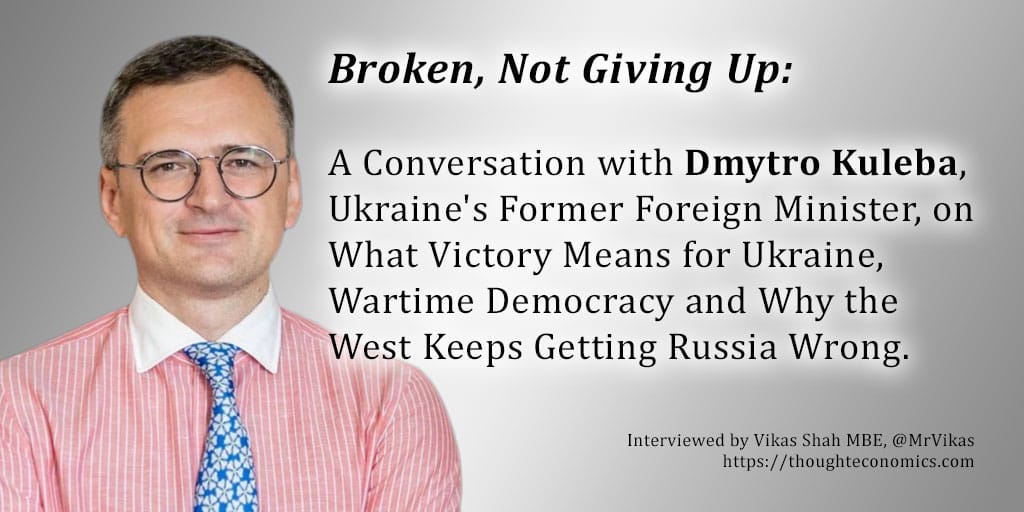
Twice during this conversation the screen went dark. Dmytro Kuleba was speaking from Ukraine, where Russian strikes on the power grid had cut his electricity, and each time he reappeared a minute or so later, once his generator had restored his connection, and picked up the sentence he had been in the middle of. He was not inclined to make much of it. “You have a very simple choice,” he said. “You either adapt or leave.”
Kuleba was born in Sumy in 1981, the son of a career diplomat, and joined Ukraine’s Ministry of Foreign Affairs in 2003 after graduating in international law from Taras Shevchenko National University of Kyiv. He left the service in 2013 in disagreement with the policies of Viktor Yanukovych, took part in the Euromaidan protests, and returned in 2014 as Ambassador-at-Large for strategic communications. He served as Ukraine’s Permanent Representative to the Council of Europe from 2016 to 2019 and as Deputy Prime Minister for European and Euro-Atlantic Integration from 2019 to 2020. In March 2020, at 38, he became the youngest foreign minister in Ukraine’s history, and he held the post until September 2024, through the build-up to the full-scale invasion and its first two and a half years. He is now a Senior Fellow at Harvard’s Belfer Center, an Associate Professor at Sciences Po, where he teaches wartime diplomacy, and a Distinguished Fellow of the European Council on Foreign Relations. He is the author of The War for Reality: How to Win in the World of Fakes, Truths and Communities, first published in Ukrainian in 2019 and in English in 2023, and his wartime speeches were collected this year as Words of Defiance (Biteback, 2026). His essay “Russia’s Plan to Break Ukraine“, published in Foreign Affairs on 30 September 2026, is where we began.
The conversation took place in the autumn of 2026, at a point when Kuleba’s own reading of the war had hardened. Speaking to Paul Ronzheimer of Bild in Kyiv in October, he said that until three months earlier the question in European capitals had been what could be done to change Putin’s calculus, and that this question “does not pass reality check anymore”; the question now is what can be done to outlive him. He pointed to three indicators: a new Russian parliament from which anyone who might take the podium and say the word peace had been excluded, a draft budget in which defence spending rises for two more years, and Russian polling that shows no sympathy for Ukraine and no challenge to the assumption that it should be defeated. He had already argued, to the Kyiv Independent in April, that the key to peace “is not in Washington, it’s in Europe and in Kyiv”, and that whatever Putin and Trump agree between themselves, they will have “zero instruments to enforce it” so long as Ukraine and Europe stand together.
Diplomats are trained to leave room for a deal, and the surprise of this conversation is how little room Kuleba leaves. He argues that a nation which has built its state machinery around waging a war has already priced in the cost, and that no quantity of diplomacy will change its mind; only shattering its capability to fight will. He argues that the West’s error about Russia was not a failure of intelligence but of arrogance, a conviction in Paris, Berlin, London and Washington that they knew Russia and could moderate it, and that the price of correcting that error has been paid in Ukrainian blood. And he rejects the word most often used about his own people. Ukrainians are not unbroken, he says. They are broken. They are simply not giving up, because they know what happens to the person who puts the weights down. His summary of the succession question, given to Ronzheimer, is the bluntest line in his recent public record: “Putin is a guarantee of war. Anyone after Putin is a chance for peace.”
In this conversation we discuss what Vladimir Putin now counts as victory and why there is no single Ukrainian theory of it; how a democracy functions during a multi-year war without a doctrine to guide it; why the line between kinetic and non-kinetic warfare is a false one; the TikTok feed his son noticed 24 hours before the invasion; and the two assumptions on which Kuleba believes Western policy towards Russia must now rest.
Q: I want to start with Russia’s theory of the war. In your recent Foreign Affairs essay you examined the strategy of attacking infrastructure, and the hypothesis was that this is no longer about conquering Ukraine but about making life unbearable for Ukrainians. What does Putin believe a Russian victory looks like now?
[Dmytro Kuleba]: According to Putin, Ukraine should belong to Russia one way or another. There is a minimal acceptable form of that belonging, and a maximalist view of how it might look. The minimal is that the Ukrainian state continues to exist. We have the flag, we have the anthem, we have the national government and the political process, but no major decision can be taken without, let’s say, counsel from the Russian ambassador in Kyiv. That is the minimum. The maximum he can hope for is, of course, the fall of the Ukrainian state and the establishment of physical Russian control over Ukraine as a territory and as a country.
Editor’s note: Kuleba expanded on Russia’s targeting when he spoke to Paul Ronzheimer of Bild in October 2026. The difference between last winter and this one, he said, is that a year ago Russia was striking energy infrastructure to black out Ukraine; now it is also hitting water and plumbing systems, pharmaceutical warehouses and the depots of supermarket chains, so that businesses cannot operate. “They don’t want to put Ukraine in darkness. They want to knock Ukraine out.” He expects Ukraine, “too big, too mobile and too agile” to be knocked out, to survive the winter, “but the price of surviving this winter will be much higher than the price last year”.
Q: It sounds like an obvious question, but I know there is a great deal of complexity to it. What about the Ukrainian side? People talk about Ukrainian victory and Russian defeat as if they were obvious things, but we are now several years into the war. What does victory mean for Ukraine now? Is it the restoration of territory, or a combination of guarantees and independence as well?
[Dmytro Kuleba]: There is no coherent theory of victory in Ukraine. Some people believe it would be enough to stop the war along the current line, and that as long as the war does not return, that should be considered acceptable, as victory. Others believe that Ukraine should continue fighting until it restores its internationally recognised border. And a third group would say that real victory will come only when Russia gives up on its ambition to re-subjugate Ukraine one way or another.
The balance between these three groups shifts with the dynamics of the war. If you had looked at it in 2022 or 2023, you would clearly have seen the goal of restoring the border overwhelmingly dominating people’s thinking. Now the advocates of that theory have been overwhelmed by those who are ready to accept the current line as something Ukraine can live with.
But if we were to design a theory of Ukraine’s victory, I would formulate it in three words: an independent, sovereign and European Ukraine. Independent: the existence of the state. Sovereign: it takes decisions of its own, and Russia has no say in them. European: it belongs to the pan-European project and to the European world, not to the Russian world. Everything else stems from these three basic words.
Wartime democracy as an unwritten contract
Q: Ukraine is fighting for democracy whilst simultaneously having to postpone some of its processes. Postponed elections and martial law are normal parts of a conflict in many ways, but if Ukraine is victorious you cannot have lost the thread of democracy that has bound the country together. How can a democracy survive a long war? That must be very hard for you and for other policy leaders.
[Dmytro Kuleba]: Ukraine represents a unique case in modern history: a wartime democracy of the 21st century. There is a lot that every democracy can learn from Ukraine, but the enemies of democracies across the globe can also learn from it where modern democracies show strength and where they expose their weaknesses.
You are right that there was no doctrine before the invasion of how a democracy should function during a long-term armed conflict of this scale. We knew how democracy should function during a war. But there was not a single answer to the endless number of questions about how democracy functions during a multi-year, full-scale war. Ukraine is learning by doing, literally. And I think we are doing pretty well, much better than things could have evolved. Both society and the political class act in a very responsible way towards each other, and the system of checks and balances functions as an unspoken and unwritten contract. Ukraine is a very interesting case to explore.
Editor’s note: Kuleba has gone further than most Ukrainian public figures on this question. In April 2026 he told the Kyiv Independent that Ukraine should hold parliamentary elections despite the war, because “the risks of not holding elections are much higher than the risks of holding elections”. The current parliament was elected in 2019 and represents Ukrainian society as it was then, he argued; a democracy at war needs legislators, including soldiers and volunteers, whom voters will find credible when hard decisions fall on civilians. Without renewal, he warned, the system faces what physicists call entropy, “the exhaustion of energy that leads to chaos”.
Q: Does that extend to the way society has mobilised? A very distinctive aspect of this conflict has been the resolve of the Ukrainian people in the face of a long and brutal war. Does that relate to the democratic pillars you describe, or has Ukraine done something else that has maintained civil support for the war and the motivation to keep fighting?
[Dmytro Kuleba]: I believe it is fair to speak about society as a whole, and not only about civil society as the driving force for democratic development. The strength of Ukraine is that the whole country, whether people are active in civic life or passive, whether they take part in politics or prefer to live their quiet lives without getting in touch with it, all of them, all of us, understand one very simple and ruthless truth. It does not matter how hard things are today. If we give up, things will only get worse.
It is like going to the gym. You start lifting weights, and then you are done. You cannot do it any more; you have run out of energy. And you know that once you put the weights down on the floor, you will feel relieved. Ukrainians know the opposite. When they put the weights down on the floor, things will only get worse for them. It is very important to understand this about the nature of Ukrainian resilience. When people say Ukrainians are unbroken, it is not true. We are broken. We are just not giving up.
The war for reality: why disinformation is kinetic
“It does not matter how hard things are today. If we give up, things will only get worse.”
Q: You have written extensively about disinformation and the manipulation of public opinion, not least in The War for Reality. This feels like the first time we have seen a full-scale disinformation war run alongside a conventional kinetic war. What have you learned about how democracies lose control of reality, and what should the rest of us take from the Ukrainian experience?
[Dmytro Kuleba]: I have an issue with the division of the domains of war into kinetic and non-kinetic. If I experience the influence of disinformation and begin to believe that it is my own government that does not want to make peace, while Mr Putin is a peace-loving bird, a dove of peace, and then I take it to the street and protest in front of the government building demanding that it sign an agreement with Russia, is that kinetic or not kinetic? It is kinetic, because it leads to physical action.
As long as it is just a war of thoughts and perceptions, we can speak about kinetic or not. But I see the Russian effort as oriented towards spilling over from online into offline, from thoughts and perceptions into actions. And it all works in concert. When you see Russian disinformation claiming that Zelensky does not want peace, and Russia striking our civilian infrastructure with missiles, these are two sides of the same attack, because they both aim at turning a civilian against his own government, and turning civilians against each other. So the so-called non-kinetic disinformation or propaganda war should not be considered a completely independent domain. It is closely tied to kinetic impact.
Q: Those campaigns had been going on for many years before the invasion, a slow chipping away at a society’s resilience. In the run-up to the war, from where you sat, did you see campaigns designed to achieve exactly those aims?
[Dmytro Kuleba]: I did not personally, but my son did. I was on an official trip to Washington and New York on 22 and 23 February 2022, so I was calling my son and exchanging texts with him. I think it was on the 23rd that I texted him: how are you? He said he was doing fine, and then he texted back that he had noticed something strange happening on TikTok. I asked what it was. He said his TikTok feed was filled with posts glorifying the invincible Russian army. They were not about defeating Ukraine. They were not about any specific war. They came from very different accounts, in Ukrainian, in Russian, some in English, and they were all about one thing: the Russian army is invincible.
That was the psychological impact Russia was trying to make on Ukrainians even before their army crossed the border, because they wanted Ukrainians to begin to believe that resisting them made no sense, because they were invincible. Of course, we can trace these efforts back many months and even years before that. But this is what literally happened just 24 hours before the invasion began.
Why diplomacy cannot stop a nation that has chosen war
Q: You have been open about once believing that diplomacy could help end this war, and I sense that you are more sceptical now. Thinking back over those years of pursuing diplomacy, including just after the invasion, what happens when one side is using diplomacy as a tool for peace and the other is committed to war? It feels as though we should be able to learn a great deal from your experience.
[Dmytro Kuleba]: War happens. The uncomfortable truth for scholars of international relations, for practitioners and for anyone who cares for the world is that if Nation A has taken the decision to wage a war and has built its society and state machinery around that goal, it means that the decision makers of that nation have already taken into account the price they are going to pay for waging it. It does not matter what you do or how you try to deter them. The only way to stop that nation is to shatter its capability of waging that war. Otherwise a lot of diplomacy will be done, but that country has already made its choice, and it will pursue it.
Editor’s note: Kuleba was Foreign Minister during the Istanbul talks of March and April 2022, and has addressed the claim, still repeated in parts of Europe, that a deal was within reach. Speaking to Ronzheimer, he said that both sides call for talks by instinct when a war begins, the attacker as a smokescreen and the attacked as a hedge, and that the document brought to Istanbul “was an act of Ukraine’s capitulation, wrapped in soft words”. It failed, he argued, because by April Ukraine had realised it was not collapsing and the atrocities at Bucha had made signing politically impossible, not because anyone told Kyiv not to sign. He was absent from the negotiations by choice. “You cannot win at the negotiating table what you lost on the battlefield,” he said, so he spent his time on weapons and sanctions instead.
Q: Was it apparent to you, in the diplomatic process, that the war was almost inevitable?
[Dmytro Kuleba]: To me, yes. To many other people, no. You see, the West suffers from its own arrogance. Our friends in Paris, in Berlin, in London, even in the United States, always build their fundamental assumptions on the premise that they know Russia, that they have leverage on Russia, that they can control Russia, that they can moderate Russia. I have to be fair: not everyone in Ukraine believed it either. But those of us who did believe that the war was inevitable were telling our colleagues that things were going to happen differently from what they expected, and that they could not stop them. So when the war did happen, the same people told us: okay, we have to admit you were right and we were wrong.
And here is the problem. It takes Ukrainian blood, pain and life to make people in the West admit they were wrong about Russia. This is the tragedy of Ukraine. We pay with blood for our friends to become more open-minded and forthcoming towards reality.
Editor’s note: On Germany in particular, Kuleba told Ronzheimer that what he encountered in Berlin in 2022 was not fear of Russia but something older: centuries of political thinking in which friendship with Russia meant money and influence, and conflict with Russia meant disaster. “It wasn’t fear, it was reluctance to accept that you cannot make money and do big politics with Russia any more.” Every early Ukrainian request for weapons, he said, met the same first answer in Berlin and Washington: escalation. He credits Olaf Scholz with travelling “a long road” to the opposite conclusion by the end of his chancellorship, and describes Joe Biden as the only US president since 1991 who cared for Ukraine and did more for it than all his predecessors together, but who “still fell short of doing everything that should have been done”.
Q: Welcome back. The resilience people have built in the face of all this is remarkable.
[Dmytro Kuleba]: I got blacked out again, so I had to wait until my generator kicked in and restored my internet. You have a very simple choice: you either adapt or leave. It is remarkable, but we adapt anyway.
“It takes Ukrainian blood, pain and life to make people in the West admit they were wrong about Russia.”
Q: So the big lesson for the West is about the consequences of not dealing with an unchecked Russia, and Ukraine has paid the price for Western caution. What is the lesson we need to learn about Russia, and how should we handle Russia from now on?
[Dmytro Kuleba]: The biggest lesson worth learning is that there will be war. There will be more war as long as President Putin stays in the Kremlin.
The intellectual problem is that when many people in the West concluded that it was irrational for Putin to wage a war of this kind against Ukraine, they failed in their analysis. People said Putin was not going to invade, because it was irrational. When he invaded, the same people said: okay, we admit he did something irrational, but now he will behave like a rational player again. He will realise that he cannot achieve his goals, and therefore we should treat him in a rational way again. Then Putin demonstrates that he is willing to pay an unimaginable price for the achievement of his goals, and people say: yes, but that only applies to Ukraine, because attacking Europe would be irrational for him. And when he attacks Europe, the same people will say: okay, he did something irrational again, but now we have to consider him a rational player and try to make a deal with him.
In my view, the best policy towards Russia can be built on two assumptions. The first is that Putin does not care about the price. He only cares about what will be written about him in the history books. The second is that as long as Putin stays in the Kremlin, there will be war, in Ukraine and outside Ukraine. But to take these two assumptions as the foundation of thinking and policy making, you have to admit one thing: that you were wrong in treating Putin as a purely rational player who read the same book on game theory and believes that win-win is the best outcome for all. No. He read different books. He does not believe in win-win.
Editor’s note: Kuleba’s warning does not stop at Ukraine’s border. European politicians, he told Ronzheimer, “were all raised on the same books”, and those books preach win-win; Putin either did not read them or disagrees with them, and for him the world is win-lose. Europe’s generals and analysts, he argued, are preparing for the war of the past, imagining an attack on NATO in the shape of the invasion of Ukraine: “Russia does not need 400,000 more people to wage that war. It needs five drones.” Unidentified drones striking a defence plant, a railway depot or an airport in Germany would leave its government choosing between admitting an attack and pretending it had not happened, and either choice would encourage the next step. He does not believe this war will end in a deal, because not all wars do: it will end, he said, when the side that caused it runs out of the means to wage it, or ceases to exist as a regime.
——–
Dmytro Kuleba served as Minister of Foreign Affairs of Ukraine from March 2020 to September 2024. He is a Senior Fellow at Harvard’s Belfer Center for Science and International Affairs, an Associate Professor at Sciences Po and a Distinguished Fellow of the European Council on Foreign Relations. His collected wartime speeches, Words of Defiance, are published by Biteback, and his essay “Russia’s Plan to Break Ukraine” appeared in Foreign Affairs on 30 September 2026. More at kuleba.info.