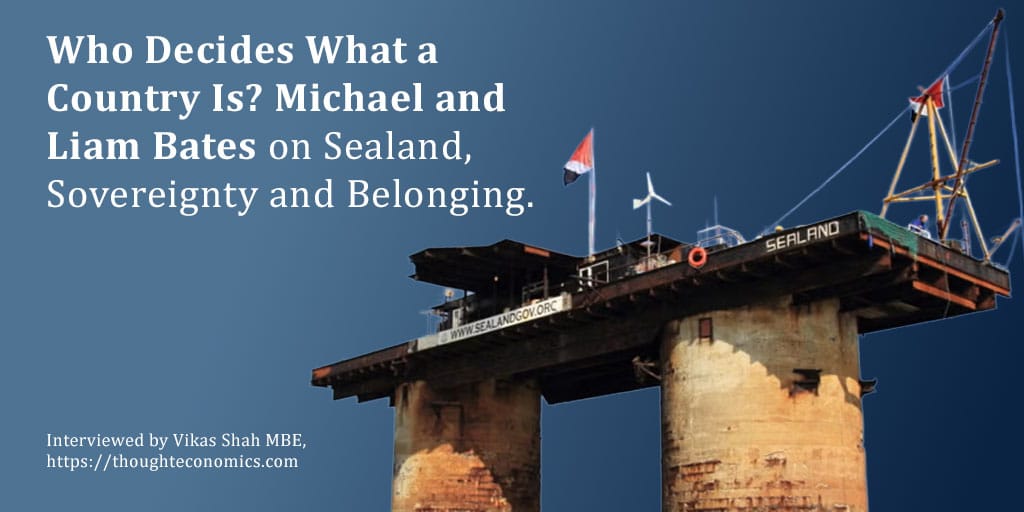
In the late 1960s, a teenage boy on a wartime gun platform in the North Sea handed a letter to a passing yacht and asked whoever was aboard to post it to his father. There was no better way to send it. Supply boats came when the weather allowed, and newspapers that wanted an interview rang the nearest Coastguard station and waited. The boy was Michael Bates. The platform was Roughs Tower, one of the Maunsell forts sunk onto the sandbanks in 1942, about seven miles off the Suffolk coast, and his father had lately declared it a country.
Paddy Roy Bates was a former Army major who had fought through North Africa and Italy, and by the mid-1960s was running Radio Essex, a pirate station, from another abandoned fort, Knock John. When the Marine Broadcasting Offences Act came into force on 15 August 1967 to shut the pirates down, he was already out beyond the three-mile limit that then marked the edge of British waters. On 2 September 1967, the birthday of his wife Joan, he declared Roughs Tower the Principality of Sealand, and gave it a flag, a constitution, stamps, passports, a currency and a motto, E Mare Libertas, “from the sea, freedom”. A year later Michael, still a teenager, fired warning shots at a British vessel servicing a nearby buoy. When he was tried at the Essex Assizes in October 1968, the court found it had no jurisdiction over the fort. Government papers since declassified, and recounted in Michael’s memoir, show that Harold Wilson’s government drew up plans to take the platform with Royal Marines and helicopters, and that Wilson refused to authorise them.
The episode the family return to most came in August 1978. While Roy and Joan were in Austria discussing an investment scheme, a group of German and Dutch businessmen and lawyers landed on Sealand by helicopter, overpowered Michael and held him prisoner. Roy retook the fort at dawn a few days later, arriving by helicopter with an armed party, and detained one of the invaders, who held a Sealand passport, on a charge of treason. Britain declined to get involved, so West Germany sent a diplomat from its London embassy out to the platform to negotiate his release. The family have treated that visit ever since as de facto recognition. Then came tens of thousands of forged Sealand passports, one of which surfaced in the investigation into the 1997 murder of Gianni Versace; the HavenCo data haven of the early 2000s; a fire in 2006; and Roy’s death in 2012, after which Michael succeeded him and set the whole saga down in Principality of Sealand: Holding the Fort.
Liam Bates and his elder brother James now run much of Sealand day to day, and they have turned a family’s private war with Whitehall into something closer to a membership. Noble titles sold online made the principality community funded; e-citizenship opened in the summer of 2024, and Sealand says it now has e-citizens in 138 countries. The fort was on CBS’s 60 Minutes again this July. Last October Liam and his family took a sceptical Michael to Balaji Srinivasan’s Network State Conference in Singapore, where around 3,000 people had registered to talk about building countries out of online communities, an idea his father had tested on a sea fort nearly 60 years before.
The easy reading of Sealand is a joke that got out of hand, and the legal case against it is strong: no state recognises it, a German court ruled in 1978 that it is not a state, and since 1987 the fort has sat inside British territorial waters. Two short explainers inside the conversation set out how micronations and network states work, and what the law, British and international, says about declaring a country of your own. But the family have spent 59 years running a live test of the argument Benedict Anderson made about nations being imagined communities, and that Yuval Noah Harari has made about the shared stories that hold large groups of strangers together. Sealand has almost none of a state’s power and a great deal of its loyalty. Liam’s version of the survival test is blunt: it lasts only as long as people believe it should. Michael’s answer to the recognition question is China, which the United States agreed to recognise only in the same year that mercenaries tied him up on his own platform. In this conversation, we discuss the pirate radio law that started it all, the tins of beans that Michael says British officials opened before they reached the fort, the forged passport that brought Interpol to Roy Bates’s door, why the next generation thinks network states need territory, what Britain might learn from a country people opt into, and who, in the end, gets to decide what is real.
Q: Michael, the first thing I wanted to ask you about is the moment your father declared Sealand in 1967. It is such a fascinating story, and I would love your view on what that vision was. It was not just claiming a fort. There is something really fundamental in Sealand about defining what a country is, and what collective belief it takes to create a nation.
[Michael Bates]: Well, it started originally because he was upset. He had one of the offshore radio stations, and the British Government changed the laws to close them down. He looked around him, and people like Ian Smith were declaring UDI in Rhodesia, and there were all sorts of things like this going on around the world. And he thought, hang on a minute. He just had this idea: I’m going to declare independence. I’m going to stick it to the man, and I’m going to be my own kind of person. So it’s a matter of collective imagination, and defiance.
As my dad said, in years gone by, in my father’s words, countries were taken or created by the strength of the strong right arm. Having said that, the world has moved on with technology, and Sealand was once isolated. It was really isolated. The boat would go away and it would be three weeks before it came back, and you didn’t know whether it was going to come back. Very often it didn’t come back when it was meant to. It was like the Battle of Trafalgar, when it took nine days for the news of the victory to get to London from Spain. It was better than that, but not a lot better. Nowadays we have good old Elon Musk, who gives us Starlink, and it’s instant, like that. And he’s a great supporter of free speech. So that’s how it all started, but the world’s moved on with the technology, and that has made it so much easier. I have actually handed a letter to a yacht going past myself, saying, “Can you post that to my dad, please?” I was 14 years old, and totally out of touch.
[Editor’s note] Radio Essex broadcast from the Knock John fort until Roy Bates was prosecuted in 1966 for broadcasting without a licence, the court ruling that Knock John lay inside British waters. Roughs Tower, further out, did not. The Marine Broadcasting Offences Act came into force on 15 August 1967, and Sealand was declared a little over two weeks later. Rhodesia’s Unilateral Declaration of Independence had come in November 1965.
Q: In those early days there were real challenges in getting Sealand established, including actual attempts by other people to take the fort. What were some of the hardest times you can remember? And, Michael, at what point in your journey did you see this as something which had, how do I phrase it, a life beyond the novelty: a demonstration of what a nation could be with enough collective belief?
[Michael Bates]: Well, I was 14, and at 14 you don’t really think politically. To me it was a huge adventure at the time. We were literally under attack. We were keeping 24-hour guard watches, and it was exhausting, but I was making the place defendable so that people couldn’t get on it. But as I got older, and my dad and I talked about it all the time, it became a hugely interesting idea. And people from around the world were helping us.
In one of your questions you asked who can become a national of Sealand, and what they have to do, as opposed to having a title. There was a Count Skylark, I think he was, a man in Australia, who wrote to my dad and designed a coat of arms for us depicting all our history. He was a Sealander: one of the people who actually gave time and effort and resources to the cause. So right from the very beginning we realised it could be a hugely interesting thing to do, and a hugely controversial thing in the eyes of the British Government, who didn’t want anything like even pirate radio to start with.
Terra nullius, the three-mile limit and the old boys’ club
Q: Am I right, and I might have my dates wrong, that for quite some time you were effectively outside territorial waters, until Britain extended them? The jurisdiction issue became quite interesting, and I wonder how it changed the nature of what Sealand was. As I was saying to Liam earlier, one of the things I find incredible, when I am on the Sealand forums and other places, is that the level of passion people have for Sealand is akin to being citizens of any other nation. Indeed, I think the love people have for Sealand is often more than they have for their other citizenship, whether it’s the UK or elsewhere. It made me think about how arbitrary the nature of a border is, and how what people feel as their citizenship is sometimes more important.
[Michael Bates]: The history behind the fortress itself is that it was built in international waters, but during a time of war, so no one cared. The British Government manned it and then they abandoned it, and then it was terra nullius. Nothing to do with the UK any more. There was a three-mile territorial limit, as there had been since 1536, which was the limit recognised around the world. And then all of a sudden the big nations, the old boys’ club, I suppose, decided to carve up the world amongst themselves, and we ended up where we are today. But we actually extended our limits the day before, a few days before, and it’s agreed that there should be a median line if limits cross each other. So that’s where we are today.
Explainer: what the law says about declaring your own country
The international test. The usual starting point is the Montevideo Convention of 1933, which sets four criteria for statehood: a permanent population, a defined territory, a government, and the capacity to enter into relations with other states. Lawyers divide on what happens next. On the declaratory view, a state exists once it meets those criteria, whatever anyone else thinks; the Convention itself says a state’s political existence is independent of recognition. On the constitutive view, a state exists only when other states treat it as one. In practice recognition decides, because recognition is what opens embassies, bank accounts and seats at the United Nations. Declaring independence is not itself unlawful: the International Court of Justice found in its 2010 advisory opinion on Kosovo that international law contains no general prohibition on declarations of independence. It simply does not follow that the declaration creates a state.
The sea. Sealand’s particular difficulty is that it stands on a man-made structure. Under the UN Convention on the Law of the Sea, which the United Kingdom ratified in 1997, artificial islands, installations and structures do not have the status of islands and have no territorial sea of their own. The only court to rule directly on Sealand’s statehood reached a similar view earlier. In 1978, the Administrative Court of Cologne heard a claim by a German supporter of Sealand who wanted to give up his German nationality on the ground that he was now a Sealander. It refused, holding that Sealand was not a state because a platform is not part of the earth’s surface and it lacked a settled community.
The United Kingdom. British law has no procedure by which a private individual, or even a part of the country, can leave it. Sovereignty rests with the Crown in Parliament, and when the Lord Advocate asked whether Holyrood could legislate for an independence referendum, the Supreme Court held unanimously in November 2022 that it could not without Westminster, because the Union is a reserved matter. Declaring your farm or your house an independent country is not in itself a criminal offence, but it changes nothing: the land stays in the United Kingdom, and tax, planning and licensing law go on applying to it and to you. Nor does going offshore take a British subject beyond every British law. The Marine Broadcasting Offences Act that closed Radio Essex applied to British subjects on offshore stations wherever they were.
Sealand in particular. The Bates family learnt early where the line fell. In 1966 Roy Bates was convicted over broadcasting from Knock John because the fort lay inside British waters; in October 1968 the Essex Assizes could not try Michael over the warning shots at Roughs Tower because it lay outside them. That line moved on 1 October 1987, when the Territorial Sea Act 1987 extended British waters from three to 12 nautical miles and took in the fort, along with the seabed beneath it, almost all of which within that limit belongs to The Crown Estate. Sealand had declared a 12-mile limit of its own shortly beforehand. Britain does not recognise Sealand, and the declassified papers the family have published suggest that its preferred policy since the 1960s has been the one Michael describes in the interview: to leave the family alone and wait for them to give up.
Q: Another really fascinating thing for me is that there’s something very fun and eccentric about Sealand on one side, but the deep part of it is a serious constitutional claim, a serious examination of sovereignty. I think one of the things you have done remarkably well is straddle that, allowing people to lean into the fun and enjoyment of being part of it whilst keeping the seriousness of the sovereign claim. So what are the big questions you are trying to answer when you are at these conferences talking about sovereignty? Is there still a fight you’re fighting around that claim? And how do you balance the seriousness of the idea with the fun, eccentric side, which no doubt is commercially very successful as well?
[Michael Bates]: Well, we’ve always tried to do the right thing, and we feel we have a responsibility to the rest of the world. For instance, the Sealand passports: we withdrew them after we got a phone call one day from the county sheriff of Miami, or whatever it was, saying that Gianni Versace had been shot and that Sealand was implicated in it. How was that? Well, the assassin apparently ran to a houseboat, and the houseboat was owned by a man with a Sealand passport. We knew nothing about this. It was a fraudulent passport.
So we enquired about it, and then a man from Interpol turned up at my father’s house. I was there at the time, and we knew nothing about it. This was before the days of the internet, so you couldn’t just look things up, and no one knew what was going on; otherwise I’m sure we would have been contacted before. Right back at the beginning, if a journalist or a newspaper wanted to contact us, they would probably phone the nearest Coastguard, and the Coastguard would get in touch with us. There was no direct contact. Now, you contact us and you get through straight away. It was just a different world back then.
[Editor’s note] Gianni Versace was shot outside his Miami Beach home on 15 July 1997. His killer, Andrew Cunanan, was found dead eight days later on a houseboat whose owner, according to press reports at the time, carried a Sealand passport. Forged Sealand passports had been produced and sold in large numbers by a group with no connection to the Bates family, with estimates running as high as 150,000. In 1997 the family revoked every Sealand passport, including those they had issued themselves.
A third generation, and a country you can choose
Q: Liam, one of the first questions I had for you is about inheritance. Your father inherited the notion of Sealand from your grandfather. For you, it’s a really unusual family business, as family businesses go. It’s not just a business or a piece of property; it’s something much more. So what is the role and responsibility you have? And how did you come to believe in the concept of Sealand, and what it means, so that you could become a leader of it as well?
[Liam Bates]: I’ve been immersed in this since I was a tiny child. I first went out to Sealand when I was probably three or four, so I’ve grown up around it. I always listened to the stories from my grandfather and my father, and I thought they were absolutely amazing. But when you’re a child, that stuff, even though you’re really intrigued, is the norm to you, because that’s all you know. As I grew up, I realised that it’s way more than just a place that we go and visit. It’s an idea that my father and grandfather have been fighting for their whole lives. And then that dawns on you. I was truly bought into the idea of what it stands for: fighting for freedom, and saying no to authority when it’s overreaching. So that’s a fight that I relish, and that my brother and I are very much looking forward to taking into the next generation.
Explainer: how micronations and network states work
Micronations. “Micronation” is the label outsiders give to a self-declared state that no government recognises. Sealand rejects it and calls itself the world’s smallest sovereign state, but it is usually filed alongside a long list of others. Most follow a pattern: a founder, a grievance, a patch of land or water nobody else is watching closely, and a set of documents that look like a state’s. Leonard Casley declared his Western Australian wheat farm the Hutt River Province in April 1970 during a dispute over grain quotas; after years of tax battles with the Australian authorities, his son dropped the claim to sovereignty in August 2020. Giorgio Rosa built his own platform in the Adriatic in 1968, and Italy seized it within two months. Vít Jedlička proclaimed Liberland in April 2015 on about seven square kilometres of Danube floodplain left unclaimed by a border dispute between Croatia and Serbia; Croatian police have controlled access to it for most of the decade since.
The territory problem. The lesson of those cases is that land is the hard part. It either belongs to someone already or it is at sea, and states defend both. When an American bitcoin investor and his Thai partner moored a floating cabin off Phuket in 2019 in the name of seasteading, the Royal Thai Navy towed it away and the couple were charged with an offence against Thai sovereignty that carries the death penalty.
Network states. The network state reverses the order. The term comes from Balaji Srinivasan’s 2022 book The Network State, which describes an online community aligned enough to act together, which then buys property in several countries and eventually seeks recognition from existing states. Community comes first, land later, sovereignty last. The closest attempts so far exist with a host government’s permission, and depend on it. Próspera, a privately governed zone on the Honduran island of Roatán, was created under a 2013 law that Honduras voted to repeal in 2022; it continues to operate and is pursuing a claim of more than $10 billion against Honduras at the World Bank’s arbitration centre. Srinivasan’s own Network School, a residential community in Forest City, Malaysia, lost its business licence in July 2026 and announced a move to Kazakhstan the next day.
States borrow the idea back. Estonia’s e-residency programme, launched in 2014 under President Toomas Hendrik Ilves, lets foreigners set up and run an Estonian company online. It carries no citizenship and no right to live in Estonia. Sealand’s e-citizenship is close to the mirror image: it offers belonging with very little of a state’s machinery, where Estonia offers the machinery without asking anyone to belong.
Where Sealand sits. Sealand has the thing network states lack, a territory it has occupied without a break since 1967, and it now has what most micronations never find, a paying community spread across 138 countries. That combination is why its princes are welcome at network state conferences, and why Liam’s argument in this conversation, that a Discord server is not a country, carries more weight than a sales line would.
Q: What does the next version of Sealand look like? You’ve launched e-citizenship and digital governance, and we’re also seeing other network states, if you like, where people are creating charter cities, crypto communities and digital nations, and reinventing sovereignty in a digital era. What are some of the concepts you are using to create Sealand two, or even Sealand three, as it might be?
[Liam Bates]: We’ve offered noble titles for quite a long time, I think about 15 years. That’s been a pretty cool way to invite the community along to the story. They buy the noble title, and it helps pay for the repairs and all that kind of thing. A few years ago now, through the noble title scheme and more recently e-citizenship, Sealand actually became community funded. It was always funded by the blood, sweat and tears of my family. Absolutely everything we’ve ever had has gone into Sealand. That’s always been the way. But it has really matured into this online community, which is truly global. We have e-citizens in almost every country in the world, and I think we have title holders in actually every country in the world, but I need to double check that.
So the global appeal of what we stand for and what we are is clearly there. People love being part of that story and part of the adventure. As far as the other network states go, I think some of the ideas are really cool. There are some pretty big holes in some of the things they believe in. You can form an online community, you can be a Discord server, but unless you actually have some sovereign territory, it remains an idea in people’s minds. We’re still physical beings, so you need the physical place where you can get together and get that true sense of community and identity.
Q: What do you think it is that people are buying? When I was researching and putting the questions together, one of the things I looked at was the Sealand forum on Facebook. People feel a remarkable sense of belonging and connection, and the language they use is very much what you would expect if they were becoming a citizen somewhere. Given that those products, if you like, don’t have much force outside Sealand, for want of a better phrase, what do you think people are really buying into when they become part of the Sealand journey?
[Liam Bates]: I think it means different things to different people. A lot of people love the story. A lot of people love just being a part, in whatever small or large way, of something that you can’t really find anywhere else in the world. There’s always been this family-against-the-world thing in the North Sea, and people love that. It’s an underdog story, of course. But it’s grown into something now where, especially in the West, there’s this feeling that people are becoming a lot more polarised and a bit disillusioned with where they live, and they don’t have that uniting culture, that uniting belief. And I think they look at Sealand and think, wow, we love what these guys are doing. They stand for freedom and independence and all those things that, especially in the US, people love. And they think Sealand should exist. They want it to exist. And I think that’s why people become e-citizens. They want to help out, financially, to make sure it exists into the future.
“We’re still physical beings, so you need the physical place where you can get together and get that true sense of community and identity.”
Q: What has it taught you, for want of a better phrase, about what it really takes to create a nation? I was intrigued by the conference you attended in Singapore as well. It is really interesting that large nations seem at the moment to be quite bad at building a sense of purpose and a shared identity, whereas, again from the research and from seeing how people interact, Sealand has a really strong sense of identity. You straddle both, being from the UK and from Sealand. If you had a magic wand, what would you want a nation like the UK to learn from the experience of building Sealand?
[Liam Bates]: I think you have to really state what your values are, who you are, and what you stand for in the world, and have a shared vision of where you actually want to take your country. That goes back to the polarisation point. Places like the US and the UK seem to be getting pulled in so many directions by so many different factions within the country that there’s no cohesive view of where we want to go, what we stand for and who we want to be.
So I think with having that, people can choose to like it or not. That’s the beauty of it: it’s completely opt-in. The country that you’re born in, unless you manage to move to a different country, you’re pretty much stuck there. You have to live under those rules, with those social norms and that culture, and you either buy into it or you don’t. But you don’t have a lot of choice about it. With Sealand, you can choose. You can say: no, I like what these guys are doing. I want to be a part of that, and I want this to exist. And hey, I’m a Sealander too now. I’m an e-citizen and a noble, whatever it might be.
Keeping the maverick spirit alive
Q: What are some of the challenges you find in this journey? Rather than a constitutional question, there have been real challenges along the way with Sealand, and even now you’re in a world of digital forgery and all these sorts of things. What are some of the risks you face now, as a leader in Sealand, in maintaining the integrity of what you’ve built?
[Liam Bates]: Sealand’s been around for almost 60 years now, so the responsibility is quite big. We always want to stay really true to that maverick spirit. But now it’s not our family any more. It’s a large community of global Sealanders. So it’s a tricky one, but I think being clear about who we are and what we stand for is a big part of whether people choose to stand with us or not.
A lot of the challenges in the early days were physical: my dad and grandfather fighting off invaders, those kinds of things. And then living in a remote location in the North Sea in the sixties and seventies was a huge challenge on its own. Today we have wind and solar for our electricity. We collect rainwater. We have Starlink. The place is quite comfortable. But that wasn’t the case back in the day. It takes some real staying power to state your claim of sovereignty, and then to actually see it through. I think a lot of people love the idea, and it’s romantic, but after a year they’ve gone, oof, that was a lot of trouble and some real hard work. So keeping at it for three generations and 60 years has been a real challenge.
Q: What about the future? There was a piece recently which described Facebook as history’s largest ever non-territorial empire, and it makes me think, because in effect it is equivalent to a nation. When I look at Sealand, and the infrastructure you are building, the machinery of state and all these other things you’re developing, it makes me wonder what the future holds. Is Sealand always going to be anchored around your site? Or is there potential for Sealand to expand to other similar locations, not to lose territory but to expand it, or even to become something digital?
[Liam Bates]: A lot of these network states’ ideas are built around that. They crowdfund, say, apartment buildings, or places like that where they can all meet up. But the issue with that is that you’re most likely always going to be within somebody else’s sovereign territory. That’s the difference with Sealand: we have our own sovereign territory. So in the future, it’s not to say that we couldn’t have embassies and places where Sealanders can meet up, where there are large enough groups of people, for example in Japan and in the US. I could definitely see that. That would be awesome. But it would probably be more on an embassy basis, where you have an agreement with that host country. I think Sealand as a location is totally unique in the legal sense, so I don’t think you could really replace that.
“It only survives if people believe it should be there.”
Q: In terms of running the business, one of the things I find fascinating is the dual role. With most businesses, you’re literally running a business: I can buy this cheaper than I can sell it for. But with Sealand there’s a legacy aspect. This is a business that has to outlast you. So as a leader, what did you learn from your dad about that, and what are you applying in your approach to being an entrepreneur, and the leader of a state?
[Liam Bates]: I think the core of Sealand’s survival into the future very much comes down to the belief that it should still exist. If you can tell that story to a broad enough audience, you’ll find your people. Those people are passionate Sealanders, and they’re willing to support us and make sure it carries on. It’s also one of those stories that I think people love to share. Did you know there’s this place where, in the sixties, someone started their own country? It’s such an out-there story that it’s very shareable. I know that a lot of parents love to tell their kids about it. And a big part of our focus is making sure that the next generation are also interested in Sealand, because that’s the only way it survives. It only survives if people believe it should be there.
Who decides what is real
Q: What do you hope the legacy of Sealand is? As I said to Liam at the start, this is probably the most remarkable family business there is, passing from your father to you, and on to your sons. So, Michael, what has been your legacy in Sealand? And then, Liam, I would love a view from you, earlier in your Sealand journey, on what you hope your legacy will be.
[Michael Bates]: I’ve been involved most of my life, and I’ve seen it go from being blood, sweat and tears, which it literally was, and a lack of finance, to try and attain our freedom and our independence. And the governments, the British Government, tried so many different ways to stop us, including cutting us off. They would open every tin of beans or whatever was going out there, just in case there was something inside that shouldn’t be. They tried every nasty trick to stop us. And it was only the power of the press that rescued us. The press have been amazing over the years.
I was looking the other day at an old newspaper article. My sister and I were out there; she was 17 and I was a couple of years younger. We didn’t know what was going on, but the supply boat didn’t come out. Then an aeroplane flies over, and we’re on the front page of the *Daily Telegraph*, and the UK is thinking: look at their hungry faces, how could the British Government do this to these people, look at these two children, that sort of thing. My dad was really good at harnessing the power of the press. It’s so much easier now with the advent of the internet. My legacy, I hope, would be that I’ve now got it this far, and eventually we plan to involve other people from around the world in whatever we do. Liam will talk to you about that.
[Liam Bates]: I’d love to think that my children will carry it on. I have two sons, my brother has four children, and my sister has three, so there’s plenty of the next generation coming through. But what my brother James and I dream of, and the thing we are bringing to fruition now, is that the Sealand community from all over the world has a real stake in Sealand. They decide on the governance, and they really decide the future: where it goes and what it should be as we go towards the next generation. I think it is outgrowing our family as we speak. I think we’ll always be involved, and we would like to make sure it’s steered in the right way, of course. But the Sealand community is really the future of Sealand.
“They would open every tin of beans or whatever was going out there, just in case there was something inside that shouldn’t be.”
[Liam Bates]: And of course, we’d like to rebuild it. We’d like to respect the heritage of what we have there, but we’d like to build somewhere that a larger permanent population can live and work, and travel to and from easily: somewhere really accessible. That’s what we’re building towards.
Q: Do you both think Sealand will serve as a precedent for more such nations emerging? At a time when the nation-state model feels so fragile at scale, it feels as if Sealand might serve as a point of inspiration for other people to create micronations or network nations around an ideal or an idea. Is that something you’re both seeing, and is it something you would both hope for?
[Liam Bates]: Yes, I think we’ve seen that since the early days. I think the man in that show on Netflix, Rose Island, was inspired by my grandfather. He did it the year after. And there’s this network state movement that you see now. We attended the conference in Singapore last year. My dad doesn’t really come to many of these, and when we took him he was a little bit sceptical. We said, no, just come and see what it’s all about. And he couldn’t believe that there were probably 2,000 or 3,000 people filling this massive place, all there to discuss, and excited about, the things my dad’s been doing for 60 years. So I think the movement is growing, and the interest in it is really growing.
And yes, I hope that we can serve as a model for people who want to ensure their freedom. I do see there’ll obviously be more breakaway states in the future, people that are desperate to preserve their freedom, and hopefully we can serve as a model. And hopefully the things we do in the future around governance can show them what flexible and agile governance can really do for people.
[Editor’s note] Giorgio Rosa, an Italian engineer, declared the Republic of Rose Island on a platform in the Adriatic off Rimini on 1 May 1968. Italian authorities seized it within two months and demolished it the following year. Netflix released a film of the story in 2020. The Network State Conference that Liam mentions was held in Singapore on 3 October 2025.
Q: Michael, does that resonate with you? It would be good to talk about the governance point with you as well, and how you build that. If we think about equivalent models for Sealand, you might look at somewhere like Abu Dhabi, where it’s family run, but the governance works extremely well and people generally have a good life. In your time, have you seen other people take inspiration from Sealand to create similar projects, or adapt what you’ve created to create zones within nations?
[Michael Bates]: I don’t think it’s going to be that easy for other people. You need some territory, for a start. We touched on recognition earlier on, and something I’d like to point out, which always amazes me, is that in 1978, just after Sealand’s own little war with some German nationals, China, with a population of nearly a billion people, was only then recognised by the United States. Only then. Now, you can’t say it wasn’t there, can you? It definitely was there, China. And now it’s a huge manufacturing superpower in the world. Even the whole recognition thing is just the old boys looking after the old boys’ club.
Liam is obviously the one to speak to about the future. My sons have really worked hard on moving it forward, on the groundwork of what my father and I did. And we’d love to see a nice modern structure, an island, whatever, there, where people could work from, as Liam said, and even commute to.
Q: I think that’s a really great ideal, and it was the principal reason for reaching out. What you’ve achieved is remarkable because it’s not a novelty; it’s something real. There’s a real claim around territory and sovereignty, and it makes you rethink what it means to be a nation. It’s exactly as you said there: who decides? Who decides what’s real and what isn’t? To close, Michael, for people who become e-citizens of Sealand, that claim feels as real as the passport they were given when they were born. So what has that journey, over all these years, taught you about belonging, and about the reality of the nation or place you belong to?
[Michael Bates]: It shows me that the big countries, like the USA and everything else, have tremendous power in the world. But as you say, a lot of countries aren’t recognised: Palestine, this one, that one. Whether they should be recognised or not is a matter up for discussion. But normally what countries like the UK do is try and ignore things and hope they go away. Well, we’ve been there for 60 years, and we want to go further with it, now that technology and the world have moved on to the extent that things can be done that couldn’t have been done before. So I think it’s got a great future, and my family will take that into the distance.
————
You can find out more about the Principality of Sealand, and apply for e-citizenship, at sealandgov.org. Michael Bates’s memoir, Principality of Sealand: Holding the Fort, tells the full story.