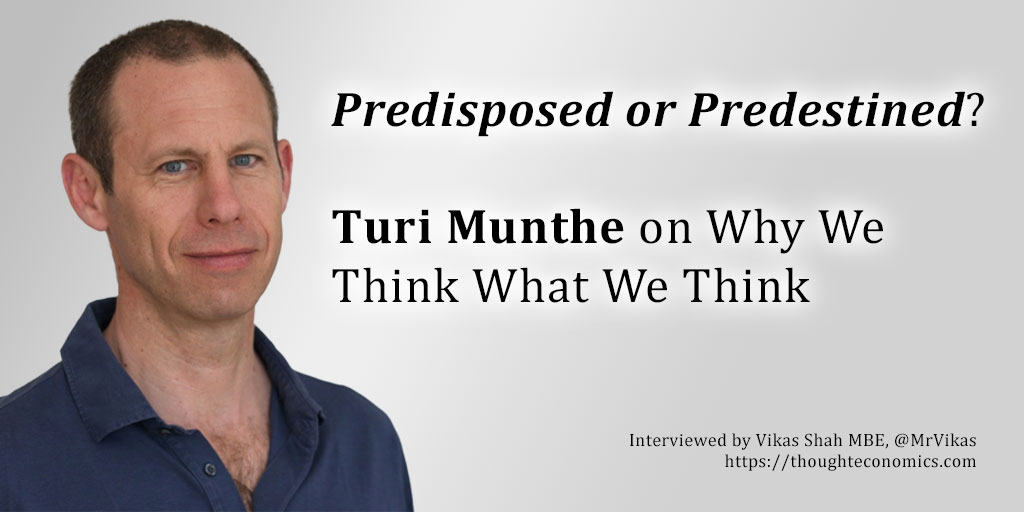
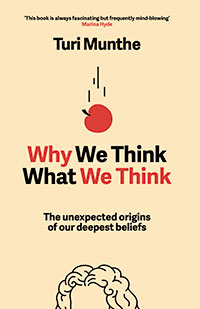
Turi Munthe is a journalist and policy analyst turned media entrepreneur and writer. He is the author of Why We Think What We Think (Penguin, 2026), which explores the unexpected origins of our deepest beliefs.
 As a journalist and Middle East policy analyst, Turi has written for the Economist, Guardian, TLS, THES, the Nation, Spectator, and many others. He has appeared on the BBC, Fox, CNN, al-Jazeera, NBC and others, and given lectures at universities all over the world – Oxford, Sciences Politiques Paris, CUNY, and elsewhere. He has also advised governments across Europe and the Middle East.
As an entrepreneur, he founded Demotix, which became the largest network of photojournalists in the world and sold to Bill Gates’ Corbis Corporation in 2012. In 2019, Turi founded Parlia, an encyclopaedia of opinion. Parlia developed the Opinion DNA – a questionnaire designed in collaboration with top academic psychologists to help users understand the fundamental drivers of their own beliefs.
As an investor, Turi has supported startups in the media and media-tech space since the mid-2010s, both as an angel and as a partner in North Base Media, the leading media-focused early stage investment firm.
Turi also advises media and media-adjacent companies and non-profits, particularly as they relate to pluralism and freedom of speech. He has sat on the boards of Index on Censorship, OpenDemocracy, the Bureau for Investigative Journalism, The Signals Network (supporting whistleblowers) and Larger Us (which works to combat polarisation). He is a board member of one of Italy’s largest media companies, GEDI, publisher of La Repubblica and La Stampa and host of radio stations, and a board member of Mill Media, one of the UK’s most innovative new journalism companies.
Turi studied Arabic and History at St. John’s College, Oxford; Hebrew at the Hebrew, University of Jerusalem; and abandoned a PhD at NYU in Anthropology of Religion to start his first business. He lives with his Italian wife and their two children between Milan and London.
Q: Congratulations on a really phenomenal — and so timely — book. We all think of our beliefs as the reflection of evidence and moral seriousness. But how much of what we think is really chosen, and how much is inherited from forces we barely understand?
[Turi Munthe]: Thank you — and that is exactly what I’ve tried to answer in the book. The standard model for why we think what we think has three buckets. The first is reason — evidence, concentration, thought, logic, all of that. The second is socialisation — the idea that we inherit our views from our parents, from the cultural context in which we were brought up, from our friends, from the books we read and the media we engage with. So there’s a sense that we are both rational individuals and also, in part, the product of our circumstance. And then most of us would accept a third bucket, which is psychology — people often say, “well, they think that because they’re insecure, or because their mum didn’t love them, or because they were traumatised, or whatever it is.” That two- or three-part model is probably how most people, if you ask them, would describe how they come to their opinions.
As I dug into the question, I realised that this accounts for only a tiny fraction of the influences on our beliefs, our deepest values and our opinions. Let me give you just a little of the spread. What I discovered, for example, is that the climate influences our opinions — which sounds kind of crazy, but it turns out that if you look at the political leanings of people in different parts of the world, they have a real commonality, and that commonality is connected to the climate. The really forceful evidence, which is more or less consensus at this point, is that hot and humid climates tend to promote a kind of right-wing, slightly authoritarian politics. The reason is that hot and humid environments are also pathogen-rich environments. They’re a paradise for bacteria, parasites and viruses — nowhere does food rot, wounds fester or infections spread faster. And over thousands of years, societies in those climates have developed what scientists call “behavioural immunity” — collective norms, attitudes and even ideologies that act as a kind of social vaccine. You see lower tolerance of deviant behaviour, stronger social conformity, much greater suspicion of outsiders who might bring disease, an emphasis on hygiene, sanitation and sexual restraint. All of that bundles, over time, into a politics that is more authoritarian and more collectivist. Singapore, which sits in roughly 80 per cent humidity year-round, is a beautiful example of it. Climate isn’t destiny, but it puts its thumb on the political scale.
Then there’s geography. Our personalities — which, measured on the standard “Big Five” scale of openness, conscientiousness, extroversion, agreeableness and neuroticism — are deeply ingrained, largely innate, and probably mostly genetic. They don’t really change much across our lifetimes. And it turns out that the personalities of people who live on mountains are measurably different from the personalities of people who live on the plains. Agriculture has a profound influence too. One of the most fascinating findings is that the single biggest cultural difference in the world — and I’m being super-generalising here — is between an individualist West and a more collectivist East. Individualism is the idea that we take ourselves extremely seriously as individuals; we describe ourselves as lawyers or doctors or plumbers or footballers, and our main responsibility is to ourselves. Collectivism is the opposite — people much more readily describe themselves as part of a network, as the son of, the daughter of, the mother or aunt of, et cetera. Collectivist cultures tend to be much more interested in harmony and in the balance of relationships; individualist ones say “go hang, I’ve got my plan, I’m doing my thing.” If you tell a Westerner they’re an individualist, they wouldn’t know what you’re talking about, because everybody around them is an individualist. These deep value schemes sit so deep in our stomachs that we can hardly recognise they are there.
Where does that come from? Most likely it comes from the earliest agriculture of our forefathers. In the West, we cultivated grain and wheat. Our earliest philosophers emerged out of Greece — Aristotle, for example — where there isn’t really much agriculture: a lot of fishing, some goat-herding, not a great deal else. That kind of food production can be sustained by an individual, if you’re a fisherman or a goat-herder, or by a small family, if you’re ploughing a field of wheat. You can produce enough food just with you and your children, or your wife or husband. The fundamental agriculture that birthed Chinese civilisation, by contrast, is rice — because the delta between the Yangtze and Yellow Rivers is the most heavily silt-laden area in the world, and rice is essentially the only thing that grows there. Rice can’t be grown by a single person. It can’t be grown by a single family. It can hardly be grown by a single village, because you’re building networks of rice paddies on a massive scale, with irrigation canals stretching across kilometres, all of which need to be managed collectively. The only way to keep yourself alive was to maintain the network of relationships you were embedded in — not just family, not just village, but communities of villages. So agriculture shapes our values too. Your great, great, great, great-grandparents are still talking through you.
And then there’s history. There’s a whole chapter in the book about strange historical influences we can still see today. One example: Brittany, the little bit of France that juts out underneath England, has always been considered by the French as slightly sui generis. When 19th-century anthropologists and sociologists began wandering around Europe, they noticed that Brittany had completely different marriage customs to the rest of France — much more egalitarian, including between the sexes — and that its inheritance laws were much more egalitarian too. They were asking themselves, why is Brittany so different? Of course, it is stuck out there, half into England already. But the answer most historians settle on is that the Romans never properly conquered it. So that Asterix story, of the little village perched out there beating Julius Caesar whenever he comes near — that turns out to be roughly true. Brittany was essentially able to repel the Roman advance, and Roman patriarchal culture never really implanted there. It is an extraordinary thought that two thousand years after the Roman invasion of Gaul, we can still see the ramifications of that invasion — or, in this case, its absence — in the cultural practices of people living there today.
So that’s culture, history, agriculture, climate, geography. But I think the most fascinating area of research, for me, was the discovery that our bodies have a tremendously important role in the way we form our opinions. It turns out that the brains — the neurologies — of people who lean right and people who lean left are measurably and fundamentally different. And it turns out that our politics, just as our religiosity, just as our sociability, our tendency to get on with people and include them in our lives, all of these are also deeply genetically influenced. Most studies today show that our political leaning is at least 50 per cent genetic in origin. In other words, genetics is as important, if not more important, to you voting Labour and me voting Reform — or the other way around — than our cultural context, our economic context, and all the evidence and engagement we have with the world. So there is a tremendous spread of non-rational influences on our opinions, on our beliefs and on our values, which exert an enormous influence — and which I don’t think we are sufficiently aware of.
Q: I want to come to our perception of the other in a moment. But if we think about our perception of ourselves — we all walk around assuming we’re morally independent agents capable of our own thinking. Yet even the most cautious interpretation of what you’ve described would suggest that a significant amount of what I’ve been thinking today has factors way beyond my conscious control. How do we still maintain a sense of individualism in a situation where so much of what we think comes from factors way outside our understanding?
[Turi Munthe]: It’s my very deep belief that it is precisely by understanding all the non-rational influences on our opinions and values that we are able to start taking slightly more active intellectual agency about the ideas we hold. Because it is only by realising we are, in a sense, predisposed to certain opinions that we can catch our minds at work and ask ourselves — hang on, is that truly my mind at full agency, or is it a kind of conditioning I’m not even aware of having? The key point I’m trying to make is that there is no sense in which we are predestined to our opinions. But the fact that we are predisposed to them rather demands that we understand those predispositions — because otherwise we are, in a sense, victims of them, aren’t we?
Q: And in that sense, wherever you go in the world, we’re in deeply polarised times. One of the arguments running through the book is about the person we disagree with — the view that they are not stupid or irrational, but that we need to understand the conditions that led them to think the way they do. It seems like a much more humane way to see other people. But how would we apply that in society? How can we remain able to healthily disagree, yet have a much more humane understanding of why the other has arrived at their position?
[Turi Munthe]: Let me explain how I think about this. When we have an argument about something we know well — an area of our expertise, or something we’ve done proper reading on, whether it’s politics or ethics or whatever — and we meet someone who disagrees with us, our tendency is to assume that, given we have done all the reading and the research and have come to conclusion X, the fact that they have come to conclusion Y must mean one of three things. Either they are stupid, because they have failed to think through the logical evidence. Or they are morally corrupt, because despite reading the same evidence they’ve arrived at some weird moral conclusion that only a bad person could hold. Or, if it’s none of those, then perhaps they are lying — bought, captured, deceiving us in some way. And the reason we think any of this is because we assume the other person is essentially like us. We assume they are, fundamentally, a broken version of us.
When you realise that the person opposite you is not a broken version of you, but a genuinely different kind of person — whose politics, opinions and values have been shaped by a completely different set of tools, because their brains are slightly different, because their history is slightly different, because their experiences are slightly different, because their agriculture was different ten or five thousand years ago — what it does is stop you thinking they’re broken. It forces you to look at them as a separate entity, as something a little foreign. And I think that, more than almost anything else, is the key. Understanding the true, innate difference of the person you are arguing with means you have to take their perspective seriously. Whereas if you think of them as a broken version of yourself, you can dismiss them outright — because they’re broken. That, I think, is the key point I’m making in the book about polarisation: it is by seeing the difference of the other person that you become able to take their ideas seriously.
What follows is that you get to have a debate amongst equals. Because part of realising that the person opposite you has a particular perspective, a set of innate predispositions to certain ideas, and a set of experiences which predispose them to a particular way of thinking, is also the realisation that the same is true of you. You do not have a monopoly on truth. You are coming to the world with a very particular perspective. And when I talk about perspective, I don’t mean it in some abstract sense. I mean a very different vantage point — biological even. One of the differences between right-wingers and left-wingers is literally brain shape, which is going to sound striking, but it’s true. Conservatives tend to have a slightly larger and more active amygdala, the little almond-shaped structure at the base of the brain — one of its earliest parts — which is responsible for processing emotion, including fear. Liberals, on average, tend to have a slightly larger and more active anterior cingulate cortex, the kind of bumper that sits at the front of the brain, just behind the eyebrows.
Those two neurological particularities mean that conservatives and liberals see the world in slightly different ways. An overactive amygdala on the conservative side means you are much more attentive to threat and danger. An overactive anterior cingulate cortex on the liberal side means you are much happier with ambiguous information — you’re constantly parsing things, trying to work them out. There’s a related finding around what psychologists call “disgust sensitivity” — the visceral revulsion you feel at the thought of, say, picking up a dead animal with your bare hands, or hearing someone clear a throat full of mucus. People with higher disgust sensitivity tend, very reliably, to lean conservative. And strong physical disgust sensitivity tracks with strong social disgust sensitivity — people with a powerful aversion to physical things often have a similar reaction to abstract things they feel violate their sense of order and tradition. So roughly speaking, conservatives and liberals are wandering around with different brains, with different tools with which to apprehend the world, and therefore they are seeing different worlds. The different worlds they see, and the different worlds they experience, inform the politics that emanate from that experience. That key realisation — that the person opposite you isn’t just coming from a different perspective in the abstract sense, but literally sees the world differently because he or she is apprehending it with different tools — helps you understand difference, and helps you not dismiss outright opinions you disagree with.
Q: If we work on that principle — that ideas and ideologies are tools — does it open the door, whether positively or negatively, for those tools to be replaced, retooled or even manipulated? Because part of me goes to the thought that, in a country where lots of people feel hopeless, we could shift the inputs in such a way that we made people feel more hopeful. But equally, a nefarious actor could surround you with enough reinforcement — as we see on social media — to actively shift your toolset. And isn’t there also a deeper point here: when we go through the education system, we are broadly taught what to think, but not given the toolkit to actually understand how to reason, how to judge, or how to make sense of those inputs in the first place?
[Turi Munthe]: I hear your question, which is: would it be helpful if people — kids and adults alike — understood that there are numerous peculiar influences on their reasoning, on their thinking process, and more importantly on the values and beliefs they hold? Yes, of course it would, which is why I have written the book. We are not given the Greek toolkit, the proper apparatus of reasoning, in any systematic way through our schooling — and yet without it we are essentially defenceless against the manipulation you describe. The architecture of social media in particular is built to surround us with reinforcement, and the more we understand the unconscious levers that shape our opinions, the harder it becomes to be moved around without our consent.
But the other thing I would say is this: just because there are a whole bunch of weird influences on our opinions — including brain shape, including genetics, including all the rest — it does not stop humans being excellent reasoners. We genuinely are. Reasoning well is a learnable skill. Learning how to think logically, learning how to parse information, learning how to interrogate information for bias, learning how to pull our own biases out of the conclusions we draw — that is a universal tool, and it turns out humans are spectacularly good at it once we apply ourselves. So we all need to be learning reasoning. And if, on top of that, we also get to understand where our blind spots are, what our conditioning is, what our predispositions are — well, that will make us better reasoners still.
Q: And that also, I guess, means that we stop seeing difference as something to solve, and rather as something to be governed.
[Turi Munthe]: “Govern” is an interesting word. I would say difference is not something we need to solve. Difference is something we need to love. Difference is something we need to respect. But beyond the kind of waffling liberal tolerance I sound like I’m describing right now, the reason difference is so tremendously precious — and this has been one of the most fascinating areas of research I’ve tried to unpack in the book — is that reasoning, it turns out, is done best in groups.
Our standard model of reason is the lone thinker — Rodin’s statue, head on fist, thinking by himself. That is exactly the wrong model of reasoning. What we now believe — and it owes a great deal to the work of the cognitive scientists Dan Sperber and Hugo Mercier, whose “argumentative theory of reason” has been hugely influential — is that reasoning evolved to be done in groups. It is, fundamentally, a contested process. The word “argument” itself comes from the Latin arguere, meaning to prove, to make clear. We now have lots of evidence from neuroscience that we actually think better in contestation, in opposition with somebody we disagree with — that argument literally improves our thinking. And we have plenty of practical evidence too. The most successful scientific papers tend to be published by more than one scientist. Scientists working in pairs and in groups have a higher H-index and a higher citation index than scientists working alone. Cities with high creative density — bankers and architects and sportspeople and comms people and politicians and artists all rubbing up against each other — produce more than the sum of their parts. So there is sociological, neurological and psychological evidence that we think better when we are in conversation.
And it’s an experience we’ve all had, Vikas, isn’t it? There are certain conversations you have where you suddenly realise — I would never have got here by myself. You are talking to somebody and it opens worlds for you, and you can see it opens worlds for them too. It’s not that they are carrying you, or that you are carrying them. It’s that together you are able to build castles in the air that neither of you could have built alone. We’ve all had those experiences — maybe with a glass of wine or eight, maybe on long walks with friends — that visceral feeling of two and two adding up to more than four. And it turns out the same is true of reasoning. That is why I say we need to love difference: because it is in the clash of difference that the great ideas emerge.
Q: And just to round off — as you do in your book, you talk about pluralism and free speech. Is that why those anchors are so important? Because one of the big takeaways for me from the book is that it really anchors the importance of pluralism, and the power of free speech, once you consider all those other inputs that come in to make us who we are.
[Turi Munthe]: Exactly. Let me come at this from two angles — one social, one personal. Many years ago, when I was 19, I lived in Syria. I studied Arabic there, and I lived under one of the most brutal dictatorships of the time, Hafez al-Assad, at a point when there were twelve different branches of the secret service operating in the country. My experience was fascinating — I adored being there — but I also watched, and felt, an extraordinary kind of cultural depression that came with an autocratic crackdown on any liberty of expression. I felt it viscerally, and it has informed a lot of what I’ve done over the last thirty years. I’ve been heavily involved in free-speech work, with non-profits and media organisations, for most of that time. So I have a personal experience of what a lack of free speech does to a culture.
Another way of thinking about the social benefit is this: when people get to disagree with each other, as you hope happens in a parliamentary chamber, better ideas emerge. When the Labour Party stands up and says, “we’ve got this great new plan for housing,” they know there’s an opposition waiting to tear it apart unless it’s watertight. When the Conservatives stand up with a great idea for economic planning, they have to work as hard as possible to make it stand up to scrutiny because they know somebody is coming for it. The existence of the opposition is actually a form of loyalty to you. Opposition is always loyal, because it forces you to improve your own thought, to improve your own ideas. And from a policy perspective, that is fantastic. The same is true in science. The fact that there are lots of other scientists arguing about what you are saying means you have to make sure you are putting forward the best argument possible. So free speech works societally — it drives society forward. That’s one argument, and I think it’s a very important one.
But there’s another argument, which I think is just as important: at the personal level, the right to contest our context, the right to contest the ideas around us, the right to take ourselves on intellectual journeys, feels to me like one of the great pleasures of being human. It feels to me like a fundamental human right — the right to go and explore. So you can make the case for free speech in utilitarian terms — it works better for society, it advances the cause of the community. But you can also make it at a profoundly personal level: freedom of expression, the right to explore, the right to have the adventure of intellectual discovery, is a deep personal right precisely because it is a deep personal pleasure.